Health Care & The Socio-Political-Cultural-Physical Environment--What's Missing w/ Obama's Approachby: Paul RosenbergSun Mar 15, 2009 at 17:43 |
Last December, Community Health Councils released The South Los Angeles Health Equity Scorecard. South LA is predominantly black, Latino and low-income. On its website, it explained:
The South Los Angeles Health Equity Scorecard, documents the inequities in South LA's healthcare and physical resource environments and provides policy recommendations for a healthy community. As you might expect, the scorecard documented systemic disparities across all the indicators it used. On its website, United Way of Los Angeles highlighted some selected findings, including:
What this report serves to highlight is (1) the complex range of environmental factors (in the broadest sense of the term) that impact upon health care, (2) how much people's health depends on issues that are not even remotely on the table in most discussions of healthcare reform, and (3) the diverse nature of the kinds of experts, stakeholders, and service providers who ought to be involved in a reality-based process of creating a nation healthcare system, as opposed to the relatively narrow set of predominantly corporate interests represented in the existing "reform" process. As with health-care, so too with education: a narrow, corporately-influenced definition of the problem, the issues and those responsible isolates the problem from the larger social context and predetermines limitations in advance that predetermine the impossibility of true success. Tables and further discussion on the flip. |
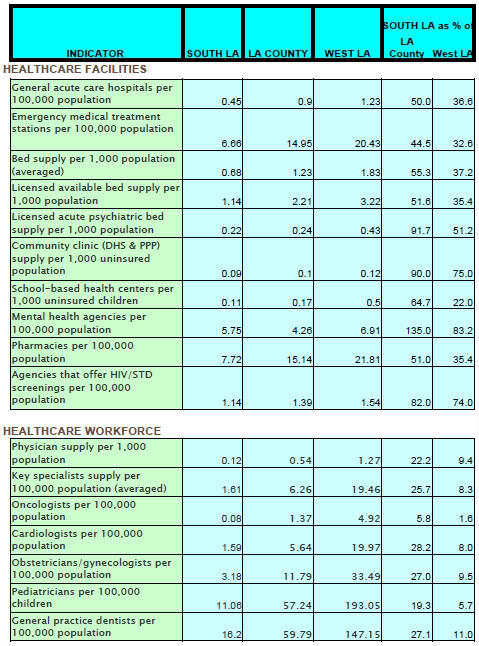
The figures in this first table show a consistent pattern of disparities across all manner of facilities and personnel. However, the differences are much more pronounced among personnel. Particularly striking is the difference in "Oncologists per 100,000 population," with 1.6% of the personnel available in West LA. This is even more striking, since South LA is heavily impacted with a variety of environmental health risks known to increase cancer rates. It's also worth noting that one reason for affirmative action programs in college and professional education is that black and Latino health care workers--especially doctors--have traditionally been vastly over-represented in providing services to their own communities. Put simply, if black and Latino medical professionals don't get educated, the figures above would almost certainly be even more inequitable than they already are. How adequate can health care reform be if it's conceptualized in terms of helping individuals, rather than entire communities that are so drastically underserved in so many ways? I'm sure that osomeone must be asking this question as the reform process advances. I just see no evidence that this question is being given the central consideration that it deserves.
Here we see the vast inequality in health care coverage manifested through a variety of measures. How well will the proposed changes actually serve this community? In contrast to single-payer systems in other countries, the answer is almost certainly, "not very well." But at least this is one area that's receiving some sort of systematic attention in current discussions.
While there are significant difference here, it's at least plausible that most of the differences could be significantly reduced through a process focused on the individual and family level. But it's certainly not guaranteed. And given the more toxic environment of South LA, what's actually needed is higher levels of preventive care.
Here is where we begin to see dramatic evidence of profound disparities which are largely absent from the health care reform debate. These are not the only health-impacting factors, yet they are numerous and diverse enough to give a good sense of how much is missing from approaches that de-emphasize the social and physical environment. A broader view of such factors is revealed in the following chart, with similar kinds of disparities:
The totality of factors measured above gives a powerful indication of how heavily the deck is stacked against the good health of low-income minorities, and how inadequate it is to think of health care reform solely in terms of the individual or the family, and matters related directly to what the "health care industry" provides. This provides some sense of how much is being left out of the picture on the front side of planning for comprehensive reform. But there's more. For each of the separate categories above, the report card presents an analysis of the problems, and what it would take to address them. These analyses provide a further indication of how much more coordination of effort is needed from lawmakers, government agencies and others, who will also be little-considered in the process of bringing about and implementing health care reform. I offer just a couple of examples to the flavor of what I'm talking about, using only the summary table of recommendations. First, from the area of environmental resources:
Note the vast ranges of agencies cited, from federal representatives to state-level officials and agencies, down to the local school district. Next, from the are of primary and preventive care:
Again, we see a similar broad range of agencies, from the federal to the local level. Simply coordinating the efforts of such a broad range of actors is in itself a daunting task. If ever there was an argument needed for consolidating efforts, the simple act of listing everyone currently responsible should provide it. And yet, such comprehensive consolidation of effort does not even appear to be a major concern. What all the above says to me is that people's lived experience in their communities is far removed from the kind of thinking about health care reform that we can expect from a process that is dominated by industry shareholders. And this is precisely the sort of systemic disconnect we can expect from the combination of forces that tend to dominate in "market-oriented" liberal welfare state and the elite special-interest oriented conservative welfare state. What is sorely missing is the bottom-up perspective reflective the inclusionary logic of the social democratic welfare state. |