So I keep hearing how AIG needs to be bailed out or else there will be financial armageddon. I heard that in 1998 during the East Asian crisis, I heard it earlier this year, and I get the sense that every policy move to socialize the losses of very wealthy Wall Street executives is going to be done under the rubric of avoiding a financial meltdown. I don’t think they are lying, of course, it’s a neat trick when you set the rules so that if you screw things up everyone suffers. I mean when someone straps a bomb to themselves the bomb does blow everyone up in the room.
And while I appreciate the quasi-optimism of Atrios and Matt Yglesias, I think it’s important to recognize that in the run-up to the Great Depression we weren’t engaged in two wars and didn’t throw a little less than trillion dollars into the military every year and have a Congressional caucus dedicated to ensuring that wars are free in the name of fiscal responsibility. Bad decision-making is everywhere, and that’s not even getting into climate change denial.
So anyway, just because it seems unlikely we’ll be able to avoid this financial meltdown forever, I’m wondering what does it actually look like? I asked Paul Krugman this question at Eschaton and he said that it’ll be really bad for a year or three, there will be a massive credit freeze as legal obligations become incredibly ambiguous, and then ‘everyone will eventually move one house to the left’.
Obviously lots of stuff goes crazy in a scenario like that, there’s a reason lots of dictators did so well in the 1930s. But seriously, what are we talking about here? Where are we headed, assuming the geniuses in charge can’t keep avoiding this meltdown? Because the alternative of ‘scary global financial meltdown’ on the one hand and on the other shoveling xyz billion to this bank or this auto company isn’t a helpful way to weigh policy options.
The Dow is down 224 points as I’m writing this. The joke I keep hearing from friends is ‘lend me $85B, I’m having a liquidity problem, I’ll get you back next week’. My friends aren’t that funny, but they do pay attention to the news.
McCain struggles when the issue is the economy.
Democrat Paul Kanjorski is in trouble. He’s pretty much the only likely incumbent loss we have right now (counter-evidence is here).
The government now owns 80% of AIG with an $85B loan. I saw the former Chairman Hank Greenberg on CNBC talk about how AIG is a ‘national treasurer’ and it’s in ‘our national interest’ to keep the company in existence. Um, ok.
Drudge is giving McCain more favorable coverage and knocking Obama more over the past month, according to self-described ‘Drudge-ologist’ Chris Cilizza.
The House voted to lift the ban on offshore drilling.
Catholics United is out with this ad hitting McCain for not being pro-life.
Everybody aboard the McCain-Palin Express to the land of cognitive dissonance. As our government scrambles to keep the country’s largest insurance company, AIG, from collapsing, John “I’m always for less regulation” McCain is calling for more government regulation.
“Now hold on,” you might say.
Isn’t this the John McCain who, told the Wall Street Journal “I am a fundamentally a deregulator,” just a few months ago?
Or, hasn’t John McCain been out on the campaign trail arguing that tax cuts and less regulation are the keys to fixing our economy?
Or, isn’t one of McCain’s top economic advisers Phil Gramm – the guy who call Americans, “a nation of whiners,” and authored the Gramm-Leach-Bliley Act to strip regulations that could have helped prevent this mess?
There’s More…
:: (0
Comments, 177 words in story)
digg it
On a day when the Federal Reserve puts up an $85 Billion loan to AIG, after Lehman Brothers fell yesterday and Bank of America ate up Merril Lynch, both Presidential candidates are releasing new commercials pushing their economic plans. The economy is not likely to get better anytime soon, and neither candidate is doing anything to create new jobs, other than talk about the problem.
In comparing the two candidates’ positions, Obama has a slight edge in terms of credibility: his economic plan was not created by the lobbyists and former Republican congress folk (like Phil Gramm) who got us into this mess in the first place. To hear McCain say that he is going to set up a Commission, like the 9/11 Commission that was virtually ignored by the current administration, is a confirmstion that he will talk big but do nothing. At least Obama has posted a fairly detailed economic plan that would change the government’s overall approach significantly.
The best thing the political discussion on the economy has done is that it has removed the ongoing fluff about Sarah Palin from the Main Stream Media. That, in a way, is a blessed relief. Since she is not going to be interviewed directly by the press and will continue in highly controlled and scripted appearances, it is better to have the media looking away from her. There is nothing there and so many important things – like the economy – need to be on the active agenda.
As we get closer to the Presidential debates, having real issues to discuss will elevate the campaigns (and Reuters/Zogby has just put out the latest poll that has once again pulled Obama ahead – it looks like folks don’t think the “fundamentals of the economy are strong.”)
Let’s watch closely where we go from here. There are 48 days left.
Obama didn’t preface this bit by saying how much he honors John McCain’s service to America:
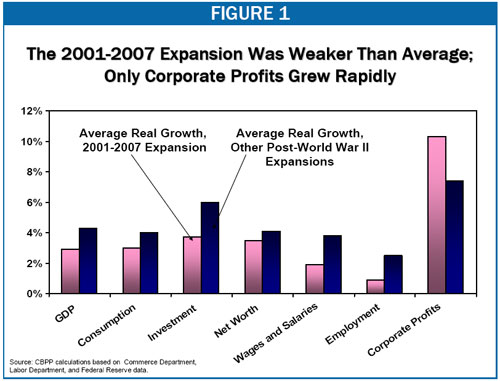
This is what happens when you see seven years of incomes falling for the average worker while Wall Street is booming, and declare – as Senator McCain did earlier this year – that we’ve made great progress economically under George Bush. That is how you can reach the conclusion – as late as yesterday – that the fundamentals of the economy are strong.
Obama didn’t start qualify this graph with a paean to McCain’s time as a POW:
Make no mistake: my opponent is running for four more years of policies that will throw the economy further out of balance. His outrage at Wall Street would be more convincing if he wasn’t offering them more tax cuts. His call for fiscal responsibility would be believable if he wasn’t for more tax cuts for the wealthiest Americans, and more of a trillion dollar war in Iraq paid for with deficit spending and borrowing from foreign creditors like China.
When Obama attacked McCain on leadership, thereby hitting right at the heart of McCain’s argument to be President, he didn’t preface the attack with an homage to McCain’s military record:
Just today, Senator McCain offered up the oldest Washington stunt in the book – you pass the buck to a commission to study the problem. But here’s the thing – this isn’t 9/11. We know how we got into this mess. What we need now is leadership that gets us out. I’ll provide it, John McCain won’t, and that’s the choice for the American people in this election.
None of these attacks would have been improved by telling people about McCain’s time as a POW before landing the attacks. The absence of such compliments to McCain is refreshing, and conveys a real confidence from Obama. Back when Obama was prefacing all of his attacks on Obama with a statement on how much he deeply respects John McCain’s service to America, frankly it made what he said afterward sound like he was walking on eggshells. Honestly, apart from repeating McCain’s message, and apart from irritating many of his own supporters, paying tribute to John McCain before attacking him just made the criticisms that followed sound weak and wimpy. These attacks, by contrast, sound confident, on message, and sharp.
This might actually be a general tendency among Democrats. While most national Democrats seem to act like they are walking on eggshells whenever they talk about foreign policy or social values, they have historically always seemed more confident when discussing the economy. It really seems to me that most leading Democrats are convinced they are only the majority party when it comes to economic policy, but not when it comes to social values or foreign policy. Even if they are centrists, they all just seem so much more confident–even brash–when the focus in on economic issues.
I like Democrats when they talk like this. Makes me proud. Wish I would see this side of them more often.
Campaigning in Golden, Colorado, Barack Obama delivered a speech today on the current economic crisis, blaming the McCain-GOP failed policies while laying out his plans to bring about “change that will make a difference in your lives.”
Dishing out some good old fashioned populist indignation, Obama called for “an end to the broken system in Washington.”
McCain’s Economic Philosophy has Failed for 8 Years
Obama: America is Prosperous when All Americans Can Prosper
FULL TEXT OF REMARKS AS PREPARED FOR DELIVERY: CONFRONTING AN ECONOMIC CRISIS
A friend of mine sent this idea. I think it’s fabulous for Obama supporters and more generally for the interests of informed democracy. Apologies if it already exists, but if it doesn’t, and you know someone who’s interested and can implement it, please do pass on. If it does and you can share the link, would be appreciated.
I had an idea, and I think it might be a good one.
I’m tired of hearing politicians argue about whose tax plan will benefit the most Americans. In this election we have both candidates promising tax breaks to the middle class; most Americans have no way of fact-checking, so they end up just guessing based on the candidate’s personality, party affiliation, etc.
Why not have an online tool that can estimate your annual tax bill under each candidate’s plan? In other words, you would type in your annual income (or fill out an easy, 5-10 question survey) and you’d get a little spreadsheet: here’s your approximate tax bill right now, here’s what it would be under Obama, here’s what it would be under McCain.
I understand it might be hard to research both plans and reduce them to simple formulas like that, but even if it just gave you a ballpark figure it would be worth it.
I’m also aware that people would accuse the calculator of being biased, inaccurate, etc. But if enough people were using it, economists and other experts would weigh in and (I hope) reach a consensus. In any case, at least it would raise the level of discourse a little.
I’m sending this message to the candidates and to news organizations in the hope that someone will give it a try. If this sounds like a good idea to you, send it to your candidate or your favorite news source. And if you know anyone that you think could work on a tool like that, send it to that person!
(Full disclosure: I’m working with the Equal Voice for America’s Families campaign in a paid position, but wanted to share today’s events with those members of the Open Left community interested in poverty and working families issues.)
There may not have been a lot of talk about poverty and the economy in the coverage of the national political conventions during the past two weeks — but you can bet there will be a lot of talk about both today at a national convention of community organizers and activists taking place in Los Angeles, Chicago and Birmingham, AL.
Follow me over the fold for the story of how and why more than 16,000 people from across America are coming together to ratify a bottom-up anti-poverty platform that has been more than a year in the making.
There’s More…
:: (0
Comments, 340 words in story)
digg it
For over two decades, he’s subscribed to that old, discredited Republican philosophy – give more and more to those with the most and hope that prosperity trickles down to everyone else. In Washington, they call this the Ownership Society, but what it really means is – you’re on your own. Out of work? Tough luck. No health care? The market will fix it. Born into poverty? Pull yourself up by your own bootstraps – even if you don’t have boots. You’re on your own.
The speech was great of course, but I really loved this section. So refreshing to see a major Democrat confront conservative economics head on. But he also said:
Now, I don’t believe that Senator McCain doesn’t care what’s going on in the lives of Americans. I just think he doesn’t know.
Well I think it’s pretty clear McCain doesn’t care, and what’s more the voters know it. From a CNN/Opinion Research poll this week:
“Thinking about the following characteristics and qualities, please say whether you think each one applies more to Barack Obama or more to John McCain. . . .”
“Cares about people like you”
Obama
McCain
Both (vol.)
Neither (vol.)
Unsure
53
36
3
7
1
There’s More…
:: (10
Comments, 584 words in story)
digg it
MI is still the home of the auto industry and dependent on them for its economic well being. From Gov. Granholm’s state of the state:
… we will not concede the automotive industry to any other state or nation.
We are the state that put America on wheels – the state that put the “car” in NASCAR. There is no vision for Michigan’s new economy that does not include cars designed, engineered, and made in Michigan. The industry’s changing – but we in Michigan cannot – will not – abandon it. And we should not allow our government in Washington to abandon it either.
Because of MI sustained efforts to keep and attract automotive research and development companies,
Today, a continuation of a short series looking into the factors affecting the current political climate. It’s no secret that the country isn’t too happy about the economy, the war in Iraq, and the direction the country is headed in. But for me at least, I like to see the data. First, the right track/wrong track question:
Click to enlarge.
The trend is clear, the numbers are huge: almost three quarters say we’re off on the wrong track. Much more below.
There’s More…
:: (12
Comments, 474 words in story)
digg it
Perhaps it’s the hot weather, but I think the meltdown in the financial markets has something to do with it. I’ve been involved long enough that I’ve lived through several of these ups and downs before, but this time seems different.
In no particular order, my complaints:
There’s More…
:: (0
Comments, 1161 words in story)
digg it
Over the last two weeks I’ve been documenting the abuses endured by workers and residents within the Atria assisted living chain, while Bruce Wasserstein, CEO of the Lazard investment house (and controller of Atria through an affiliated real estate fund) makes millions in bonuses even as the investment itself tanks. You can read my collected posts here.
What’s happening at Atria–the gouging of seniors’ meager disposable income to ensure profit margins are met, even while services and benefits are cut and rents are increased dramatically–is an extreme, but all-too-real example of what’s happening all over the globe…the systematic transfer of wealth and the power to create wealth from the larger mass of the human community to a select class of uber-wealthy players at the top of the social scale. It’s worth looking at the issue in a larger context, if only to reiterate what I think most of us already know…that we’re being robbed, cheated, gouged, and nickel-and-dimed to death to make others rich.
There’s More…
:: (0
Comments, 816 words in story)
digg it
So there’s this sudden faux-grassroots movement on the right to open up all of our wildlife reserves and our shores for oil drilling, under the pretense that it’ll reduce our dependence on foreign oil and lower prices at the pump. It’s even got a catchy, easily memorable slogan: “Drill Here, Drill Now, Pay Less.” And it’s all the rage in East Wingnuttia.
Too bad that it’s completely wrong and as far from the truth as one can get while still being in the same space/time continuum.
There’s More…
:: (0
Comments, 501 words in story)
digg it
Thousands upon thousands of homes are being foreclosed on, gas is over four dollars a gallon, the economy looks rosy only to the colorblind-and yesterday I learned that Leona Helmsley had left a trust worth between 5 and 8 billion dollars “to dogs.” According to the New York Times, this sum represents nearly ten times the assets of all animal-related non-profit groups in 2005 (and I imagine some of those groups might even squander some of their dollars on non-canines).
The article noted that at first Ms. Helmsley had two goals for her trust:
“to help indigent people…[and] to provide for the care and welfare of dogs. A year later…she deleted the first goal.”
Trust Ms. Helmsley to have her priorities straight.
There’s More…
:: (5
Comments, 238 words in story)
digg it
When it comes to telling a story that you want people to understand and connect to, nothing beats hearing the words of other people. I can pontificate, theorize, and analyze all I want, but to simply read the stories of people who are in the trenches, being affected by the issue, drives the point home.
In the case of the ongoing campaign to force Lazard CEO Bruce Wasserstein to clean up the conditions and improve the standards of the Atria assisted living chain, I wanted to take a moment and share some more stories from people affected every day by the decisions Wasserstein is making…everyday people like you and I who are in tough spots and being forced to make tougher decisions because of Wasserstein’s greed. Read on.
There’s More…
:: (0
Comments, 506 words in story)
digg it
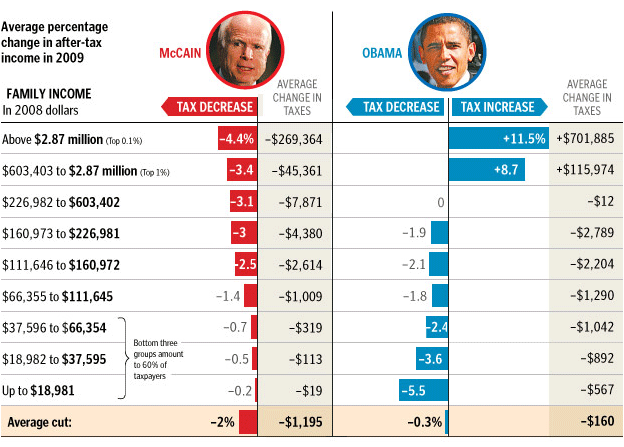
Really good table in the Washington Post yesterday (based on an Urban Institute/Brookings study), worth getting around to all your friends who don’t make over $603,403 a year.
Barack Obama is getting very close to hitting the messaging that will win this campaign: Iraq hurts the economy. Check out his remarks on McCain, Iraq, the economy, and transportation costs today:
“John McCain, just yesterday, on the Today Show said that he didn’t think it was that important how long troops are there as long as we are not suffering casualties,” Obama said. “I agree that obviously the most important thing is making sure that our young men and women aren’t killed, but the notion that if they are not being killed that we can leave them there in perpetuity — 100 years, John McCain says.(…)
First of all, that means he’s not thinking about the extraordinary burden that families are under on two or three or four tours of duty. But he’s also not thinking about taxpayers who are spending $10- to $12 billion a month in Iraq. And that’s money that could go to rebuilding Wisconsin and putting people back to work right here in the United States of America.”
The simple message, “Iraq hurts the economy,” will win this campaign. Obama is not getting close to refining this message. It succeeds for several reasons:
It combines the two top issues in the minds of Americans, Iraq and the economy. Even though there is a pundit push to marginalize Iraq in this election, it was decisive in both nomination campaigns. Also, given the huge amount of money we have spent on Iraq that has delivered virtually no economic return for the vast majority of Americans, there is no justification for viewing them as separate issues.
It is a long-term progressive message. Hammering home the notion that excessive military spending and elective wars like Iraq are fundamentally damaging to the American economy has the potential to shift national opinion on one of the “untouchable symptoms”: the value of military spending. Winning an election on a message that the Iraq war is bad for the economy is the first step, over the long-term, of redirecting the spending of the federal government away from the military-industrial complex.
John McCain reinforces it. Recently, McCain’s top economic advisor suggested that in order to pay for corporate tax cuts, McCain will cut military spending. So, with the McCain campaign agreeing that military spending needs to be reduced, this will be an easy point to hammer home.
Obama is getting close to nailing the winning message, which goes something like this:
John McCain wants to stay in Iraq for 100 years, even though Americans are spending $10-12B in Iraq every month. Now, to pay for a corporate tax cut, McCain’s top economic advisor says he will cut defense spending. By contrast, Barack Obama will end the Iraq war and use that money to invest in American jobs, transportation, health care and a new energy economy. Senator Obama will put the peace dividend to work for you.
That is probably a bit wordy and dry, but I feel confident that a great speaker like Obama can eventually hit it on the head. This is the message we need to win the election, and also to govern like progressives in the future. It is great to see Obama already close to sticking the landing on this one.
Update: I meant to say that Obama is getting close to nailing this message. Damn typos.
According a Forbes article, McCain’s economic advisor suggests that he will pay for a corporate tax cut by cutting defense spending:
McCain’s top economic adviser, Doug Holtz-Eakin, blithely supposes that cuts in defense spending could make up for reducing the corporate tax rate from 35% to 25% and the subsequent shrinkage in federal revenues. Get that? The national security candidate wants to cut spending on our national security. Wait until the generals and the admirals hear that.
If true, this would be a much bigger bombshell that McCain’s remarks on Iraq withdrawal. Unlike Forbes, it isn’t the hypocrisy of being “tough” on national security while suggesting cuts in defense spending that would be a big deal. Instead, it would be a big deal because it has the potential to create a bi-partisan consensus in this election on the need to cut the defense budget in 2009.
Obama should jump all over this, and argue that if we are going to cut defense spending, it should not be to pay for a corporate tax break, but instead to invest in American infrastructure, health care, and a new energy economy. He should also argue that McCain won’t actually cut defense spending, because his refusal to withdraw from Iraq would make a reduction in defense spending impossible.
71% of Americans already think that Iraq is hurting the economy, which as a nation moves us down the path of realizing that excessive military spending is damaging to the economy and our standard of living. Obama has already argued that Iraq is hurting the economy, and now McCain’s campaign is doing something very similar. This is a huge opening for a progressive re-organization of federal spending, and Obama needs to move into it as quickly as possible.
“He’s going to raise taxes on those wealthy lobbyists that work for the McCain campaign,” Obama’s communications director Robert Gibbs, in a jab at Fox News
I just got done reading Obama’s speech on the economy. I’ve tried to distill it into the essence of what he’s proposing, and go over his economic philosophy which is split between a neoliberal Rubin-type policy tone and an embrace of behavioral economics, a new school of thought popularized by books like The Tipping Point, Freakonomics and Predictably Irrational. You’re not going to see the Naomi Klein critique of disaster capitalism in his policy team.
There’s More…
:: (55
Comments, 1162 words in story)
digg it
I started this during the week, and it now seems like ancient history… Except, of course, we all know how things just keep popping up again, like you was playing whack-a-mole….
Last Saturday, over at TPM, Josh called attention to yet another example of ABC being in the tank for McCain. First, he cited the fact that McCain spokesman Tucker Bounds called Obama “recklessly dishonest” for directly quoting McCain’s own words. Then he noted that ABC News had picked up the Tucker Bounds claim and written a story around it. Now, compared to the mega-travesty of the presidential debate a few days earlier, this was certainly small beer. On the other hand, considering how much criticism ABC got for that sorry outing, you might think they’d want to keep their noses clean for a least a millisecond or so.
But noooooo!
In fact, as you’ll see below the fold, the sequence followed this simple pattern:
(1) John “Straight Talk Express” McCain makes a contradictory set of statements, both acknowledging that Americans are hurting economically (which is true), and claiming that the country has made “great progress economically,” under Bush (do you have to ask?)
(2) Media doesn’t say diddley.
(3) Obama picks up on the absurd lie, and uses it to attack McCain as out of touch.
(4) McCain spokesperson attacks Obama as “recklessly dishonest.”
(5) ABC News writes story, “Obama Twists McCain on Economy,” with the lede:
Who says Barack Obama doesn’t know how to “twist the knife”?
This sort of sequence is so incredibly commonplace that we barely even notice it sometimes. But it’s worthwhile to stop and take a closer look at it, dissect it a bit, in order to better understand how ABC is helping John McCain.
There’s More…
:: (3
Comments, 2252 words in story)
digg it
Even when times are good, it’s hard to believe that corporate CEOs can look you in the eye and tell you that they’ve truly earned their outrageous $10 million, $50 million, $100 million or more pay packages.
And right now, times aren’t good.
But this week I saw another round of stories on corporate CEOs getting multi-million dollar “bonuses” even as their companies lose millions of dollars.
There’s More…
:: (0
Comments, 304 words in story)
digg it
This week’s post is by DMI’s Director of Research Amy Traub
John McCain can talk a pretty good game when he wants to. On Tuesday, as he unveiled his economic plan at Carnegie Mellon University, the presumptive Republican Presidential nominee acknowledged that “economics is not a subject that can be wrenched apart from the rest of life, or from the values that give life direction.” He felt the pain of those like the Pennsylvania woman who “work and save for years, and at the age of 47, still struggle for the basics of life.”
Ah, but that was the introduction. When McCain delved into actual policy proposals, the man who had scarcely finished announcing that “it will not be enough to simply dust off the economic policies of four, eight, or twenty-eight years ago” did just that. As with President Bush, tax cuts were presented as the main solution to any economic problem. McCain vowed to maintain the Bush tax cuts – predominantly benefiting the wealthiest Americans and to introduce vast new tax cuts to further undermine an already dangerously indebted federal treasury. But middle-aged worker struggling for the basics of life so vividly evoked in the introduction was quickly forgotten. She would be unlikely to benefit from the proposed corporate tax cuts, which the non-partisan Congressional Budget Office found (pdf) “typically does not create an incentive for [businesses] to spend more on labor” (i.e. hiring or providing raises). Nor would she be likely to get a raise or a new job as a result of incentives for new business investment, since, as the same CBO report noted “last time such incentives were employed, the results were not encouraging.”
There’s More…
:: (0
Comments, 464 words in story)
digg it
Tim Cunha, Democratic candidate for U.S. House seat representing Florida’s 6th district, calls on voters to attend Cliff Stearns’ town hall meetings tomorrow (Saturday April 12).
Mr. Cunha asks his constituents to “Confront him [Sterans] at ‘Town Meetings’ in Marion County” and not “let him [Sterans] evade the tough questions.”
Excerpts are below the fold or see the full article here.
Tim was one of the first Dems in Florida to back the Responsible Plan, so click here to reward good behavior.
There’s More…
:: (0
Comments, 427 words in story)
digg it
This post is by Mark Winston Griffith, Senior Fellow of The Drum Major Institute for Public Policy.
If there is one thing that distressed homeowners need right now is smart, forward thinking legislation that can help slow down the wave of subprime mortgage inspired foreclosures, and establish strong anti-predatory lending measures.
Unfortunately, the Foreclosure Prevention Act of 2008 which the Senate is poised to vote on, is not the one. Commentators on both the ideological right and left have plenty to complain about. It’s the kind of bipartisan, patchwork Frankenstein monster that only a politician’s mother could love.
Let’s be fair. It’s not all bad. In fact there is alot about the bill that is promising. It includes much needed FHA modernization provisions, monies for foreclosure prevention and housing counseling, and Community Development Block Grants for state and local governments to purchase foreclosed properties and turn them into affordable housing.
But ultimately, in an effort to satisfy Senate conservatives, none of whom are particularly interested in helping out distressed homeowners, it’s filled with unnecessary tax breaks and measures designed to serve the interests of homebuilders and, bizarrely enough, perhaps even speculators. Even the “enhanced” mortgage disclosures are a cruel joke for those hoping for full-scale, subprime mortgage era, anti-predatory lending provisions.
And of course, it wouldn’t be a real piece of patriotic American legislation without a nod to veterans. Fine, but quite a few civilians could use the 9 month stay on foreclosure proceedings too.
Perhaps most conspicuously absent is the bankruptcy reform that many progressives were advocating for, which would have given bankruptcy judges the ability to make mortgages more affordable, the way they already do with other kinds of debt.
Is this the best that this senate could salvage given opposition to more meaningful proposals? Perhaps. Bush is announcing weak measures of his own which are designed to do an end-run around this bill.
Nonetheless, the Senate has missed a real opportunity to create a broad mechanism for modifying mortgages destined for disaster, or to put in place landmark public policy that could help prevent abusive lending practices. The most enduring legacy of this bill could be that it serves to preempt stronger congressional measures, like those introduced by Durbin and Dodd for example. To add insult to injury, it lends credence to critics of foreclosure prevention efforts who have been warning against bloated government bailouts.
Another classic example of government action. By aiming too widely, it misses the mark.
THE WAR IN IRAQ AND THE ECONOMY The war in Iraq ranks second behind the economy as the country’s most pressing problem and most Americans think the cost of the war has contributed to the country’s economic woes, including two-thirds who think it has contributed a lot.
HOW MUCH HAS THE IRAQ WAR CONTRIBUTED TO U.S. ECONOMIC PROBLEMS?
A lot 67%
Some 22
Not much/not at all 10
Americans who think going to war with Iraq was the right thing to do are less likely to think the war is responsible for the country’s economic problems.
Arguing over whether or not Democrats should run on the economy or whether or not they should run on Iraq is a false choice. Instead, Democrats should run on a platform that Iraq is hurting the economy. While that is not the only reason the Iraq war needs to end, and while Iraq is not the only reason the economy is struggling, the simple principle that the war is bad for the economy not only connects the two issues, not only makes for a simple campaign slogan, and not only is something that nine in ten Americans believe, but, as I have argued in the past, it would be the clearest, transformative, progressive message Democrats have run on in decades. Implicit in the message is that war in general, and excessive military spending in general, is bad for the economy. Once people accept the message, they will be less willing to go to war, and less willing to spend freely on the military, in the future. And thus, we start to strike a blow against the untouchable symptoms.
The message is our there. The public is ready to accept it. We just need a critical mass of Democrats willing to put it front and center in their campaigns. And then, we will really have something big.
The Secretary of the Treasury, Henry Paulson, has proposed some rather significant reforms to the Federal Reserve. These changes would allow the Fed to intervene and review the books of any company with significant financial business in the American economy. On the face of it, his proposal looks more like something from the New Deal than the Bush Administration, but that may be the very point.
The Executive may be setting up the Fed to fail.
Treasury Secretary Henry M. Paulson Jr. is trying to turn the complicated muddle that is the U.S. banking regulatory system into something more coherent. To that end, he would replace a sprawling set of regulators aiming to ensure the soundness of the nation’s financial institutions — including the bank-supervision arm of the Fed, the Office of the Comptroller of the Currency, the Office of Thrift Supervision and the National Credit Union Administration — with a single Prudential Financial Regulatory Agency.
…
But the Fed would give up its power to regulate the day-to-day affairs of banks, responsibilities that many in the institution view as essential to its role as guardian of the economy — even as the central bank gains new powers to insert itself into the affairs of any business creating risk for the financial system as a whole.
…
“The Fed’s ability to deal with diverse and hard-to-predict threats to financial stability depends critically on the information, expertise and powers that it holds by virtue of being both a bank supervisor and a central bank,” Chairman Ben S. Bernanke said in a January 2007 speech.
In the Treasury Department’s plan, the Fed would lose the responsibility for day-to-day monitoring of banks’ financial stability. It would gain a more loosely defined ability to monitor and correct risks to the entire financial system, whether they come from banks, investment firms or hedge funds.
To many people with ties to the central bank, that is a lousy trade.
“The Fed should not be enamored of this proposal at all,” said Ernest T. Patrikis, a former senior official at the Federal Reserve Bank of New York who heads the banking regulation practice at the law firm Pillsbury Winthrop Shaw Pittman. “It takes away a lot of authority, power and involvement.” – The Washington Post
There’s More…
:: (0
Comments, 724 words in story)
digg it
Massive federal deficits, not enough money for social programs. Where have all our tax dollars gone?
The charts below (click for full page versions) show how our income tax dollars were spent in FY2007, which ended last September 30 (data from Budget of the United States Government: Historical Tables Fiscal Year 2009, Table 8.7). As you can see, 52.7% of these discretionary funds went to the military.
More over the fold about military spending, federal deficits, and real security…
There’s More…
:: (1
Comments, 1540 words in story)
digg it
(This piece is by Drum Major Institute Senior Fellow Mark Winston Griffith)
It’s hard to imagine that there could be a serious presidential candidate who would declare a “no-action” position on the subprime loan and foreclosure crisis. John McCain, however, holds that dubious distinction.
Not a day goes by that we don’t hear another grim announcement about the downward spiral of the economy, or how homeowners with subprime loans are losing their homes in record numbers. Estimates of likely foreclosures over the next few years related to subprime mortgages have ranged between two and three million. In some parts of the country, foreclosures are outpacing home sales. Recession looms and the National Association for Business Economics recently declared the subprime foreclosure crisis as the greatest threat to the American economy.
The scariest part is that hundreds of thousands of subprime loans are scheduled to re-set in the latter part of this year and into 2009, which means that the economic policies of the next president will have a profound impact on the lives of ordinary working- and middle- class Americans.
How has John McCain responded to this call to leadership? By essentially saying that nothing should be done. In his remarks at a conference in Santa Ana, California on Tuesday, McCain rejected any broad policy response and actually staked out a far weaker role for the federal government in addressing the foreclosure crisis than even the Bush Administration has offered. Although he was quick to blame homeowners and “rampant speculation”, there was scant recognition by McCain of exhaustively documented predatory lending practices or the scandalous oversight failures of federal regulators, legislators and a president who arguably encouraged abusive lending practices through his ownership society”.
To the extent that McCain offered any specific “solutions” at all, it was to encourage mortgage lenders to reach out to distressed borrowers – something that banks working with Secretary Paulson under the Hope Now alliance are supposedly doing already. His other bright idea was “to convene a meeting of the nation’s accounting professionals to discuss the current mark to market accounting systems.”
Great. Just what homeowners and the economy need: The formation of a committee of accountants.
McCain has buried his head in the sand all along about the role of the federal government in the foreclosure crisis. In December 2007 he told the editorial board of New Hampshire’s Keene Sentinel that he is “not smart enough” to offer a “specific solution”. While this might qualify in McCain’s book as “straight talk”, it’s also shockingly weak-kneed and irresponsible.
In comparison, Clinton and Obama have presented specific proposals that have been subjected to intense scrutiny. Clinton has called for billions in government assistance, a foreclosure moratorium, and rate freezes. Obama has proposed a universal mortgage credit, the establishment of a mortgage refinance fund, and greater loan disclosure. While critics on the left and right may take issue with these approaches, Clinton and Obama have at least acknowledged the severe financial distress confronting homeowners and would offer Americans specific plans to address it.
But a different legacy is in store for McCain if he is elected president. As a member of the Keating Five, that notorious group of Senators accused of currying favor for Charles Keating, chairman of the failed Lincoln Savings and Loan Association, McCain became a face of the Savings and Loan crisis of the eighties and nineties. With breathtaking irony, McCain is poised to associate himself with another banking meltdown by sitting idly by, in Herbert Hoover-esque fashion, as working class Americans and communities are devastated by the effects of homeowner displacement, property devaluation, family asset depletion, and the loss of real estate tax revenue.
One possible explanation for McCain’s hands off approach is that some of the biggest names in the subprime mortgage industry, Citibank, Goldman Sachs, Merrill Lynch and Lehman Brothers, for example, have been among McCain’s largest campaign contributors.
But these Wall Street giants have figured just as prominently in Clinton and Obama’s campaigns. And unlike during the S&L; debacle, McCain, now the presumptive Republican presidential nominee, has gained the moral authority and opportunity to actually intervene.
So the issue isn’t whether John McCain is “smart” enough to propose government actions and market reforms that could relieve some of the nation’s financial pain while attempting to make predatory mortgage lending a thing of the past. The question is; does he care enough to bother.