On Christmas Eve Day, Paul Krugman wrote a brief diary, "Yes, There Are Prisons" in which he reproduced the following graph by Mike Konczal, from "The Conservative World View and Prison Populations, Broken Windows", which he describes as "a cross-section of countries and the strong correlation between their prison population per capita and an index of their 'economic freedoms' [per Cato Institute], with a plot of the United States since 1970 over it":
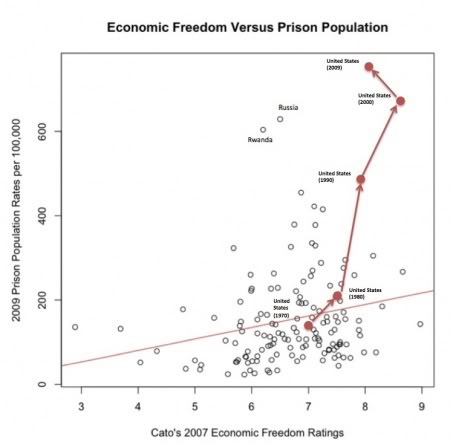
The graph is arresting in itself, because of what it tells us--(1) that libertarian "economic freedom" is correlated with putting people into prison at the international level, and (2) that the growing power of movement conservatism is even more strongly correlated with putting people into prison, at the national level. But Krugman and Konczal both have more to say. Konczai has a number of points to make in support of "why I think we can think of our current prison population dilemma as a conservative project," and why, therefore, anyone who thinks that criminal justice reform might be an agenda item for the new Republican House is sorely mistaken. But let's take Krugman first, as his remarks are briefer:
I'll have to think about exactly what's going on here. But the discussion brings to mind something I ponder on now and then: what happened to the inevitable collapse of American society?
All through the 70s and 80s, and some way into the 90s, it was almost a given that all of America - or at least all of our central cities - would turn into something like the South Bronx, or worse. It was practically a cliche of popular culture; it was also a theme propounded solemnly and at great length by writers like Gertrude Himmelfarb, who insisted that only a return to traditional moral values could arrest our decline.
And then a funny thing happened. Values continued to shift: we kept on having premarital sex and getting divorces, gay and lesbian couples went out in public, relatively few Americans went to church (although a larger number claimed that they went.) Yet crime declined sharply, big cities (New York in particular) became safer than they had been in many decades, and in general society seemed to hold together.
Actually, this is not the least bit surprising. Conservatives have been proclaiming the imminent end of civilization since at least Heroditus, in Works and Days with his five ages of man, each one more debased than the one before. Liberals, on the other hand, have been telling tales of progress--unsteady progress, to be sure, but progress, nonetheless--for almost as long, as Eric Alfred Havelock argued in The Liberal Temper in Greek Politics. We cannot tell what the future holds, and there's been a great preponderance of folly lately, but historically so far, conservatives have repeatedly vastly under-estimated human resilience and our powers of renewal, and whatever the precise details this time, the big picture seems quite familiar.
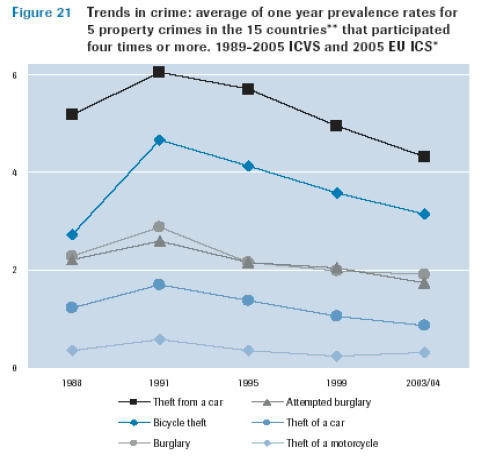
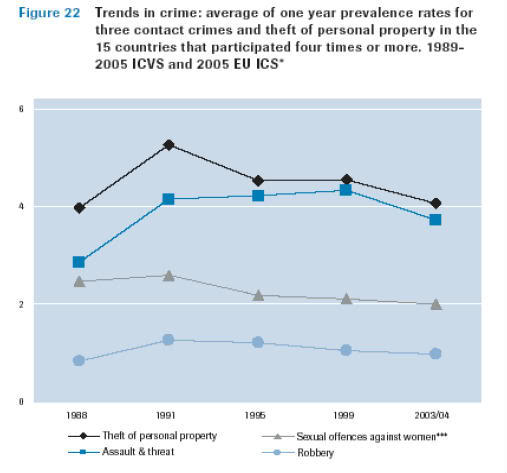
Before turning to Konczal, who has a more complicated argument, I just want to supplement Krugman's observation with a brief presentation of some international data about the rise and fall of broad categories of crime rates, which unfortunately only start in 1988, but show a sharp 1991 peak for everything, followed by an almost equally broad, if slower decline ever since, thereby showing that the US was not alone:
|
| From "Some Main Results on International Comparison and Trends. Results from the International Crime Victims Survey and the European Survey on Crime and Safety":
Now on to Konczal. Remember, his argument is that "we can think of our current prison population dilemma as a conservative project." Along the way he will cite some conservative arguments, without much effort to question or refute them. He's not out to argue the merits, primarily, but simply to show what the conservative arguments are, and why they lead to over-imprisonment.
Konczal's first point was made by the chart that started it all. For his second point, he points to David Frum, saying, "One thing that surprised me was that he listed James Q Wilson's Thinking about Crime (1975) as one of his Top Five Books on Core Conservative Philosophy, something that he said "surprised" him. It shouldn't have, though, since conservatives have always looked for bad people to blame, and a pre-occupation with crime as a key aspect of the social world is precisely what we should expect from conservatives--along with a profound indifference, if not blindness, to the crimes of the powerful.
However, Konczal quotes Frum making a different argument--which shouldn't surprise us really:
Why is this a conservative book?
It's a conservative book because of its mood. Its mood is unsentimental. It does not believe there is greater virtue at the bottom of society, it doesn't accept conventional excuses, it doesn't make racism the centre of the American story. Also, because it's willing to contemplate the effective use of state punitive power to solve a social problem....
The older conservatives were primarily literary intellectuals - Russell Kirk, Richard Weaver...What the neoconservatives brought to politics was the application of social science to social problems. What made them conservative was, as Mrs Thatcher said, that the facts of life are conservative. They are social scientists, they use social-science methods, they are interested in the governance of society and public policy.
Of course, Frum is quite mistaken with respect to social science. As I've noted recently, conservatives and science don't mix all that well, and the social sciences are no exception. Charles Murray's two high-profile forays, Losing Ground and The Bell Curve are both profoundly flawed and profoundly influential. But this is how conservatives like to think of themselves. Konczal simply provides a couple of links to cover "the empirical dubiousness of the Broken Windows approach working", and turns to look at the philosophy for his third point, quoting a key four-paragraph passage from "Wilson popularizing his idea in a very influential 1982 Atlantic Monthly article"
He then picks up and discusses a key theme Wilson has just laid out: that the police traditionally didn't solve crimes--they preserved order--and this is what they should be doing now. He goes on:
The idea of a police force that solved crimes rather than one that maintained order was the result of the private detectives industry being absorbed into police forces and the professionalization of lawyers and prosecutors. But that was an accident that needs to be fixed [according to Wilson's argument]. The police force isn't there to investigate crimes, present evidence to a prosecutor who then presents evidence to a jury. By the time that is important the rot and decay of social disorder has set in and it is too late. There are sharp distinctions between "decent folk" and criminals, families and outsiders, etc.
There's an important rhetorical trick that the Broken Window ideology brought to the table, one that caught progressives off-guard and brought in liberals hook-line-and-sinker. As Bernard Harcourt has noted, it transforms the idea of offensive acts into harmful acts. Public drinking and loitering aren't harms, but they are offensive to some. Broken Windows allowed people to believe the notion that offensive behavior created (by creating the potentials for and inevitability of) legal harms. It also became backwards compatible, with people being able to think that harmful acts were obviously preceded by an offensive act; criminalize and ruthless prosecute the offensive acts, and you can prevent the real harms from taking place.
This is quite typical of conservative thought: the "better sort" defines right and wrong, and there is very little difference between what's offensive and criminally harmful, just as there's very little difference between what's morally questionable and what's illegal. Following orders handed down by "legitimate authorities" is the way to run a society, and things like democracy and science are all very well and good, so long as they don't get in the way of that. This isn't something new. This is how conservatives have always thought about such things.
Of course, Prohibition was a dramatic demonstration of just what's wrong with such thinking. It turns out that there are actually profound advantages that come from treating different kinds of arguments about harms as proper to different kinds of social action. The intersection of moral and legal argumentation is a tricky one, requiring a good deal of reflection, and often a good deal of empirical study as well.
Mike Konczal's fourth point is that "The conservative movement is pretty fantastic in how patient they (and their funders!) are." Looking back at how long and persistently they've been pushing a tough-on-crime agenda, and what they did with their power in the 1990s, there's little indication the leopard is interested in changing its spots. And he concludes:
[I]t all goes back to the issue of police needing to use force, even at the costs of so-called "Rights", to maintain social order combined with the idea that there are just a few bad people out there who are harming the decent folks. When those bad people are removed, a full community can flourish. Offensive acts form the basis of harmful acts. It's a very conservative view of both why there is crime and how to fix it, and simply throwing a few technocratic fixes here and there to preserve state budgets won't necessarily displace it or the infrastructure, ideologies and people that put it into place.
In fact, views on crime cut very deep at the core of what distinguishes liberal and conservatives. The conservative belief in hierarchy is expressed in their belief that crime is primarily a matter of the social riff-raff, those at the bottom of society, and those outside it altogether: foreigners, criminal outsiders, etc.
This belief makes them quite blind to criminal activity by those in the establishment. White collar crime is routinely punished less frequently and less severely than so-called "street crime." And yet, punishment tends to be less effective against street crime because many steet criminals are cognitively impaired, and can't think ahead that well, thus diminishing the effectiveness of deterrents, which would be far more effective in preventing white collar crimes, if they were seriously enforced and well-publicized.
One species of white collar crime I've written about several times is wage theft. Back in September 2009, I wrote an article for Random Lengths News, which I republished here as "Robbed On The Job". The article itself began:
Robbed On The Job
Wage Theft Is Rampant-Estimated at Roughly $2.9 Billion Annually
By Paul Rosenberg, Senior Editor
Property crime is a serious concern in America today. In 2007, the total dollar value of all property officially reported stolen in California-population about 38 million-was just over $2.8 billion, almost half of which was motor vehicle theft. The rest came to $1.47 billion. Of that $2.8 billion close to one-third of it was recovered-$912 million.
But a new report indicates that these statistics are woefully incomplete. "Broken Laws, Unprotected Workers" finds that wage theft is rampant among the bottom 15 percent of the workforce, and so widespread that workers in just three cities-Los Angeles, Chicago and New York City (total population about 15 million)-had roughly $2.9 billion in wages stolen from them in 2008, a rate more than double that of reported theft in California. As for recovering any of it, workers were more likely to get fired for asking than ever seeing a dime of what had been stolen from them. |
Let's run through those numbers again: 38 million Californians suffered $2.8 billion in "regular" theft losses. Low wage workers in cities with 15 million people suffered $2.9 billion in wage theft losses. That's a per capita loss due to wage theft roughly double that due to "regular" theft losses. Yet, it's virtually an unknown, untalked-about phenomena.
There's no realy mystery why: Car theft hits the middle class. Heck, it even hits the wealthy. But wage theft is heavily concentrated in the working poor, the lowest 15% of income-earners, who were surveyed for the report I wrote about. And because those who suffer are the very bottom-of-society stratum that conservatives love to blame for crime, their suffering, their loses, their crime victimization, is not part of the story. It's not part of the conservative story of crime, but it's not part of the mainstream news story, either. And up until very recently, it hasn't been part of the progressive story, either, although that's slowly and haltingly beginning to change.
Finally, of course, there's the role of mass imprisonment in maintaining a white supremacist social order. Just because we have a black President and black superstars in sports and entertainment, doesn't mean that things have completely changed for blacks as a people, and mass imprisonment is a key mechanism in keeping the old order alive, as Michelle Alexander shows in her book, The New Jim Crow: Mass Incarceration in the Age of Colorblindness.
From Publishers Weekly:
Starred Review. Contrary to the rosy picture of race embodied in Barack Obama's political success and Oprah Winfrey's financial success, legal scholar Alexander argues vigorously and persuasively that [w]e have not ended racial caste in America; we have merely redesigned it. Jim Crow and legal racial segregation has been replaced by mass incarceration as a system of social control (More African Americans are under correctional control today... than were enslaved in 1850). Alexander reviews American racial history from the colonies to the Clinton administration, delineating its transformation into the war on drugs. She offers an acute analysis of the effect of this mass incarceration upon former inmates who will be discriminated against, legally, for the rest of their lives, denied employment, housing, education, and public benefits. Most provocatively, she reveals how both the move toward colorblindness and affirmative action may blur our vision of injustice: most Americans know and don't know the truth about mass incarceration-but her carefully researched, deeply engaging, and thoroughly readable book should change that.
There's a great deal more that could be said on this subject. But that's enough to chew on for now. |

 STATE BLOGS


 Powered by: SoapBlox