|
The right to non-discriminatory treatment is part of centuries-old English common law, the very same common law tradition that Tea Baggers and others of like persuasion routinely misappropriate for their own nefarious political purposes. That's just one of several facets of deep stupidity worth noting this week.
So much stupid. So little time. And it's not just Rand Paul I'm talking about. As noted in my earlier diary, "Privatizing public housing--Obama's "Shock Doctrine" march to the right of Bush", and several recent quick hits as well, Barack Obama is doubling down on failed conservative policies like a drunken sailor in his last hour of shore leave. The two are not unrelated. If the Republicans weren't batshit crazy, Obama's mania for bipartisanship wouldn't be batshit in its own way as well. So I'd like to cut to the bottom line here, the bottom-line crazy, so to speak. Although Rand Paul got hung up on his "libertarian" principles, there are really three distinct elements of the patriot-traitor ideology. Libertarianism is one part, "Constitionalism" is another part, and "the common law" is part three. And the patriot-traitor movement he represents fundamentally misunderstands all three, as well as some basic relationships between them. This is the big stupid that we will now briefly explore.
The "common law" aspect was much more prominent in the 1990s "Militia Movement," but it's still a potent force expressing itself primarily in the form of various "grand jury" initiatives, such as the "American Grand Jury" that Rachel Maddow did a segment on back on May 6 (transcript here), or the organizing of Montana conservatives to pass a state initiative or draft legislation that would create what critics call a return to "frontier justice" (hang first, ask questions never.) The way it works, at the most fundamental level, is that libertarianism is presented as America's founding philosophy (based on a complete misunderstanding of John Locke), blended against the background of centuries of Anglo-American common law, and supposedly enshrined in the Constitution. Anything they don't like is represented as fundamentally opposed to all three, with varying degrees of emphasis.
Expanding far beyond the recent Michael Lind piece ("Glenn Beck's partisan historians: The academics behind the progressivism-as-fascism meme") that I blogged about last weekend ("Glenn Beck, conservative hegemony and Obama's intellectual subservience"), historian Greg Grandin recently published a piece at TomDispatch and elsewhere, "Glenn Beck, America's Historian Laureate: The Tea Party's Guide to American Exceptionalism (It Is All About Race)" that explicates the racist sub-text of the libertarian ideology that he zeroes in on as follows:
At the heart of Tea Party history is the argument that "progressivism is fascism is communism." Conceptually, such a claim helps frame what many call "American exceptionalism," a belief that the exclusive role of government is to protect individual rights -- to speech, to assembly, to carry guns, and, of course, to own property -- and not to deliver social rights like health care, education, or welfare.
Of course--in addition to the excellent historical critique Grandin provides (you really should read the whole thing)--this ideology is squarely at odds with the Preamble of the Constitution:
|
We the people of the United States, in order to form a more perfect union, establish justice, insure domestic tranquility, provide for the common defense, promote the general welfare, and secure the blessings of liberty to ourselves and our posterity, do ordain and establish this Constitution for the United States of America.
whose purpose is then echoed in the powers given to Congress (Article 1, Section 8):
The Congress shall have power to lay and collect taxes, duties, imposts and excises, to pay the debts and provide for the common defense and general welfare of the United States; but all duties, imposts and excises shall be uniform throughout the United States;
Misunderstanding John Locke
So that's one fundamental facet of stupid on the libertarian right. This week, Rand Paul stumbled into two other fundamental facets of stupid. The first is the "traditional" libertarian misreading of John Locke. Locke's social contrast is not an enshrinement of absolute individual rights, as libertarians simply assume. It's something much more subtle than that--a reconception of political legitimacy that rests on individual rights even as at it recognizes their inevitable limitations.
Before Locke (and others whose ideas he borrowed and built on), government was legitimated theocratically in a top-down manner, best known as the "divine right of kings". This had run into trouble with the Reformation, as church power & legitimacy was divided between Catholic and Protestant, thus making a hash of the already troubled religious legitimation process (Popes & secular leaders had been duking it out for centuries prior to the Reformation.) Locke offered a purely secular rational for legitimate government that dovetailed reasonably well with pre-existing aspects of English common law, a descendent of Roman common law, infused with Germanic elements as well--all distinctly non-Christian in origins, btw.
In Locke's account (not necessarily meant as anthropology, as that conceptual framework did not yet exist), the natural of state of complete personal freedom was profoundly untenable, since unlimited freedom by one posed a profound hazard to others. If the freedom of one was not secure from the violations of another (his freedom, from his perspective), then that abstract freedom was fundamentaly insecure. Rather than destroying freedom by taking it away, a legitimate government enhanced freedom by protecting it. Some particular aspects of freedom might be sacrificed (the freedom to drive down the wrong side of the road, as a straightforward modern example), in order to preseve the most basic inalienable freedoms--such as the freedom to travel. Thus, it is the Lockean position that just governments substantially enhance human freedom, even if they are not the original source of said freedom.
Like I said, it's more subtle than libertarians can imagine. At least the vast majority of them.
Of course Locke was not the only influence on the American constitution, not by a long shot. Garry Wills has even argued that his influence is vastly overstated, and that much more is due to the Scottish Enlightment, which is less individualistic in conception, encompassing a much more realistic view of human nature as essentially social. But that's a topic for another time. For now it suffices to say that even as individualistic as Locke's outlook might have been, even as influential as it might have been, it much more fundamentally social than any libertarian can stomch. And the failure to grasp this is one of the fundamentla facets of liberatarian stupid.
A related facet of conservative stupid is the failure to realize that Locke's theory was anti-theocratic and entirely secular. The (non-Christian) Deist "Creator" may have been invoked by Jefferson and others as the original source of "natural rights", but this was in no wise logically necessary, unlike the logic behind the "divine right of kings", which held that all rights--like everything else--were a gift from God, and therefore could be forfeit to his earthly representatives. Thus, the conservative trope that rights come from God, not from government represents a profoundly stupid misreading of Locke's philosophy and the Founder's theory of government.
Misunderstanding English Common Law
But there's one piece, one more facet of fundamental stupid to go--and this is the common law right to non-discriminatory treatment, the exact opposite of the "libertarian freedom" claimed by Rand Paul--a "freedom" only enjoyed by property owners, thus underscoring the degree to which "propertarian" is a far more accurate destription of the "libertarian" philosophy. On Friday, Brad DeLong posted a diary "Common-Law Duties of Non-Discrimination", citing a 1972 book, The Laws of Innkeepers, with a passage that began thus:
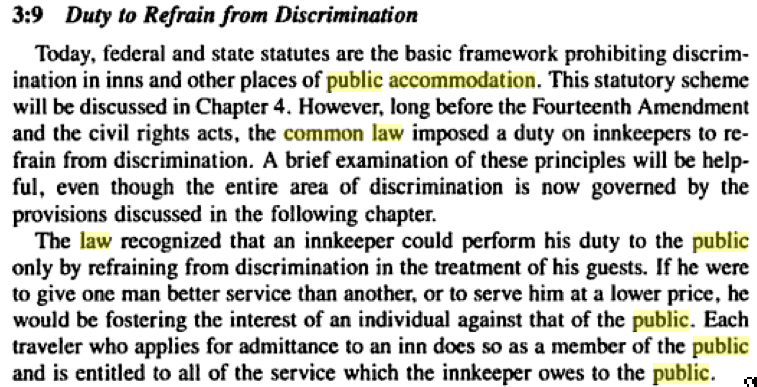
The point made in this passage (and its continuation)--that there is a common law obligation of non-discrimatory service has not gone unnoticed by legal scholars. More than a decade ago, I read with fascination the book The Wrong Side of the Tracks: A Revolutionary Rediscovery of the Common Law Tradition of Fairness in the Struggle Against Inequality, published in 1986. The Publishers Weekly review said:
In the past, Americans seeking equal public services in poor neighborhoods have argued for them on constitutional grounds (rights to equal protection of the laws) in federal courts. Such efforts, note the authors, have often required deprived citizens to prove discrimination on racial grounds, which is difficult to do. In this well-researched study, Haar and Fessler propose that a more effective remedy for municipal service discrimination lies in Anglo-American common law, which for centuries has held that a provider of public services has a "duty to serve." The bulk of their book examines this common-law doctrine in detail as it has evolved in court decisions (involving millers, ferries, railroads, etc.) from the 15th century to the present. The authors argue that the doctrine can become a "compelling" alternative in the state courts for advocates seeking to improve living conditions on the "wrong side of the tracks." For specialists. Haar and Fessler teach law at Harvard and the University of California respectively.
There is also an excellent and extensive review of the book for the New York Times, by author and former just Lois G. Forer. (Forer, a judge in the court of common pleas in Philadelphia, resigned from the bench rather than comply with rules forcing her to impose sentences she regarded as injurious and unjust. Her book, A Rage to Punish: The Unintended Consequences of Mandatory Sentencing provides a compelling case, based on her own judicial experience, for substituting restorative rememedies for punitive ones. I recommend it for everyone. But I digress.) Forer concludes her review with the following paragraph:
In ''The Wrong Side of the Tracks,'' Mr. Haar and Mr. Fessler have performed a valuable service by demonstrating both the failure of the Federal courts to carry out the constitutional promises of equality and the availability, in state courts, of a common-law legacy to remedy discrimination in the distribution of public services. And they have shown a clear need for further efforts to encourage the provision of equal municipal services to all. With the drastic cutbacks in funds for legal services for the poor, this obligation rests with the lawyers of America. But what the nation seems to lack is a new generation of able, dedicated, resourceful lawyers who will forgo the attractions of corporate mergers and takeovers and represent those who have been denied a meaningful share of American life.
Clearly, whatever else Rand Paul, the Tea Baggers and the rest of the conservative movement have in mind, it is not the preservation of the historical rights of Anglo-American common law. That is the very last thing they are interested in, the very last thing they understand. |


