On Wednesday, to the surprise of some spectators in the courtroom, a U.S. federal judge did the right thing: he followed the law.
Judge Lewis Kaplan had a clear choice before him: he could exclude the testimony of a government witness discovered via abusive CIA interrogation of Ahmed Khalfan Ghailani, or he could allow the government to introduce that testimony, in blatant violation of U.S. law. Ghailani, transferred from Guantanamo Bay to New York last year, is now on trial for allegedly assisting in the 1998 bombings of two U.S. embassies in East Africa.
In a U.S. federal court, testimony derived from a coercive interrogation is not admissible. A similar rule applies in the military commissions at Guantanamo Bay. Although judges there have more leeway, most military judges are equally principled and take the ban seriously. Torture-derived evidence is inadmissible for two reasons: to prevent U.S. authorities from engaging in torture, and because such evidence is inherently unreliable. International treaties similarly ban its use.
The government knew, of course, that this would be a problem, and it surely has plenty of other evidence against Ghailani or it wouldn't have transferred him to civilian court in the first place. After Judge Kaplan's ruling, Attorney General Eric Holder expressed his continued confidence in the case. Notably, four of his alleged co-conspirators in the bombings were tried and sentenced to life in prison back in 2001 - without the use of this particular government witness. Evidence introduced in that trial pointed to Ghailani as well.
Still, since Wednesday, commentators such as Liz Cheney and Jack Goldsmith have seized on Judge Kaplan's ruling to lament not the fact that Ghailani was thrown in a CIA black site for two years and likely tortured (the government refuses to address Ghailani's treatment in this trial but concedes he was "coerced"), but the fact that the judge has excluded the evidence that his interrogators squeezed out of him - or to claim the administration should never have given Ghailani a trial at all.
"If the American people needed any further proof that this Administration's policy of treating terrorism like a law enforcement matter is irresponsible and reckless, they received it today," announced Cheney after the ruling. Goldsmith, the Harvard Professor and former head of the Office of Legal Counsel Under President Bush, now writing on the new Lawfare blog, wonders "why the government is bothering to try Ghailani." Why not simply imprison him indefinitely?
Coming from Goldsmith, this is particularly disappointing. When he was at OLC, he had the courage to criticize his colleagues John Yoo and Jay Bybee for their twisted legal analysis that allowed them to institutionalize torture as U.S. policy. Now, rather than recalling that error as the source of the problem in Ghailani's trial today, he's criticizing the Obama administration for applying the rule of law at all.
Technically, Goldsmith may be right: the administration could just declare Ghailani an al Qaeda member and ongoing threat and hold him in military detention forever. That's the unfortunate consequence of the "war against al Qaeda, the Taliban and associated forces," which has no logical end. But as a matter of principle and policy, imprisoning people indefinitely without trial would be a disgrace, along the lines of what Goldsmith's colleagues at OLC sanctioned.
If there's anything the United States stands for -- or used to stand for -- it's that we don't throw people in prison without proof they've done something wrong.
Principle aside, it's just bad strategy. As General Petraeus has acknowledged, winning the war against al Qaeda and the Taliban is as much about winning over the local populations where they live as it is about U.S. military prowess. Throwing Muslims in prison for decades without charge or trial is hardly a good strategy. If, as national security experts tell us, al Qaeda's strategy is to present the U.S. war against terror as a war against Islam, indefinite detention of suspected Islamic insurgents without trial hands al Qaeda its most effective propaganda campaign on a silver platter.
Cheney and Goldsmith may be right that excluding a witness derived by torture will make the government's case against Ghailani more difficult. But in the end, a fair trial for a suspected terrorist in a respected federal court will do far more to defeat al Qaeda and its associates -- and to bolster the image of the United States in the world -- than will foregoing justice altogether.
It is noteworthy that General David Petraeus appeared yet again on the evening news last night, repeating his very real concerns and continued dismay over the planned burning of a Koran by Preacher Terry Jones. General Petraeus was emphatic in his denouncing the act, firmly believing that it will lead directly to increased American casualties: "General David Petraeus told NBC television that images of the Koran burning would be used by Islamic extremists to fuel anti-Americanism and harm the US mission in Afghanistan and other areas in the world. "We're concerned that the images from the burning of a Koran would be used in the same way that extremists used images from Abu Ghraib that they would in a sense be indelible", Petraeus told NBC. "They would be used by those who wish us ill, to incite violence and to inflame public opinion against us and against our mission here in Afghanistan, as well as our missions undoubtedly around the world, he added." Likewise similar concerns have now been voiced by General Ray Odierno, who recently stepped down as the ranking officer in charge of our military mission in Iraq. As of last night the F.B.I. has announced that a reaction to the burning of a Koran is imminent and the State Department has put American embassies and consulates on a full alert worldwide in expectation of their being targets of attack.
It is also noteworthy that in light of their current concerns, neither Petraeus or Odierno so much as uttered a passing reference to the controversy surrounding the planned construction of an Islamic Cultural Center in lower Manhattan. In light of this it's interesting to note the following. General Petraeus has a Ph.D. in International Relations from the Woodrow Wilson School of Public and International Affairs at Princeton University and General Odierno received a Masters in nuclear effects engineering and national security and strategy from the Naval War College. Thus a reasonable and well informed observer of political affairs would conclude, that in the midst of all the concern about the expected fallout from burning a Koran, both of these well educated and politically astute Generals would at least mention the planned construction project in lower Manhattan if it was even remotely related to issues of national security and safety. Yet, they didn't. Why because both of them know what many of the rest of us know as well, that it's not relevant or germane to what we can expect to be the follow on to the reckless folly that is scheduled to transpire this coming Saturday in Florida.
There are those among us who will continue to conflate the issues of burning a Koran and constructing an Islamic Cultural Center in their ill conceived and conceptually flawed argument as to how these issues relate one to the other or how both relate to the debate over national security and public safety. In trying to tie the two together they continue to reveal just how little they understand of the importance of the issue at hand, which is the burning a Koran on American soil by an American preacher for all the world to see. What we have here is a crass attempt to politicize one issue so as to distract the public from the other. In their silence on the issue of the Islamic Cultural Center, Generals Petraeus and Odierno, have effectively rendered this issue as something of little or no practical value in the current debate. It's time for those who are trying to use the "Mosque Controversy" as a foil or counterargument to the public concern with Preacher Jones' recklessness to realize the folly of their position and get on the right side of the issue once and for all.
Steven J. Gulitti
9/9/10
Sources:
Koran burning could amount to another Abu Ghraib: Petraeushttp://sify.com/news/koran-burning-could-amount-to-another-abu-ghraib-petraeus-news-international-kjjhkicfcda.html
Petraeus: Burning Qurans will undermine U.S. efforts in Afghanistanhttp://www.stripes.com/news/petraeus-burning-qurans-will-undermine-u-s-efforts-in-afghanistan-1.117486
Opposition is mounting to the "Burn a Koran Day" scheduled for September 11th in Florida. General David Petraeus said it could harm our troops, Secretary of State Hillary Clinton called it unrepresentative of Americans. Attorney General Eric Holder called it "idiotic and dangerous," and the Vatican has called the planned demonstration "outrageous and grave."
But the event planners, Terry Jones and the Dove World Outreach Center, are moving forward in spite of the outcry. In fact, they posted five MORE reasons to burn a Koran on their blog just yesterday.
Human Rights First has compiled our own list--we asked our supporters to submit reasons NOT to burn a Koran. We received over 5,000 responses. Below is the Top 10 list:
Ten Reasons NOT to Burn a Koran
Book burning! Do I really need to say why?
By not burning a Koran I'm not burning a bridge to communication.
Burning the Koran because of extremist Taliban and Al-Qeada terrorists makes no more sense than burning the Bible because of the Ku Klux Klan or Nazis.
Hatred breeds more hatred and that is not going to solve any of our problems.
That type of hate-filled religious intolerance has no place anywhere in the world, and is especially abhorrent in a country where religious freedom is one of the pillars of its foundation.
It's a sacred book to millions of people. We should respect all people's beliefs.
It will only inflame. I'd like people to understand each other.
I may not believe in the words of the Koran but I would never burn one out of respect for my fellow humans who do.
Support our troops!
We must learn to coexist. We cannot continue to live in fear and suspicion.
You can make a stand with us. Show the fearmongers and the world that Americans don't stand for bigotry by ordering your free "Americans Don't Burn Books" bookmark (you just need to cover shipping and handling).
Help us urge other leaders--including former President George W. Bush--to speak out against bigotry. He and members of his administration spoke out for tolerance and freedom of religion during his presidency. George W. Bush could make a difference by speaking out now.
We need everyone to speak out--Democrats, Republicans, and Independents. Join our efforts--get your bookmark and carry it proudly!
The controversy surrounding the proposed and ill conceived burning of a Koran by a preacher named Terry Jones has devolved, to some degree, into an intellectual parlor game as to the rights of this preacher to do, untrammeled, what he pleases and the rights related to building an Islamic Cultural Center in the vicinity of Ground Zero. Lost in all of this intellectual exercise is the welfare of those Americans now serving in the armed forces overseas. Some would suggest that if Muslims have the right to build a religious and cultural institute in lower Manhattan, then Preacher Jones is justified in carrying out his burning of the Koran, as if the two were somehow conceptually equivalent as it relates to the potential fallout. Lost in all of this is the reality that while people have rights of freedom of speech and expression, those rights are in fact neither absolute nor boundless. Such rights are conditioned by an operative test as to what extent these actions fall within a society's accepted norms and fundamental mores. Both individual and group actions are viewed within the bounds of what rational people would consider reasonable in a civilized society. That's why we operate with common sense conditions on human action with the overall welfare of the population in mind, the prohibition of yelling fire in a crowded theater being an often cited example. The point is a very simple one, while as citizens we constitutionally have the freedom of speech and expression, those freedoms don't extend to or accommodate license and reckless behavior. Thus viewed against the social, political and legal realities of American society, one could only classify the intended behavior of Preacher Jones as that which has now gone beyond the pale of protected behavior and into the realm of unmitigated recklessness. Behavior that can only increase the threat level for Americans both at home and abroad.
By itself, the preacher's actions could be dismissed as the ranting and raving of just another maladjusted soul who seems prone to bizarre and anti-social behavior. But when that behavior puts the lives of Americans serving in the Middle East and Southwest Asia in jeopardy, then these actions are clearly at variance with the well being of both the nation's military and it's citizens. General David Petraeus has already raised the alarm that Preacher Jones' actions will increase the risk of attacks on Americans in Iraq and Afghanistan and protests of the planned burning have already materialized in the region. The General has drawn parallels with Abu Gharib and how the mistreatment of Muslim prisoners aided Al Qaida's recruitment efforts thereby directly adding to the number insurgents we had to face in both Iraq and Afghanistan. Like Abu Gharib, the burning of a Koran by a Christian preacher will provide images that directly help Islamic radicals in their recruitment efforts, the General said. Jones' intended act will undo much of the progress made in winning the hearts and minds of Afghanis and Iraqis as well as creating further disincentives for moderates in the region to align themselves with the American effort. The net affect of Preacher Jones' act of freedom of expression, if carried out, will most likely be Americans losing their lives so that this glorified storefront preacher can garner his fifteen minutes of fame. That's what's really at issue here and all of the rest of this intellectual gymnastics is both now misplaced, misconstrued and totally misses the point that when freedom of speech or expression crosses over to the reckless, then it need be proscribed for the good of the overall public. While people can certainly continue to discuss the pros and cons of Preacher Jones' actions, those who chose to do so are blind to the larger issue entwined within all of this and that is the safety of their fellow Americans. The time for the intellectual games has passed and the time for an advocacy of the rational and reasonable as it relates to this issue is now upon us .
Steven J. Gulitti
9/7/10
Sources:
Quran Burning Warning: General Petraeus Words Fall On Deaf Ears?
http://www.postchronicle.com/n...
Top US Commander: Burning Quran Endangers Troops
http://news.yahoo.com/s/ap/201...
Burn a Koran Day Sparks Protests in Afghanistan
http://www.breitbart.tv/burn-a...
Koran Burning: Terry Jones Burn A Quran Day Not Cancelled
http://www.newsopi.com/us/kora...
On Monday, Rep. Nita Lowey (D-NY) announced she would not support foreign aid for Afghanistan until she was assured that the Afghan government had put an end to corruption.
"I do not intend to appropriate one more dime for assistance to Afghanistan until I have confidence that U.S. taxpayer money is not being abused to line the pockets of corrupt Afghan government officials, drug lords, and terrorists," said Lowey, who heads the House State and Foreign Operations Subcommittee. Lowey was responding to recent reports that more than $1 billion a year are flowing out of Afghanistan to elite Afghans outside the country, and that Afghan authorities have derailed corruption investigations of politically powerful Afghans.
Lowey's statement is an understandable expression of frustration. But cutting off foreign aid now is absolutely the wrong approach for the United States to take in Afghanistan.
After several visits to Afghanistan in the last few years, Human Rights First issued recommendations to the Obama administration last year specifically recommending that the United States help train Afghan investigators on evidence collection and documentation and help Afghan prosecutors provide fair prosecutions. Current plans do just that, in addition to working with Afghan officials on improving their own detention facilities and their judiciary.
Lowey's frustration is understandable, not only because of the Washington Post's recent news stories, but also because of this report prepared for the State Department last year that reviewed a broad range of Afghan institutions and concluded that corruption is rampant and growing. Not surprisingly, thirty years of war has undermined the development of reliable and legitimate institutions, and of a judicial system able to keep corruption in check. But to keep Afghanistan from returning to Taliban rule or simply descending into chaos, the United States has an obligation to help the Afghan government develop and enforce laws that reduce corruption and improve government transparency. Given the recent reports that Afghanistan has some $3 trillion worth of natural resources it's eager to exploit, transparency will be critical to make sure the proceeds of those riches don't just get shipped out of Afghanistan like the billion dollars a year flying out of there now.
Although our NATO allies should and will be helping in this effort, the necessary "nation-building" isn't going to happen unless the United States commits to funding carefully-targeted programs designed to improve governance and reduce corruption. Continued funding can be made contingent on the acceptance and participation of Afghan leaders and institutions with this anti-corruption agenda.
Lowey is right that US aid to Afghanistan should be spent wisely, and not indirectly fund warlordsto provide security or corrupt officials to spread as graft. But the State Department and the military's Joint Task Force in charge of detention facilities in Afghanistan are just beginning their work to improve local government enough to allow the U.S. military to transition out of there. Cutting off the funding that will allow that to happen would not only undermine the development of legitimate government institutions in Afghanistan, but would make the United States' goal of eventually leaving the country that much more elusive.
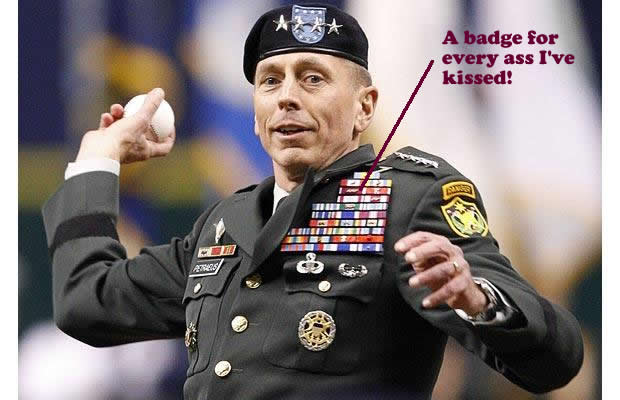
My name is General David Petraeus and I want to be your Commander in Chief because I admire everything about you, especially that amazing and unique way you have about you.
The values are all there: teamwork; fairplay; a transparent and honest judiciary. By many counts, sports embody liberal values.
So why does it seem like pro sports -- and its apotheosis, last night's Super Bowl -- are the domain of conservative thinking? Is it the martial posturing (although, despite the on-field pre-game presence of David Petraeus, the NFL does claim it's moving away from military metaphors)? Is it the culture of excessive consumerism embodied in the ads? Is it the machismo that sometimes resembles an anti-woman ethos (and has led to Superbowl Sunday having a horrid reputation for spousal abuse)?
Boxer should have held up the pic with Maliki and Amedinajacket
Mr. Petraeus can you explain this picture? Especially the holding hands part? Were Iranian missles showering the Green Zone on this day?
by: gaspare @ Wed Apr 09, 2008 at 08:50
I heard Juan Cole on the radio a few days back, and he was remarkably charitable toward McCain's bottomless ignorance. He didn't say that McCain was clueless old coot, despite the fact it was lke asking Stephen Hawkins about Bart Simpson's science project. Regarding McCain's 100-year plans, he said something to the effect that McCain didn't seem to realize that Iraq wasn't Germany or Japan (after WWII). But, the more that I thought about it, the more I came to think that Juan was just a little bit off on this one point: Iraq is Germany--right at the beginning of the Thirty Years War.
The Thirty Years' War was fought between 1618 and 1648, principally on the territory of today's Germany, and involved most of the major European powers.[2] Beginning as a religious conflict between Protestants and Catholics in the Holy Roman Empire, it gradually developed into a general war involving much of Europe, for reasons not necessarily related to religion.[3] The war marked the culmination of the France-Habsburg rivalry for pre-eminence in Europe, which led to further wars between France and the Habsburg powers.
The major impact of the Thirty Years' War, in which mercenary armies were extensively used, was the devastation of entire regions scavenged bare by the foraging armies. Episodes of widespread famine and disease devastated the population of the German states and, to a lesser extent, the Low Countries and Italy, while bankrupting many of the powers involved. The war may have lasted for 30 years, but the conflicts that triggered it continued unresolved for a much longer time. The war ended with the Treaty of Münster, a part of the wider Peace of Westphalia.
Over the course of the war, the population of the German states was reduced by about 30%;[4] in the territory of Brandenburg, the losses had amounted to half, while in some areas an estimated two-thirds of the population died. Germany's male population was reduced by almost half. The population of the Czech lands declined by a third. The Swedish armies alone destroyed 2,000 castles, 18,000 villages and 1,500 towns in Germany, one-third of all German towns.
The analogy is striking--fragmented country riddled with religious conflict plus surrounding neighbors, each it's own agenda=a generation plus of incredibly bloody civil war with 30% population loss. If you ask me, the Lancet study is pretty much right on track.
This is what stupid Hitler analogies gets you: total blindness to rather obvious historical precedents that are far more relevant to actual situation.
I wish someone would ask Petraeus and Crocker about that.
Of course, weighty historical analogies, no matter how valid, and how much they might save our ass, only speak to a certain segment of the population. Hence, the eminent common sense of gaspare's suggestion. If the Democrats had learned anything from the Republicans over the past 20-30 years, not just Boxer, but two or three other senators, and a similar number of representatives would have asked strikingly similar, though not identical questions requiring display of the same photo.
Amd then there is the question of supporting out troops, and how the Iraq war is destoying out military....
The costs of war are staggering, a little over $3900 a second, but the key moment today was Ambassador Crocker's admission to Senator Biden that we should be focusing on Al Qaeda in Afghanistan/Pakistan rather than Iraq.
Here's DDay:
Every single argument that the Administration and their lapdogs like John McCain have made or are making break down after that answer. The Ambassdor to Iraq just admitted that Iraq is not the central front in the war on terror. He just admitted that the potential for Al Qaeda to gain a beachhead in Iraq should the United States withdraw is miniscule compared to the already-established beachhead along the Pakistan-Afghanistan border. He admitted that the global fight against terror is currently misdirected.
A withdrawal and reallocation of forces and resources is the only responsible path. I'd like to see questions tomorrow on the House side put to Petraeus on whether he agrees with Crocker on force allocation.
He doesn't outright endorse 100 years in Iraq, unlike John McCain, but anything but endless war is irresponsible.
Bayh, a potential vice presidential nominee, said he did not want to get "sucked into the presidential campaigns," but went on to ask Petraeus to give the American people a general idea of when troop withdrawals can begin.
"Is it just impossible to offer any rough estimate?" Bayh asked, in the four-and-a-half-hour hearing's final volley.
Petraeus, as he did earlier, staunchly demurred. He said it was "flat-out not responsible to try to put down a stake in the ground" and estimate when troops could begin leaving Iraq.
Petraeus and Crocker have no problems projecting out the potential implications of leaving Iraq - but they refuse to make projections of what staying will look like. That double standard is absurd. Is there a strategic plan for our presence in Iraq? If so what? The answer is pretty clearly no. They have no end game. There is no exit strategy. The Bush/McCain/Petraeus/Crocker plan is simply to stay and to stay a very very long time in the hopes that things slowly get better.
Petraeus won't even firmly assert that our presence in Iraq is making us safer, though he basically says he thinks it is. I've heard from a bunch of military folks that he has to believe his strategy is working, that it's just leadership to be optimistic and can-do. But Petraeus isn't being optimistic, he's just waffling and avoiding questions. It's dangerous that Petraeus has put himself in a political role while in uniform.
Democratic challenger Don Wiviott is using his platform as a candidate to put out an ad on Iraq in response to Petraeus's testimony. On Saturday, Wiviott asked his supporters for questions to ask Petraeus.
This is a very smart way to use the national media environment to a candidate's advantage. Institutionally, the DCCC would probably argue that keeping paid advertising limited until the last two months or so makes sense.
"General depending accounting used, this war will cost us from $2 - 3.5 trillion. Help me explain to my constituents why it is more important to rebuild Iraq and not rebuild America."
Tim Cunha (FL-06) sent a letter to Democratic House leaders.
When General David Petraeus and U. S. Ambassador to Iraq Ryan Crocker meet with Congress Tuesday and Wednesday, Tim Cunha, Democratic 6th district congressional candidate, wants them asked: "Is the continued American involvement in the Iraq civil war making America safer?"
Alice Kryzan (NY-26) in a heavily contested primary has a video.
This week is a tremendous messaging opportunity on Iraq for anyone who wants to take it. General Petraeus and Ambassador Crocker are testifying in the House and the Senate on Tuesday and Wednesday about the surge. The goal from our perspective should be to pose the question of whether our presence in Iraq is making us safer, rather than focusing on levels of violence and the tactical questions surrounding the surge. Barack Obama frames it correctly with this question.
Obama, an Illinois Democrat, also wants a quick end to the war. On Friday, he said: ""We still don't have a good answer to the question posed by Sen. (John) Warner the last time Gen. Petraeus appeared: How has this effort in Iraq made us safer and how do we expect it will make us safer in the long run?"
By far the worst framing is done by Carl Levin, speaking about the surge.
"In my judgment, it's too rosy, but there are parts of it that are not so rosy, and both pieces need to be declassified," Sen. Carl Levin said, pointing in particular to the portion of the report describing Iraq's political progress.
Levin also likes to blame the Iraqi government for the problems in Iraq. It's actually a fairly common line, with prominent Democrats undercutting a coherent message.
"We saw a meaningful reduction in violence, and that presented an opportunity to build up national reconciliation that was the underlying premise of the surge," said Representative Howard L. Berman, Democrat of California and chairman of the House Foreign Affairs Committee. "It seems that the Iraqis have largely frittered it away."
Republicans, meanwhile, see this week as an opportunity to push their message about winning in Iraq. Here's what Republicans are planning.
On the Republican side, a veterans group tied to the party is planning a rally near the Senate, while House Republicans are coordinating with conservative bloggers and will invite conservative radio commentators to broadcast from Washington. Republicans plan to push for new money for troops in Iraq; to highlight statements by Democrats that the troop "surge," which ended last fall, has worked; to point out some signs of political reconciliation; and to insist that troops can be removed from Iraq only when military leaders decide it is the proper time.
"The goal of the effort is not just to reinforce the message delivered by General Petraeus, but to launch a full-fledged assault on the misinformation campaign promoted by Democratic leaders who have lost every time they have tried to legislate defeat for America," said an internal strategy memo for Republican communications operatives.
It is clear that DC Democrats have several different lines of messaging going on that work against each other. Some of them want to drill into the tactics of the surge, some want to discuss larger national security questions, and some want to concede the surge worked but that the Iraqis are somehow at fault.
It's important to recognize that this is all a sideshow to the real question in front of all of us, one avoided by many of the politicians in DC. What do we do in Iraq to make our country safer?

 STATE BLOGS


 Powered by: SoapBlox