Driving home from work I endured NPR's inexplicable decision to give Jonah Goldberg airtime to admit that it is "more fun" for conservative pundits to be out of power (actually, I agree, it is more fun having Jonah out of power. Conservatives breaking the Planet isn't fun).
From my non-expert understanding of the subject matter, Alter does a fine job smashing up Shlaes' arguments throughout, but the highlight is the callers and emailers, who give me some sense and hope that conservative New Deal denialism isn't sticking with the public. In particular, at the 8:00 mark in the program, the very first caller actually attended FDR's inauguration and was 16 years old at the time, working as a Senate page. He makes a point of noting Shlaes' perception of history ignores that by 1935-36, things clearly had visibly improved. NPR's host stupidly insists on moving on to other callers in the too-quick manner of NPR, but Alter makes a point of getting contact info from the caller, so hopefully we will hear more from this man. There are very few people alive who were old enough to remember the New Deal in progress, never mind that actually worked in Washington and knew the players. The guy also has a good quip about the 20th Amendment (also from 1933) saving the country from 2 more months of Bush.
While researching FDR's first cabinet selections for that earlier post, I came across a quote I couldn't include in there, but want to call attention to separately because it's just awesome. From that great Time piece from 1933 on FDR's initial cabinet, a section on Senator Thomas Walsh of Montana, the nominee for Attorney General:
Entering the Senate in 1913 as a Helena attorney, "Tom" Walsh, grim of mien and gruff of manner, quickly developed as a great constitutional authority. He fought notably for the confirmation of Louis Dembitz Brandeis, first Jew on the Supreme Court. Organized Labor is still grateful to him for his efforts to exclude unions from the anti-trust laws He led the fight that ended only when Michigan's wealthy Truman Newberry resigned from the Senate seat he was accused of buying. His relentless investigation of the Teapot Dome and Elk Hills oil leases finally put Albert Bacon Fall behind bars. He presided over the 103 ballots cast by warring Democrats in Madison Square Garden in 1924, presided again last June at Chicago. After the oil investigation had made him a headliner, Washington's Daisy Harriman took him in hand, trimmed his scraggly mustache, made a society lion out of him. But no amount of social attention could diminish his capacity for public indignation or soften the glare of righteousness in his hard blue eyes. As an Attorney General, he is rated faintly radical because he sponsored the Federal Trade Commission's investigation of the "Power Trust."
"faintly radical"? Awesome. He had just remarried at 73 too (doesn't mention his wife's age). The man sounds like quite a dude. Unfortunately he died on the train to DC, so we'll never know what he might have done as AG. I'm trying to imagine who would be the contemporary equivalent to this guy. Fitz? Pre-scandal Spitz? Is there anyone like this in national prominence any more? Not dissing Holder specifically, but he's just not this cool.
One thing is clear: the GOP is not about to fold up shop and go along with Barack Obama, just because he's President and the Democrats won a substantial legislative victory as well last November. They're already starting to marshall their forces to oppose, or at least slow down, and render as ineffective as possible, whatever stimulus package Obama comes up with. And, of course, recycling lies about the New Deal, FDR and the Great Depression are essential parts of the package. On Sunday I wrote a diary, "A Brief Peek At UCLA's Anti-FDR Propaganda", which looked only at the gross parameters surrounding claims made in a paper that David had referred to in passing in a previous diary.
While kanzeon weighed in late to make the point: "The measure of when the Depression ended, to conservative critics, isn't usually GDP or real output, but unemployment," negative GDP growth is the standard by which economists routiney identify recesssions--and by extension depressions--as well as being the single most comprehensive measure of economic activity (for good or ill), so I still think it's useful to look a little more closely at GDP as a pre-emptive antidote against conservative/GOP bullshit that's bound to be coming at us in the days ahead.
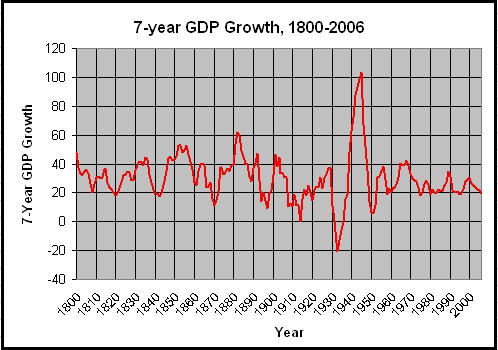
The UCLA report claimed that the Depression should have ended in 1936--7 years after it began, and roughly 3 3/4 years after FDR took office. Without ignoring Kanzeon's caveat, that still seems rather hard to accept given just how badly the GDP was doing. Thing is, I don't think I've ever seen a clear graphical representation of just how bad that was. So I decided to make one myself. Given the UCLA author's belief in a magic 7-year time-frame, I decided to chart the 7-year GDP growth figures from around the beginning of the US economy to date. You can clearly see just how drastically the Great Depression departs from anything else in our history, as well as just how powerful our recovery was, particularly once WWII spending kicked in:
This chart just goes to show how incredibly unusual the Great Depression was. No wonder a large number of people, all across the political spectrum, thought that it well might be the end of capitalism. There was nothing remotely like it in all our history. And the idea that everything could readily be solved by simply letting normal economic forces work--as the UCLA researchers propose--seems utterly unbelievable, simply by looking at the relatively limited scope of any of the other previous sharp rises, none of which is remotely large enough to get us back into the 20-40% 7-year GDP growth range that is normal for the economy in the specified 7-year time frame--much less the 3 3/4 years that FDR actually had in office before the end of 1936 rolled around.
This past Monday, TomDispatch featured a story taking a hard look at the team that FDR put together to fight the Great Depression-a wide-ranging ideologically mixed bag-and contrasted it sharply with the path that Obama seems to be on. It's particularly compelling, I think, because it echoes a point that I've made a number of times, which I think should be obvious, but that still seems to fly right past the Versailles crowd, to wit: there's a tremendous practical benefit to be gotten from ideological diversity, and there's a good deal of ideological danger to be gotten from relying merely on narrowly-defined "competence."
As Fraser describes it, the sense of anticipation greeting Roosevelt-with no clear sense of what he had in store-was much like that greeting Obama today. And yet, the differences are already striking.
It's hard to overstate the transformative moment that we're in as a nation and, particularly, as progressives. In just a few years, we've gone from the high point of conservative power to a stunning rejection of conservative federal leadership and the historic election of a progressive African-American president.
But the electoral sea change is just part of the extraordinary national moment. The financial meltdown and slide toward deep recession have crystallized Americans' anger over deteriorating economic security, stagnant mobility, growing inequality, and policies of isolation instead of connection. Americans are ready for a new social compact and a transformed relationship between the people and our government. They are calling for a new era of big ideas and different values than we've seen over most of the past three decades.
The electorate has shown an unprecedented willingness to overcome racial and ethnic barriers to take on daunting shared challenges. Young people, people of color, and low-income people turned out to register and vote in unprecedented numbers that bode well for a far more participatory and egalitarian democracy going forward.
Even before this year's remarkable events, opinion research showed a historic, progressive shift in Americans' views on issues that (not coincidentally) were barely mentioned in the election. Perhaps most striking is the shift on criminal justice and problems of addiction, where the U.S. public has moved broadly to support rehabilitation and treatment over incarceration and retribution, as well as assistance and integration for people emerging from prison.
But an unprecedented opportunity for progressive values and ideas is not the same as victory for a progressive social and policy vision. The stark challenges of rising inequality, faltering security, and broken systems of health care, immigration, and criminal justice are the same on November 5 as they were on November 4. What's changed is only the chance for transformative change.
History shows that progressives could easily blow this opportunity, just as conservatives blew their transformative moments after the 1994 elections and the attacks of September 11, 2001. A few principles can help progressives move from opportunity to realization in ways that profoundly benefit our country.
AMY GOODMAN: What happened in those first 100 days? In fact, Roosevelt wasn't Roosevelt at the very beginning, the Roosevelt we know of the New Deal. It took tremendous pressure from within his cabinet. Of course, they were people he appointed. Adam Cohen, the editorial writer for the New York Times, has a very important book coming out on exactly what happened in those hundred days. But, Bob Kuttner, you also write about it... how people struggled within the administration, like Frances Perkins, Henry Wallace, who became his vice president, Harry Hopkins, the social worker, and how they beat out the more conservative forces.
ROBERT KUTTNER: Well, and they had two things on their side. They had reality on their side. If Roosevelt didn't become bolder, he would have been Hoover all over again. They also had social movements. And if you look at the great presidents-Lincoln, Roosevelt, the Johnson of the civil rights, not the Johnson of Vietnam-you had the abolitionist movement, you had the industrial labor movement, you had, of course, the civil rights movement.
And I think there's going to be a tug-of-war inside the administration. And the really interesting question is, what is going happen to the youth movement that became an Obama movement that I think needs to become its own movement for social change, not simply Obama groupies.
Assuming all goes as we hope, and Obama is our next President; we have bigger Democratic margins in the House and Senate; it is my belief that Obama will either be huge success or a massive failure (not to put too much pressure on you, big guy). I think our problems are just too big, and the decisions Obama and the Democrats in Congress have to make are just too monumental, for there to be any middle ground. Either Obama's going to come out of this mess looking like he saved the country from disaster, and go down as another FDR or Lincoln, or he's going down in history as the Presidents who preceded FDR and Lincoln and failed- James Buchanan or Herbert Hoover- awash in massive problems they were unable to solve. For the sake of the country, the Democratic Party, and the progressive movement, we'd all better hope it's the former.
The difference will be whether he pushes to be, and succeeds at being, a transformational President, or whether he goes toward what Digby calls neo-Hooverism: that sense that we need to be frugal, cautious, slow, careful, and all other things center-right. Massive problems cannot by solved by halting half-steps, crisis cannot be resolved by too much caution.
Being the history buff that I am, I always perk up when a columnist discusses history to make a political point. The other day, David Brooks did that, and boy did he screw it up.
In parts 1-4 two weeks ago, I wrote a series of articles quite critical of Barack Obama's echoing rightwing narrative frames demonizing forms of dissent.
those who attack America's flaws without acknowledging the singular greatness of our ideals, and their proven capacity to inspire a better world, do not truly understand America.
Meanwhile, some of those in the so-called counter-culture of the Sixties reacted not merely by criticizing particular government policies, but by attacking the symbols, and in extreme cases, the very idea, of America itself - by burning flags; by blaming America for all that was wrong with the world; and perhaps most tragically, by failing to honor those veterans coming home from Vietnam, something that remains a national shame to this day.
In part 3, "Patriotism Smackdown: Barack Obama Vs. Jane Fonda?", I expanded the critique of Obama's echoing rightwing Vietnam-era myths by taking on the image of Jane Fonda. I drew on Jerry Lembcke's paper, "Gender, Betrayal, and Public Memory: America's Lost War in Vietnam" to illuminate how Jane Fonda was reinvented as an icon of cultural betrayal years after the fact, in stark contrast to the historical realities of the time, and how this reinvention fit into some of the oldest myths of American identity.
Then in part 4, "Patriotism Smackdown: "Hanoi Jane" vs. Tricky Dick", I looked at how it was actually Richard Nixon who was responsible for the senseless deaths of tens of thousands of Americans in South Vietnam, as he schemed along with Henry Kissinger to prevent the signing of a peace treaty in 1968, before the November elections.
Collectively, these aticles go to show that Barack Obama tacitly--at the very least--embraces a view of political history since the 1960s that is deeply shaped by rightwing fantasies of liberal treachery, and that deliberately ignores and excuses the actual reality of rightwing treachery. The charge is not that Obama makes such a fantasy the cornerstone of his politics. He clearly does not. But he does allow this fantasy to define the limits and outline the shape of his politics. It is defines the box in which he lives--and in which he would have all of us live with him.
This fifth installment--unfortunately delayed by illness--completes the series by taking a longer historical view of the underlying dynamic in terms of one of its classic metaphors--the "stab in the back" that played such a crucial role in the emergence of Naziism after Germany's defeat in WWI.
In doing so, I'm going to hitch a ride through the 20th Century with Kevin Baker, who wrote a fantastic piece for Harpers a couple of yearrs ago, "Stabbed in the back! The past and future of a right-wing myth". In it, Baker makes specific reference to Lembcke and The Spitting Image, which we'll get to shortly. But he begins with a very tight thesis paragrph that cuts to the chase
Every state must have its enemies. Great powers must have especially monstrous foes. Above all, these foes must arise from within, for national pride does not admit that a great nation can be defeated by any outside force. That is why, though its origins are elsewhere, the stab in the back has become the sustaining myth of modern American nationalism. Since the end of World War II it has been the device by which the American right wing has both revitalized itself and repeatedly avoided responsibility for its own worst blunders. Indeed, the right has distilled its tale of betrayal into a formula: Advocate some momentarily popular but reckless policy. Deny culpability when that policy is exposed as disastrous. Blame the disaster on internal enemies who hate America. Repeat, always making sure to increase the number of internal enemies.
This is what we're up against--to this very day. But it's not just fighting off this profound evasion of responsibility and the wildly proliferating demonology it produces. There's also the little detail about getting past all this delusion to actually come up with something that makes sense as foreign policy--something we can't even get close to doing so long as we're spending all our time fighting off--or even worse, being seduced by--rightwing demons. If you don't believe me, just ask Buffy, the Vampire Slayer. She tried to have a normal life, but, well. You know.
It was post-WWI Germany, and a fellah named Adolph something-or-other who really got the ball rolling on this whole stabbed-in-back fantasy, in a way that the American right later picked up on, "big time," as America's #2 war criminal would say. Gory details on the flip.
In that purpose we have been helped by achievements of mind and spirit. Old truths have been relearned; untruths have been unlearned. We have always known that heedless self-interest was bad morals; we know now that it is bad economics. Out of the collapse of a prosperity whose builders boasted their practicality has come the conviction that in the long run economic morality pays. We are beginning to wipe out the line that divides the practical from the ideal; and in so doing we are fashioning an instrument of unimagined power for the establishment of a morally better world.
This new understanding undermines the old admiration of worldly success as such. We are beginning to abandon our tolerance of the abuse of power by those who betray for profit the elementary decencies of life.
In this process evil things formerly accepted will not be so easily condoned. Hard-headedness will not so easily excuse hardheartedness. We are moving toward an era of good feeling. But we realize that there can be no era of good feeling save among men of good will.
That's the conversation we're having right now, it's just not in our political leadership class yet.
In the wake of the disasterous Bush presidency there are two possible responses. One is that, just like the last time conservatives controlled the country--1920-1932--they are destroying the country. The second is that both sides are to blame. They're both fighting, instead of solving the problems we face. Obama represents the second response, and he is, quite simply, utterly, totally and dangerously wrong. Whatever his intentions may be, action based on this worldview cannot fundamentally reverse the damage that movement conservatism has done to our country. Because of the fierceness of movement conservative opposition, his worldview demands that we change things only modestly in the grand scheme of things.
This is what's at the root of the problems Obama has faced recently, epitomized by his remarks praising Ronald Reagan, however you interpret them. Obama claims he has been misunderstood. But really, it is Obama who fundamentally misunderstands history, and it his misunderstanding that it is the root cause of the confusion he spreads to others. His misunderstanding is based on three inter-related things--a lack of historical knowledge, an acceptance of the dominant political discourse, and a devaluing of material causes and conditions. In particular, the dominant narrative blaming both sides for our political problems, and attributing the cause to bad attitudes in people's heads and hearts, is not just historically inaccurate, it results from a virtual rightwing takeover of the media and many other institutions--a material cause that affects the nature of our political narratives regardless of the actual evidence at hand.
Specifically:
Our problem is not that people are too partisan. The problem is the opposite--there are too many people with divided loyalties, and this has produced a 40-year period dominated by divided government, unlike any other time in our history.
The problem is not that Democrats are too combatative, just like Republicans. There is nothing the Democrats have done that is remotely close to the GOP impeachment of Clinton. To the contrary, the Democratic leadership has refused to even consider impeachment for a list of literally dozens of high crimes and misdemeanors.
The problem is not individual attitudes preventing politicians from agreeing. There are real, fundamental differences, driven by a widening wealth gap, and loss of political power by average people.
Kennedy and Reagan were not transformative leaders. FDR and Nixon were--not necessarily because of who they were, or anything to do with personal charisma, but because they came to power at the true turning points in political alignment--or in Nixon's case, de-alignment.
Let's take these up, one-by-one. The order will change a bit, because of how the evidence flows.
In Part One, I presented the argument for viewing conservatism as a form of identity politics, showed how differences on issues between liberals and conservatives are much smaller than differences on candidates, and showed that conservatives--even self-identified extreme conservatives--support welfare state spending. In Part Two, I examined two cognitive models that distinguish liberalism and conservatism., both of which show reasons why conservatism is associated with a constricted notion of identity, while liberalism is more diffuse.
Now, in Part 3, I address how to construct a diverse liberal identity. The key to doing so lies in weaving together issues, values and narratives, and doing so with a diversified messaging and organizing strategy. To bring things solidly down to earth, I will focus on two key concepts that I believe have tremendous potential for liberal politics, both in 2008, and for decades to come. These concepts can be expressed in a simple pairing: "dignity and security for all."
As I will explain, there is more than just a rhetorical echo of another famous liberal formulation, "liberty and justice for all." In a very real sense, dignity is the lived foundation for justice, just as security is the lived foundation for liberty (this is a key aspect of Locke's social contract theory). What's more, when these concepts are presented together, they represent a fuller and more robust expression of Franklin D. Roosevelt's "Four Freedoms" --freedom of speech and expression, freedom of every person to worship in his own way, freedom from want and freedom from fear.
Thus, what I am arguing for is a new articulation of core liberal values in a form that pro-actively responds to 40+ years of rightwing slander, as well as the realworld challenges of the 21st Century. To accomplish a lasting political realignment--along the lines seen in 1930/1932--we will need to change the basic contours of the politically possible, which means the politically imaginable. Fortunately, we've done it before. We can do it again.

 STATE BLOGS


 Powered by: SoapBlox