In 1860, in the midst of tensions surrounding the Civil War, it was widely believed in the United States that Abraham Lincoln was Catholic. Coming on the heels of decades of anti-Catholic sentiment, the rumors seem to have had two roots: The first was the ambiguous nature of Lincoln's upbringing in Illinois, where Jesuits were very active, leading to the notion that Lincoln had been baptized a Catholic; the other was that Lincoln represented a prominent critic of the Church. The rumors were widely repeated by Lincoln's political opponents.
In 1940, in the midst of tensions surrounding World War II as well as economic hardship from the Great Depression, it was widely believed in the United States that Franklin Roosevelt was Jewish. Coming on the heels of decades of anti-Jewish sentiment, the rumors seem to have had several roots: The first was the ambiguous origins of Roosevelt's earliest American ancestors, who came from Holland in the 17th century; the second was the abundance of Jewish appointees to Roosevelt's administrations in New York and Washington. The rumors were widely repeated by Roosevelt's political opponents.
In 2010, in the midst of tensions surrounding wars in Iraq and Afghanistan as well as economic hardship from the Great Recession, it is widely believed in the United States that Barack Obama is Muslim. Coming on the heels of decades of anti-Muslim sentiment, the rumors seem to have had several roots: The first is the ambiguous nature of Obama's upbringing, in which his father was a Muslim and he spent formative time as a child in a Muslim country; the second is Obama's vocal outreach to the Muslim world and his support of the rights of Muslim Americans. The rumors have been widely repeated by Obama's political opponents.
It's got a nice repetitive symmetry to it, and no doubt a bit of truth, but then there's this key graph:
The entire debate about the "Ground Zero mosque" and the even-wider campaign against Islam in general that's been waged across the United States this summer misses a larger point: These kinds of campaigns have been waged in the United States since our founding. It's the nature of how we conflate political frustration, economic anxiety, and concern about the changing fabric of our identity. In a country where our national character has been tied up with God since our founding, it's hardly surprising that we tar our political opponents with worshiping a different god than we do. After all, a politician who subscribes to our religious values would never have gotten us into this mess, now would he?
Three points:
(1) Despite the internal pattern of US history being similar, the significance in world affairs is drastically different. The mobilization of anti-Islamic attitudes in the US is exactly what al Qaeda and its allies want. There is no comparable parallel to this in the past examples.
(2) The nature of our fact-free corporate mass media makes the destructive disinformation potential much more damaging than in the past examples cited.
(3) While part of the suggested logic makes perfect sociological sense:
After all, a politician who subscribes to our religious values would never have gotten us into this mess, now would he?
There's just one teeny-weensy little problem: Neither Lincoln, nor Roosevelt, nor Obama got us into the mess. Obama may be particularly inept with his messaging on the subject, but the same wasn't true of Lincoln or FDR, and lots of folks thought he was Muslim even before he took office, when it was perfectly clear that the shit had already hit the fan.
This is not to say that this explanation is totally wrong--just that it's incomplete, failing to fully account for all the dimensions of reality distortion involved. And when you combine the unnaccounted-for distortions with Obama's abysmal messaging, and the uniquely dangerous world historical situation this puts us into, then I think that Feiler's optimistic conclusion:
But as reliably as Americans have adopted these views, they've also moved past them.... And odds are the pattern will repeat itself with Muslims in the twenty-first century.
Is not something we can comfortably rely on.
Things are a lot more dire than that, I'm afraid. And this sort of "don't worry, it's nothing new" narrative may be exactly the wrong message to be sending right now. Fact it, it took a great deal of struggle, and a good deal of luck to get us through those past bouts of collective madness. Knowing we've seen this before should be a warning signal to take this much more seriously than we have so far.
Michael Tomasky's article, Against Despair: How our misreading of history harms progressivism today adopts the pose of an historically informed adult reprimanding childish activists for their petulance. But it's really nothing more than one long distraction from the actual facts at hand. FDR and LBJ weren't perfect paragons, we're reminded, and Rome wasn't built in a day.
What this misses is the real crux of the problem: Obama's crippling ideological and imaginative limitations as a child of Reagan--something that simply has no parallel in FDR and LBJ, for all their shortcomings. Like other attempts to portray FDR as a centrist Democrat, no different than Obama, this is simply historically false. If FDR was not always a good Keynesian, for example, it was because Keynesianism was just being invented and no one in America really understood it yet. When Obama's not a good Keynesian, it's because he's unwilling or afraid to simply and repeatedly state facts and push back against lies.
Of course it's quite true that Roosevelt was not as progressive as many of his contemporaries, starting with his wife. And it's true that he backed some conservative ideas as well--though the most significant examples were budget-related ones that largely reflected the primitive state of economic knowledge at the time. But it's also true that he had a much more ideologically diverse group of advisers than Obama, including staunch progressives like Frances Perkins who have no equal in Obama's inner circle.
FDR also had a history of reformist activism from his earliest days in the New York Senate, when he lead a group of insurgents who refused to support the Tammany Hall candidate for US Senate. Although he later mended fences with Tammany somewhat, there was a clear pragmatic purpose for that--getting elected Governor of New York--and the underlying animus never really went away. Tammany Hall supported Al Smith for the Democratic nomination for President in 1932, after which the New Deal effectively crippled Tammany Hall, and though it managed a resurgence under Carmine De Sapio in the early 1950s, his torpedoing of FDR Jr.'s run for NY Attorney General lead to Eleanor Roosevelt's involvement in organizing the New York Committee for Democratic Voters, which eventually drove De Sapio from power.
Conservatives have historically argued against progressive policies on a variety of fronts: the unintended consequences of change, the primacy of the individual over government, the dangers of a growing bureaucracy (or more generically, "big government"), the importance of traditional values and local control, the worry of people growing too dependent on government, etc. With increasing vehemence, though, conservatives have begun to argue that kind-heartedness, compassion, and a sense of community are actually evil: that they lead inevitably to Nazism and death camps.
Political debate has always been hot and heavy in this country, with conservatives swinging hard and heavy and making some pretty wild claims: the pro-British Tories in the 1770s decried the "rats of democracy"; the pro-slavery Southern planters in the first half of the 1800s said that slaves were better off than if they were free; the Social Darwinists said society would be better off if the poor were allowed to starve to death, because their death would improve the gene pool. But the compassion equals evil argument didn't really get laid out in detail until Ayn Rand's writings, where she actually did argue that people with compassion and concern for others were leeches who drained society of its competitive life blood.
Just as Ayn Rand took the Social Darwinist argument and made it more virulent, the conservative author Jonah Goldberg brought a new, more extreme twist to the argument, literally saying that progressives like FDR were ideological soul mates of Hitler and Mussolini's brand of fascism. This easily debunked book has become the right's excuse for accusing everyone arguing for progressive causes of being a Nazi.
Glenn Beck is, of course, the present day leader of the pack when it comes to this kind of invective. Here's his latest insight on the subject:
Shahien Nasiripour points out a gaping rhetorical contrast between President Obama's speech on Wall Street reform at Cooper Union, and a famous speech FDR in the closing days of his 1936 re-election campaign. Obama, ever the unifier, reached out to Wall Street, while FDR drew a sharp, harsh contrast:
With Goldman Sachs's top leaders in attendance, President Barack Obama urged financial executives to work with him in passing the financial reform bill currently pending in the Senate.
"Ultimately, there is no dividing line between Main Street and Wall Street. We rise or we fall together as one nation. So I urge you to join me -- to join those who are seeking to pass these commonsense reforms," according to Obama's prepared remarks for a speech in New York City. "And I urge you to do so not only because it is in the interests of your industry, but because it is in the interests of our country."
Obama's call for a more cooperative relationship stands in sharp contrast to another presidential address to financial executives in New York a few years removed from a financial crisis.
"We had to struggle with the old enemies of peace -- business and financial monopoly, speculation, reckless banking, class antagonism, sectionalism, war profiteering," Franklin Delano Roosevelt said in a 1936 speech. "They had begun to consider the Government of the United States as a mere appendage to their own affairs. We know now that Government by organized money is just as dangerous as Government by organized mob. Never before in all our history have these forces been so united against one candidate as they stand today.
"They are unanimous in their hate for me -- and I welcome their hatred."
The rhetorical difference between Obama and FDR could hardly be greater. However, there is something else that Obama said today that actually reminded me of a rhetorical move FDR often made. Like FDR, Obama emphasized that he believed in a free market.
White House talking points today:
The President is an ardent believer in the free market and a strong financial sector, and the reforms in this legislation are not about stifling competition or innovation. By laying out clear rules of the road and empowering our consumers with clear and concise information when making financial decisions, we'll offer more choices for consumers, more opportunities for businesses, and more stability in our financial system.
In spite of defects as exhibited, I am still a believer in the capitalistic system... I do not see, however, why intelligent men in the world cannot do something toward remedying the effects of the capitalistic form of government.
From Obama's speech today
As I said two years ago on this stage, I believe in the power of the free market. I believe in a strong financial sector that helps people to raise capital and get loans and invest their savings. But a free market was never meant to be a free license to take whatever you can get, however you can get it.
Famous FDR speech, 1938:
"You undergraduates who see me for the first time have read your newspapers and heard on the air that I am, at the very least, an ogre - a consorter with communists, a destroyer of the rich... that I was driving the nation into bankruptcy, and that I breakfasted every morning on a dish of 'grilled millionaire.'
"Actually I am an exceedingly mild mannered person-a practitioner of peace, both domestic and foreign, a believer in the capitalistic system, and for my breakfast a devotee of scrambled eggs.
On these rhetorical points--emphasizing that they believe in capitalism, but feel its worst aspects must be reined in--FDR and Obama are nearly identical.
As the title implies, my point in this article is not actually to equate Obama and Roosevelt, but to call into question mythologies that have built up around progressive figures of the past (and Roosevelt actually refused to call himself a "progressive," opting for what at the time was the more right-wing "liberal"). It is true that Obama is far from the ideal of a progressive crusader, but the image as FDR achieving that ideal comes from viewing his presidency selectively and in distant hindsight. FDR was in fact so far from that ideal at the time that he faced the very real prospect of being defeated for renomination--not re-election, renomination--in 1936 from a left-wing challenger.
Progressive mythology is an odd sort of thing, since we are supposed to be finding our ideals in a future that has not yet been achieved, not in a past that can never be regained and never actually happened (see conservatives on Ronald Reagan, life before the 1960's, and other matters). We should pretty much always find our leaders to be unsatisfactory, but not because they failed to live up to a progressive figure of the past.
Brad DeLong began his post, Barack Herbert Hoover Obama? thus:
For some time I have been worried about fifty little Herbert Hoovers at the state level. Right now it looks like I have to worry about one big one:
Jackie Calmes: Obama to Propose Freeze on Some Spending to Trim Deficit: President Obama will call for a three-year freeze in spending on many domestic programs, and for increases no greater than inflation after that, an initiative intended to signal his seriousness about cutting the budget deficit, administration officials said Monday.
Later, he added an update (at the top of his post):
UPDATE An administration source says that he believes that discretionary non-security is not frozen at 2010 ex-stimulus levels for 2011, but is instead bumped up from 2010 to 2011--that the freeze part applies to fiscal 2012, 2013, and 2014.
And then a second one:
UPDATE II: It seems that it is not a freeze in non-security discretionary outlays, but rather an overall cap on non-security discretionary--which is a diffrent animal. And it seems that it is not an overall cap on non-security discretionary outlays, but instead an overall cap on non-security discretionary authority--which is a different animal. And it seems that it is not a binding cap on overall non-security discretionary: that ARRA extensions and other job-boosting deficit-spending measures, plus other "emergencies", are exempt...
These qualifications do not really go to the heart of the matter--that it's stupid to be talking about spending less when the employment side of the worst recession in 70 years is still ongoing--but neither are they trivial. During the campaign, Obama repeatedly attacked John McCain precisely for advocating an across-the-board freeze, and now he announces the very policy he attacked McCain for-only it's not actually the same thing. On the face of it, this is just terrible messaging.
Why not call it what it actually is--an "overall cap"--and avoid giving folks the easy ammo of compilation clips like this?
The basic reason, I'd argue, is that it's squid ink--intended to distract and confuse. Or like conman patter and the play of confederates in a game of three-card monte. It's all designed to keep our attention distracted from the really big play--the destruction of the American welfare state, and with it, America's mass middle class. Like NAFTA before it--a small-time dress rehearsal--it's something the GOP could never pull off. Only the 21st Century Democrats could destroy what the 20th Century Democrats created.
As noted in quick hits by BDB and rayj, [UPDATE] and by David in a diary that just caused me to push back this diary's publication time, Obama has now gone off the deep end. After passing a stimulus that most economists (not just liberal ones) said was too small, and that was made even more inadequate by being heavily tilted toward poor-performing tax-cuts, Obama is now intentionally recreating FDR's mistake of 1937, when he prematurely cut back spending to try to balance the budget, and sent the country into a new recession.
Let me repeat that, in larger type:
Obama is now intentionally recreating FDR's mistake of 1937, when he prematurely cut back spending to try to balance the budget, and sent the country into a new recession.
Specifically: He's going to announce a spending freeze on domestic programs (but not, of course, on the military) that is "projected to save $250 billion." The rationale is that he wants to appease folks worried about runaway deficits. Which is just what FDR was worried about in 1937.
This is Bush-style idiocy. There is no other word for it.
Adding insult to injury, at the same time, he's also proposing more Ronald Reagan/GW Bush tax cuts... which will, of course, increase the runaway deficits.
And he's also talking about privatizing NASA. Because privatizing the Pentagon turned out so great!
It's time to seriously start talking about primarying Obama in 2012. He's now officially the most conservative Democratic President since Grover Cleveland. And the dumbest one since James Buchanan.
Here, to remind you, is the chart I put together during the stimulus debate, showing, among other things, the relative ineffectiveness of tax cuts vs. spending in generating jobs, which is the key to getting the nation out of this recession--the only way that we can rationally hope to start bringing down the deficits:
While some tax cuts are much better than the real stinkers, it's virtually a given that once Obama starts talking about tax cuts, the GOP is going to start demanding that Bush's tax cuts be made permanent. Not only--as you can see from the chart--are these about the least helpful tax cuts of all, they are also heavily skewed toward helping the rich and the super-rich.
In 1928, the Democratic Party nominated NY Governor Al Smith as its candidate for President--a move that had at least a few parallels with the nomination of Barack Obama 80 years later. It was the first time a major party had nominated a Catholic to run for President, it brought new voters to the Democratic Party, and it lost a portion of white Protestants in the South. Smith's earlier career--though far more varied and illustious than Obama's--also had some rough parallels, including a progressive reputation (with a lot more to show for it) as well as a relationship big city machine politics. But the reason I titled this diary "The Party of Al Smith" is because of what happened after the 1932 election--one which saw him bitterly try to block FDR's nomination, although he did support FDR in the general election.
Smith's style of progressivism included working closely with business leaders, and was reflective of the policies of the First New Deal, when the National Recovery Act tried to stabilize the economy through what was basically a cartelistic approach. It didn't work, and FDR, to his credit, realized as much. It also got overturned by the Supreme Court. As business leaders became more oppositional to Roosevelt, he turned left, drawing support from the rapidly-growing labor movement, and the Second New Deal--the one that's remembered to this day--was significantly more populist, and "progressive" as we generally understand the term today. This turn of events rekindled his animosity to FDR, and Smith ended up supporting the GOP in both the 1936 and 1940 elections. (Smith died in 1944.)
Smith was a progressive in the framework of pre-1932 politics--a period of time in which middle-class progressives were often bitterly at war with working-class socialists. But he revolted against the embrace of populism the came with the New Deal, a period of time when progressive and socialist politics converged with one another. For all the elitism that remained in place, and the anti-populist attitudes that John Emerson has written about here, the post-1932 Party of FDR was dramatically to the left of where it had been pre-1932, and where it would have remained if Smith had been the candidate in 1932, instead of Roosevelt.
With Obama, all that has changed. With Obama, the Democrats are no longer the Party of FDR. They are the Party of Al Smith--a good and decent man, by all accounts, but his politics, not so much. He was, quite simply, out of touch with what had happened in the world after his 1928 run. As David Mizner notes in a quick hit:
Another week, another perplexing Michael Lind piece in Salon, "Can Obama give 'em hell before it's too late?". First, the good part, to dispel the false impression that I'm constantly bad-mouthing him. Toward the end of his article he imagines the sort of speech that Obama ought to give, in the spirit of FDR during the 1936 campaign. "A Rooseveltian or Trumanesque campaign speech, addressing the concerns of the American majority, invoking the heroic history of American reform and naming the enemy, practically writes itself," he says. This is how it begins:
"My fellow Americans, we say that healthcare is a right of all citizens. The other party says that it is a privilege for those who can afford it. If you agree with them that healthcare is a privilege, not a right, then vote for them. We would like to persuade you to join us, but if we can't, then we are going to defeat you.
"Decades ago our opponents tried to block Social Security and Medicare, using the same bogus arguments that they are using today against healthcare reform. They said Social Security and Medicare would bankrupt the country. They were wrong. Once we fix the cost inflation of our broken medical sector, with some minor tweaks Social Security and Medicare can be made solvent forever.
"Decades ago, our opponents said that Social Security and Medicare would turn the United States into a fascist or communist police state. They were wrong then and they are wrong now. And not only are they wrong, they are hypocritical. Many of our opponents who claim absurdly that universal healthcare will bring tyranny to the U.S. have defended some of the greatest assaults on civil liberties and the rule of law in American history during the previous administration.
"They can draw a Hitler mustache on me. They can draw a mustache on the Mona Lisa, for all I care. They are wrong and we are going to defeat them.
"We won the elections and we are the majority. We would like to build the biggest consensus possible, but progress is more important than consensus. Our job is to help the American people, not split the difference between right and wrong by giving a veto to the party that the American people have rejected....
I agree totally. That would be a great speech. Where I differ from Lind is not in terms what the Democrats need to do. It's in terms of understanding why they don't.
As I have tried to reveal in several articles this month, the "fiscal conservative" philosophy to which Republicans, and many Democrats, claim to adhere is a complete fabrication. Over the last 140 years, no politician or political party has ever actually reduced the size of government spending relative to the overall size of the economy in any significant, long-term way. During this entire period, excepting for the end of the two world wars, government spending has consistently increased relative to the overall size of the economy. It has happened to such a degree that even fiscal conservative icons such as Ronald Reagan, Newt Gingrich, and Tom DeLay advocated for a much larger government than either FDR or LBJ. To phrase this historic trend in the current lingo of conservatives, Ronald Reagan was far more "socialist" than FDR.
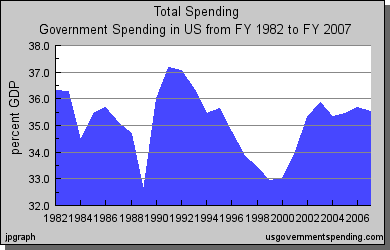
It is fairly simple to prove that Regan was ore "socialist" than the New Deal or Great Society, if the size of government spending relative to the overall size of the economy is examined. The following chart graphs the percentage of government spending relative to the overall size of the economy during the peak era of Republican political power: fiscal year 1982 (Reagan's first budget) through fiscal year 2007 (the final budget passed when Republicans controlled both Congress and the White House).
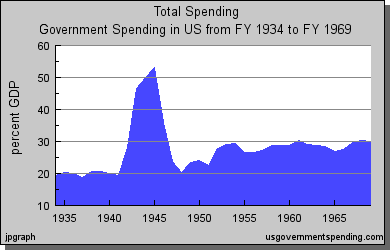
This chart is even taken from a pro-teabagging site. It shows that government spending was 36.30% the total size of the economy in 1982, and ended up at 35.53% in 2007. This minuscule change of less than 1% is the entire "limited government" accomplishment of fiscal conservatism. Further, the variation of government spending relative to the overall economy is also quite narrow, with no changes in either direction of more than 4.12% during the entire period. Overall, these levels of spending are also far beyond the level of government spending undertaken during the peak years of Democratic political power, fiscal year 1934 (FDR's first budget) to fiscal year 1969 (the final pre-Nixon year of Democratic control of the White House and Congress):
According to this chart, outside of World War Two, government spending under FDR and LBJ reached an all-time high of 30.07% in 1969. This compares to an all-time low of 32.55% under Reagan. As such, by their own standards, conservatives must label Ronald Reagan as more socialist than FDR, he of the New Deal, or LBJ, he of The Great Society. Under FDR, government spending consistently hovered at around 20% of GDP, compared to 35% under Reagan. This actually makes Reagan nearly twice as socialist as FDR.
Some Republicans believe they can regain power by distancing themselves from the Bush years, and "returning" to a clear, populist articulation of a "limited government" philosophy. The problem with such an idea is that there is no actual example of this "limited government" philosophy in practice. No politician or political party has ever significantly reduced the size of government over the long-term. Because of this, pretty much all self-identified "fiscal conservatives" are either lying about, or entirely ignorant of, the size of government they actually support.
There has been much talk lately about the Great Depression, how it parallels our current economic crisis, and how passage of the New Deal might serve as a model for the Democrats and the new Obama administration in their attempts to rescue the economy.
But it is how the passage of the New Deal may serve as a model for the Progressive movement that I want to discuss here. For, as I will demonstrate, if it were not for the Progressive movement, and Roosevelt's harshest critics from the left, we would have ended up with a very different New Deal - one which, arguably, would not have been much of a deal at all.
FDR Economist Says Obama Should Put Stimulus First
April 2 (Bloomberg) -- When John Maynard Keynes came to Washington in 1934 to persuade President Franklin Roosevelt to spend more to revive the U.S. economy, Roosevelt didn't pay the British economist much attention, Thomas Worsley recalls. He hopes President Barack Obama won't repeat Roosevelt's mistake.
Worsley, then a 23-year-old economist about to take a job in the Treasury Department, says Roosevelt balked at too much economic stimulus, and even allowed conservative Democrats to talk him into reining in federal outlays in 1937.
Now, at 97, Worsley is watching as Obama wrestles with the deepest economic slump since the Great Depression and is coming under fire from critics at home and abroad over his spending plans. Ultimately, Worsley said, only World War II delivered the U.S. from its hard economic times, and he advises Obama to keep pumping money into the economy.
"That vindicated Keynes's argument," Worsley said during an interview at his brick townhouse in Alexandria, Virginia, where his framed economics degrees from the University of Virginia, including a doctorate, are displayed. "You have to get enough spending going to get private enterprise interested in taking chances on investing."
Top Economics Aide Discloses Income
Summers Earned Salary From Hedge Fund, Speaking Fees From Wall St. Firms By Philip Rucker and Joe Stephens
Washington Post Staff Writers
Saturday, April 4, 2009; Page A05
Lawrence H. Summers, one of President Obama's top economic advisers, collected roughly $5.2 million in compensation from hedge fund D.E. Shaw over the past year and was paid more than $2.7 million in speaking fees by several troubled Wall Street firms and other organizations.
Regarding that stimulus package... I think we're going about this the wrong way. The past few years have clearly shown that the American people want things to change in this country. They want politicians to change the way they do things in Washington.
We've got a crisis. A huge, complicated multifaceted problem that developed over a long period of time. There is no silver bullet that will solve it. So why are we treating the problem that way by using this quasi silver bullet stimulus package?
It's not working for us. It has become just like the huge omnibus spending bills that are the epitomy of "typical Washington". We've lost the forest through the trees as the Republicans tramp through the forest with media teams shouting "Look at this tree! The Democrats are going to spend 20 billion dollars to save this tree! It's not a tree worth saving! Americans don't want that tree!"
Democrats have lost control of this bill and it's now being driven by the Republican minority. I think there is a better approach.
Driving home from work I endured NPR's inexplicable decision to give Jonah Goldberg airtime to admit that it is "more fun" for conservative pundits to be out of power (actually, I agree, it is more fun having Jonah out of power. Conservatives breaking the Planet isn't fun).
From my non-expert understanding of the subject matter, Alter does a fine job smashing up Shlaes' arguments throughout, but the highlight is the callers and emailers, who give me some sense and hope that conservative New Deal denialism isn't sticking with the public. In particular, at the 8:00 mark in the program, the very first caller actually attended FDR's inauguration and was 16 years old at the time, working as a Senate page. He makes a point of noting Shlaes' perception of history ignores that by 1935-36, things clearly had visibly improved. NPR's host stupidly insists on moving on to other callers in the too-quick manner of NPR, but Alter makes a point of getting contact info from the caller, so hopefully we will hear more from this man. There are very few people alive who were old enough to remember the New Deal in progress, never mind that actually worked in Washington and knew the players. The guy also has a good quip about the 20th Amendment (also from 1933) saving the country from 2 more months of Bush.
While researching FDR's first cabinet selections for that earlier post, I came across a quote I couldn't include in there, but want to call attention to separately because it's just awesome. From that great Time piece from 1933 on FDR's initial cabinet, a section on Senator Thomas Walsh of Montana, the nominee for Attorney General:
Entering the Senate in 1913 as a Helena attorney, "Tom" Walsh, grim of mien and gruff of manner, quickly developed as a great constitutional authority. He fought notably for the confirmation of Louis Dembitz Brandeis, first Jew on the Supreme Court. Organized Labor is still grateful to him for his efforts to exclude unions from the anti-trust laws He led the fight that ended only when Michigan's wealthy Truman Newberry resigned from the Senate seat he was accused of buying. His relentless investigation of the Teapot Dome and Elk Hills oil leases finally put Albert Bacon Fall behind bars. He presided over the 103 ballots cast by warring Democrats in Madison Square Garden in 1924, presided again last June at Chicago. After the oil investigation had made him a headliner, Washington's Daisy Harriman took him in hand, trimmed his scraggly mustache, made a society lion out of him. But no amount of social attention could diminish his capacity for public indignation or soften the glare of righteousness in his hard blue eyes. As an Attorney General, he is rated faintly radical because he sponsored the Federal Trade Commission's investigation of the "Power Trust."
"faintly radical"? Awesome. He had just remarried at 73 too (doesn't mention his wife's age). The man sounds like quite a dude. Unfortunately he died on the train to DC, so we'll never know what he might have done as AG. I'm trying to imagine who would be the contemporary equivalent to this guy. Fitz? Pre-scandal Spitz? Is there anyone like this in national prominence any more? Not dissing Holder specifically, but he's just not this cool.
One thing is clear: the GOP is not about to fold up shop and go along with Barack Obama, just because he's President and the Democrats won a substantial legislative victory as well last November. They're already starting to marshall their forces to oppose, or at least slow down, and render as ineffective as possible, whatever stimulus package Obama comes up with. And, of course, recycling lies about the New Deal, FDR and the Great Depression are essential parts of the package. On Sunday I wrote a diary, "A Brief Peek At UCLA's Anti-FDR Propaganda", which looked only at the gross parameters surrounding claims made in a paper that David had referred to in passing in a previous diary.
While kanzeon weighed in late to make the point: "The measure of when the Depression ended, to conservative critics, isn't usually GDP or real output, but unemployment," negative GDP growth is the standard by which economists routiney identify recesssions--and by extension depressions--as well as being the single most comprehensive measure of economic activity (for good or ill), so I still think it's useful to look a little more closely at GDP as a pre-emptive antidote against conservative/GOP bullshit that's bound to be coming at us in the days ahead.
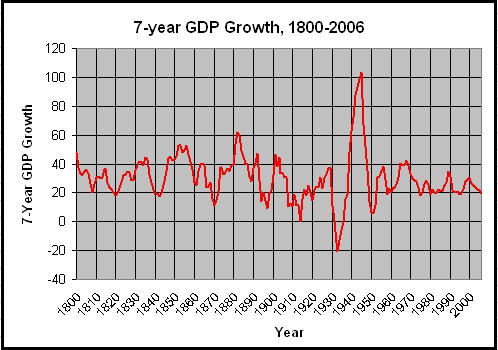
The UCLA report claimed that the Depression should have ended in 1936--7 years after it began, and roughly 3 3/4 years after FDR took office. Without ignoring Kanzeon's caveat, that still seems rather hard to accept given just how badly the GDP was doing. Thing is, I don't think I've ever seen a clear graphical representation of just how bad that was. So I decided to make one myself. Given the UCLA author's belief in a magic 7-year time-frame, I decided to chart the 7-year GDP growth figures from around the beginning of the US economy to date. You can clearly see just how drastically the Great Depression departs from anything else in our history, as well as just how powerful our recovery was, particularly once WWII spending kicked in:
This chart just goes to show how incredibly unusual the Great Depression was. No wonder a large number of people, all across the political spectrum, thought that it well might be the end of capitalism. There was nothing remotely like it in all our history. And the idea that everything could readily be solved by simply letting normal economic forces work--as the UCLA researchers propose--seems utterly unbelievable, simply by looking at the relatively limited scope of any of the other previous sharp rises, none of which is remotely large enough to get us back into the 20-40% 7-year GDP growth range that is normal for the economy in the specified 7-year time frame--much less the 3 3/4 years that FDR actually had in office before the end of 1936 rolled around.