We at Open Left are taking the New Year's weekend off. Golden Oldies will run in their place. Regularly Scheduled programming will resume on January 4th--Chris Bowers
A Daniel De Groot Golden Oldie
From Mon Nov 24, 2008. Original HERE.
There has been here, and elsewhere, a low-level (ahem) ideological debate about the relative importance of ideology versus pragmatism. To some, the election of Obama is seen as a victory for getting things done as opposed to what I suppose in this formulation is the old Washington game of tilting at ideological windmills. It's a theme I have seen frequently here in the comments, through the discussion on the merits of Obama's cabinet and other nominations so far. I want to address the underlying fiction which claims there is some practical ideal route of policy that can eschew ideology itself. Greenwald addressed this today, more specifically on pragmatism as foreign policy:
If one discards the need for ideology in favor of "pragmatism" and "competence" -- as so many people seem so eager to do -- then it's difficult to see how one could form any opinions about questions of this sort beyond a crude risk-benefit analysis (i.e., "pragmatism"). Are there military and economic benefits to be derived for the U.S. from invading Pakistan? Bombing Iran? Lending unquestioning support to Israel? Escalating our occupation of Afghanistan? Remaining indefinitely in Iraq and exploiting their resources? Propping up dictators of all types? Deposing Hugo Chavez? Torturing suspected terrorists for information, or detaining them without process? If so, then those who are heralding "pragmatism" as the supreme value -- or at least something that should trump "ideology" -- would have no real basis to oppose those actions. It is only ideological beliefs that permit opposition to those polices even if they are "beneficial" to our "national self-interest."
We at Open Left are taking the New Year's weekend off. Golden Oldies will run in their place. Regularly Scheduled programming will resume on January 4th--Chris Bowers
A Matt Stoller Golden Oldie
Tue Jan 06, 2009. Original HERE.
Well, I suppose I had to make the announcement at some point, so here goes. I won't be blogging at OpenLeft for some time. I've taken a job inside the House of Representatives (more on that when I've cleared what I can say) to see how the place works and to help create the space for more progressive policies.
Ultimately what I've learned, from many of you as much as from the task of writing for the public for the last five years, is that there is a serious leadership gap in this country. And by leadership gap, I mean something very specific, so specific that I'm going to give it a name. I call it a 'rootsgap'. A rootsgap occurs when a leadership is dramatically out of step with its base or the public at large. In the 1970s, the conservative base felt consistently sold out by its politicians, like Gerald Ford, who pushed centrist unpopular pieces of legislation, like the Panama Canal Treaty, through the levers of government. Birth control, abortion, public sector unions, civil rights, consumer rights, the Equal Rights Amendment - all of these provoked a fierce reaction from the conservative base who felt betrayed by the Republican politicians who did not oppose liberalization fast enough.
A Chris Bowers Golden Oldie
From Mon May 05, 2008. Original HERE.
Is there a progressive movement? This question has seemed particularly relevant over the last two weeks, as support for Barack Obama has washed away apparent long-standing principles of the movement: do not legitimize Fox News and Democrats should become more partisan. Now, apparently, we need to go on Fox News as much as possible and we much ditch partisanship altogether. If the Obama campaign can change the principles of the movement so quickly, perhaps there isn't a movement at all.
Perhaps a different question is necessary: what is a political movement, anyway? Thinking back over the 20th century, the defining characteristic seems to be a large-scale political undertaking that not only had goals of changing governmental institutions, but that changed the way people lived by shifting the balance of power in other major institutions as well. A political movement seeks to reorganize society on a far broader level than simply changing governmental policy. Examples include:
The labor movement fundamentally changed the economic structure of this and other countries by granting wage-laborers more power over the American workplace.
In addition to expanding access to government, the civil right's movement sought to reorganize educational, housing and employment patterns throughout the country. Other examples from this time period include the Black Panthers and the "counter-culture," which were primarily organized around institutions other than governmental policy (law enforcement and cultural consumption).
Radical Islamicist movements have worked to reorganize virtually every major institution in a given society, from education to religion to familial structures to cultural consumption.
A political movement always targets more than governmental policy change, since only changing policy would not alter the general framework of how people live in a given society. With that in mind, in what ways is the contemporary progressive movement going beyond seeking governmental policy change, and directly altering the way people interact with other major institutions in our society?
Looking over the major ideological institutions in America--the family, education, mass media, religion, and the workplace--the largest and most rapid changes are currently taking place in the latter three. By lowering the cost of information, the Internet has dramatically changed both the media landscape specifically and cultural production / consumption patterns more generally. Also, in terms of religion, nationally there is a broad movement away from self-identification as Christian, and even a dramatic re-organization within Christianity itself. Within the workplace and our larger economic structures, the rise of the Creative Class has had a major impact on the types of jobs available in America, and also on income inequality. This isn't to say that there are not major changes in other major ideological institutions like education and the family, just that the changes in the above three are far more pronounced in recent years.
Now, which of these three major changes can be identified a part of a "progressive movement?" The religious shifts don't really work, since the movement away from traditional religious identification and institutions is not organized by any group of people, and is simply happening on its own. Since it is at least partially a side-effect of a rising corporate power, income inequality, and de-industrialization, the rise of the Creative Class doesn't really work, whether or not most members of the Creative Class tend to be progressive. This leaves us with the lower cost of information, and resulting explosion in cultural production, brought on by the Internet. Perhaps the de-centralization of mass media consumption, the public sphere interaction, and cultural production brought on by the Internet is the progressive movement. It is the clearest example of how daily life has changed in a progressive way over the last decade. The medium is the movement.
Identifying the medium, and the changing cultural and media consumption / production patterns it has created, as the progressive movement itself helps provide perspective both on Barack Obama and on policy priorities for maintaining a healthy movement. First, changing viewpoints that Obama's campaign has created about Fox News and partisanship will not be isolated incidents. Since the consumption and production patterns themselves are the major change, the movement is ultimately lacking in fixed precepts. We should expect other changes in the future, including an inevitable rejection of Obama's ideas on partisanship and Fox News. Second, in order to maintain a healthy movement and the positive feedback loops the movement creates for progressivism, telecom policy and net neutrality should be understood as top, non-negotiable policy priorities. If net neutrality is ended, then the contemporary progressive movement, along with all progressive policy and lifestyle changes it promises, will come to an end. The movement is not just dependant upon the medium, but is in fact embedded in it. If net neutrality is ended, it will shift control of the medium away from individuals with broadband access, and toward large corporations. If the movement is the medium, then control over the medium for the average Internet user must be maintained, and expanded, at all costs.
Finally, from a "medium is the movement" perspective, the choice between Clinton and Obama isn't really even a choice at all. It's Obama by a mile.
A Paul Rosenberg Golden Oldie
From Sat Jul 25, 2009. Original HERE.
In early 2006, I began working on a book project that never really worked out. (Got a spare $20k? I'm willing to give it another shot!) I wanted to address the extreme disconnect between the conservative political climate in Washington (remember, this was about six months before the 2006 midterms) and the political attitudes of the American people, which, according to the best social science, had only changed modestly overall since the early Nixon era. During the course of researching and drafting an introductory chapter, the importance of conservative identity politics became blindingly clear as the result of a series of number-driven arguments.
As I've been wrestling with recent manifestations of conservative identity politics that I planned to blog about this weekend--the Birthers, The Family, etc.--I remembered this earlier work, and the hard foundations of data on which it rested. I thought it would make a good companion piece to my contemporary observations to go back and resurrect that argument. So I took a draft chapter, whittled it down a bit, and I'm presenting it after the jump.
There are two overarching points that I hope will clearly emerge from this. The first is that my contemporary focus on conservative identity politics is not just some arbitrary whim. It emerges out of an inquiry that was not originally concerned with it at all. In fact, I was taken by surprise as the logic of it virtually ambushed me. The second point--closely related--is that conservative identity politics cannot simply be ignored, or factored out of other discussions. It lies at the very heart of understanding conservative hostility to liberals, which is the main driving force polarizing our politics today, and interfering with the important work of solving major problems that confront us as a society--such as meeting the challenge of climate change.
This is a long diary, over 4000 words, so feel free to skim the parts that may seem tangential to you. I wanted to preserve enough of the original to accurately reflect the range of factors that I had considered. And I hope that even if this is a bit long for you to read online all at one go, you'll want to bookmark it and return to it again. Heck, maybe even as soon as my next diary posts.
Obama's sudden lurch to the right is all in accord with one of Versailles' most treasured, and most bogus narratives, the claim that America is a "center-right" country, and thus that it's both natural and necessary for any Democrat to attack the party's base and trample the things it believes in. After all, they're just a bunch of DFHs, whose views are hated and despised by real Americans (who read David Brooks religiously to know what they should think).
I'll have more to say about the center-right premise in another diary...
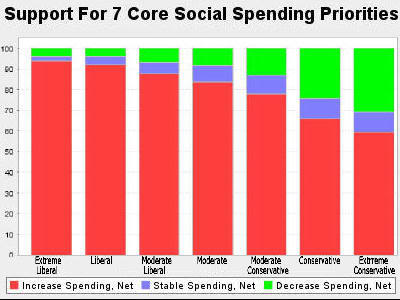
Well, this is that diary. I want to go back to the same data source I used before, the General Social Survey (GSS), which is the most thorough long-term survey of American public opinion, administered 26 times since 1972. The GSS is the gold standard when it comes to American public opinion research, and is cited more frewuently by social scientists than any other data source except the US Census. The data I've drawn from it relates to social spending, and it shows remarkably consistent findings across all the times it has been administered. There are fluctuations, to be sure, but even when the public is in its most conservative frame of mind, support for these programs remains remarkably robust-and not just among liberals and moderates. This data provides undeniable evidence of conservative support for welfare state social spending.
The first thing I'm going to do is look at a combined index of spending preferences, a slightly different one than the one I used in my earlier diary, since this one includes Social Security, which the GSS did not start polling for until 1984. Since then, majority of extreme conservatives (self-identified 7 on a 1-7 scale) said we were spending too little on a combined measure (call it NatWelfComp) of whether people think we're spending too little, too much or about right on seven different areas-Social Security, welfare, "improving [the] nation's education system," "improving & protecting [the] environment," "improving & protecting [the] nations health," "improving the conditions of blacks," and "solving problems of big cities." The number of extreme conservatives who thought we were spending too little on one or more programs (net: i.e. "too little" on two, but "too much" on one is a net of "too little" on one) was nearly twice the number of extreme conservatives who thought we were spending too much: 59.3% to 30.7%. This can be seen in the last column of the chart below:
A Matt Stoller Golden Oldie
Tue Dec 25, 2007. Original HERE.
Here's Ezra Klein expressing a fairly common sentiment among both Democratic base voters and Democratic elites.
As a result of my post defending Obama this morning, I'm getting a bunch of links along the lines of "Ezra Klein, no fan of Obama..."
This is, to be sure, my failure as a writer, so just to be clear: I'm impressed with all three of the major Democrats, and, for that matters, most of the other Democrats not named "Bill Richardson."
Ezra is happy with the Democratic candidates; most Democratic voters share Ezra's views. I don't (and neither do a few others). The issues we are dealing with today - health care, jobs, even a war in Iraq - are literally the same issues we dealt with in 1992. How can that possibly be considered progress? A real progressive candidate would take an apolitical problem and turn it into a mainstream political subject. None of our candidates have done that. Here are five easily mainstreamable problems ripe for the picking. There are more of these, I'm just picking at five that touch on the national security state, secrecy, economic injustice, and attacks on our civil liberties.
Subject: End the War on Drugs
Factoid: There are 1 million people put in jail for doing what Barack Obama, Bill Clinton, and George Bush have done.
Marijuana is America's largest cash crop, and it is responsible for around 225,000 arrests a year. Overall, the war on drugs incarcerates around 1 million people a year. Direct spending on the war on drugs this year is $50 billion dollars, about $600 a second. Around half of high school seniors have consumed marijuana (pdf). Simply put, why do some people go to jail for marijuana and cocaine, and others run for President?
Subject: End corporate media ownership:
Factoid: General Electric, a major defense contractor and conglomerate, owns NBC, MSNBC, and CNBC.
Our media is owned and controlled by a few major companies. One of them, GE, has major defense contracts, and strong incentives for war. It also has huge interests in the financial industry. Why is this company controlling our news content again, while we are in two wars? And why did the FCC just relax ownership requirements in local areas, again?
Subject: End American empire
Factoid: As of 1998, America had troops stationed in 144 countries around the world.
There are any number of ways to talk about this issue, from disparities of foreign aid to complaints about the IMF to the war in Iraq to the CIA and blowback. The bottom line is that America has troops everywhere in the world, it's expensive, the way it is done now is a bad idea, and we need to bring them home and return to being a republic. That or we need to figure out how to be a responsible international power again and get rid of the Blackwater-style military we are building and the gunrunning vigilante CIA-style Cold War and post-Cold War nonsense.
Subject: End the war economy:
Factoid: Money for Iraq keeps passing in 'emergency' legislation to avoid being subject to budget rules.
For some reason, Blue Dog Democrats and Republicans argue that they are fiscally responsible while ignoring their votes to spend 700-800B a year on war. Libertarian charlatans like energy expert Amory Lovins think that the corporate sector and the military sector are legitimate parts of the state, but that other spending is wasteful. The whole notion of the military not being a part of the overall government is crazy, and reflective of a huge, corrupt, and Soviet-style misallocation of capital through secret budgets and fear.
Subject: End the cradle-to-prison superhighway
Factoid: 2 million people are in prison in America, by far the highest total of any other country in the world.
Think slavery has ended? Think torture is 'new'? Think again. With two million people in prison, and tens of thousands of sexual assaults every year, prison is a huge industry and a horrendous abridgment of the idea that is America.
Touching on any of these massive injustices in our economic infrastructure is something no candidate has systematically done. Only John Edwards has remotely addressed the concept of the war on terror, in a somewhat half-hearted way, and he has made 'poverty' a somewhat commonly repeated theme, though not in any meaningful sense. Clinton and Obama are disgracefully absent on these topics. Ironically, Bill Richardson, aside from his great work on residual forces, has also said that the 'war on drugs is not working', which reflects perhaps a more executive oriented and confident worldview. Chris Dodd has also advocated for marijuana decriminalization, which is a less aggressive but still laudable sentiment, especially in light of his work on core constitutional issues.
So anyway, while the insider wonk community is happy that their issues seem to be taken care of, and Democratic base voters like the different candidates we have, I find that actual progressive reframing of our political system is appearing only at the margins of our secondary candidates like Bill Richardson and Chris Dodd, and among crazy white supremacist types like Mike Huckabee and Ron Paul. Each of the five hinges I've discussed starts with the verb 'end', and that was not planned when I started this post. I think it means that we must end a chapter in American history, and begin a new one.
Restoring healthy communities, healthy citizens, a healthy global order, healthy local media, and a healthy sustainable economy are the key drivers of where need to go as a country. The cancerous symptoms are all around us, and leading Democratic Presidential candidates are too corrupt and morally crippled to even begin talking about them. But we'll get there.
A Chris Bowers Golden Oldie
From Fri Mar 07, 2008. Original HERE.
Back in 1988, I became obsessed with a compute game called President Elect 1988, which was an early PC game that simulated a variety of historical and ahistorical presidential elections. One of the lessons I learned from the game is that it was a lot easier for Democrats to win if they nominated a southerner, and especially if another southerner was also on the ballot as vice-president. As such, four years later, when I was barely old enough to vote in the Democratic primary in New York, I liked Jerry Brown (despite his horrendous sales tax proposal) but also didn't mind if Bill Clinton won, because I figured Clinton could win some southern states and take the general election. When Clinton chose Al Gore as his running mate, I was pretty happy, since my lesson from playing hundreds of games of President Elect was that there was pretty much no way such a ticket could lose during an economic downturn.
That was all well and good, and it worked well for its time. The civil rights backlash had fractured the New Deal coalition, and white, socially conservative, working class and middle class voters were turning to Republicans in droves. The vast majority of these voters lived in the south, which had once been a solid Democratic region and gave Democrats a nearly unbreakable partisan hold on power in Washington, D.C. The so-called "Republican Revolution" of the time was basically flipping conservative southern whites. These were the so-called "Reagan Democrats" who Dems became obsessed with winning back after the Mondale general election fiasco. While Clinton used them to win in 1992, in 1994, Republicans flipped these voters for good, and took control of Congress. Now, this is a group of voters that chooses Republicans in general elections by margins of more than 2-1.
While this treads into "votes that don't matter" territory, the truth is that after watching politics for more than twenty years, at this point trying to win back those "Reagan Democrats" feels like a lost cause. I've had enough of it. I'm tired of how trying to appeal to these voters basically never seems to work, but always succeeds in pushing the Democratic Party to the right. I'm tired of how it has created a perception in the Democratic Party that the progressive base don't matter, except as an ATM machine. And I'm tired of it because it has just gone on for so long at this point that we now have massive, emerging Democratic voting blocks that we should appeal to instead: non-Christian whites, the "creative class," and Latinos / Asians. While the once-Democratic and now Republican "Reagan" Dems are growing pretty darn old, the future of the country and the electorate can be found elsewhere. Why continue to chase after voting groups that are shrinking in size, that push the party to the right, and who we never seem to win anyway, when instead we can chase after far more fertile voting blocks that will push the party to the left and who represent more than 100% of the population growth in the United States?
One of the reasons is that Reagan Dems are still voting, and still on the brink of swinging not only the 2008 general election, but also the 2008 primary for the same stupid, racist reasons that they put Republicans in power back in the last quarter of the 20th century . Consider the following chart from Brendan Nyahn:
As an anti-spam measure, there is a 24-hour waiting period after registering before new users can comment. blog advertising is good for you
blog advertising is good for you