Democratic candidates in Utah must feel as if they're facing an impossible task. The state is often considered the most far-right Republican stronghold in the United States. Winning Utah is akin to slaying a mighty dragon with only a bow as one's chosen weapon.
Like all dragons, however, Utah has a weak spot. The year 2012 may be a ripe time for Obama to shoot an arrow through it.
In a recent Washington Post article titled "A Good Time to be a Conservative"; Mr. Kristol made a bold assumption, claiming the "center of gravity" within the Republican Party would shift farther to the right, propelled in that direction by a collection of conservative personalities from beyond the Beltway. Indicating a lack of faith in the G.O.P.'s elected leadership, Kristol says: "Even if Republicans pick up the House in 2010, the party's big ideas and themes for the 2012 presidential race will probably not emanate from Capitol Hill. The center of gravity, I suspect, will instead lie with individuals such as Palin and Huckabee and Gingrich, media personalities like Glenn Beck and Rush Limbaugh, and activists at town halls and tea parties. Some will lament this -- but over the past year, as those voices have dominated, conservatism has done pretty well in the body politic, and Republicans have narrowed the gap with Democrats in test ballots." Kristol's logic is derived from two polls. First, the Gallup Poll of October 26, 2009 that puts the percentage of Americans identifying themselves as conservatives at 40 percent, and an earlier Rasmussen Poll indicating that the only 2012 Republican presidential prospects polling double digits are Mike Huckabee, Sarah Palin, Newt Gingrich and Mitt Romney. When one looks inside the numbers, it would appear that there are more than a few flaws in Mr. Kristol's math and intuitive reasoning.
The Gallup results show that the net increase in the percentage of people identifying as conservatives had taken place within that subset of the electorate classified as independents. Quoting Gallup: "Changes among political independents appear to be the main reason the percentage of conservatives has increased nationally over the past year: the 35% of independents describing their views as conservative in 2009 is up from 29% in 2008. By contrast, among Republicans and Democrats, the percentage who are "conservative" has increased by one point each." In spite of the shift in independents identifying as conservatives, the actual percentage of voters who identify with the G.O.P., which is the defacto conservative party, has fallen to historical lows. The latest political identification polling results available on Pollster.com reveals that just 25 percent of those polled identify themselves as Republicans. That percentage improves when registered and likely voters are polled, but the G.O.P. still trails the Democrats here as well. To date, had independents firmly embraced the principles of the conservative movement generally or the G.O.P. in particular, the percentage of voters identifying as Republicans would show a marked increase and so far that is not the case. I would argue that the shift to the right among independent voters is far from solid and is conditional, being subject to a set of factors that will likely change by the time of the 2012 election. In fact an even newer Gallup Poll reveals just how transient independent political attitudes actually are. That poll: "Race for 2010 Remains Close; Democrats Recover Slight Lead", which came out on December 14 states: "The current generic-ballot results are similar to those Gallup found in July and October of this year, and indicate that the Republican gain observed just after the Nov. 3 elections was not sustained. Shifts in candidate preference for Congress typically occur primarily among independents, whose "unanchored" status makes them much more vulnerable to short-term events in the political environment than are those who claim allegiance to either major party." I would go beyond the latest Gallup findings to suggest that the number of independents identifying as conservatives will decrease proportionately to the degree to which the G.O.P. moves to the right, especially if the Republican Party finds its public image welded to the personalities of Rush Limbaugh, Glenn Beck, Sarah Palin or the Tea Party crowd.
In his reliance on the results of the above cited Rasmussen Poll, Mr. Kristol is in effect betting the house on a collection of would be candidates that, in spite of polling in the double digits, leave much to be desired when it actually comes to getting elected. Kristol is one of Sarah Palin's most passionate cheerleaders, but in suggesting that the future of the conservative movement might lie in the fortunes of Ms. Palin, he seems to be gambling on a horse not worth the wager. Mid-December poll results from both Pollster.com and Polling Report.com show Palin registering an unfavorable rating of 48 percent. An ABC poll of November 15th showed that 53 percent of respondents would not vote for Palin with 60 percent saying she was not qualified to be president. More damaging still is a CBS poll of November 15, which revealed that 62 percent of those Republicans polled felt that Palin lacked the ability to be an effective president. At the time of Palin's resignation from elected office, Republican strategist Mike Murphy opined: "If the Sarah Palin we perceive today wins the nomination in 2012, the G.O.P. will lose. Most Americans don't think Palin is ready to be President. The base loving you is not enough to get you elected." Conservative columnist Michael Gerson, reflecting on Palin's resignation said: "She really alienated women and the college educated on both coasts and that is not how you rebuild the Republican Party." The reality is that the Republican Party cannot hope to win without the support of independent voters, whom Palin clearly alienates and whose ranks are, according to Pew Research, now at a seventy-year high. Recently, two Republican heavyweights: Haley Barbour, former Chairman of the RNC, and Congressman Eric Cantor (R-VA) both declined to endorse a 2012 Palin presidential bid when they appeared on MSNBC and Fox News.
In spite of the fact that Mike Huckabee, Mitt Romney and Newt Gingrich have double-digit support among Republicans, none of them breaks a 40 percent favorability rating among voters generally, except Huckabee. However, Huckabee's 40 percent approval rating was registered before Maurice Clemmons, an inmate pardoned by Huckabee, gunned down four police officers in late November. That said, we might see a decline in Huckabee's overall standing in the polls. Poll numbers aside, in the 2008 Republican primaries, Huckabee was only able to win in the south and thus his viability as a national candidate is questionable. Furthermore, Huckabee's past equivocation on the topic of evolution works to his detriment when it comes to appealing to that large segment of the population that believes in science as well as religion. Mitt Romney, as a result of his Mormon faith, had problems with the evangelical base of the G.O.P., which plays a crucial role in the early primary states of Iowa and South Carolina. Moreover, Romney may well run into formidable headwinds from the far right as a result of his relatively moderate approach to politics and policy positions. Newt Gingrich, who's favorable ratings are the lowest, at 14 percent, has a closet full of skeletons of his own which led in 1998 to his stepping down as the Speaker of the House and his departure from Congress altogether. Needless to say these issues will surely be resurrected and they will be in the forefront of the debate in the event that Gingrich becomes a serious presidential contender.
It is in his rather absurd suggestion that the G.O.P.'s center of gravity might travel further to the right as a function of the influence of Rush Limbaugh, Glenn Beck or the Tea Party Movement, that Kristol, having slipped his moorings to reality, has embarked on what can only be considered a voyage of political fantasy. Neither Limbaugh nor Beck are particularly compelling personalities beyond the realm of their audience. Both traffic in the sensational, often blurring the lines between fact and fiction with their primary purpose being incendiary commentary rather than legitimate hard news analysis. The media watchdog, Media Matters for America has compiled fifty-three pages of citations detailing Limbaugh's distortion of facts or their deliberate misrepresentation for political purposes. For Glenn Beck there are forty-two pages. The latest NBC/WSJ poll (June 2009), which I was able to find on Limbaugh's popularity, showed that 50 percent of those responding viewed him in a negative light. A similar poll in September showed Glenn Beck registering a positive rating of just 25 percent. In spite of the fact that both Limbaugh and Beck have a committed following, accurately measuring the true size and composition of their respective audiences and the extent to which they actually reflect more than a thin slice of this country's political spectrum is almost impossible. Paul Farhi of the Washington Post attempted to plumb the length and breadth of Limbaugh's audience and therefore his influence, in a March 2009 article: "Limbaugh's Audience Size? It's Largely Up in the Air." Relying on interviews with media industry sources, Farhi claims that Limbaugh's audience fluctuates between 14 to 30 million, depending on the issues of the day. Quoting Michael Harrison of "Talkers Magazine", Farhi puts Limbaugh's average audience at 14.25 million listeners per week, which is just under 5 percent of the population. Glenn Beck's audience is far smaller and his largest audience to date was roughly 3.4 million viewers on September 15, 2009, which amounts to just 1.1 percent of the population.
When it comes to the Tea Party Movement, it is equally difficult in coming to an agreement as to just how many people are involved here and to what extent they really reflect more than a microcosm of American political life. According to the conservative Americans for Tax Reform, a pro-Tea Party group, just 578,000 people participated in the 2009 April Tax Day Protests. Their website does not display figures for the July 4th protests nor does FreedomWorks.com or any other pro-Tea Party website that I came across. The largest number I remember seeing is in the neighborhood of 215,000 protestors. Regarding the September 12th Washington D.C. protest rally, Talking Points Memo described the turnout as follows: "FreedomWorks, the main organizers of the Tea Party event in Washington this past weekend, has dramatically lowered its estimate for the size of the crowd at the event from 1.5 million, a number the group now concedes was a mistake, to between 600,000 and 800,000 people -- though this is still substantially more than the tens of thousands that most mainstream media outlets have estimated, and which FreedomWorks wholeheartedly rejects." Thus if we add up the total attendence at all three Tea Parties, using the higher estimates, we come up with a gross attendence of roughly 1.6 million or just one half of one percent of the population.
What the math reveals is that the actual number of people who either participate in Tea Parties or who listen to Rush Limbaugh or Glenn Beck, presumably many do both, is a rather small percentage of the overall population, even considering that portion that would identify as conservative. That said, its a bit of a strectch to assume that such a statistically insignificant number of people is either enough to move the Republican Party further to the right or that it is likely to do so.
There is one final flaw in Kristol's analysis and that is his ignoring the rising tide of moderates within the party that are opposing any suggestion that the G.O.P. needs to be purified of any moderate tendencies via litmus tests that even Ronald Reagan would fail, that political orthodoxy should be the face of the G.O.P. or that Republicans can only win elections when they embrace ultra conservative ideas. The now formidable array of moderates seeking to stem any drift to the far right encompasses a spectrum of Republican notables from sitting Senators to strategists and political commentators including: Olympia Snowe, Lindsey Graham, John McCain, Bob Inglis, Mickey Edwards, Christie Todd Whitman, Newt Gingrich, Tom Ridge, Colin Powell, David Frum, Andrew Sullivan, Kathleen Parker and a host of Republican strategists. Gingrich, appearing on Meet the Press (5/24/09) stated that the G.O.P. has to be "broad enough to incorporate divergent views and can't be purged to the smallest conservative base." Tom Ridge stated that the G.O.P. "needs to be less shrill and less condeming of those who don't hew to a far right view." Following the departure of Arlen Specter from the Republican Party, Olympia Snowe, in a New York Times editorial opined: "There is no plausible scenario under which Republicans can grow into a majority while shrinking our ideological confines and contiuing to retract into a regional party. Ideological purity is not the ticket back to the promised land of governing majorities." At an April debate over the future of the G.O.P. Lindsey Graham made the following observation: "We are not losing blue states and shrinking as a party because we are not conservative enough. If we pursue a party that has no place for someone who agrees with me 70 percent of the time, that is based on an ideological purity test rather than a coalition test, then we are going to keep losing." I could go on, but anyone who has been paying any attention to the civil war within the Republican Party knows that there are more than enough voices and intelligent arguments being made to more than call into question the logic and wisdom of people like Bill Kristol and their fanciful notions that the redemption of the G.O.P. lies in the likes of Rush Limbaugh, Glenn Beck or the rank and file Tea Party participant. All one has to do is examine the results of the 2009 off-year elections and what is evident is that where Republicans won elections, in the gubernatorial races in Virginia and New Jersey, they did so by running moderate campaigns that played to the centrist voter. In contrast, the great and financially costly effort by the far right in trying to influence the congressional election in New York's 23rd Electoral District resulted in a conservative failure with a Democrat capturing a seat held by the G.O.P. since as far back as the Civil War.
Over the course of his career, William Kristol is a man who has backed more political losers and also-rans than winners and it would be nothing less than disastrous for the Republican Party to heed his advice or put any stock in his predictions. Kristol worked for former Secretary of Education William Bennet, the voice of personal responsibility during the Reagan Administration, who subsequently lost much of his credibility when he admitted to losing over a million dollars in Las Vegas slot machines. He was Vice President Qualye's Chief of Staff. Kristol managed the failed Senatorial campaign of Alan Keyes in 1988 and Keyes would go on to fail twice more in seeking a seat in the Senate and then two more times when running for president. Kristol championed the pardon of Scooter Libby and the nomination of Sarah Palin as John McCain's running mate, a decision that McCain's staffers would later admit to be his single biggest mistake. But it is in an examination of Kristol's unabashed cheerleading for the War in Iraq that his predictive abilities are revealed to be so totally lacking. It was Kristol who predicted that the removal of Saddam Hussein from power would unleash a chain reaction of democratic reform across the Middle East that to date has failed to materialize.
Bill Kristol represents that desperate sort of conservative that can't abide the dynamics of political change wrought by the election of Barack Obama. Likewise, the relatively rapid decline in the influence of Neoconservatives since the 2004 election can't bring him much joy either. To my mind, Bill Kristol falls into that category within the Conservative Movement that is firmly wedded to the notion that their orthodox ideology is the only one acceptable for America and that anything else is either politically irrelevant or treasonous. Kristol's faulty logic gives rise to the notion that he is engaged more in wishful thinking than objective political analysis. His prediction as to future direction of the G.O.P. amounts to nothing more than a political "Hail Mary pass" in hoping beyond hope, that somehow or other the Republican Party can be moved to embrace the orthodoxy of the far right. In my opinion, having watched him over the past decade and read his articles, he seems to be increasingly assuming the role of a shill for ultra conservative ideas, becoming as a result less objective in his political analysis. Republicans would be well advised to part company with Mr. Kristol, least they find themselves facing a future of continued electoral defeat and a decline in the party's appeal among that now indispensable factor in American politics, the unaligned independent voter.
India was in the lead until 1500, when China took over. Western Europe became the equal of those two powers by 1700, and by the mid-19th century, the British Empire had moved to #1. The United States did not take over until after WWI. Personally, I was particularly interested to find that India was ever in the lead (wouldn't have guessed), and that the Roman Empire was, apparently, almost as industrious as the Chinese Empire 2,000 years ago (always wondered about that).
As cool as these lists are, they also demonstrate that Purchasing Power Parity (PPP) measurements of total GDP are a useless measurement of power. In 1820, India is listed as having a GDP three times as great the United Kingdom, even though the UK ruled almost all of India in 1820.
Mittens! Looking ahead to 2012, Mitt Romey's approval ratings have moved sharply upward, according to Pew. The only other recent poll on Romney, conducted by CNN, confirms his upward rise.
It is hard to accept that this is because of anything Romney actually did, given that he has been so invisible that the number of people who don't know who he is has actually increased. As such, the world must be shifting under Romney's feet in a way that is proving more beneficial to him than any of his campaigning ever was. Too bad for him that, in order to become President, he will have to start campaigning again.
Is change even possible? Forgetting about elections for a moment. Ezra Klein has a surprisingly depressing post about how no strategy, and no combination of elected officials, might make it possible to "enact wise legislation solving pressing problems." Given how relatively little change there has been even though there is a wide Democratic trifecta, significantly alternated national demographics, a new media landscape, and vast hatred of corporate power, I am sometimes inclined to think the same way. Discussions of short-term strategy and tactics often imply that we are close to achieving sweeping change, and just need to tweak our messaging and organizational structure a bit. But, as Senator Dick Durbin said after the cramdown defeat, "banks frankly own the place." Throw in our antiquated, unrepresentative Senate framework, and a 50-state structure which, more often than not, props up corporate power through a regulatory race to the bottom, and it really does often feel like we are dealing with an utterly indomitable status quo.
Harry Reid's staff can't lower the bar fast enough My occasional feelings of futility aren't helped much by the Senate Democratic leadership tripping over itself to say that, even though Al Franken gives Democrats 60 votes in the Senate, and even though the Democratic leadership spent years raising money off trying to reach 60 votes, that 60 votes doesn't really matter much at all:
"It's true," said Manley [Harry Reid's press secretary] when reached by phone. "It is obviously sometimes difficult to say this to your audience [Huffington Post readers]. While this is, of course, good news to the people of Minnesota, President Obama, and the Senate Democratic, Franken's mere presence alone will not mean that the Democrats will be able to jam through our agenda, or make it any less critical for Democrats and Republicans to work together. We have a diverse caucus who represent diverse constituencies. No one's vote is ever automatic. Also... we have two senators that currently aren't voting right now. But then I would go back and say that up until now we have gotten very little to no help from Republicans who say no against everything and are prepared to bet on this president to fail."
Fine. Whatever. Keep spitting up whatever excuses you want. I'm sick of pretending that electing a bunch of more Democrats, and pleading with them to do the right thing, is actually going to change much at all. And I'm equally sick of the common left-wing response of threatening to vote for a third-party. Yeah, that has proven sooooo effective. The leadership isn't leading, and the longstanding alternatives just don't work.
Fortunately, there is a new strategy emerging independent of the Obama administration, independent of the Democratic congressional leadership, independent even of electoral politics and the many lame, staid, milquetoast progressive advocacy organizations. As I will discuss later today, and in the first episode of 300 Seconds, The Progressive Block is the new path. McJoan gave a good rundown of the strategy on Sunday, and Firedoglake has been absolutely instrumental in pulling it together.
The fight for 2012 is here. Beltway media insiders rejoice!
Who's it going to be? Spunky Sarah? Moneyed Mitt? Holy Huckabee? Some dark-horse candidate flying under the radar? One thing is for sure: While the media clamors for every tiny detail in the looming battle for the Republican presidential nomination, the real fight for 2012 is taking place right before their very eyes.
That's Mitt Romney calling McCain out on lying, following on Karl Rove's assertions that McCain has "gone too far." This is starting to look coordinated, and Rove doesn't speak out of turn for no reason. Either there are some very angry conservative insiders knifing McCain or this is part of some dramatic PR ploy in which McCain will somehow be portrayed as a hero.
I don't know, it's a little spooky.
Update: My mistake. This video is from the primaries.
"Barack is a fine person, but I don't think he's ready to be president," he said.
Mitt Romney on Bush, eight months ago:
"[W]e also love a president who has kept us safe these last six years."
This seems like an easy attack ad on judgment. Does someone who thinks George Bush is a good President have the judgment to become a good President, or even determine who would be a good President? Nope, but I will take their criticism as a compliment. It would be easy to do the same thing for McCain:
Republican Sen. John McCain, a popular moderate, delivered a hearty endorsement Monday night of President Bush, describing him as a "tested" leader.
John McCain aggressively challenged Barack Obama's readiness to be president and understanding of military affairs Monday.
Perhaps a better set of quotes could be found, but the attack is simply. Anyone who thinks that Bush is a good President has bad judgment, and will be a bad President. It strikes me as a simple, and effective, attack to make on the "judgment" issue that would cut at the heart of McCain's campaign message.
Partial transcript from an interview with CNSNews.com:
Huckabee: ... You know, it's interesting, the California decision as well as the Massachusetts decision, I don't think should ever have been implemented by the governors, Schwarzenegger and Romney. They were both decisions that the governors simply could have said the court has said that we have to do it, but let them enforce it. Because those were administrative decisions that had to put that in place and there was no mandate.
Jeffrey: Right, but Governor Romney actually went ahead and certified same-sex marriages without an act of his state legislature.
Huckabee: It should never have happened. It should never have happened. And while we want to blame the courts-
Just kidding. This is not an anti-Mormon post. Some of my best friends are Mormon. But if Mitt can dish it out, he should be able to take it. By it, I mean, of course, intolerance. In other words, I don't care what religion he is. But I do care that Mitt has said he wouldn't have Muslims in his cabinet.
The Mormons were, indeed persecuted. But if Mitt's sensitivity and acceptance in restricted to Mormonism, it's hard for me to feel sorry for him. Mitt's religious-tolerance preaching and JFK comparing is opportunistic, in light of his less than tolerant stance on Muslims and atheists. It's as hypocritical as, let's say, preaching immigration tolerance, while at the same time advancing immigrant-intolerant speech and policies. If that sounds familiar, it is. During the Republican debates-- sorry, during the Florida, Youtube, debates, Mitt slammed Giuliani for being the mayor of a sanctuary city, and bragged about his own zero tolerance for "aliens" stance:
If you're here illegally, you should not be here. We're not going to give you benefits, other than those required by the law, like healthcare and education, and that's the course we're going to have to pursue.
Coupled with their campaign stops, the following information on Super Tuesday ad buys provides further insight to campaign strategy on Super Tuesday:
Mr. Obama, of Illinois, has run advertisements in 21 of the 22 states that will hold Democratic primaries or caucuses. Mrs. Clinton, of New York, has run advertisements in 16 of those states. His campaign has aimed advertisements on different issues at particular cities in an effort to tailor his message to the concerns of voters.(...)
Mr. Obama has spent $10.9 million on advertisements in the states voting on Tuesday; his first expenditure was Jan. 12, according to officials from both campaigns. Mrs. Clinton has spent about $8 million, starting on Jan. 17 in California. Between them, Mr. Obama and Mrs. Clinton have spent at least $1.3 million a day for the last week on television advertising in the states voting on Tuesday, said Evan Tracey, chief operating officer of the Campaign Media Analysis Group, which tracks political advertising.
Most of this money has been expended in just two weeks. By comparison, all the presidential candidates spent a total of $43 million in Iowa and $32 million in New Hampshire, according to a report from the Wisconsin Advertising Project. In those states, advertising ran for months before the votes.
Illinois, Mr. Obama's home state, is the one place where neither Mrs. Clinton nor Mr. Obama is advertising. Of the five other states where Mrs. Clinton is not advertising, four - Alaska, Colorado, Kansas and Minnesota - have caucuses, the kind of competition that aides to both candidates believe gives an edge to Mr. Obama. In the fifth state, Georgia, Mr. Obama is looking to do well, in part because of the state's large black population.
Mr. Romney and Mr. McCain began their television effort on Friday; there were no specific figures available on their spending, though it appeared to be about $2 million for Mr. Romney and about $1 million for Mr. McCain. Mr. Romney, again reaching into his own pockets, bought television advertisements across California and on national cable television, a venue rarely used in a primary campaign.
This is interesting on several levels:
First, I'm pretty sure that Clinton and Obama are combining for a larger ad buy than Kerry had heading into the final week of the 2004 campaign. Then again, I suppose that isn't too remarkable, since Super Tuesday presents a larger playing field than the swing states did in 2004, and because they are two campaigns instead of one.
Second, it indicates that Clinton has ceded both Kansas and Georgia to Obama, since she is neither campaigning nor advertising in either state, while Obama is campaigning and advertising in both. So, along with Illinois, that makes for three safe Obama states, instead of just two.
Third, Obama is clearly targeting a delegate strategy at this point, as indicated by his advertising even in places like Arkansas, New York, and Oklahoma. The only rationale I can think of for advertising in states that he is certain to lose is to pick up as many delegates in those states as possible. This is further emphasized by an earlier passage in the article that indicates Obama is targeting select media markets in many states, clearly trying to win a congressional district here and there even if he does not win the entire state.
Fourth, Romney apparently has decided to give it a go in California, seemingly hoping that he can win a couple dozen congressional districts there and call it a draw of sorts.
Firth, it is interesting that both Romney and Obama are now heavily counting on low turnout caucuses to wage a delegate count strategy, and deny their opponents a quick coronation. An analogy to socioeconomic classes is useful in understanding this. In the delegate system, super delegate endorsements are akin to aristocrats, caucuses are like the bourgeois, and primaries are like the working class. In the Democratic Party, Obama has a strong edge among our "bourgeois," high-information voters and grassroots activists, while Clinton has an edge among the aristocracy and the working class. Romney seems to have an edge among the aristocracy and the bourgeois but, at least according to the Gallup poll, is getting crushed among the rank and file working class of the Republican Party.
Polling, itineraries, and now advertising: the Super Tuesday picture is starting to come into focus. Last year, I had suspected that Super Tuesday would be nearly impossible to follow, but enough information seems to be trickling in that has made it much easier than expected.
Now, McCain is going to clean up on Super Tuesday. However, if, in addition to expected wins in Utah and Massachusetts, Romney can continue do this well in the six caucus / convention states on February 5th (Alaska, Colorado, Minnesota, Montana, North Dakota and West Virginia), and if Huckabee can win a couple of southern states outside of Arkansas, then McCain will still be a few hundred delegates from the nomination From that point, outside of Beltway Tuesday on February 12th (119 delegates), and Super Tuesday Two on March 4th (265 delegates) there are not many primary delegates to be had in the Republican campaign until April 22nd. So, it is entirely conceivable that, if a few states break their way on Tuesday, and if they decided to stay in the campaign and make stands on either Beltway Tuesday or Super Tuesday Two, then Romney and Huckabee could force the Republican nomination to drag on until at least April.
It is not the most likely scenario, but it also isn't impossible. While I fully expect McCain to win the Republican nomination no matter what, a long, bitter Republican campaign could weaken him for the general. And that works for me.
Update: In the comments, IVR Polls notes that the outcome of the key Republican primaries and caucuses on Super Tuesday will largely depend on turnout:
Compare Gallup's loose screen with Rasmussen's tight screen and you either get a McCain blowout or a tied race. As my Texas poll gave almost identical numbers to Rasmussen's national poll, I tend to think Rasmussen might be on to something.
In other words, low Republican turnout could mean that Romney and Huckabee win more states than expected or predicted by current polling, thus forcing the Republican nomination past February 5th.
So it's still possible that there will be a brokered convention on the Republican side, as the anti-McCain forces in the Party, of which there are many, are right now working hard to pull together around a strategy for dead-locking the convention. Romney, as well as obviously Huckabee and Giuliani, have pretty much lost any chance of winning the nomination outright. The question is now whether they can get to a brokered convention by each of them picking off enough states and enough delegates to stop McCain from getting over 50%. The odds are against them, given the winner-take-all rules in some states. But they still have a shot if all the anti-Nelson forces have a coordinated strategy.
However, it's clear that we have to assume that we have to beat McCain in the fall. That's going to be a huge challenge. McCain is beloved by the media and independent voters generally like him pretty well. They think of him as genuine, a maverick, a war hero, and overcoming all of that likability and those kinds of clichés about him is going to be very tough.
It's interesting that McCain was vastly outspent on TV by Mitt Romney and Rudy Giuliani, and yet is on the cusp of the nomination.
I have a new piece in the Nation on new organizing models that have emerged since 2004. It takes the angle of looking at the technology of field, but the larger story is that we are seeing the first significant change to the architecture of politics since direct mail in the 1970s. There are an interrelated series of improved technologies, activist networks, new institutions, and better talent that has rejuvenated progressive politics. But a lot of what is happening is that broadcast TV is dying; senior field people kept telling me that the focus of politics is moving to targeted word of mouth communication and away from 30 second ads.
This shift is hitting a good deal more than Presidential campaigns or even political campaigns in general, it is tapping into all of politics, including issue fights and legislation. So it's interesting to see Mitt Romney and Rudy Giuliani getting torched in a fight even though they are the broadcast TV champs.
Number of final polls with lead: McCain 6, Romney 4, Tie 1
Early voting across seven polls: Romney: 34.0%--30.3% McCain
Trendline: Favors McCain
ARG curse: Hurts Romney
Flip a coin. It looks like the trendline was favoring Romney until Florida Governor Charlie Crist endorsed McCain. While it appears that Romney has a slight lead in early voting due to earlier trends, it also looks like McCain has momentum that could cancel out that advantage. Still, the six final polls that show McCain ahead only give him a 2% advantage on average, while the four final polls that show Romney ahead give him a 6% lead on average.
I'm cheering for Romney, but my gut tells me that McCain will eek this one out. I'm basing this not only on the trendline and that ARG always seems to be wrong, but that elections this close almost always seem to break against the candidate I want to win (2006 Senate races notwithstanding). If McCain wins Florida, there will be no stopping him toward the Republican nomination. There might be no stopping McCain even if Romney wins tonight, but the longer it drags on, the more divided Republicans become and the more damaged McCain will be for the general election.
Come on Romney, pull this one out for Massachusetts!

 STATE BLOGS

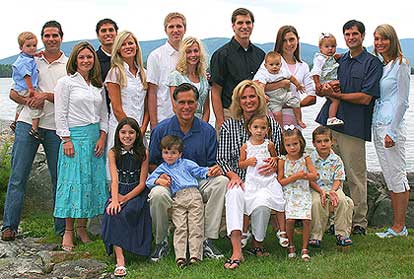 And you think ONE wife is time-consuming.

 Powered by: SoapBlox