In part of a fresh spate of conservative tendenticious ideological arguments against the stimulus, Robert Barro rehashes the same dubious WWII based analysis he used against the stimulus back in January 2009:
To realistically evaluate the stimulus, I've been using long-term U.S. macroeconomic data to estimate some key economic relationships: the effects on GDP from increased government purchases (the spending multiplier) and from increased taxes (the tax multiplier).
For spending, the main results come from fluctuations in defense outlays associated with major wars such as World War I, World War II and the Korean War. The data feature large positive values in the early stages of wars (extra spending of 26% of GDP in 1942) and large negative values in war aftermaths (27% of GDP in 1946).
Back in January 2009, Paul Krugman made severalposts (naming Barro specifically) refuting the idea of using wartime spending as a model for the effects of peacetime civilian stimulus spending. Krugman focuses on the impact of war time rationing which would have had a decisive anti-stimulative effect.
Additionally, Barro's equivalence of WWI, WWII and Korea is problematic. As this paper analyzes, Korea was funded by tax increases, not debt. War spending on Korea is even less comparable to ARRA than WWII.
Mainly though, I'd like to flog a dead hobby horse of mine by pointing out that this is a great example of the weakness of GDP/GNP as an overall metric of societal performance, wealth and health. War spending is not just as good as peaceful development spending, but GDP treats them as such.
That said, however, what is the alternative? Calculated Risk says we can do better. But can we, really?
It's not that hard to think of people who have the intellectual chops for the job of Fed chair but aren't fully part of the Borg. But it's very hard to think of people with those qualities who have any chance of actually being confirmed, or of carrying the FOMC with them even if named as chairman (which is one reason why this suggestion is crazy). Does it make sense to deny Bernanke reappointment simply in order to appoint someone who would follow the same policies?
I'm new to the obscure world of the Fed, but I don't think things are as hopeless as Paul assumes. "FOMC" is the Federal Open Markets Committee, of which the Fed Chair is just 1 vote. It is made up of the Federal Reserve Board, the President of the NY Fed and four other rotating regional Fed Bank Presidents. I'm guessing that in the Greenspan and Bernanke eras, the FOMC (and Fed Board itself) would back the Chair without fail. What if that changed?
Watching some liberal members of the House explain why they won't do what's necessary, and pass the Senate bill, I was wondering what they imagine will happen. Then the answer came to me: it's the Underpants Gnomes business plan. In its original form this was:
1. Collect underpants.
2. ?????
3. Profit!
The current version is:
1. Reject the only bill that can be enacted any time soon.
2. ?????
3. Universal coverage!
Sigh.
On the future of the issue it raises an interesting point. I think it was Ezra Klein who pointed out health care reform attempts come along I believe every 17.5 years (although maybe at the rate of things falling apart, the next chance will be sooner). But however long the time period, is the degree of how terrible the situation is regarding health care reform (number of uninsured, among other yardsticks) inversely proportional to the chance that progressives will get a better bill next time? Meaning, if you hold out and wait for things to get worse, are your chances for a better bill improved? Will a grassroots swell among the citizenry emerge in favor of single-payer, for example? Or will there be an even worse bill next time?
And how long will it actually take? On the one hand, as Chris argued here, we would have achieved a public option or Medicare buy-in had a few Senators not lied. So it is only a matter of ridding ourselves of a few bad apples to achieve an acceptable bill to those in the House currently refusing to support it. But you also need a supportive President and similar or better congressional majorities, and how long that takes, given that a shellacking appears likely this November, is anyone's guess. Alignment of all those stars is difficult.
Given all that, it seems to me the central point here is that the crystal ball is hazy, and you never know how long it will take to get the political dynamics all aligned again to take another shot. I can't find the comment link, but one of the strongest arguments I've seen in favor of passing the bill was by Mark Matson (who can correct me if I'm not paraphasing correctly) which is that if the bill became law in the future, no one would want to go back to the health care situation this country had in 2009. Given that the political future is hazy on when we'll get another shot, that seems worth keeping in mind as members of Congress consider whether it's worth banking on another shot in the future.
Paul Krugman has been thinking deep meta-thoughts about deep meta-theories, and his foundational analysis of evolutionary biology has been chronicled on a New York Times blog devoted to similar issues.
Krugman celebrates the factuality of biological research, and encourages old-media economists to gather much, much more data from the internet, where graduate students in economics can "download securities prices from Bloomberg and see how blue skies and rain affect the behavior of financial markets." The blog's curator indulges Krugman's fantasy in a made-to-order universe where we can "brutally confront theory with data."
Obviously both of those hyper-intelligent individuals could avoid this sort of "abuse of language" at the price of tedious qualifications which would quickly overburden their readership and leave them talking into a vacuum, and nobody wants that, but nevertheless it may not be entirely out of place to wonder exactly how tedious those qualifications would have to be.
Unfortunately for all of us, the qualifications are endless, and we will never ever "see" a connection between cause and effect, neither on the Bloomberg ticker or even in a physics lab, where visual and conceptual "metaphors" are respectably anchored in standard procedures, but inevitably dissolve into the fog of quantum mechanics before anybody "sees" anything.
So what?
Everybody already knows that data only really "confront" the bleary eyes of weary lab assistants, and what's the harm in a little convenient shorthand for what everybody already knows? Without it no finite person could ever enunciate any kind of theory, economic or physical.
The harm is payrolls shrinking by hundreds of thousands of jobs month after month, and almost every relevant article in the New York Times winding up with a professor of economics somewhere "seeing" light at the end of the tunnel. Happy days are (almost) here again!
Meanwhile simple alternatives to watching this mess get worse, like hiring the unemployed for massive public-works projects which our disintegrating infrastructure absolutely requires anyway, get lost in a fog of Keynesian stimuli or Chicago laissez-aller, and outright destitution is now confronting millions of Americans more brutally than mere data will ever confront anything.
Obama's stimulus was a bastardization of Keynesian deficit spending and Friedman-esque tax cuts, a grab-bag of almost all contemporary economic theories, and only the eyes of faith can "see" much in the way of results, but the same $700 billion package could have employed 6,000,000 people at $3000 per month tax-free for about 40 months, with no theoretical framework whatsoever except giving jobs to the jobless, and if our moribund economy still didn't have a pulse after 40 months, at least tax-payers would have had some brand new bridges and thousands of windmills to show for their money, and 6,000,000 people would have also earned a living for what promises to be three lean, mean years.
But instead we got theories, and "abuse of language."
My friend Paul Krugman (hey, he linked to me, I can pretend) posts this chart from Emmanuel Saez, which shows that in 2007 the top 0.01% of income earners in America took home 6% of the national income.
Let's get some scale here. In 2007 there were 301M people in America, which gives us 30,100 people in that top 0.01%. CIA Factbook says US GDP for 2007 was $14.11T in PPP US dollars. 6% of that is $846B. So the top 0.01% averaged $28 million dollars in income, each. Wow. That isn't quite correct since Saez is actually using "tax units" rather than people for his top 0.01% so this might only represent 12-15K actual IRS tax returns, and you probably can't divide GDP quite that neatly, but we're still talking about a tiny number of people taking an inordinate piece of the pie.
Following Krugman's link to Saez, I found this chart (which I snazzified):
Note this is now the top 0.1% (vice top 0.01% in Krugman's post). Check out the blue (the bottom chunk for the colourblind). That's employment income. Contrast the share of their income that salary made up between the classic gilded age (c1929) and the modern one, and see how much bigger a share is coming from salary (and bonus). Otherwhere in the data (fig4) Saez gives you the percentages of each category of income for the top 0.1%, where you can learn that in 1929, captial gains made up about 65% of the income of the top 0.1ers, and employment income was 20%. Skip to 2007, and employment now makes up almost 50%, with capital gains down at 20% (remainder is something called "entrepreneurial income" for which I can't locate a definition).
I post this because we are regularly exposed to anecdotal stories of how much this or that CEO makes, or some trader's obscene bonus, but it is important to have some data that shows this is a real phenomenon and not just a few isolated exceptions blown out of proportion. It turns out that $70 million here and $16 billion there and pretty soon you're talking about real money. Upper management in America's corporations really are emptying the till like never before.
According to Paul Krugman, that's the unofficial rallying cry of the conservative opposition to health care reform. Across the country, much of the oxygen in the debate is sucked up by the tragic irony of Medicare recipients speaking out against a government takeover of health care. If the misinformation swamps our chances of overhauling the system, it will be an unmitigated disaster.
Yet it's only the most vivid example of how too many Americans are blinded by anti-government ideology to the basic facts of how the nation's economic and political system functions. And nobody says it better than Krugman. In his column on Monday, the economist pointed out that the very "government meddling" denounced on the right appears to have saved the economy from the worst of the economic crisis. Yet as Krugman has argued in the past, we could potentially be in much better economic shape than we are today - with hundreds of thousand fewer people out of work, for example - if we had disregarded calls to limit the size of "government meddling" and enacted a larger and more effective stimulus in the first place.
This ain't just about Paul Krugman, perceptive though I think he is. Nor is it simply about the big national debates on health care and economy. Again and again, good, even necessary public policy smacks up against public ignorance about the way government is already deeply and intrinsically involved in structuring markets that are made to appear "free" of interference. Clear-eyed libertarians can argue that we'd be better off with a self-sustaining, self-regulating free market. The distortion comes in when we imagine that unobstructed free markets brought us the benefits we enjoy today.
Consider a point John Petro illustrated a few weeks back, in which investing in mass transit and changing land use policies gets painted as intolerable government coercion. In effect, spending public money to extend new roads, new sewer lines, new electric wiring and emergency services to areas on the exurban fringe is invisible, but public investment in light rail shows the long arm of big government. Similarly when a municipality makes a zoning ordinance that permits only large lots with single family homes in a given area, that's the free market. If zoning regulations are altered to permit condos or mixed-use buildings, suddenly the government has "interfered."
When I saw that Michelle Malkin will be on the Stephanopoulos panel this week, my first thought was that nobody as far to the left as she is to the right would ever appear on such a panel. But then I started to wonder (a) what I mean by that (b) if it's true.
I don't want to be like Bill O'Reilly, who considers anyone he disagrees with a "far-left" activist. So we need some objective metric. The most natural would seem to be voter opinion: what fraction of the American public is to Malkin's right? Would somebody with an equally small number of people to his or her left get on a Sunday morning panel?
Krugman went on to specify even more stringently:
The trouble, of course, is how to measure that. In principle, it shouldn't be hard. What I'd like to have is a Guttman scale of positions on political matters, such that almost everyone who gave the "liberal" answer to question 7 also gave liberal answers to questions 1-6, while almost everyone who gave the conservative answer to question 7 also gave conservative answers to questions 8-13.
In fact, a Guttman scale is pretty much impossible, even if you're going to define ideology so narrowly that it misses much of what you want to capture. There are multiple reasons why this can't be done. First off, a lot of people have only the foggiest notion of ideology, and their policy positions are a complete mish-mash. (Demanding that the government keep its hands off Medicare is just the tip of a very large iceberg.) Second, there really is a significant diversion between economic liberalism in a New Deal sense and social liberalism, in a feminist, pro-gay, pro-diversity sense. Third, even within more narrow issue scales people often don't line up in Guttman scale order.
In short, the concept of "ideology" in American politics is inherently too fuzzy to fulfill Krugman's desire for a Guttman scale. But that hardly means we can't do better than Bill O'Reilly. We just have to accept the fact that we're measuring something messy. But we can still make some headway. A couple of posts at The Monkey Cage tried to respond to Krugman, and I'd like to use one of them as a good jumping-off point for talking about some of the complexities involved.
John Sides came up with the following chart as a "lazy bloggers" solution:
It uses three questions from 2008 American National Election Study, which are economically ideological in nature. Unfortunately, there's a very old finding of public opinion research that tells us this picture is incomplete.... (More charts on the flip.)
I quit practicing medicine in 2003 at the age of 43. Burned out. Like most doctors I went into medicine with a lot of idealism. The first half of my medical career was in the Army (they paid for my medical education). The second half was in private practice.
In the Army system, a single payer system, I was free to focus my attention on patient care, as were my colleagues. Conversations between doctors revolved around the latest medical research on how to best care for our patients. I never thought about how much money a particular treatment option for a patient would earn for me - I was paid a salary and it was the same no matter what treatment options I chose. I never had to deal with getting an insurance company to pay me for my medical services after I had already given them. I never had to argue with an insurance company after they denied my treatment plan for a patient as "medically unnecessary."
In private practice I was horrified to see how money was the driving force behind everything doctors did (do). Doctors talked with each other about opening their own specialty clinics to capture fees that had previously gone to hospitals. Over the years the discussions at medical conferences began to devote less time to the science behind new innovations and more time to teaching doctors how to make money with the new innovations.
It's bad enough to be jobless for a few weeks; it's much worse being unemployed for months or years. Yet that's exactly what will happen to millions of Americans if the average forecast is right -- which means that many of the unemployed will lose their savings, their homes and more. To head off this outcome -- and remember, this isn't what economic Cassandras are saying; it's the forecasting consensus -- we'd need to get another round of fiscal stimulus under way very soon. But neither Congress nor, alas, the Obama administration is showing any inclination to act.
Not much about macro-economics is obvious, and even mathematical economists who subscribe to exactly the same sub-division of economic ideology can radically disagree about factors as fundamental as the fiscal multiplier.
Likewise even the definitions of terms like "unemployment" are so complicated and indefinitely qualified that even the most official of all official measures of unemployment by the Bureau of Labor Statistics is immediately fractured into six "alternative measures of labor underutilization," and there wouldn't be much hope for the average person to understand anything about the statistical measures of unemployment if all those different indicators weren't moving in exactly the same direction.
Zoom!
One of many unpleasant aspects of depression and recession economics is what you might call a snowball effect, and as more and more people lose jobs, the salesmen who formerly sold them boats goes under, and then the worker who built the boats, and so on.
Prescriptions for dealing with similar phenomena have been incorporated into the folk-wisdom of all times and places, in the form of nostrums like "an ounce of prevention is worth a pound of cure" and "a stitch in time saves nine," but American political economics possesses a peculiar un-wisdom of its own, and although one or two "stitches in time" could have prevented the whole mess ten years ago when Brooksley Born was ringing alarms all over Washington, and Larry Summers was making sure nobody listened, now the same little snowball which Ms. Born detected in its very beginnings has doubled its snow-mass again and again and again and turned into a regular avalanche.
But not every avalanche is a roaring monster consuming skiers and chalets and tiny Swiss villages on its way to the bottom of the mountain, because mountainsides all over the world are terraced with avalanche-fences to stop little avalanches before they grow, and almost every avalanche-fence in the world is located somewhere between the top of a slope and the middle, because by the time an avalanche gets anywhere near the bottom of a mountain, you need something more like the Great Wall of China than any kind of fence to stop it.
This is a picturesque translation of the arguments Paul Krugman and Joseph Stiglitz and Dean Baker and many other honest economists made for applying a realistic stimulus to the American economy before our current recession/depression developed too much momentum, but instead we got a feeble and slow-motion stimulus full of tax-cuts, like a rickety fence that wouldn't even stop a rabbit, much less an avalanche, and the American economy is still bleeding ten or fifteen or twenty thousand jobs every day.
Two weeks ago, I wrote a diary, "The Recovery Myth", warning about the risks of ignoring longer-term economic prospects for short term upticks. This diary continues that theme (and is fully in tune with Mike's recent diary, "We Need a Jobs Package, Not a Stimulus Package").
A rising tide of voices are warning that optimism over a coming recovery--the promise of "green shoots"--is looking increasingly questionable. Typical of these are Dean Baker's "The Green Shoots Are Dead", hence my diary title. The subhead to his article explains:
The latest jobless figures show America's economy is stuck in the doldrums. The US urgently needs a new stimulus injection
Krugman argues along similar lines in his July 9 column, "The Stimulus Trap"
As soon as the Obama administration-in-waiting announced its stimulus plan - this was before Inauguration Day - some of us worried that the plan would prove inadequate. And we also worried that it might be hard, as a political matter, to come back for another round.
Unfortunately, those worries have proved justified. The bad employment report for June made it clear that the stimulus was, indeed, too small. But it also damaged the credibility of the administration's economic stewardship. There's now a real risk that President Obama will find himself caught in a political-economic trap.
But Robert Reich is even more pessimistic, as noted by William Timberman in Quick hits. Reich writes:
When Will The Recovery Begin? Never.
The so-called "green shoots" of recovery are turning brown in the scorching summer sun. In fact, the whole debate about when and how a recovery will begin is wrongly framed....
In a recession this deep, recovery doesn't depend on investors. It depends on consumers who, after all, are 70 percent of the U.S. economy. And this time consumers got really whacked. Until consumers start spending again, you can forget any recovery....
This economy can't get back on track because the track we were on for years -- featuring flat or declining median wages, mounting consumer debt, and widening insecurity, not to mention increasing carbon in the atmosphere -- simply cannot be sustained.
Meanwhile, Bonddad is on a counter-contrarian kick at DKos, writing "The Economic Free Fall is Over", which I believe is instructively mistaken. It's true in one sense, but it misses the point in a larger one (after all, FDR reversed the downward plunge of the GDP within his first two years, but unemployment remained crushing until WWII came along). More on all of these viewpoints--and more viewpoints as well--on the flip.
I have been in the battling-the-rich-and-powerful-on-behalf-of-the-poor-and-middle- income business for a very long time now (almost 30 years), and it can get pretty discouraging at times. For one thing, in some news that I am sure will be shattering to you, the rich and powerful have a lot more money. And they have seemed to have a lot more political friends over that era than do the poor and the middle income folks combined.
But hope rises anew from time to time, and there are encouraging signs. The most obvious one, of course, is that we have a President and both houses of Congress led by center-left politicians who will be with the poor and middle income quite a bit more than their predecessors in the Bush White House and the Republican led Congress - not always, of course, but more than the last set of politicians. But my hopes are rising for a lot less visible reasons than that.
More on what those reasons on in the extended entry.
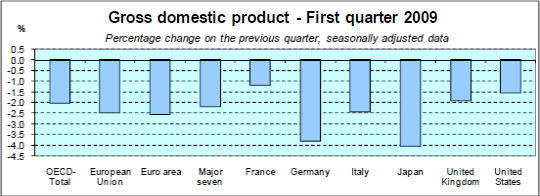
Amidst a recent upsurge of happy talk about economic "green shoots," the Organization for Economic Cooperation and Development (OECD) released a sober reminder this week in the form of its Quarterly National Accounts figures (pdf) showing that the global recession deepened in the first quarter, while the New York Review of Books published a forum, "The Crisis and How to Deal with It" with Bill Bradley, Niall Ferguson, Paul Krugman, Nouriel Roubini, George Soros, and Robin Wells. It was from an April 30 panel discussion, but things have not improved so much as to render it outdated. Indeed, Huffington Post just published a followup report on the "American families" featured in his 30-minute campaign ad. They've yet to see any real help from his presidency. And while they are still patient and trusting towards him, the collective picture is not encouraging.
OECD first:
Gross domestic product (GDP) in the OECD area fell by 2.1% in the first quarter of 2009, the largest fall since OECD records began in 1960, according to preliminary estimates, and followed a fall of 2.0% of GDP in the previous quarter.
In the United States GDP fell by 1.6% in the first quarter of 2009, the same rate as in the previous quarter. Japan's GDP declined by 4.0%, following a 3.8% decrease in the previous quarter. GDP in the euro area was down 2.5%, following a 1.6% fall in the previous quarter.
Of the Major Seven* countries, only in France, where GDP fell 1.2%, did the rate of contraction ease in the first quarter.
Compared with the same quarter a year earlier, all the Major Seven* economies recorded a fall in GDP, and a marked deterioration on the previous quarter's year-on-year figures.
The United States contributed 0.9% to the total OECD fall of 4.2% between the first quarter of 2008 and the first quarter of 2009. Japan contributed 1.0%, the euro area (13 countries) 1.3%, and the remaining countries 1.0%.
* "Major Seven" and other groups of countries defined at end of diary.
I was reading Paul Krugman's column the other day and was dismayed by his argument. According to the Nobel Prize-winning economist and New York Times columnist, a half-ass, half-hearted measure on curbing carbon emissions is better than doing nothing, but I'm unconvinced. As written in The Washington Post:
On paper, the Waxman-Markey bill puts a cost on carbon dioxide by imposing a ceiling, or cap, on greenhouse gas emissions and then setting up a market for regulated industries -- such as the electric power sector -- to buy and sell allowances to pollute under that cap. As the cap is reduced each year, market participants will exchange allowances in a complex auction market.
If you liked what credit default swaps did to our economy, you're going to love cap-and-trade. Just read Title VIII of the bill, which lets investment banks, hedge funds and other speculators participate in the cap-and-trade market. They don't have emissions to cut; they have commissions to make.
The real hidden catch of the cap-and-trade system, though, is that it will require consumers to pay twice: first for emission allowances and then for the construction of new low- and zero-carbon power plants.
That doesn't sound very good, and the bad news gets progressively worse.
Contrary to assurances from the bill's sponsors that utility customers wouldn't have to pay these costs for the first decade, some coal-dependent utilities would be forced to purchase more than half of their allowances when the program is scheduled to begin in 2012. Would these allowances reduce our greenhouse gas emissions? No; that would come when consumers footed a second bill - for the cost of their utilities either to retrofit coal and gas plants to capture carbon - something that cannot be done today on a commercial scale - or to shut them down and build non-carbon-producing nuclear plants and wind farms instead.
When Paul Krugman's posted "The Defining Moment" on his blog April 24, the title was significantly more comprehensive than he probably intended, and while it defined the moment that defined the New York Times and the rest of the mainstream media in the United States, and it also defined Paul Krugman as a prestigious but essentially conformist contributor to the same self-prostituted hodge-podge of buzz-words and propaganda.
Almost nobody that anybody ever heard of stood up against the invasion of Iraq and the ridiculous "evidence" which was supposed to justify it... "And the question was, should you stand up against that? Not many did -- and those who did were treated as if they were crazy."
And now Paul Krugman says "I'll never trust "sensible" opinion again."
"Sensible" opinion?
What the heck are those "scare quotes" supposed to mean?
Rutabaga Ridgepole speculated about that peculiar phrase in a comment on Professor Krugman's blog...
Paul Krugman says "I'll never trust "sensible" opinion again," and here "sensible" either means "mainstream," or nothing.
The usual meaning of "sensible" as "indicative of good sense" obviously doesn't apply to arguments for invading Iraq based on transparently false allegations. Any possible connection with "common sense" is also inappropriate, where the sort of evidence which common sense can judge never appeared.
So Professor Krugman can only mean that he will never trust mainstream opinion again, but because he writes for a mainstream newspaper, and wants to continue in his current venue, he can't say that he will never trust mainstream opinion again, because that would make him "crazy," that would make him a freak, and he would inevitably disappear from the New York Times, because the New York Times doesn't publish freaks.
Rootie's comment has been "awaiting moderation" on Professor Krugman's blog for the last 36 hours, and it's obviously destined to wait there forever, but the intellectual standard of comments which were already approved by the moderator isn't exactly overwhelming...
"Yes, yes, yes. And today's column was one of your best," is mab's complete comment, and that comment was posted within 15 minutes after mab composed it.
So Paul Krugman defined himself as one of the un-crazy non-freaky insiders with columns in the mainstream media and endowed professorships in the Ivy League, and although those "sensible" professors may have uttered a few modest chirps about the really crazy bullshit that took us into Iraq, they didn't get shrill about it, and the few tiny ripples that they made disappeared in the tidal wave of approval by the New York Times and the Washington Post and dozens of Ivy-League graduates in the administration of George W. Bush, like Douglas Feith (Harvard magna cum laude 1975), Paul Wolfowitz (Cornell 1965), John Ashcroft (Yale 1964), and George W. Bush himself (Yale 1968).
But when the time came to expose that tidal wave of bullshit, the Ivy League was "sensible" instead of sensible, and the New York Times was "sensible" instead of sensible, and before you could find a common-sense exposé of all those lies, you had to get freaky, and travel so far out on the spectrum of freaky that you might even meet... a talking rutabaga.
For the last week or so there has been a faint drumbeat of positive economic news. Consumer confidence ticked slightly higher in March, new home sales actually increased in February, durable goods orders have increased, inventories declined, and stocks rallied. Certain "market watchers" have told us to jump back into the stock market, the media is reporting signs of "economic hope", and Ben Bernanke talked about the economy's "green shoots", prompting an online debate about recovery hosted by The New York Times.
The response to this rather superficial positive news - after all, foreclosure activity increased again in February and the unemployment rate rose to 8.5% - was necessarily swift. Paul Krugman pointed to an increase in industrial production in 1931; Tyler Cowen warned about "suckers' rallies" and what will happen when Bernanke is eventually forced to hike interest rates; the new Baseline Scenario holds that "The one positive sign is that some forecasters are beginning to recognize that growth in 2010 is not a foregone conclusion"; at Vox EU economists plotted frightening graphs showing how the global downturn is in some ways worse than the Great Depression; and a gargantuan op-ed in the Wall Street Journal on Monday very chillingly sourced both the Great Depression and the current economic collapse to a consumer debt crash. In sum, the economic picture became worse for its comparison to the titillating glimmers of economic rebound.