Nora Eisenberg, whose excellent novel about veterans returning from the Gulf War, When You Come Home, will soon be reviewed on this site, recently penned a piece for Alternet on the lost lessons hidden in the way the Gulf Was has been remembered.
We highly recommend it -- as our Reading Liberally "Read of the Day" -- and will bring you more on her novel soon.
With rare exceptions, American politicians seem incapable of opposing an American war without befriending another in a different place or time.
Barack Obama, an early and ardent enemy of the Iraq War, quickly declared his affinity for a war in Afghanistan and/or Pakistan. And like so many Democratic leaders, he has commended Bush 41's Gulf War over Bush 43's, for its justifiable cause, clear goals, quick execution and admirable leadership.
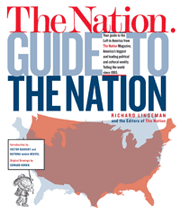
Do you know the Democracy Burlesque in Chicago? Or the best food co-op in Nebraska? What about the lefty cafe of Salt Lake City...or that same town's unique vegan S&M; gear?
Chances are that unless you live in one of those town's, you don't (and even if you live there, you may not); fortunately, The Nation Magazine has found them for you.
In The Nation Guide to the Nation, you can find the cafes, film festivals, historical hotspots, a bleeding-heart romantic hide-aways that dot the "purple" landscape of America.
It's not a book you sit down and read straight through. But it's a thick volume that welcomes you to thumb to almost any page and smile with surprise. It's the kind of guide that may help settle a bet after a night of too much liberal drinking ("I told you that there were liberal oases in Idaho!").
And it's especially the book you'll turn to as you plan your travel around the country -- because you'll find new destinations in any state you plan to visit, sites that will amuse, educate, and generally make you feel like Liberal America is everywhere...and that you are part of it.
The book isn't complete -- it can't be. It doesn't list my favorite liberal dive...but that's part of the fun. If the book can start an conflict among friends as to which historical homes should really be included on a drive along Route 66, or which films should never have been left off a top-ten progressive movie buff's list, then the book will prove itself a true lefty institution: one that gets liberals arguing with each other.
As for my favorite listing: well, it has to be the New Belgian Brewing Company in Fort Collins, Colorado. The maker of Fat Tire runs its brewery on wind-generated energy. That's Drinking Liberally...
For more from the guides behind the Guide, check out the video below.
(We're honored that Nora Eisenberg, longtime friend of Living Liberally, award-winning novelist, and author of the soon to be published When You Come Home (Curbstone Press), the first American novel about the 1991 Gulf War and Gulf War illness, has allowed us to publish this special Veteran's Day post.)
What does a war injury look like? In the case of Iraq, we tend to picture veterans bravely getting on with their lives with the help of steel legs or computerised limbs. Trauma injuries are certainly the most visible of health problems - the ones that grab our attention. A campaign ad for congressman Tom Udall featured an Iraq war veteran who had survived a shot to his head. Speaking through the computer that now substitutes for his voice, Sergeant Erik Schei extols the top-notch care that saved his life.
As politicians argue about healthcare for veterans, it is generally people like Sgt Schei that they have in mind, men and women torn apart by a bullet or bomb. And of course, these Iraq war veterans must receive the best care available for such complex and catastrophic injuries.
My parents kind of get what I do. They have a sense of what blogs are and how they interact with the larger world of politics, though they don't read blogs (and definitely don't have user accounts). They have a sense, gleaned from the occasional New York Times article or conversation with one of my peers, that technology is tearing down barriers. But they probably haven't heard or used the term "gatekeeper" very often.
So Markos, thank you for writing a book for them.
Markos's new work, Taking On the System, is an exploration of how all of us have just been handed power...if we decide to grab hold. We can change media narrative by becoming our own media through blogging. We can become our own campaigns with simple cameras and free video hosting sites.
And it's not just in politics. Markos quite consciously weaves stories of other industries, most notably the music business, among his anecdotes from Senate campaigns, the anti-war movement, immigration rallies and other political efforts. In doing so, he creates an argument that doesn't just appeal to the political junkie but to anyone who wants to understand entrepreneurship, idea-generation and anti-authoritarianism in the digital era. He also does it in a well-written, fun, and at-times inspirational style that is full of examples and lessons, which are helpfully broken down into "rules."
My parents will understand the progressive movement -- and these times -- much better when they read it.
But it's not only aimed at the newcomer to these discussions.
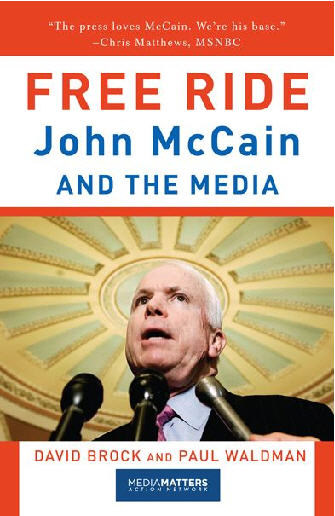
Ever wonder how McCain got where he is? Why after all the flip-flops, the slip-ups, and the just flat-out-inappropriate jokes, McCain continues to credibly crawl toward the White House? If so, then Free Ride: John McCain and the Media proves to be indispensable reading (not to mention that it is one of the two books that will be discussed at next Tuesday's first-ever meeting of Reading Liberally NYC!).
To say that Matthew Yglesias's new book, Heads in the Sand will single-bookedly save the Democratic party is a slight overstatement. It does, however, provide what may be one the most important tools democrats can use to win in 2008 and govern in the years to come: a coherent, intelligent and aggressive liberal policy on National Security.
HITS is a book that, for starters, takes the issue of National Security seriously. Unlike many liberal thinkers and politicians of the past decade, Yglesias argues that National Security is an issue of prime importance to the Democratic Party and to America. It cannot be sidestepped in favor of domestic issues, that democrats are traditionally more comfortable with. The few democrats who do address National Security, Yglesias's "Liberal Hawks," only do so in a way that reinforces the failed Bush doctrine of militaristic nationalism, even if they disagree with his specific policies.
Yglesias asserts that since Bush took office, a National Security/ Foreign Policy ideal of using American military force to unilaterally rid the world of its evils had . Since 9/11, the face of this evil has been terrorism. Bush's War on Terror operates on the wrong assumption that you can combat a transnational villain, such as Al-Qaeda, by attacking national entities, like Iraq, and can do so through the pure might of American power. Bush's view was also faulty because it saw terrorism as an expression of "Freedom-Haters," who abhorred the American way of life, instead of as a specific reaction to specific actions taken by the United States and other countries, an idea espoused by many well-established intelligence and military organizations.
Democrats, Yglesias adds, have recently been holding more consistently anti-war positions, but have yet to attack the flawed ideological underpinnings of the Bush foreign policy nor have the provided an affirmative alternative policy. Matthew Yglesias to the rescue!
The key thesis of HITS is that instead of treating organizations like the UN as a shackle that confines and restricts American interests, the United States should focus on aggressively strengthening these kinds of organizations to create a "liberal world order", governed by laws, that could in part act as an international police force, more able to effectively confront transnational criminals than a single national army could. Thus, instead of America being the world's police department, America would become the Commissioner of a larger international police force, that would protect human lives and human rights.
Hooray! The Progressive Book Club is here! And in the next few days, I will receive three books -- including Cliff Schecter's "The Real McCain" -- for $1 each!
What might sound like a scheme on par with the treasure of deposed African dictators or a "Buy Now!" infomercial is actually a welcome and much-anticipated new cog in the growing progressive infrastructure: an organization that supports liberal authors and publishers, serves left-leaning literates, and rivals one of the right-wing's important tools.
Reading Liberally Page Turner
by Amanda Milstein, Living Liberally
(A quick word before you read on - the review below is the last in-house work by Amanda Milstein, our incredible winter intern and indispensable partner for the last several months. While we doubt this is the last you'll see of her work on Open Left, we want to wish her the best as she heads off to get a master's degree in public policy, including a stint at a think-tank this summer. Thanks, Amanda!)
Ray Bourhis, author of Insult to Injury, is an angry man. He has good reason to be-he is a lawyer that has spent much of his career attempting to get insurance companies to pay disabled people the money that they are owed, and has seen his efforts been thwarted again and again-and seen lives of many of his clients disintegrate as a result.
Bourhis describes the travails of people like Dr. Stuart Gluck, who had three disability insurance policies. He was diagnosed with HIV and also had a nervous system disorder ad triple coronary bypass surgery, sustained brain damage as a result of surgery-this was clearly a man who couldn't work anymore. UnumProvident, his insurance company, decided that despite all of this he should still be employed and they even threatened to demand some of the money they had already paid him back.
Reading Liberally Page Turner
by Amanda Milstein, Living Liberally
I was being interviewed by a radio station about a snarky article I'd written for a paper-and-ink (and also online) magazine, and they referred to me as "journalist Amanda Milstein." This struck me as clearly false (although far be it from me to argue with them, given it sounds better than "part-time job-holding, part-time interning, soon-to-be grad student Amanda Milstein") - and it looks like I'm not the only one who thinks so. One of the arguments made by Clay Shirkey in his new book Here Comes Everybody (which Matt mentioned here yesterday ) is that the title "journalist" is increasingly meaningless when anyone can write a blog post about an issue and publish it - and even if they are blogging about an issue as trivial as a lost phone, it is possible for them to get a large audience.
Shirky begins by describing a Gutenberg-era pamphlet written in defense of scribes, whose jobs were being taken over by the printing press. The pro-scribe argument was printed off on a printing press for maximum efficiency - it's always bad if your chief defender can't even be bothered to use your services. All much like how my childhood best friend's instant messenger screenname was something like luddite77; if you're bothering to have a screenname, you're clearly not devoting yourself to smashing machines.
Reading Liberally Page Turner
by Amanda Milstein, Living Liberally
Today the House Committee on Oversight and Government Reform is holding a hearing about the catastrophe that is Abstinence-Only Education. In honor of that, I am reviewing Bonk: The Curious Coupling of Science and Sex, by Mary Roach, while filled with hope (OK, I am way too cynical to be filled with anything that even remotely resembles hope) that, in the future, science and sex will be more closely linked in classrooms around the United States.
"Since when did Science become a liberal issue?" a comic asked at last week's Laughing Liberally in NYC. I would guess that that occurred sometime between when Galileo got in trouble with the church and the Scopes Trial. But now the truth is oddly liberal, so I hereby claim Bonk for liberals and those with a high threshold for the somewhat alarming.
Reading Liberally Page Turner
by Amanda Milstein, Living Liberally
There's very little to say about Abortion Without Apology: A Radical History for the 1990s that isn't actively nauseating. Between a step by step guide to how to fill a vagina with blood and bits from a cow's liver in order to get a hospital to perform a D&C;, and realizing that the dreams of the initial pro-choice activists would never be filled, the whole book was somewhat distressing.
The book talks about the three women who gave birth to the organization that eventually became NARAL and their impetus for becoming abortion activists. One of them married at 15 because of her family's extreme poverty, was told she would probably die if she gave birth to a second child, and then wasn't given information about or access to birth control.
I went to sit in on a class at a Public Policy program that I might attend next year, and decided to do the assigned reading, as I find few things to be duller than sitting in on a class when I have no idea what is going on (also I wanted to procrastinate doing my calculus homework). The book for the class was Understanding Affirmative Action by J. Edward Kellough, which is not only a clear guide to legal cases that have dealt with affirmative action, but also an excellent size to whap people with should they persist in not agreeing with your affirmative action views, whatever those may be.
Reading Liberally Page Turner
by Amanda Milstein, Living Liberally
When I was a small child, my father, who often votes for Republicans, was explaining to me the difference between Democrats and Republicans. "Republicans want you to keep the money you worked for, and Democrats will take it from you and give it to people who never worked a day in their lives and make you live on the side of the road in a cardboard box. Mommy votes for Democrats - why don't you ask her why she wants you to live in a cardboard box?"
Thankfully I developed a slightly more nuanced view of the American political system. For those who still believe my father, Myth of the Welfare Queen, by David Zucchino, the story of two welfare mothers who are doing anything but living the high life, comes to the rescue by providing a detailed look at the lives of welfare mothers during the Clinton administration.
Reading Liberally Page Turner
by Amanda Milstein, Living Liberally
A friend said Hi to me on the subway while I was reading Prison Profiteers, an anthology of shocking articles about the privatization of prisons edited by Tara Herivel and Paul Wright. I had to send him an e-mail explaining that if I had looked like I was about to throw up it was not because of him, but rather because I was totally and utterly disgusted by the account I was reading about medical conditions going untreated in prisons managed by private corporations.
The paragraph I was reading when my friend saw me was about the medical neglect of a 57 year old man who was imprisoned for rape:
Bernie Horn, the author of Framing The Future will be appearing at the DC chapter of Drinking Liberally on Thursday, February 21 - discussion and book signing begin at 7:30 pm at Timberlake's Restaurant is located at 1726 Connecticut Ave NW (Dupont Circle Metro). For those in the Denver area, our local Reading Liberally chapter will meet with Bernie in the back room at Forest Room 5, 2532 15th St, just west of I25, starting at 6pm.
I understand how Bernie Horn’s Framing the Future (Berret Koehler Publishers, 2008) could be mistaken for a dozen or so other books on progressive framing. While it’s true that Lakoff’s books, or What’s the Matter with Kansas, are of the same general milieu, I would approach Framing the Future in different terms.
Imagine for a moment you are one of a community of survivors after a devastating catastrophe. A once great civilization lies in partial ruins. In its capital city boulders obscure the ceremonial fountains, flooding has overtaken the main streets and boulevards, the museums and galleries are looted. Where once sat cafes now is rubble.

 STATE BLOGS



 Powered by: SoapBlox