Did you think they were doing a pretty good job? Well think again. All you have to do is look at the following Resolution that is making the rounds of Republicans called "RNC RESOLUTION ON FINANCIAL SUPPORT OF CANDIDATES," and you'll see why they have only begun to place the gun to their collective foot:
The problem of tossing around the notion of Reagan winning a realigning election popped up again this week in the discussion thread of Chris's Monday diary, "Wall Street Bailout Thwarting Democratic Realignment", and so I decided it was time to take another solid whack at it, something to bookmark, perhaps. Which is why I'm going to give you some picture first, and then explain what they mean.
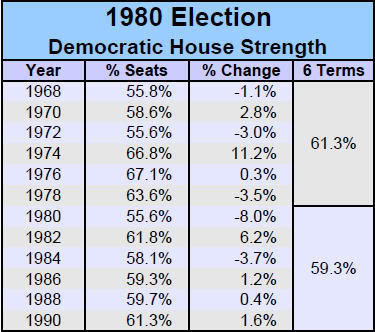
First, here's Reagan's election in 1980, along with averages of Democratic House share for 6 elections before that, and six elections from 1980 on. You will note that there is very little difference between the averages.
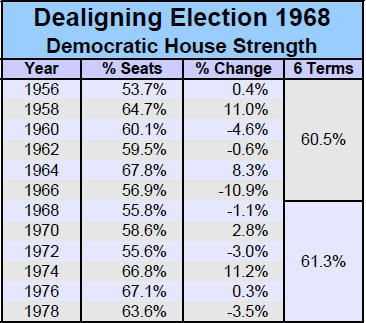
Next, here's the same thing, with Nixon's election in 1968--the de-aligning election that kicked off the Sixth Party System, the only party system in which divided government is the rule, not the exception. You will note that again there is very little difference between the averages:
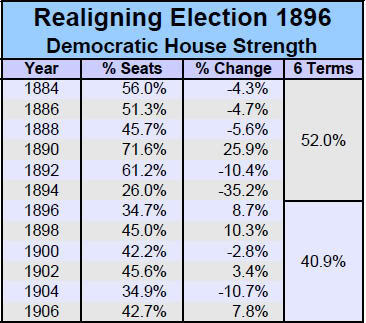
Finally, here's an example of what a true realigning election looks like--in fact, the weakest example of one using this particular tool. The difference between averages is just over eleven points (for other realigning elections it's roughly 20-25 points):
That's step one in the demonstration to be explained below, showing quite clearly that Reagan did not win a realigning election.
Once the health care fight is over, the next big fight is the battle over financial regulation. As challenging and frustrating as healthcare has been, at least reformers have been in the game in terms of a decent bill. The odds have never been even, but a decent bill, in my view, is a possible ending. With the financial regulation fight, the odds are much tougher because the Wall Street lobby is so powerful, and the forces on the other side are still relatively weak, and the Obama proposals overall are a weaker starting place than in health care. As important as it is, though, the financial regulations fight is only a pre-cursor to the massive economic policy debates that we will be engaging in for the next four years. These fights are symbolized by a phrase that the President and his economic advisors repeat too often, a phrase that is both politically tone deaf and potentially indicative of a much deeper problem in their thinking. It's the phrase, "jobs are a lagging indicator" of our recovery. I worry less that they say it, though, and more that they might actually believe it.
That "jobs are a lagging indicator" thing is a phrase that conservative economists (which is most of them) like to use because in their neo-classical economic models about recessions and financial crises, first the bankers regain confidence and their economic health, then they start loaning to businesses again, then businesses get healthy - and finally at the end of the happy cycle - they start hiring workers again. Of course, as the brilliant Paul Krugman piece on the economics profession in the NYT magazine pointed out, many of the same economists said both a real estate bubble and a financial panic were actually impossible because they didn't correspond to their free-market-cures-all-problems-and-provides-perfect-equilibrium models.
If the basic ideas behind the jobs being a lagging indicator phrase sound vaguely familiar, it's because they are essentially another version of the trickle-down economics we have been hearing for years from the two Presidents Bush and President Reagan: give those rich people and corporate CEOs more money, and it will eventually trickle down to the rest. There are a great many problems with this theory, but they can be summed up rather simply with the fact: pretty much nothing ever trickles down. In all the years of the Reagan and Bush presidencies, 20 years in all, the income of middle class workers stagnated (or worse), while the income of the rich skyrocketed.
So now we see one article after another on the economy reporting some version of the news that banks have recovered, businesses are starting to do better, but workers are getting left behind. You can grab any article on the economy at random written over the last couple of months, and find the same kind of quote, such as this one from a WP article from September 1st: "The emerging economic recovery suffers from a great contradiction: Even as factories seem to be cranking out more stuff, the job market remains terrible."
Now I am not suggesting that Obama's economic philosophy is the same as the right-wing Republican trickle-down philosophy of Reagan and the Bush kin. There are lots of things to like about what he has done and proposed so far. The stimulus was classically liberal Keynesian, with hundreds of billions in job-creating public capital investments, and it is clearly helping prop up the economy right now. Even the tax cuts that were included in the stimulus bill were considerably more progressively structured than any tax cuts ever passed or proposed by Republican Presidents. Obama's budget proposal was also very progressive: the most money for poor people of any federal budget in history, even LBJ's War on Poverty budgets, for example. He has generally argued strongly for a more progressive tax system than we have seen in the Bush or Reagan years. Although we don't know what we will get in the end, his initial health care and energy proposals included solid policy ideas with lots of good progressive notions in them. And he clearly does believe in a stronger regulatory hand than Republican Presidents whose lack of support for even basic regulation is so much of the reason we are in the economic mess we are in today.
In spite of all this though, I do have a couple of deep worries about Obama's economics, and neither of them are small things, they go to the very core of whether the "lagging indicator" ever catches up to the happy days the Wall Street bankers are experiencing right now. One worry is about the President and his economic team's core belief system, and the other is his tactical mindset.
On the economic belief side, I worry that he doesn't fundamentally get that the neo-classical theories that have dominated the economics profession over the last couple of decades are just flat out wrong, and that our economy, despite the recent uptick in some statistics because of the stimulus and the trillions of dollars the Fed injected into the system over the last year, is on some level truly broken. Neo-classical economics assures that once we stabilize the banking system, more credit will go to businesses to invest, and they will all eventually start hiring people. The problem is that this economy is still fundamentally weakened, that the cracks and bruises it suffered in its sudden fall last year made it vulnerable to other problems that will sap its strength. If the neo-classical economists are wrong again- just like they were about the housing bubble, just like they were about deregulating finance and the financial crisis in general- and the economy stays soft, will the jobs ever start getting ginned up again, especially after all that stimulus money runs out in the middle of 2011? (What a delightful time for the economy to turn south for an incumbent President gearing up for his re-election campaign.)
The other thing I worry about with President Obama is on the tactical level. I give him huge credit (in fact of all the things I like about him, what I like best is this) for his willingness to swing for the fences, to try to do big things, transformational things: health care reform, climate change, financial reform, immigration reform. His ambition and desire for big change is his best quality. But when it comes to how you get things passed, his instinct seems to be to follow Rahm Emanuel's more conservative lead and stay carefully within the cautious conventional wisdom lines: rather than being as gutsy on his tactics as he was on his big change agenda, he seems to be pulling back. In order to break through the power of DC special interests, I think Obama is going to have to take them on directly, pick fights with them, and beat them decisively. Because not only is the economic system broken, the political system is broken as well. He needs to think big about programs that create jobs directly, and think bigger than he's done so far about taking on Wall Street.
In the 1930s, FDR figured out that the economic theories that he studied in college were no longer working, and needed to be directly challenged. He put money directly into jobs and income for the poor and working class people rather than doing bank bailouts and tax cuts for the wealthy. He took the fight to the big special interests, the "economic royalists", with pride and with gusto. And the American people supported him. Now is the time for President Obama to take FDR's example, and to fully embrace bottom-up policies rather than the trickle-down variety.
As I have tried to reveal in several articles this month, the "fiscal conservative" philosophy to which Republicans, and many Democrats, claim to adhere is a complete fabrication. Over the last 140 years, no politician or political party has ever actually reduced the size of government spending relative to the overall size of the economy in any significant, long-term way. During this entire period, excepting for the end of the two world wars, government spending has consistently increased relative to the overall size of the economy. It has happened to such a degree that even fiscal conservative icons such as Ronald Reagan, Newt Gingrich, and Tom DeLay advocated for a much larger government than either FDR or LBJ. To phrase this historic trend in the current lingo of conservatives, Ronald Reagan was far more "socialist" than FDR.
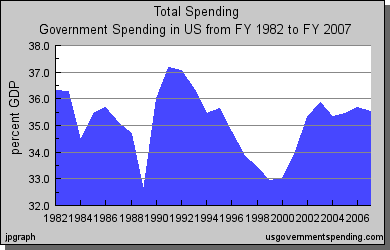
It is fairly simple to prove that Regan was ore "socialist" than the New Deal or Great Society, if the size of government spending relative to the overall size of the economy is examined. The following chart graphs the percentage of government spending relative to the overall size of the economy during the peak era of Republican political power: fiscal year 1982 (Reagan's first budget) through fiscal year 2007 (the final budget passed when Republicans controlled both Congress and the White House).
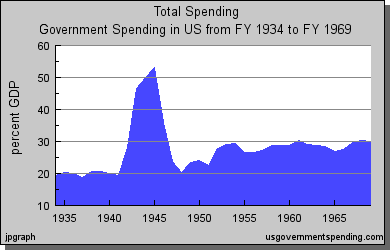
This chart is even taken from a pro-teabagging site. It shows that government spending was 36.30% the total size of the economy in 1982, and ended up at 35.53% in 2007. This minuscule change of less than 1% is the entire "limited government" accomplishment of fiscal conservatism. Further, the variation of government spending relative to the overall economy is also quite narrow, with no changes in either direction of more than 4.12% during the entire period. Overall, these levels of spending are also far beyond the level of government spending undertaken during the peak years of Democratic political power, fiscal year 1934 (FDR's first budget) to fiscal year 1969 (the final pre-Nixon year of Democratic control of the White House and Congress):
According to this chart, outside of World War Two, government spending under FDR and LBJ reached an all-time high of 30.07% in 1969. This compares to an all-time low of 32.55% under Reagan. As such, by their own standards, conservatives must label Ronald Reagan as more socialist than FDR, he of the New Deal, or LBJ, he of The Great Society. Under FDR, government spending consistently hovered at around 20% of GDP, compared to 35% under Reagan. This actually makes Reagan nearly twice as socialist as FDR.
Some Republicans believe they can regain power by distancing themselves from the Bush years, and "returning" to a clear, populist articulation of a "limited government" philosophy. The problem with such an idea is that there is no actual example of this "limited government" philosophy in practice. No politician or political party has ever significantly reduced the size of government over the long-term. Because of this, pretty much all self-identified "fiscal conservatives" are either lying about, or entirely ignorant of, the size of government they actually support.
If he [Obama] had started out stronger the evolving dynamic would have been different
The Republican Senators would have come over because they would be under public pressure not to screw the country. Instead he handed them the dynamic and they got to push those 3-4 Republicans to go with their party instead of the people. It's known as whipping the vote. He let the whip fall out of his hands and into their theirs.
Someone here linked to these Harry Truman quotes. Obama must not have ever read them..because he violated each precept.
"Carry the battle to them. Don't let them bring it to you. Put them on the defensive. And don't ever apologize for anything."
"I don't like bipartisan. Whenever a fellow tells me he's bipartisan, I know that he's going to vote against me."
He let them carry the battle to him. He let them put him on the defensive. And he apologized.
And he didn't know that this was the Republican definition of bipartisan....voting against you.
I believe that her point is inarguable, self-evident. One can spin whatever sorts of theories one wants about Obama's grand strategy--and I've got a post in the works on that. But one thing should be blindingly clear: it's just been refuted, "big time" as war criminal Dick Cheney would say. If one wants to argue that Obama's bipartisan strategic vision is not to blame, then all the blame has to go to how it was executed--and it surely could have been better done. But if it had been better executed, wouldn't that have only postponed the inevitable??
So, John McCain has taken to calling Barack Obama a "socialist". Why? Because Obama wants to "redistribute" the wealth. Of course, every time you tax someone, you redistribute wealth. And every time that government spends some money that benefits someone, that, too, redistributes wealth. By McCain's criteria, every government that ever existed in human history was "socialist." You might think that's sort of a whacked-out extremist position, somewhere two football fields to the right of the John Birch Society. And you'd be right. Because by John McCain's standards, I'd like to introduce you to four of the most prominent members of the Republican Socialists of America:
Ben Smith reports that Obama is talking up Reagan again (h/t David Mizner in Quick Hits).
"What happened was Democrats had gotten complacent, had gotten fat and happy. they thought there was a government program to solve every problem. Ronald Reagan came in and said we need to break out of the old ways of doing things and create a leaner, more effective government," he said. "That was the right message then. I think that right now we went too far in the wrong direction. We can't go back to the old liberalism of the past, but [when] you are on your own economic philosophy [of] Bush and McCain doesn't work either. Let's try a new way where we apply common sense, have government do what it does well."
Let's look at the data. Did Reagan shrink government? Well, as economist Angry Bear notes, he did not. He actually increased the size of government by .2% Federal executive employees per thousand population, versus 1.17% shrinkage under Jimmy Carter and 2.80 shrinkage under Bill Clinton, both of which outpaced George W's -1.09%. In fact, the last Presidency to increase the government's size is JFK/LBJ, who under their (combined) eight year term increased government size by 2.02% a year. Even George HW Bush shrank government more than Reagan did. So why is Reagan considered a true fiscal conservative? My theory is that what he did that Clinton and Bush I did not do is reward Republican interest groups. And the data bears this out.
In 1998, I was extremely naive. I thought that George W. Bush could never be elected President for one very simple reason: he had made his fortune by getting the taxpayers to build a baseball stadium for him. That may have played just fine in Texas, a corrupt Southern political culture, but once outsiders started focusing on it, I did not see Bush lasting very long.
Far from being opposed to "big government", Bush was a poster boy for it... so long as it benefitted people like him. Surely, some GOP rival would step forth and ridicule him off the stage in the primaries, and if not, he would be blown away in the general election.
Yeah, right. Well, earlier this year, Pulitzer Prize-winning journalist David Cay Johnston of The New York Times published a book that puts Bush's financial shennanigans into perspective, and shows how its just a tiy part of a massive, multi-faceted restructuring of the American economy to subsidize the rich and the super-rich, while the rest of us sink under the weight of supporting them. In short, it shows how the currently-proposed Bush bailout is nothing more or less than a direct continuation of the very practices that caused the financial crisis in the first place. The book is Free Lunch: How The Wealthiest Americans Enrich Themelves At Government Expense (And Stick You With The Bill.), and Johnson appeared on Bill Moyers Journal in January to talk about it. Excerpts on the flip.
Politicians lie. Heck, pretty much everyone lies. But we're particularly aware that politicians lie. Still just because two people, or two politicians lie, that doesn't mean they lie for the same reasons or in the same ways.
Some people lie reluctanctly, as a sort of last resort, when they feel they have no other option. Others lie quite freely, saying whatever comes to mind, whether true or not. Some people merely want to please, they lie to make others feel good, and then they lie some more, to keep their lies from being discovered. Some lie out of embarrassment, to avoid feeling badly themselves. Some lie quite strategically, to achieve very specific goals. And some simply lie tactically, to get themselves out of lifes little jams--or into them, as the case may be.
In the current presidential campaign, the GOP ticket gives us quite a pair of liars, with very different profiles. But before looking at them specifically, it can help if we survey some other recent examples, in order to get ourselves oriented. So let us begin with Richard Nixon, aka "Tricky Dick," and work our way forward from there. I'm not arguing that any of these are pure examples. Rather, each of them is best understood in terms of a different landscape of lies.
Oh, this is some dogwhistling. John McCain is kicking off his 'Service to America Tour' in Meridian, Mississippi on Monday, the tour designed to introduce America to his biography.
Meridian, MS, is 40 miles from Philadelphia, MS, the place where three civil rights workers were murdered in 1964 and the city where Ronald Reagan kicked off his Presidential campaign in 1980 with a speech on states' rights largely seen as the political springboard for the emerging civil rights backlash. Meridian itself is significant because one of the civil rights workers was actually from the town. McCain also has some military history in the town, but there's a reason this is the first stop on the tour, and I don't think it's just because he was stationed there.
Now, McCain of course won't distance himself from Reagan's famous racist kick-off speech, and this clearly looks like a dogwhistle to racists within the Republican Party. I'm just wondering whether the press is going to cover the fact that McCain is kicking off his bio tour in the town where a famous civil right martyr was born and the place where the racist civil rights backlash kicked into high gear.
Michael Scherer, I'm waiting.
UPDATE: McCain's speech is here. I was probably wrong on this incident, it doesn't look like a dogwhistle.
I have a great deal of respect for George Lakoff. More than I do for just about any politician I can think of. It's not just due to his work related to politics, either. I first read Metaphors We Live By in 1989, and I helped produce a lecture/discussion series on cognitive linguistics as Midnight Special Bookstore in Santa Monica with him as the lead attraction back in 1994. Moral Politics did not come out until 1996, and when it did, I reviewed it for the Christian Science Monitor. But I also reviewed Philosophy in the Flesh and Where Mathematics Comes From, as well later books on politics. So I'm very familiar with his work, not just as it applies to politics, but in terms of how it relates to the larger currents of Western thought.
But I have to say that I'm still a bit puzzled by his recent post, "What Counts as an "Issue" In the Clinton-Obama Race?" at the Huffington Post. I'm not puzzled by the points he is making-they are quite familiar to me. But I'm puzzled about the supporting evidence, which is a repeated problem with Obama. (As I pointed out in a diary yesterday, "Rankism--An Issue Custom-Made For Obama", I think Obama could easily add significant substance to his campaign.) I want to take this opportunity to use Lakoff's piece to clarify my concerns, since this still seems to be something people have a hard time figuring out-not just about me, but about lots of people who remain skeptical, when they'd much rather not. Because, you see, if I saw Obama the way that Lakoff does, I would not be having such doubts.
For some reason, The Hotline is calling Paul Volker "Reagan's Fed Chair". They note that he was first appointed by Carter, but still call him "Reagan's". I'm a bit baffled by this. Take this explanation of Volker's tenure as Fed Chair:
Little wonder Reagan liked Paul Volker so much. He had already made the unpopular but necessary decisions required to tame out-of-control inflation under Jimmy Carter and the inflation arc that had been building for about a decade before Carter took office was already showing signs of coming under control by the end of Reagans second year in office.
Oh, and, of course, Reagan really liked the idea that he would get the credit for the hard decisions Carter made in choosing the right person for the right job of Fed Chairman at the right time (to his political detriment) while he had to make virtually no unpopular decsions with respect to inflation and interest rates.
In the wake of the disasterous Bush presidency there are two possible responses. One is that, just like the last time conservatives controlled the country--1920-1932--they are destroying the country. The second is that both sides are to blame. They're both fighting, instead of solving the problems we face. Obama represents the second response, and he is, quite simply, utterly, totally and dangerously wrong. Whatever his intentions may be, action based on this worldview cannot fundamentally reverse the damage that movement conservatism has done to our country. Because of the fierceness of movement conservative opposition, his worldview demands that we change things only modestly in the grand scheme of things.
This is what's at the root of the problems Obama has faced recently, epitomized by his remarks praising Ronald Reagan, however you interpret them. Obama claims he has been misunderstood. But really, it is Obama who fundamentally misunderstands history, and it his misunderstanding that it is the root cause of the confusion he spreads to others. His misunderstanding is based on three inter-related things--a lack of historical knowledge, an acceptance of the dominant political discourse, and a devaluing of material causes and conditions. In particular, the dominant narrative blaming both sides for our political problems, and attributing the cause to bad attitudes in people's heads and hearts, is not just historically inaccurate, it results from a virtual rightwing takeover of the media and many other institutions--a material cause that affects the nature of our political narratives regardless of the actual evidence at hand.
Specifically:
Our problem is not that people are too partisan. The problem is the opposite--there are too many people with divided loyalties, and this has produced a 40-year period dominated by divided government, unlike any other time in our history.
The problem is not that Democrats are too combatative, just like Republicans. There is nothing the Democrats have done that is remotely close to the GOP impeachment of Clinton. To the contrary, the Democratic leadership has refused to even consider impeachment for a list of literally dozens of high crimes and misdemeanors.
The problem is not individual attitudes preventing politicians from agreeing. There are real, fundamental differences, driven by a widening wealth gap, and loss of political power by average people.
Kennedy and Reagan were not transformative leaders. FDR and Nixon were--not necessarily because of who they were, or anything to do with personal charisma, but because they came to power at the true turning points in political alignment--or in Nixon's case, de-alignment.
Let's take these up, one-by-one. The order will change a bit, because of how the evidence flows.
On a segment of CNBC with Jack Welch today, Obama clarifies his Reagan comments.
Question: I gotta ask you this. Part of the reason that there's so much excitement about your campaign is to leave some of the divisive politics behind, and you made a comment about Ronald Reagan and his Presidency and I can tell you that probably half of this country looks back on those years and there's a lot of, you know, admiration left for President Reagan. Even the Wall Street Journal, I don't know if you saw the editorial, seemed to commend you for that. Then in the debate the other night it looked like you couldn't run fast enough from those comments when you were debating Senator Clinton. How do you really feel about the Reagan years?
Obama: You know I didn't run from the comments, what I said was, and I'll repeat, I think he was a transformative political figure and that he provided people with a sense of optimism at a time when folks were feeling discouraged and attracted Democrats to vote for a Republican President. But what I also said was that there were a number of his ideas that I disagreed with and, you make an important point, which is that I don't think that everything is either/or. And I don't think that we as Democrats have to spend all our time running down Republicans, what I'm trying to do is get Democrats and Republicans to work together to move the country forward. That's the kind of President I want to be.
I don't want to present myself as some sort of singular figure. I think part of what's different are the times. I do think that for example the 1980 was different. I think Ronald Reagan changed the trajectory of America in a way that Richard Nixon did not and in a way that Bill Clinton did not. He put us on a fundamentally different path because the country was ready for it. I think they felt like with all the excesses of the 1960s and 1970s and government had grown and grown but there wasn't much sense of accountability in terms of how it was operating. I think people, he just tapped into what people were already feeling, which was we want clarity we want optimism, we want a return to that sense of dynamism and entrepreneurship that had been missing.
And.
"I think it's fair to say that the Republicans were the party of ideas for a pretty long chunk of time there over the last 10 to 15 years in the sense that they were challenging conventional wisdom."
"I didn't' say I liked Ronald Reagan's policies," Obama explained. "What I said was that was the kind of working majority we need to form in order to move a progressive agenda forward.
This is how Democrats should use Reagan's words. To give credit where it's due, Obama's speech this past Sunday at MLK's own Ebenezer Baptist church lifted Reaganesque language and put it in a progressive context that I can only applaud. Emphasis mine:
... I'm talking about a moral deficit. I'm talking about an empathy deficit. I'm taking about an inability to recognize ourselves in one another; to understand that we are our brother's keeper; we are our sister's keeper; that, in the words of Dr. King, we are all tied together in a single garment of destiny.
... We are told that those who differ from us on a few things are different from us on all things; that our problems are the fault of those who don't think like us or look like us or come from where we do. The welfare queen is taking our tax money. The immigrant is taking our jobs. The believer condemns the non-believer as immoral, and the non-believer chides the believer as intolerant.
... We have scorned our gay brothers and sisters instead of embracing them. The scourge of anti-Semitism has, at times, revealed itself in our community. For too long, some of us have seen immigrants as competitors for jobs instead of companions in the fight for opportunity. ...
Contrary to what some have suggested, the public wasn't concerned about how government had "grown and grown" until Reagan made government a symbolic stand-in for brown people, poor people, 'lazy' people, immigrants (who were also lazy, except when stealing our jobs,) gays and uppity women.
And if you think you know better what Reagan's Big Government meant to a certain class of white voters than a white, Reaganite, working class, minister's daughter from Los Angeles, please think about that again.

 STATE BLOGS



 Powered by: SoapBlox