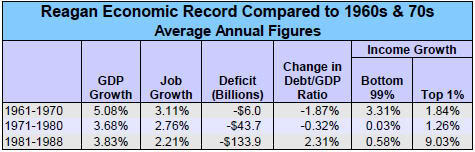
But when it comes to Reagan's economic legacy, the record is crystal clear: Before Reagan, we were on a path on reducing our debt-to-GDP ratio, the most fundamental measure of national fiscal responsibility. With him, we began using irresponsible increases in the debt-to-GDP ratio to produce extremely skewed economic growth targeted narrowly toward the very top of the income ladder. The so-called "Reagan miracle" is a complete and utter myth, as one can see from these simple comparisons of basic economic growth statistics. As one can readily see, the 1970s were a troubled decade compared to the 1960s, but we still managed to keep reducting our debt-to-GDP ratio. Then Reagan came along, and gave us a junk-food "cure" that was only marginally better in terms of GDP growth and income growth for the bottom 99%, was actually worse in terms of job creation, and showered the top 1% with wealth--at the very time that their taxes were being slashed as never before:
Reagan's policies--modified slightly under Clinton, and put on steroids under GW Bush--are the root cause of the economic distress we are experiencing today. And the newsletter Too Much has the goods on the root of Reagan's selfishness that helped lead our nation astray economically:
The Tax that Turned Ronald Reagan Right
With the centennial of our 40th President's birth fast approaching, how about a shout-out for the soak-the-rich tax rates that he so despised - and more civic-minded Hollywood stars so enthusiastically embraced.
Did Ronald Reagan change history? Well, we all change history in our own way. The more interesting question: What changed Ronald Reagan?
What changed the labor advocate - with enough street cred to get elected president of Hollywood's actors union - into a labor basher extraordinaire? What turned Reagan the standard-issue New Deal Democrat into the 20th century's premiere pusher for almost entirely unrestrained "free enterprise"?
The answer? According to Reagan himself, the federal income tax - specifically the over 90 percent top rate on top-bracket income that went into effect during World War II - changed Ronald Reagan. That tax levy absolutely incensed the amiable actor.
At his Hollywood height, actor Ronnie Reagan was making $400,000 per picture. With the top federal tax rate over 90 percent, Reagan used to tell his White House chief of staff Donald Regan, he always chose to "loaf" around rather than make more than two pictures a year.
"Why should I have done a third picture, even if it was Gone with the Wind?" Regan remembers Reagan asking. "What good would it have done me?"
Actually, instead of griping about his tax bill, the World War II-era Ronnie Reagan should have been counting his lucky tax stars. Things could have turned out much worse for Reagan - and the rest of America's high-income set - if Congress had let President Franklin D. Roosevelt have his way.
In April 1942, just a few months after Pearl Harbor, Roosevelt asked Congress to enact a 100 percent top federal income tax rate, in effect a "maximum wage." No individual, FDR told lawmakers, should be taking home, after taxes, over $25,000 - the equivalent of about $335,000 today.
FDR's call for a $25,000 personal income limit struck millions of patriotic Americans as right on the mark. A Gallup poll, in late 1942, found 47 percent of Americans supporting the notion of an income limit and only 38 percent in opposition. And the supporters of FDR's $25,000 cap even included some of Ronnie Reagan's fellow Hollywood stars.
"I regret," the widely admired Ann Sheridan told reporters, "that I have only one salary to give for my country." ....

 STATE BLOGS


 Powered by: SoapBlox