A previous post of mine (Splitting equals losing...) now has over 100 replies.
The good news is that I found topics that people feel passionately about (how to advance progressive ideology, and how [or even whether] to recapture the Democratic party from the hands of corporate interests). The bad news is that some of the responses to my post involved a fight between the Pro-Naders and the Anti-Naders. This fight is like a red-hot coal (lots of heat, and not much light).
The point of my post was not to point fingers at the past, it was to point the way towards victory in the future.
On the topic of Nader, both sides seem to agree upon two facts. One is that there were a dozen factors that helped Bush steal the election (purging Black voters, confusing butterfly ballots, Katherine Harris, a bizarrely biased 5-4 "no precedent" Supreme Court decision... and of course Gore's own lackluster campaign). The second fact is that, if we could change history, holding all else constant and ONLY removing Nader from the race, the result would have been: President Al Gore. (And while Gore is only progressive on the environment, I think we can all agree that Gore would have been better than Bush.)
One commentor actually accused other commentors of "not caring" about all those that died during the Iraq war. I will not accuse FeralCat, Dr. Anonymous and others of "not caring". If they did not care, they would not spend their time posting here.
What I do want to do is help us all agree upon effective strategy for the future. And to achieve that, I have a few suggestions.
One is that we should all try to spread the "fusion voting" model to every state. We have that model in New York, and when I vote, I look for candidates that are on both the Working Families ballot, and the Democratic ballot (and I then pull the lever for WF).
A second thing that I would suggest is that splitting is great (when the split is among the Right). In 2008, I signed petitions in favor of including Ron Paul and Bob Barr in the debates. When the Right fights itself, the Left wins. Most of our time and money should be spend in making the Left stronger, but whenever we can help the Right defeat itself, we should do so.
A third good idea that I have heard here is that support for progressive third parties should focus on congress first, before attempting to influence the presidential election. That idea has a lot of merit.
A fourth idea is that progressives should support third party candidates in non-competitive states only. In 2000, I had not yet moved from Texas to NY. I knew that Bush would win Texas, and I liked some of what I heard Nader saying. (In the end, I chose to vote for Gore, to give him a larger mandate.) But maybe in 2012, if the race is between Obama/Biden and Huckabee/Palin, Kucinich will run as an independent or as a Green. If that happens, then progressives can make a deal: for every Kucinich supporter in a competitive state (like Virginia) that votes for Obama, an Obama supporter in a safe state (like NY) will vote for Kucinich. That way, Kucinich gets the same number of net votes, but he does not flip a competitive state to the Republicans.
Finally, I want to address another kind of splitting. Among all of us here at Open Left, who care passionately about progressive causes, let's feel free to disagree, but let's avoid name-calling and personal attacks. If we agree upon policy goals (universal health care, green energy, a living wage, less war abroad, and so on), then when we quibble over tactics, let us not forget that the REAL enemy is guys like Rush Limbaugh and Grover Norquist. A dissenting fellow progressive is, at worst, a misguided friend.
Back in the late nineties, I was one of those odd souls who took what most would consider to be an inordinate amount of interest in Microsoft's antitrust troubles.
From the period 1997-2000 I can't say I cared more deeply about any other issue.
Of course, that issue faded from view as much more important things came to the fore, but it did lay in the back of my mind.
Now, this week, that part of my life has come back together full circle.
Let's start with a frightening New York Times article about the geometric growth of viruses, malware, and general criminal activity on the internet.
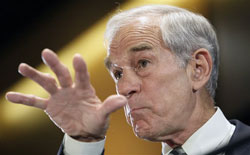
Texas Congressman and Republican Primary candidate Ron Paul is holding a "counter convention" which he calls the Rally For the Republic in Minneapolis while the RNC goes on in St. Paul. While he says that this rally is not an event to get votes as a write-in candidate, it is certainly a thumb in McCain's eye.
The event covers "the great American principles of individual liberty, constitutional government, sound money, free markets, and a noninterventionist foreign policy." It is strongly focused on getting out of Iraq.
This is an interesting mix of speakers who are independent, or libertarian, or radical-right-Republicans. Take a look at their schedule today:
Tuesday's Rally for the Republic schedule:
11:30 - Doors open
12:30 - Intro: Tucker Carlson
12:40 - National Anthem: Matt Colvin
12:50 - Invocation: Barb Davis White
12:55 - Howard Phillips
1:10 - Doug Wead
1:30 - Tom Woods
1:50 - Grover Norquist
2:10 - Lew Rockwell
2:30 - Bill Kauffman
2:50 - Special Guest
3:10 - Bruce Fein
3:35 - Gov. Jesse Ventura
4:05 - John Tate‚ Campaign for Liberty Presentation
4:25 - Gov. Gary Johnson
5:00 - Aimee Allen
6:00 - Break
7:00 - Intro: Barry Goldwater (Jr.)
7:05 - Ron Paul
8:05 - Sara Evans
9:30 - End of Program
9:30 - Jimmie Vaughan After Party
Paul has said that this "a philosophic campaign... my campaign for the Presidency has ended." But it will compete with the first really big day of the RNC (and be covered live on C-Span2) and can't be good for the Republican Party's hopes to get back on track after Gustave muted their first day.
So it looks like the Republicans have their own Nader... and it remains to be seen if this, combined with the Bob Barr Libertarian Party campaign, has an effect on the election.