Paul Krugman in what may be his finest blog post articulates a fear I have had but been unable to properly express:
But watching the failure of policy over the past three years, I find myself believing, more and more, that this failure has deep roots - that we were in some sense doomed to go through this. Specifically, I now suspect that the kind of moderate economic policy regime Brad and I both support - a regime that by and large lets markets work, but in which the government is ready both to rein in excesses and fight slumps - is inherently unstable. It's something that can last for a generation or so, but not much longer.
By "unstable" I don't just mean Minsky-type financial instability, although that's part of it. Equally crucial are the regime's intellectual and political instability.
The failure here is not the policies themselves, but the 2nd and 3rd order intellectual and social structures that maintain sufficient social support for the policies of curtailed capitalism and the state enforcement of broad social mobility and equality. In this sense, I say the New Deal did fail, because it failed to sustain itself much past the generation of people who lived through the crisis that made it possible. It is getting harder to protect Social Security because with each passing year there are less people with living memory of what life was like without it. Those people were generally immune to the propaganda, but those of us left behind lack that personal connection to seeing retired people reduced to begging and literally dying in gutters and under bridges.
That's what we have to account for if and when we create the conditions to implement a New New Deal. How to make the liberal consensus not only strong enough to do it, but self sustaining?
On July 14th, Green Change announced the campaign for a Green New Deal, a 10-point program to create economic prosperity together with ecological sustainability.
Since then over 100 candidates for elected office at all levels have joined the Green New Deal Coalition.
The Green New Deal Coalition will cut military spending, create millions of green jobs, and revive the economy by protecting the planet we depend on.
Green Change is inviting all candidates, individuals and organizations that support a prosperous, sustainable future for America to endorse the Green New Deal.
Read the call for a Green New Deal and sign on today.
To date, 11 candidates for governor, 11 candidates for US Senate, and 33 candidates for US House of Representatives have joined the Green New Deal Coalition.
All agree on the need to cut military spending, fund green public works, ban corporate personhood, pass single-payer health care, restore progressive taxation, ban usury, enact a revenue-neutral carbon tax, legalize marijuana, institute tuition-free public higher education, change trade agreements to improve labor, environmental and safety standards, and pass sweeping electoral, campaign finance and anti-corruption reforms.
These candidates represent a clean break with the failed policies of the past that have led America down the road to economic and ecological disaster.
The Green New Deal promises a brighter tomorrow for America – one that combines the New Deal’s promise of freedom from economic hardship with decisive action to protect our planet.
You can help build the movement for real change by endorsing the Green New Deal today and asking candidates for elected office to join you.
In 1993, anti-choice extremists murdered a doctor, burned 12 buildings, set off a bomb, and blockaded 66 abortion clinics. The following year, President Bill Clinton signed the Freedom of Access to Clinic Entrances (FACE) Act. FACE made it a federal crime to obstruct a clinic or intimidate patients and providers.
Wendy Norris of RH Reality Check reports that, in the intervening 16 years, the Justice Department has only prosecuted 19 civil and 45 criminal cases under FACE. Abortion provider Dr. George Tiller was assassinated last year by a hardcore clinic protester, and many asked if the FACE Act was being enforced.
Norris's story is part of a series on FACE published by RH Reality. The next installment will explore how one radical anti-choice protester has managed to terrorize the same clinic for 30 years with apparent impunity. Kudos to the Guggenheim foundation for funding this important and timely series, and to the John Jay College Center on Media, Crime and Justice for providing editorial input.
The Pill and I
May 9th is the 50th anniversary of the FDA's approval of Enovid, the first birth control pill. Care2 contributor Ann Pietrangelo, who recently celebrated her own 50th birthday, reflects on how the Pill changed history:
I went through my entire reproductive life in a way that my female ancestors, indeed my own mother, could scarcely have imagined. The Pill and other contraceptive choices were always available to me. I have never had to face the dreaded abortion decision, but throughout my reproductive years, I had the peace of mind of knowing that such a decision, difficult though it would be, was mine to make. I, and millions of women of my age group and younger have been most fortunate. We've lived a different kind of life than would have been possible in another time and another place.
Anti-"personhood" coalition kicks off
A new group has united to fight Colorado's proposed "egg as person" ballot initiative, Joseph Boven of the Colorado Independent reports. The organization calls itself Protect Families, Protect Choices (PFPC). If Amendment 62 passes, it would effectively outlaw abortion, stem cell research, and even some forms of contraception. Women who drink, use drugs, or attempt suicide could face criminal charges if the ballot initiative becomes law.
The Colorado measure is one of of many similar measures proffered by anti-abortion activists in state legislatures around the country. The last time Coloradans voted on whether to give fertilized ova the full complement of rights under state law, 73% voted against the measure. If the bill passes, will frozen embryos be able to own property? Could Coloradans evade their creditors by signing their houses over to zygotes?
Will health care reform save Democrats?
In TheNation, Katherine S. Newman and Steven Attewell tackle the question on everyone's mind: Will health care reform change the political fortunes of President Barack Obama and the Democrats? They warn that Democrats shouldn't expect short-term political gains, even if reform is ultimately regarded as a success story:
For some time to come we can expect the firestorm of opposition to health care reform that is unfolding today to persist, even from people who stand to benefit from the provisions of the new law. The rose-colored glasses through which we sometimes view the legacy of the New Deal and the Great Society often obscure how contentious the debates were or how long they continued after the passage of key legislation. We should not be deterred by the noise coming out of the Tea Party. The weight of history is against them.
Passive aggressive red states
Suzy Khimm of Mother Jones sees trouble ahead: So far, at least 15 states have refused to create high-risk health insurance pools. The refusniks are red states hostile to health care reform. High-risk pools are a stopgap to provide coverage for people with preexisting conditions. Insurers are free to discriminate against sick people until 2014, and high risk pools are supposed to cover those who can't buy coverage in the meantime.
Khimm explains that the federal government will have to step in and create high-risk pools if states aren't willing to do so. Health care reform left a great deal of power in the hands of states. The stage has been set for a grim power struggle, a bureaucratic battle of attrition.
This post features links to the best independent, progressive reporting about health care by members of The Media Consortium. It is free to reprint. Visit the Pulse for a complete list of articles on health care reform, or follow us on Twitter. And for the best progressive reporting on critical economy, environment, health care and immigration issues, check out The Audit, The Mulch, and The Diaspora. This is a project of The Media Consortium, a network of leading independent media outlets.
Last week, President Barack Obama released key legislation designed to fight the banking industry's too-big-to-fail problem. But Obama's plan doesn't actually address too-big-to-fail at all. It reinforces a broken system in which economically dangerous companies are bailed out whenever they drive themselves to the brink of failure.
If we want the economy to support all people, we have to break up the big banks and start treating the creation of good jobs as an economic priority on par with Wall Street rescues.
The editors of The Nation break the political debate over banking into three camps:
The first camp is composed of bank lobbyists, Republicans and conservative Democrats and wants to do nothing.
Camp two, endorsed by the White House and influential Rep. Barney Frank (D-MA), would impose tougher regulations on too-big-to-fail banks to keep them from getting out of control.
The third camp wants to go even further: If a bank is too-big-to-fail, it is also too-big-to-regulate. Companies that pose a danger to the economy have to be split up into smaller firms that cannot induce economic ruin.
The Nation editors rightly see the third strategy as the most sensible. While the "break-up-the-banks" policy is being portrayed as a left-wing pipe dream by cable news networks, the policy actually relies on an age-old observation of conservative economists. Regulators make mistakes, and they often get co-opted by the very industries they are supposed to be supervising.
The practical policy is to impose structural limits on what activities banks can participate in and how big they can get. Just look at the list of high-profile supporters: former Federal Reserve Chairman Paul Volcker, former Citigroup Chairman John Reed, Bank of England Governor Mervyn King. I don't remember seeing any of those guys at the Iraq War protests.
Many of the regulatory blind spots that brought down the economy were obvious to some policymakers for years. Back in 1994, Sen. Byron Dorgan (D-ND) wrote an article for The Washington Monthly warning that derivatives trading was putting the economy in grave danger. Commodities Futures Trading Commission Chair Brooksley Born tried to take action on these derivatives, but was overruled by other regulators, including then-Fed Chair Alan Greenspan, and then-Treasury Secretary Lawrence Summers, now the top economic adviser to President Obama. Summers and Greenspan even convinced Congress to pass a law banning the regulation of key derivatives, including credit default swaps, which ultimately brought down insurance giant AIG.
Fifteen years after Dorgan's article first ran, The Washington Monthly is featuring it again, along with a recent speech by Dorgan that details massive failures in Wall Street and Washington.
"We had regulators come to town in recent years and willfully boasted that they wanted to be blind as regulators," Dorgan says.
There are good elements of Obama's plan to deal with too-big-to-fail. It gives policymakers the option of putting a too-big-to-fail institution through a special bankruptcy process administered by the executive branch, thus avoiding the problems created in bankruptcy court when Lehman Brothers failed. But the bad part is really bad: Officials would also have the option to provide unlimited bailouts to Big Finance via loans, guarantees and even asset purchases.
As Mike Lillis notes for The Washington Independent, some responsible Democrats like Rep. Brad Sherman (D-CA) have been objecting to this aspect of the legislation for months. Sherman, in fact, calls it "TARP on steroids," noting that the bank bailout at least came with some meager oversight and a limit on the program's actual size.
The bank lobby is spending money like mad to maintain their stranglehold on the economy. Neither Congress or the administration will change course without intense public pressure. So it was very reassuring last week to see thousands of people protesting the annual meeting of top bank lobby group, the American Bankers Association. David Moberg chronicles the protest in a blog post for Working In These Times that covers speeches by both key union leaders and ordinary people facing foreclosure after watching their tax dollars go to the very bankers who wrecked the economy.
"There was broad agreement on anger at the banks for providing so little, if any, public benefit for the massive bail-out, and for so quickly returning to the greed and abuse that precipitated the crisis," Moberg writes.
Laura Flanders covers the protests for GRITtv, including video of protesters chanting "Bust up big banks!" In a roundtable discussion with Christina Clausen of the United Food & Commercial Workers Union, George Goehl of National People's Action and Rob Robertson of the Right To The City Alliance, Rolling Stone journalist Matt Taibbi explains the overriding impotence of the regulations Congress is about to approve. Regulators will not be able to crack down on abusive derivatives, a full 8,000 of 8,200 banks will be exempt from Consumer Financial Protection Agency oversight, while the same agencies that screwed up heading into this crisis will be charged with preventing the next one.
"They've had sweeping powers to do whatever they wanted," Taibbi says. "They've had this regulatory power all along."
What we need are good jobs, and lots of them. Obama's economic stimulus package has made tangible economic progress. It's saved hundreds of thousands of jobs, and is clearly responsible for the turnaround in gross domestic product (GDP) we saw in the third quarter. But a full 17% of the workforce remains unable to find full-time work, as Julianne Malveux explains for The Progressive.
When Wall Street crashed in 1929 and unleashed the Great Depression, the government eventually stepped in as an employer-of-last-resort. The Works Progress Administration (WPA) and Civilian Conservation Corps (CCC). built schools, parks, roads and bridges which still serve our communities today. Both the WPA and the CCC employed literally millions of people-in the 1930s. It's a model that could work very well today.
As the current recession makes clear, ending too-big-to-fail and guaranteeing a good job for everyone in our society who wants one are the two most critical structural reforms our economy needs. Don't let lawmakers forget it.
This post features links to the best independent, progressive reporting about the economy by members of The Media Consortium. It is free to reprint. Visit the Audit for a complete list of articles on economic issues, or follow us on Twitter. And for the best progressive reporting on critical economy, environment, health care and immigration issues, check out The Mulch, The Pulse and The Diaspora. This is a project of The Media Consortium, a network of leading independent media outlets.
is Countdown's Free Clinic partnership events shaping up. I honestly don't know if they can pull this off fast enough to make a difference in the short term, soon enough to win the battle in this go-round. But this is the sort of thing we need to start seeing in terms of changing the whole zeitgeist. The contrast between these mass events of public healing and the jackassery of the tea-partiers should be particularly striking.
It took a couple of years of this sort of thing to build up the momentum for the really big stuff during the New Deal, so I think that if we focus on building strength, and pulling off events like this, our strength will only increase in the years ahead. Maybe not the Conservadem's, but they're really not my concern. And since Obama loves them so much, he's not my concern, either. He will come to us when there's nowhere else to go.
I want to be clear, I'm not giving up on us getting a decent bill this year. But I think that if we take a longer view--and don't buy the Versailles CW that it's got to be now or never--then we'll be much better prepared to hang tough in the short run, and not fold. And that's what's needed to win.
Don't get me wrong--I want health care reform to pass this year. But I want us to be both as clear and strong as we possibly can be. And I want to draw a very clear distinction between the logic of Versailles and the Democratic leadership, and the logic of progressive Democrats out in the wilds of America.
Inside Versailles, there can be no doubt--if the Democrats don't pass health care now, it will be dead for another decade or more--and so will the Democrats. There can be no doubt about this, just as there could be no doubt that Iraq had WMDs, and that Bush's election in 2004 signaled the consolidation of a permanent GOP governing majority.
In other words, it's pure and utter crap. Maybe it will happen. Maybe it won't. Nobody knows for sure. But we do know what follows from assuming that it's true: a wholly uncalled-for degree of Democratic paralysis. In virtually all other walks of life, what's more American than saying, "If at first you don't succeed, try, try again"?
But when it comes to health care reform, we're supposed to stand and salute the proposition, "Take anything you can get--brown rice, seaweed and a dirty hot dog--and call it a victory, no matter what." Could there possigbly be a more cowardly, unimaginative, downright un-American fore-ordained loserattitude than that?
Political Poison: None For Me, Thanks...
Furthermore, if we recognize the obvious--that an individual mandate forcing people to buy private crapolla insurance is pure political poison, then how can we not be willing to see health care "reform" die this year, rather than pass such a suicidal bill into law?
As Digby wrote, regarding individual mandates, and potential Constitutional challenges:
Reform advocates will undoubtedly look back on all this and wonder if the politics of single payer would have actually been easier. In this particular respect, it almost certainly would have been. There's no doubt that the federal government has the power to tax for certain benefits or compel payments to outside parties for certain optional privileges (like driving.) But whether it has the power to compel all citizens to pay money to particular private interests is an unknown. Who knows what the Roberts Court will decide on that?
Of course, if a public option is in place it's a different argument altogether, isn't it?
Sigh! None of this would have happened if only we'd had a constitutional lawyer as President!
I don't think that it needs to come to this. In fact, I think that being willing to let health care reform die may well be the key to ensuring that it doesn't. "Boldness has genius, power, and magic in it." -- So wrote Goethe, and he was absolutely right. The converse of that is, "If you don't stand for something, you'll fall for anything." And that's become the Democrat's de factor operating script ever since 1994.
After 14 years of operating out of fear of failure, isn't it time we started operating out of hope of success?
At the very least, can't we just stop trying to out-stupid the Republicans? Because in that game, even when you win, you lose.
There has been much talk lately about the Great Depression, how it parallels our current economic crisis, and how passage of the New Deal might serve as a model for the Democrats and the new Obama administration in their attempts to rescue the economy.
But it is how the passage of the New Deal may serve as a model for the Progressive movement that I want to discuss here. For, as I will demonstrate, if it were not for the Progressive movement, and Roosevelt's harshest critics from the left, we would have ended up with a very different New Deal - one which, arguably, would not have been much of a deal at all.
As OpenLefties know, many progressives are comparing the current economic situation to the 1930s. While the hardships of this recession do not (yet) compare with what our country faced in the Great Depression, there is no question that these are tough times.
The idea that we are reliving the Depression or something like it is part of a larger argument that the U.S. is undergoing a leftward political realignment similar to that of the '30s. The hope is that the Democratic Party will rediscover its New Deal heritage and a new progressive coalition will come together around issues of health care, income inequality, corporate power, etc.
However, even if we assume that Barack Obama and his allies are potential New Dealers with good progressive instincts (and I don't assume anything of the sort), we should recognize that the political landscape of today is missing many of the forces and actors that made the Roosevelt era so ripe for change.
In the 1930s, the possibility that American society would be upended by a genuine social revolution, while probably very remote, was a real fear of some people. As FDR put it: "I was convinced we'd have a revolution in [the] US and I decided to be its leader and prevent it. I'm a rich man too and have run with your kind of people. I decided half a loaf was better than none - a half loaf for me and a half loaf for you and no revolution." Roosevelt was half-bullshitting as politicians always do, but there was some truth to that statement.
Consider the times:
In those years, Huey Long, a terrifyingly ambitious populist from alligator-haunted Louisiana, had the political establishment (and many on the left) shitting bricks with his crusade to radically restructure the American economy.
During this same period, important sectors of the labor movement advanced an explicitly anti-capitalist line. Also, many prominent artists and intellectuals affiliated with the Communist Party, or with Trotskyism, or with the Socialist Party of Norman Thomas.
Left-wing newspapers developed respectable circulations and wide appeal, with sports pages, comics and all. Homeless people, tenants, farmers and other burdened groups organized themselves into associations and managed to cause considerable trouble.
Today we have to ask ourselves, where is our radical labor movement? Where is our EPIC? Where is our Farmer Labor Party? Where is our Daily Worker? Where is our Huey Long?
Maybe the social conditions of this economic downturn will produce similar anti-systemic left/populist movements, but right now I don't see anybody arguing for anything beyond the mild liberalism of MoveOn. I'm all for MoveOn and we'd be lucky to get the MoveOn agenda realized, but I believe progressive politics is the art of backing up maximalist demands with credible threats ... and MoveOn isn't nearly scary or threatening enough for the task at hand.
Driving home from work I endured NPR's inexplicable decision to give Jonah Goldberg airtime to admit that it is "more fun" for conservative pundits to be out of power (actually, I agree, it is more fun having Jonah out of power. Conservatives breaking the Planet isn't fun).
From my non-expert understanding of the subject matter, Alter does a fine job smashing up Shlaes' arguments throughout, but the highlight is the callers and emailers, who give me some sense and hope that conservative New Deal denialism isn't sticking with the public. In particular, at the 8:00 mark in the program, the very first caller actually attended FDR's inauguration and was 16 years old at the time, working as a Senate page. He makes a point of noting Shlaes' perception of history ignores that by 1935-36, things clearly had visibly improved. NPR's host stupidly insists on moving on to other callers in the too-quick manner of NPR, but Alter makes a point of getting contact info from the caller, so hopefully we will hear more from this man. There are very few people alive who were old enough to remember the New Deal in progress, never mind that actually worked in Washington and knew the players. The guy also has a good quip about the 20th Amendment (also from 1933) saving the country from 2 more months of Bush.
The continued stalling of getting Al Franken seated in the Senate may be having much more serious consequences than anyone yet realizes. It's inevitable, of course, that having come close, the Republicans will never accept that they lost, and will therefore always hate Al Franken even more than they already would have, which is quite a lot, considering that (a) They hate Hollywood, and (b) firmly believe that only Republican actors and entertainers should ever be elected to public office. (c) They hate anyone with a sense of humor that doesn't revolve around sadism of some kind. (d) They hate anyone who is smart. (e) They hate anyone they can't intimidate. (f)... well, you get the point. Al is pretty much an all-purpose collection of every sort of thing the Republicans just can't stand.
WASHINGTON - The spirit of bipartisan change may be coming to the White House, but so far it has eluded the new Congress, where Minnesota's U.S. Senate recount has only widened the old partisan divide.
With a few days remaining before the inauguration of Barack Obama, Democrats are holding fast to their lockdown on Republican Norm Coleman, whose office has gone semi-dark -- barred from doing anything senatorial.
Because he's not a senator anymore!
Republicans, meanwhile, have turned what they see as the mistreatment of Coleman into a fundraising pitch to defeat Senate Majority Leader Harry Reid in 2010...
Senate Democrats say their actions regarding Coleman are not personal. "This is not anything we were looking for, but it's happened and we're going to deal with it as quickly as possible," said Jim Manley, a spokesman for Majority Leader Reid.
But Senate GOP leaders take a more jaundiced view, saying Reid's hard line against Coleman threatens Obama's vision of a post-partisan 111th Congress.
Totally typical. Any failure to kiss GOP ass "threatens Obama's vision of a post-partisan 111th Congress." Why, if Democrats really believed in bi-partisanship, they'd all just resign from the Senate and let the GOP run the whole thing!
But I spoke of more serious consequences, and I meant it. Because rigtht now, the future of our country hangs in the balance, and we need every powerful advocate we can get--particularly one like Al, with a talent for cutting through bullshit.
One thing is clear: the GOP is not about to fold up shop and go along with Barack Obama, just because he's President and the Democrats won a substantial legislative victory as well last November. They're already starting to marshall their forces to oppose, or at least slow down, and render as ineffective as possible, whatever stimulus package Obama comes up with. And, of course, recycling lies about the New Deal, FDR and the Great Depression are essential parts of the package. On Sunday I wrote a diary, "A Brief Peek At UCLA's Anti-FDR Propaganda", which looked only at the gross parameters surrounding claims made in a paper that David had referred to in passing in a previous diary.
While kanzeon weighed in late to make the point: "The measure of when the Depression ended, to conservative critics, isn't usually GDP or real output, but unemployment," negative GDP growth is the standard by which economists routiney identify recesssions--and by extension depressions--as well as being the single most comprehensive measure of economic activity (for good or ill), so I still think it's useful to look a little more closely at GDP as a pre-emptive antidote against conservative/GOP bullshit that's bound to be coming at us in the days ahead.
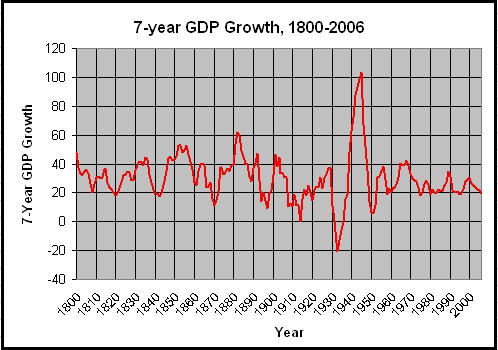
The UCLA report claimed that the Depression should have ended in 1936--7 years after it began, and roughly 3 3/4 years after FDR took office. Without ignoring Kanzeon's caveat, that still seems rather hard to accept given just how badly the GDP was doing. Thing is, I don't think I've ever seen a clear graphical representation of just how bad that was. So I decided to make one myself. Given the UCLA author's belief in a magic 7-year time-frame, I decided to chart the 7-year GDP growth figures from around the beginning of the US economy to date. You can clearly see just how drastically the Great Depression departs from anything else in our history, as well as just how powerful our recovery was, particularly once WWII spending kicked in:
This chart just goes to show how incredibly unusual the Great Depression was. No wonder a large number of people, all across the political spectrum, thought that it well might be the end of capitalism. There was nothing remotely like it in all our history. And the idea that everything could readily be solved by simply letting normal economic forces work--as the UCLA researchers propose--seems utterly unbelievable, simply by looking at the relatively limited scope of any of the other previous sharp rises, none of which is remotely large enough to get us back into the 20-40% 7-year GDP growth range that is normal for the economy in the specified 7-year time frame--much less the 3 3/4 years that FDR actually had in office before the end of 1936 rolled around.
Now, it's true - back in 2004, two UCLA professors published a little-noticed report claiming the New Deal's government intervention prolonged the Great Depression. But that assertion has been subsequently eviscerated by, ya know, actual data.
What this immediately reminded me of was a UCLA "study" from 2005, (I wrote about at MyDD here), purporting to show that there really was leftwing bias in the media, a study that included, along the way, the identification of both the ACLU and the NRA as centrist think tanks. Since neither of them are either centrist or think tanks, there was an obvious problem with the study, and it seemed the height of irresponsibility for an academic institution of UCLA's stature to allow itself to be used to promote such obviously shoddy "research" with such an obvious propaganda value. Indeed, as I dug into it further--and others did as well--the total lack of effective peer review became quite obvious. It was "peer-reviewed", it turned out, in a journal devoted to a disciplinary approach that had no competence whatever in the field of media studies.
This smelled a whole lot the same to me, particularly when I actually clicked the link and took a look. Ho boy! I had no idea!
I'm hoping to weigh in later on the general outlines of neo-Hooverism, picking up on Matt's post "Why the Right Will Oppose Getting Us Out of Recession" along with a few others coalescing into a general theory. But here I just want to slice and dice a truly hallucinatory neo-Hooverite fantasy piece from a few weeks back by Amity Shlaes. It shows just how utterly divorced from reality these people are.
"Obama Will Take Us Backward By Channeling Keynes" was a Bloomberg commentary piece that ran on Nov. 19. Not only does Shlaes slam Keynes, that's the easy part. She actually attacks the interstate highway system, and equates it to the "Bridge To Nowhere"!
Well, on second thought, that's not really that strange. I mean, if every foreign leader who looks cross-eyed at us is Adolph Hitler, then the interstate highways system really is the "Bridge To Nowhere." You see, it's a demonstrable fact that any false statement can be deduced from any other false statement.
As conservative economics collapses disastrously under the weight of its many, many lies, it is only natural that the liars fall-back position is to take aim at the hope of actually cleaning up their mess. And hence the sudden rise of New Deal denialism. It's not as if this comes out of nowhere. It comes out of the same sorts of folks who denied the New Deal as it was succeeding right before their very eyes. And it comes out of the right-wing think tank complex. And it gets spouted by George Will on ABC This Week. And it's a load of bull. Video of Will on the flip. Pride of place to this simple diagram (click to enlarge), which shows the truth: the New Deal was working just fine, until FDR, with a premature sense of relief, and a lingering belief in the old economics, decided it was time to go back to balanced budgets, thus precipitating the recession of 1937/38. It was, in effect, a text-book science experiment: turn the New Deal stimulus policies on, economic goes up, turn them off, economy goes down. But Will--and many others--are trying to pretend the exact opposite, that FDR's policies remained constant, and proved disasterous in 1938:
Being the history buff that I am, I always perk up when a columnist discusses history to make a political point. The other day, David Brooks did that, and boy did he screw it up.
I was asked to speak on a panel today regarding the anniversary of the New Deal, hosted by the Roosevelt Institution. Here's what I said:
I've got some discomfort at speaking on a panel with such a title- I'm what they call the opposite of an academic. Being the decidedly un-intellectual political operative that I am, my usual speech topic is more like:
"How do we beat the hell out of Republicans on the health care issue?"
or
"How do we make Mark Foley and Tom DeLay metaphors for the entire Republican Party?"
But I will give this "intellectual underpinnings thing" a shot.
I think the reason I was asked to speak here has to do with the fact that I am writing a book on the history of the American political debate between progressivism and conservatism. My book will argue that when progressives were in power, we created the best ideas that America had to offer- democracy, equality of opportunity, and bottom-up economics, among them; and that when conservatives have won the day, we made mistakes of historic significance, including slavery, Jim Crow, the Great Depression, mass corruption, and the troubles of our present day.
It may come as a surprise to learn that many of our debates on issues echo over and over through all of our time as a country. For example, who do you think was the first American political figure to advocate for:
-A publicly funded Social Security system for the elderly
-A progressive estate tax and a progressive income tax system
-Welfare programs
-Employment centers for the jobless
It was not FDR or Woodrow Wilson, or even the populist movement or labor movements of the 1880s and 1890s. It was Tom Paine in the 1790s.
Another example is that n addition to winning the Civil War and ending slavery, Abe Lincoln presided over the biggest public distribution of wealth in history with the Homestead Act, and the biggest promotion of affordable college education with the land grant university system, the most significant public infrastructure program of all-time with the Pacific Railroad Act, and the first adoption of the progressive income tax?
I would argue that the intellectual underpinnings of a renegotiated social contract are rooted deeply in our history. And that relates to the newest and freshest debates we are having. The renegotiated social contract is going to have to involve the dramatic changes in our economy and media and technology, but the values that are involved in those debates are historical.
When progressives argue that net neutrality is an essential underpinning of American democracy because the internet needs to be a neutral space in the public square, we are making the same argument that the advocates of public education made, and that the advocates of the idea that railroads needed to treat their customers equally made.
When progressives argue for universal broadband so that all Americans have equal opportunities, we are making the same argument that Jefferson did in the Declaration of Independence and Lincoln did in the Gettysburg Address and King did in the "I Have a Dream" speech.
When my partner on OpenLeft, Matt Stoller, created the Legislation 2.0 idea with Senator Durbin, a new way of using the internet to create legislation with the public fully involved in drafting legislation through live-blogging, he was reviving the old argument between Jefferson and Hamilton on true democracy vs. one run by the elites. By opening up the debate to anyone who wanted to participate, Durbin and Stoller were echoing Lincoln by saying we ought to have a government of the people, by the people, and for the people.
Our great leaders have always understood the importance of tying their ideas to history. Lincoln in the Gettysburg Address very consciously went back four score and seven years before, to the Declaration of Independence rather than the Constitution 11 years later that embraced slavery. FDR was the one who created the Jefferson Memorial after conservatives had tended to downplay his legacy in the decades before, and FDR quoted from Jefferson and Tom Paine constantly. Martin Luther King, Jr. stood in Lincoln's shadow, and quoted from Jefferson in his "I Have A Dream" speech.
We live in a new era, with new technologies and new issues facing us. We will have to be innovators, open to fresh ideas about how to renegotiate our social contract. But our basic intellectual underpinnings are the same as they have always been.