There is a strong and growing Progressive presence on Twitter. I am aware of two other leaders besides myself who are subject to harassment and intimidation from the right. The timing of this makes it appear that this is another centrally initiated effort similar to the flood of female conservatives who arrived concurrent with Sarah Palin’s “grizzly mom” prattle.
My response to the threatening conduct has been to basically dare the person behind it to actually step up and do something. I am far more aggressive than most and would not expect the rest to follow my lead. An organized community response will be the best approach to beheading this nuisance before it gets any momentum.
The political process has failed. Cap and trade legislation is dead in this Congress.
Kerry and Reid said as much last week. They said they don’t have the votes in the Senate, so instead of introducing the legislation before the August recess, Reid will introduce a very minor energy bill instead, and that’s it. Technically, the comprehensive legislation could still be offered in September, but the vote becomes more difficult, and less likely, as the election approaches. If they thought they had the votes, they would introduce it now. They don’t have the votes, they don’t expect to get them, and barring a miracle, after this November there will be no chance to get them. The legislative effort is dead. Our political system has failed to respond to the greatest challenge of our time.
The political process has failed. Cap and trade legislation is dead in this Congress.
Kerry and Reid said as much this week. They said they don’t have the votes in the Senate, so instead of introducing the legislation before the August recess, Reid will introduce a very minor energy bill instead, and that’s it. Technically, the comprehensive legislation could still be offered in September, but the vote becomes more difficult, and less likely, as the election approaches. If they thought they had the votes, they would introduce it now. They don’t have the votes, they don’t expect to get them, and barring a miracle, after this November there will be no chance to get them. The legislative effort is dead. Our political system has failed to respond to the greatest challenge of our time.
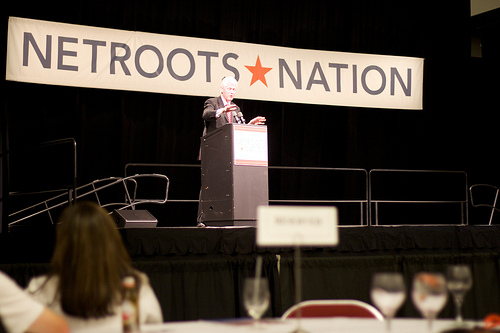
Fmr. Pres. Bill Clinton speaks at the 2009 Netroots Nation Convention in Pittsburgh, PA | Flickr Photo by kyleshank
Each year, for the past five years, members of what has become known as the “netroots” [a term that almost exclusively means progressives, liberals or Democrats that regularly blog and organize on the Internet] have come together for an annual convention known as Netroots Nation to participate in a forum for progressive activists and candidates to strengthen communities online and grow the progressive movement. It has attempted to inspire action and help those in attendance grow new ideas to affect change.
As the “netroots” prepare to meet in Las Vegas to once again discuss what they could be doing (and have been doing) to “amplify” their “progressive voice” by using “technology to influence the public debate,” one wonders if this convention will have any potential long-term value at all to movements in this country desiring more change from the Obama Administration.
David Lightman of McClatchy Newspapers aptly presents the dilemma the “netroots” currently face, “Activists in the liberal blogosphere face a crossroads: They had tremendous success in 2008 helping to turn voter anger into votes for Democrats, but persuading Congress and the White House to adopt their agenda is much harder.”
Lightman adds during the convention “members will quiz House Speaker Nancy Pelosi, D-Calif., and Senate Majority Leader Harry Reid, D-Nev., among others, about why Washington doesn’t move more quickly to end the Afghanistan war or give more help to the millions who are out of work” and the “netroots” will likely be told ” (a) Washington works in complex, deliberate ways, and one should be happy to achieve 80 percent of one’s goals, and (b) since Democrats took control of Washington 18 months ago, they’ve won the enactment of historic legislation on health care, economic stimulus and financial regulation — no small achievements.”
Lightman’s preview of Netroots Nation indicates the convention will be another Democratic exercise in the lowering of progressives’ expectations of what is possible in terms of change in this country. There’s also indication that the focus will not be on Democrats at all. Rep. Chris Van Hollen (D-MD), chairman of the Democratic Congressional Campaign Committee (DCCC), who reassures readers in the McClatchy article that the party is in “no danger of being a captive of the left” believes in unifying “this year’s congressional candidates behind an anti-Republican message: that if the GOP were in charge, things would be much worse.” The DCCC is a sponsor of Netroots Nation.
Rep. Van Hollen appeared on “Meet the Press” on Sunday. Here’s a glimpse at the story the Democratic Party will likely be promoting as it seeks to ensure Americans will vote for them in November:
REP. VAN HOLLEN: Well, what you’re, what you’re hearing is–as, as Bob said, look, we know that we have a long way to go on the economy. People are still hurting, that’s absolutely clear. But we also know what the American people know, which is the day George Bush lost–left office, we were losing 700,000 jobs a month. And during the full eight years of the Bush administration we lost private sector jobs. We are now beginning to climb out. And what we are saying is yes, let’s focus on the policies, because why in the world would we want to go back to the same economic agenda that created that mess, that, that lost jobs for eight years? And I think the challenge that our colleagues have here, Pete and John, is to say to the American people, how do you expect to do the same thing and get a different result? I mean, that, that’s Einstein’s definition of insanity, right? [emphasis added]
Such a message hinges upon whether or not the financial reform legislation can be viewed as shifting the country away from the same economic agenda that created this mess. Robert Reich, who was the Secretary of Labor under President Clinton and is a fairly outspoken progressive voice, asserts, “Congress has labored mightily to produce a mountain of legislation that can be called financial reform, but it has produced a molehill relative to the wreckage Wall Street wreaked upon the nation.”
Also, should we be so certain that the Republican’s are following “Einstein’s definition of insanity”? What they are doing may not be working out for certain sections of the American population, but it is most certainly, politically, paying off. As a tactic, crafting a debate on issues that ranges from what the Tea Party is not willing to accept to what the U.S. Chamber of Commerce, Wall Street and other private interests fear will infringe on their precious free enterprise system today has effectively defanged every piece of legislation that has come up for debate in Congress.
Representatives like Rep. Van Hollen ignore the tactic that the Obama Administration has practiced, the courting of Republican votes for legislation the party will continue to oppose no matter what concessions the Administration grants them.
The Administration has decided Republican voices are more important than any liberal or progressive voices in the Senate or House that might be making demands.Instead of seeking to silence the conservative echo chamber that effectively skewers any progressive agenda items that could potentially be put on the table, the Administration has gone out of their way to assure and reassure Republicans that they can move the debate in their direction.
Progressives, on the other hand, have learned that they will incur the wrath of those in the Administration like the brawny and rugged Chief of Staff Rahm Emanuel and other Obama advisers if they dare to oppose the Administration’s attempts to sterilize legislation on behalf of the corporations they are attempting to regulate.
Given the record of scorn displayed toward progressives who organize with their own agenda in mind (e.g. Emanuel calling liberals “fucking stupid” as they ran ads against Democrats opposing the public option), it’s no surprise that progressive voices would be reluctant to tug the conversation in their direction. Instead of incurring the fire of the Obama Administration, many probably would rather focus on the reactionary Tea Party faction growing within the Republican Party and simply tackle that instead of the failures of the Democratic Party during Obama’s first two years in office. Unfortunately, this ignores the reality that Democrats have failed to rebuff the growing rancor of anti-government sentiment in the GOP and offer an alternative message; in fact, that Tea Party message is effectively dragging the Democrats toward supporting a political agenda more conducive to a vastly unregulated free market system that Democrats admit has gotten us into the mess we are in today.
Democrats have gradually become more and more the party of “no” to progressives. Their admission of running on a message that is anti-Republican is an indication that their campaign strategy for these elections will also be a strategy of “no.” How is this any different than what Republicans have been doing as they claim Democrats are the party of “no”?
What we have in this country is a political establishment discourse that has devolved into discussions from Democrats on why the population should reject Republicans and a discussion from Republicans on why the population should reject Democrats. It does not allow for real talk on the issues any more than a domestic dispute between a husband and wife allows for real discussion on who was responsible for escalating the situation and why there was yelling and screaming in the first place.
To some extent, both parties are right: neither offer an agenda for a future that will go to the root of the problems this country faces and take on the private and powerful interests that are further entrenching these problems in the fabric of American society.
This failure produces a “trickle-down” effect that has a detrimental impact on the “netroots.” Articles and postings like Eric Alterman’s recent essay are published and proclaim that America cannot have a progressive presidency right now. They debilitate, demoralize and produce comments demonstrating an acquiescence to this meme.
The “netroots” will meet and focus on primaries and electing better Democrats, using blogs, Twitter and other social networking technologies to turn “red states” “blue”, how to improve online organizing, the current state of progressive media, etc. There is no doubt that many will take home some valuable knowledge and insight they did not have before they attended. And most likely they will network with other people who are part of the “netroots” community and gain the opportunity to be more effective at what they do. However, this is an event receiving sponsorship from the Democratic Legislative Campaign Committee (DLCC) and the Democratic National Committee (DNC), which contribute to the maintenance and polishing of the Democratic Party’s image.
There would be nothing wrong with these committees supporting this event if wedding this event to those committees did not automatically limit the scope of debate at a time when the dimensions of discussion in politics need to be expanded.
Only in America do political activists (especially ones who call themselves progressives) limit their visions for change to what can be passed legislatively this year or the next. Only in America do those committed to organizing consistently coach themselves to accept terms for organizing that will not alienate the very politicians who have contributed to the situations organizers seek to address.
An event that organizes those who are the most vocal section of society has great potential. But, the dominance of politically-safe sessions (in the aftermath of the Citizens United v. FEC decision, no abolish corporate personhood now workshop), the absence of any sessions on reforming the broken electoral system, and the lack of discussions around the very few differences between Republicans and Democrats and what to do about that reality warrants skepticism.
If the “netroots” leave ready to do more to defend Obama and Democrats from Republicans, this convention will have massively failed. But, if they leave ready to advance small-d democratic policies and items that often appear on proposed progressive agendas, if they leave committed to creating space in the public sphere for real progressive organizing to take place, there is a chance that this event will not have just been an opportunity for Democrats to revitalize support for their increasingly stale politics in this country.
The legislative process is irritating and exhausting. Its two steps forward and one step back – on a really good day. The last couple of days have been relatively good days. The two steps forward were on the Defense Authorization bill: Don’t Ask Don’t Tell is blessedly about to become history, and we got a big boost for the idea of buying American and preserving America’s industrial base with the passage of the Fair Defense Competition amendment, which directs the Department of Defense to consider unfair competition from foreign companies when awarding defense contracts. The step backward was on the “jobs” bill, where the deficit hawks are turning the bill into blue smoke and a mirror or two (Reminder to the deficit hawks, from my time as a Clinton advisor: the best way to get rid of deficits is to create a strong economy with full employment).
The biggest legislative news, though, is now behind the scenes: the conference committee negotiations over the banking bill. I am very concerned about a dynamic developing, and I want to beg every progressive activist and writer to stay deeply engaged in this fight. I’m getting the feeling form a lot of people I’m talking to and a lot of posts I’m reading that people are seeing the fight over this bill as pretty much done. The posts I’m reading have a retrospective quality, people speaking in past tense about how the bill is pretty good versus those who say it didn’t go far enough, etc. This fight is a very long way from being over, however.
Amazingly (to me, anyway), in a lefty blog, somebody recently actually asked the sort of question that, IMO, progressives should have been asking themselves all along. That diary, by “cabaretic”, appeared in docudharma, and was entitled In Search of a Strong Progressive Response to Tea Parties
I hope we’ll learn from the Tea Party in one especially important fashion—not in their crudely rendered signs, prominently displayed firearms, hateful rhetoric, and message of fear, but in their desire to hang together no matter what and in so doing make their voices heard. I find much about the movement loathsome and contemptible, as I’m sure you do too, but one must grant them reluctant kudos that they have staged rally after rally, protest after protest, and have no desire to disband.
While I find this condescending and distorted (“message of fear”, e.g.), at least the author showed some open-mindedness to looking for positives, especially positives that could be emulated.
Below the flip I re-post my comments to “cabaretic”, which speaks to the “what lessons can we learn” question. I don’t develop the ideas much, and frankly, I don’t think one can be confident of their validity, or lack thereof, until somebody attempts to implement them all within the same movement.
Celebrations of Earth Day has garnered some more of the world’s attention to the environmental crisis threatening the health of the global community and our planet, but we must not forget that working towards a sustainable future is a responsibility that will require dedication all 365 days of the year. And while some corporations have jumped on the eco-bandwagon in an attempt to attract the green consumer, we would like to call attention to the unsung heroes. The individuals, communities, and national leaders who have continually shown a dedication to environmental activism, not driven by profit or personal gain, but by the mission of ensuring we have something to celebrate in the decades to come. We, along with our partner Rainforest Alliance, encourage you to join them, because even though there may be little acclaim for the individual in doing the right thing for the planet, your efforts will lead to rewards that extend far beyond your time.
I have noticed there are three operating rules of engagement when it comes to some wide swaths of LGBT community and the Human Rights Campaign.
Rule #1: If we win any electoral campaigns or legislation, it must be because of The Grassroots operating on their own and not anything HRC did.
Rule #2: If we lose, it must be because HRC squandered lots of money and has no influence over the Administration or Congress, and not because The Grassroots didn’t care or had other priorities, but because HRC failed to mobilize The Grassroots.
Rule #3: If HRC does something cool, it should be questioned with cynicism. For example, if something cool happens- like the National Equality March drawing hundreds of thousands of people to the National Mall, driven in part by Lady Gaga’s appearance- it’s teh awesome. But if 1,000 people rally with HRC at Freedom Plaza in DC in the middle of a workday driven in part by Kathy Griffin’s appearance, the use of celebrities in movement activism is questioned.
To that end, it raises a question in my mind on the role traditional legacy organizations play. As Pam notes in her piece on Barney Frank’s comments regarding the LGBT agenda, if our legacy organizations with their foot in the door are ineffective at pressuring the Administration and members of Congress to do what we want, that’s problematic. She’s right. On the other hand, in terms of whether we succeed or fail at something, is it as Pam describes in discussing DADT repeal in trouble:
The bombshell, as it were, is the fact that we see, yet again, that the White House is letting the LGBT community down on DADT repeal in a way that shows the impotence of HRC’s efforts.
Or is it because effective activism by community members hasn’t been lobbed at the White House? I haven’t seen tens of thousands of phone calls flooding the White House switchboard, day-in and day-out. Aside from Dan Choi’s chaining himself to the White House fence, I haven’t seen direct action- either in DC or out following the President around the country- since the President’s State of the Union. So, who is “letting the LGBT community down”, here?
Too often I think there is a misconception that organizations with lots of money and big e-mail lists can mobilize whoever they want, whenever they want. If hundreds of thousands of calls aren’t pouring in, it must be because HRC didn’t push that big red button.
When in reality, it’s hard to mobilize communities. We are not all HRC’s zombies, here. I’ve been doing LGBT organizing for 6 years- both online and offline, in college, on the streets with Soulforce around Don’t Ask, Don’t Tell in 2006, and today. I could name a dozen gay friends who wouldn’t do anything for LGBT rights unless they got a personal phone call from Madonna, and even then only if it’s something they can do on their computer. I’m serious- apathy is real in the LGBT community. Out of the zillions of e-mail lists out there and the millions upon millions of e-action blasts sent, a tiny fraction have truly worked. Chris and I manage e-action at OpenLeft and we can tell you: mobilizing people virtually is hard, especially now that everyone gets flooded from list after list.
Now, to be fair, HRC hasn’t asked people to call the bejeezus out of the White House, or follow the President around the country demanding to know whether he wants to see repeal this year, ginning up earned media- and I’ve called that out, too. They have done event after event in targeted states with swing members of Congress, though, and are partnering with organizations around the country on a massive veterans lobby day on the Hill next month. And at the risk of sounding repetitive, I go back to Chris’ piece on how to start your own netroots organization. Decentralized activism is in these days, as it should be- it’s part of what we do here at OpenLeft. Hell, a blogswarm flooded HRC’s phone lines on DADT just less than a month ago. OpenLeft participated in another one pushing the Speaker’s office on ENDA more recently. From what I heard, both were slammed with calls. Yes, there are limits to what non-large, well-monied organizations can do- not everyone has $40 million to throw around. But just because HRC doesn’t do a tactic doesn’t mean it can’t be done. And don’t assume that if people aren’t mobilized, it must be because HRC is failing to mobilize them.
Nevertheless, if repeal of Don’t Ask, Don’t Tell fails, predictably, the blame game will focus exclusively on HRC, calls to not donate will be made, Andrew Sullivan will once again incorrectly write how they haven’t done anything since their founding, etc. And no doubt, newer, less monied, more “grassroots”- whatever that means- groups like GetEqual will get a pass. My question is whether that will all be correct or not.
The purse strings on activism, so to speak, are not all in the hands of A Few Large Monied Organizations. It’s important to hold them accountable and call out poor organizing where one sees it- I’ve done so myself in many places, including with HRC. As Pam writes, they play a key role in pressuring the White House. But for the sake of responsibility, the rest of us all play a role, too. I don’t assume HRC or anyone else has all the power, and consequently don’t rely on them. Neither should anyone else.
From a long reply of mine (Comment #43) at firedoglake, this mostly stands on it’s own, OK. I argue for creating a credible civic value proposition, that is so easy to attain, as well as so compelling, that even a lazy citizen will be sufficiently motivated to make the necessary effort. In my example, that’s 3 hours PER YEAR.
Today is the end of the first fundraising quarter for candidates for federal office. By April 15th, all candidates for federal office, as well as all federal PACs, have to disclose how much cash they have on hand, how much they raised from January 1st through March 31st, and what expenditures they made.
In an attempt to make themselves appear more viable to party committees, to media outlets, and to other donors, candidates try to rack up as many donations as possible on the last day of the quarter. With email now such an essential part of campaign fundraising to a huge deluge of political fundraising emails today. For some perspective, at 1:30 p.m. Today, eastern, Brandon English tweeted that he had already received 53 email fundraising asks today:
Now 53 end-of-quarter emails in my inbox today. Most popular subject lines are “Midnight” and “X hours to go”. Give to your fav Dems today!
Now, Brandon works on new media for the DCCC, so he might be on more of these candidate email lists than anyone in the country. He also clearly isn’t bothered by the deluge.
However, with literally hundreds of campaigns sending out fundraising emails today, and with many campaigns selling their email lists to other campaigns as a means of paying off campaign debt after elections are over, the signal to noise ratio for online organizers is reaching a disturbing level. I have donated to about 25 different federal campaigns since 2003, mostly in small amounts, and as a result I have received dozens of emails over the past week. Instead of reading them, these days I am pretty much just deleting them all.
While most campaigns will still make far more money over email today than they made any other day this year, the possibility of a long-term, chronic decline seems real. As more campaigns sell their lists to each other, and as campaign email lists grow larger, the usefulness of email as an activism tool can only decline on an email per email basis. And then, as individual emails become less valuable, campaign email lists might grow even larger, as they become cheaper to purchase.
Email remains at the center of new media political organizing for now, but days like today are a reminder that won’t be the case forever. Eventually, social networking will replace email, since social networking groups cannot be sold and since it is much easier for an individual to choose which groups they join. This probably doesn’t spell danger for large, email-based activism organizations over the next few years, but in a decade, or perhaps a little more, the declining value of email will make the basic structure of online political activism completely different than it is now.
Public universities across America are raising tuition so high that many students simply can’t afford it.
For example, the University of California system is boosting its average undergraduate tuition from $7,788 to $10,302. [1]
In five states, public universities already charge undergraduates on average more than $10,000 per year for tuition and fees. [2]
It’s outrageous that US politicians sign blank checks for war, yet turn their backs on young Americans struggling to get an education.
Tell your members of Congress to support tuition-free higher education at public universities.
State governments are justifying massive tuition hikes as a necessary evil in the face of growing state budget deficits. But the real question is one of priorities.
Congress recently passed the largest military budget in US history, [3] while Wall Street enjoyed a massive $14 trillion bailout. [4]
Our members of Congress must prioritize education above endless wars and subsidies for corporate profits.
The future of our nation depends on making quality education available for our young people.
Tell your members of Congress now: support tuition-free higher education at public universities!
Notes: 1. Jenna Johnson and Daniel de Vise, “Students protest cuts to higher-education funds.” Washington Post, March 4, 2010.
2. College Board, Trends in college pricing. October 20, 2009.
3. Tony Capaccio, “Congress Approves $636.3 Billion for Defense in Fiscal 2010.” Bloomberg, December 16, 2009.
4. “Behind the real size of the bailout.” Mother Jones, December 21, 2009.
In the latest game of public option hot potato, Senator Dick Durbin says he will whip hard for a reconciliation bill that includes a public option. However, the caveat is that he will only do so if the House sends a reconciliation bill to the Senate with the public option in it. If the House sends the Senate a reconciliation bill without a public option, then Durbin will whip aggressively against adding one in the Senate. From a Durbin spokesperson:
“I want to be crystal clear: Sen. Durbin and the rest of the Senate Leadership will be aggressively whipping FOR the public option if it is included in the reconciliation bill the House sends over. Conversely, the Leaders will whip against any attempt to alter or amend the bill if the public option is not in it (or as your email says – whip against adding the public option as an amendment in the Senate.)
The reason is simple. There can be no amendments – good or bad – to the reconciliation bill once the House passes it and sends it to the Senate. The House will not do step one (passing the Senate healthcare bill in the first place) if they do not have assurances that the fixes they want (i.e., the fixes in their reconciliation bill) will be passed unchanged by the Senate.”
This is the same point I argued last week: the public option must be in the reconciliation bill that the House sends to the Senate in order to have any chance. Because of the leaderships twin desires not to blow up any deals on votes once the bills reach the floor, and their desire to stop the Republican strategy of filibuster by amendment, they are not going to allow any strengthening amendments to the health reform bills to pass. This includes a public option amendment.
However, it is highly unlikely that there is a public option in the House reconciliation bill. Two weeks ago, Speaker Nancy Pelosi said it was off the table. So, the only way to get it in the bill is through the Budget Committee markup of the bill (which will happen next week sometime), after someone proves that there are 216 votes for a reconciliation fix that includes a public option. That isn’t much time, but it also isn’t entirely impossible.
Now, given that the House is apparently going to have to find the votes for health reform without the Stupak bloc, there are good reasons to think that the House does not have 216 votes for a health reform reconciliation fix without the public option. The Democratic leadership is going to have to find votes for passage among a number of Representatives who voted against the House health reform bill back in November. You can see the list of those members here, and it is not a pretty one when you are looking for about a dozen votes in favor of a health reform bill that includes a public option.
That is the task ahead for the public option–find 216 votes in about five days. CREDO and the PCCC have already sent out action alerts urging people to start this last ditch effort. If you haven’t already received an email from them, visit their websites, and join in.
Did progressive organizations and members of Congress get completely rolled in the health reform negotiations? Nope.
By comparing the current state of health reform legislation to the most conservative proposals that were passed out of Congressional committee, a healthy list of concessions progressives forced out of the right-wing of the party becomes visible. If there were no alterations from the most conservative health reform proposals that were passed out of Congressional committees in 2009, then the current state of health reform legislation would have:
$125 billion less for Medicaid, CHIP and exchange subsidies (total across all three programs);
Numerous exceptions to Medicaid eligibility even for people below 133% of the federal poverty level (FPL from here on out);
No minimum medical loss ratio for health insurance plans, instead of an 85% minimum medical loss ratio;
The Stupak amendment, instead of the Stupak state opt-out that is in the Senate bill;
No extra money for federally funded Community Health Centers, instead of increased funding to provide primary care to 16.2 million patients annually;
An excise tax on high end insurance plans would start in 2013 (giving most unions no time to renegotiate contracts), and a lower threshold (making it less progressive);
No 2.9% tax increase on unearned income, making the funding mechanism for the overall bill less progressive;
A stronger individual mandate and fewer responsibilities for employers;
No national exchange, instead of what appears to be both a state-based and a national exchange in the proposal form the White House.
Does this list of concessions mean that progressive health reform activists have won resounding victories up to this point? Certainly not–the current state of health reform legislation is far from ideal, and much closer to the right-wing proposals that passed Congressional committees in 2009 than the left-wing proposals that passed out of committee.
(Even the best proposals that passed out of committee are a far cry from what many progressives wanted. Then again, there are some conservative Democrats who want no reform at all. As such, I am only looking at proposals that passed committee, since those were the only viable proposals on either side.)
Still, it is an impressive list that should make any progressive activist who participated in the health reform fight proud, even if dissatisfied. You really did improve the bill, and have the opportunity to keep improving it.
In the extended entry, I provide extensive justification for this list of progressive improvements to the health care bill. I do so by comparing the most progressive, and least progressive, proposals to be passed either out of a Congressional committee, or by the full House or Senate in 2009, to the current state of health reform legislation. This analysis looks at ten key fights legislative fights over health reform that have occurred over the past year:
The public option;
Repealing the health insurance industry’s anti-trust exemption;
Instituting a minimum medical loss ratio for insurance policies;
Expanding primary care in low-income areas through Community Health Centers;
Medicaid expansion;
Exchange subsidy levels;
Tax structure for funding the bill;
Insurance exchange structure;
Reproductive rights;
Mandate
It is a lengthy post, but in order to develop a comprehensive list of ways that progressives had improved such a large piece of legislation requires a lot of detail. I have no doubt that there are some areas where my analysis could be cleaned up quite a bit, but at the very least I hope this is a good starting point in an important discussion. So many people who poured their guts into this effort need to know what they achieved, because if this bill passes they achieved quite a bit.
President Obama has proposed a whopping $54 billion in loan guarantees for the construction of new nuclear power plants.
What does that mean? If the costly new nuclear plants aren't finished, then taxpayers cover the huge financial loss.
If they are built, then we're stuck with power plants that generate overpriced electricity and create deadly radioactive waste that will remain toxic for thousands of years.
Either way, the nuclear industry wins, and we lose.
Tell President Obama to stop the nuclear power boondoggle.
Nuclear power creates deadly radioactive waste, from the mining process onwards. It's got a scary history: think Chernobyl and Three Mile Island.
Just recently, a nuclear plant in Vermont was ordered shut down after radioactive tritium, which is linked to cancer, leaked from the plant into local water supplies.
Nuclear power is so financially risky that even Wall Street won't bet on it. It's a public health and financial disaster waiting to happen.
Instead, our government should promote energy efficiency and a decentralized power system based on safe, clean, renewable energy.
Tell President Obama today: don't risk our future with nuclear power subsidies!
Human Rights activists from more than 25 countries gathered in Washington last week for a meeting designed to mobilize greater support for those struggling to advance respect for basic freedoms in fragile new democracies and repressive authoritarian states. They had a packed agenda, including a meeting with President Obama and senior National Security Council staff at the White House.