This is a substantive debate on the issues, with the moderator (Brunswick News reporter Jess Davis) sitting between the two candidates and pitching real questions.
Jack seems peeved to have to be on the same forum as some upstart; sound like certain other debates? Bill was the keynote speaker at the Valdosta Obama office opening.
Bill Gillespie wants to get us out of Iraq by handing over to the Iraqis, preferably within 18 months. Jack Kingston wants any timetable to be decided by the general in Baghdad.
Jack Kingston promotes himself as a champion of renewable energy (although local students don’t agree) but then gets off on offshore drilling.
Is all of the House of Representatives and one-third of the Senate up for election in November? In the midst of all of the talk of vice presidential choices, Paris Hilton and who is the real celebrity, and how much was raised this quarter by the DNC and RNC, I almost forgot.
Well, I didn’t forget. I can’t forget. But things are seriously amiss when it comes to the attention paid to The Other Election day happening on November 4 – and, frankly, on how much people know or follow Congress at all. When 72% of middle-class Americans can’t name a single bill passed by Congress in the last two years that benefited them or their families, we have a problem on our hands.
Now I’m not expecting people to have encyclopedic knowledge of the voting records of their representatives, but in a time in which the minimum wage was increased and college made more affordable and a stimulus package passed, that percentage speaks to a profound disconnect between people and their policymakers that festers in a culture in which reporting on Congress is confused with political horseracing.
This week’s post is by DMI’s Director of Research Amy Traub
John McCain can talk a pretty good game when he wants to. On Tuesday, as he unveiled his economic plan at Carnegie Mellon University, the presumptive Republican Presidential nominee acknowledged that “economics is not a subject that can be wrenched apart from the rest of life, or from the values that give life direction.” He felt the pain of those like the Pennsylvania woman who “work and save for years, and at the age of 47, still struggle for the basics of life.”
Ah, but that was the introduction. When McCain delved into actual policy proposals, the man who had scarcely finished announcing that “it will not be enough to simply dust off the economic policies of four, eight, or twenty-eight years ago” did just that. As with President Bush, tax cuts were presented as the main solution to any economic problem. McCain vowed to maintain the Bush tax cuts – predominantly benefiting the wealthiest Americans and to introduce vast new tax cuts to further undermine an already dangerously indebted federal treasury. But middle-aged worker struggling for the basics of life so vividly evoked in the introduction was quickly forgotten. She would be unlikely to benefit from the proposed corporate tax cuts, which the non-partisan Congressional Budget Office found (pdf) “typically does not create an incentive for [businesses] to spend more on labor” (i.e. hiring or providing raises). Nor would she be likely to get a raise or a new job as a result of incentives for new business investment, since, as the same CBO report noted “last time such incentives were employed, the results were not encouraging.”
(Another instalment in this excellent series that’s garnering more and more attention as time goes on. Don’t be left out… – promoted by Paul Rosenberg)
People from different cultures have different ways of organizing themselves for collective action. Here, I talk about differences between people from working-class and middle-class professional backgrounds.
It’s important to stress that I am not talking about individuals, but instead cultural patterns that play out (or don’t) uniquely in different contexts. These patterns can illuminate why groups act the way they do, but they can’t predict how any individual will act, and don’t capture everything (and sometimes don’t say much at all) about a particular group. In this post I am talking about approaches to social action fairly broadly, and not simply within the tradition of Alinsky-based organizing.
Drum Major Institute for Public Policy’s Rapid Response to the 2008 State of the Union
Click here to read DMI’s full analysis of the President’s domestic policy prescriptions – complete with statistics and talking points — online at www.drummajorinstitute.org/sotu2008
The American people want change. Every Presidential candidate, Democrat and Republican, has made this a mantra. But the State of the Union Address reveals no alteration from President George W. Bush. This year the President labored to keep breathing life into the same worn out ideology that has repeatedly failed America’s current and aspiring middle class.
The President continues to proclaim the foundation of our economy sound when so many current and aspiring middle-class Americans are losing their spot in the American Dream. He prioritizes ideology over proven methods of stimulating the economy and providing health care. He uses the language of consumer choice to dress up what really amounts to unbridled corporate power and profiteering. He continues to assert that the market will right itself, if only people understand it more and restrict it less, despite all of the evidence to the contrary.
Despite the praise-worthy components of President Bush’s address tonight – his signing of the Energy Independence and Security Act, his cooperation with Congress to pass a stimulus reform that would include millions of low-income Americans he initially intended to exclude, his newfound interest in supporting military families – his approach reflected a commitment to ideology, as opposed to willingness to see how that ideology has actually impacted current and aspiring middle-class Americans.
After years of insisting that the economy was doing great as middle-class families were squeezed by stagnant wages and a rising cost of living, it takes weak corporate profits to make the President recognize that times are tough.
* Because the President’s ideology insists that tax cuts are always preferable to government spending, the stimulus proposal includes costly and ineffective incentives for business rather than a fast and efficient expansion of unemployment benefits that would both boost the economy and help the middle-class households hardest hit by the downturn.
* Looking at the corporate recklessness and lack of government oversight that created the subprime mortgage crisis, President Bush avoids regulating the industries at fault. Rather he touts a plan that allows banks to decide on a purely voluntary basis whether they care to work out a payment plan with beleaguered homeowners. We don’t imagine that’s the kind of volunteerism he heralded elsewhere in his address.
* A middle-class standard of living is defined by things like access to education, health coverage and the opportunity to hold down a stable, well-paid job, yet from education to health care to tax policy, the President preferred to experiment with market-based solutions that won’t help aspiring Americans work their way into the middle class. It was particularly shocking that the President urges Congress to make his failed tax cuts for the wealthy permanent, despite their failure to help the nation recover from the last economic downturn.
The President tells us that he trusts the American people. The more important question is whether the American people have any reason to trust the White House. The President’s support of choice in this State of the Union address reveals that he is choosing not to heed the call of the American people for common-sense solutions to the challenges they face.
Yet, what is most important this address, is not the President delivering it, but the ideas represented. This State of the Union can either serve as a blueprint for continuing to move backwards, or a line of demarcation away from a policy outlook that has caused irreparable harm to America’s middle class. While the President’s years of imposing dangerously flawed policies on the nation are drawing to a close, future leaders, in Congress and the White House, will determine whether his distorted worldview lives on, and continues to afflict the middle class and the nation.
* * * * * *
You will find DMI’s full analysis of the President’s domestic policy prescriptions online at www.drummajorinstitute.org/sotu2008
Click here to read DMI’s analysis of what Bush’s State of the Union address means for:
Economy (including the foreclosure crisis)
Budget
Energy and Environment
Healthcare
Education
Veterans
Immigration
FISA Immunity
The problem:
America’s current immigration policy is clearly unacceptable to the general public, immigrant rights activists, immigration opponents and organized labor. Even corporations are dissatisfied with the status quo, even if for their own profit-driven reasons. There is a consensus that reform is needed but there is no consensus on what that reform should look like. At the same time, the status quo of maximum noise with minimum action is a political strategy for a certain segment of the organized right wing. The netroots can play a critical role on this issue by facilitating a conversation that will lead to increased political will for a progressive immigration policy that will benefit America’s squeezed middle class and all those struggling to become middle class.
Many progressive and centrist politicians and political influencers have, until recently, chosen to either remain silent on the need for comprehensive immigration reform or confine their speech to statements supporting an increase in border control only. Local elections across the nation have shown that anti-immigrant demagogy does not win elections despite the public’s concerns about the issue. Yet political leaders continue to advise progressives running for office to regard immigration policy as a “third rail” that should not be touched.
The current state of the debate on immigration policy is entirely unproductive and the relative silence of progressive movement voices has, and will continue, to contribute greatly to the lack of vision and unity on this issue. Treating immigration as a cause to support or attack for the sake of political expediency will not lead to an immigration policy that will strengthen and expand the middle class.
Many already have written about the extremely sickening attacks on a 12yr. old young man, Graeme Frost, and his family.
You can find a reading of others thoughts Here, Here, Here, Here, Here, and Here. And if you just search his name you’ll come up with 41 other hits under Diary’s.
Many may have caught ‘Count Down’, last night, and the interview with the parents of Graeme and his little sister.


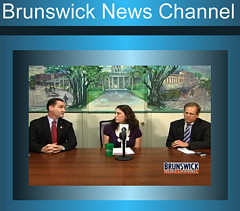 This is a substantive debate on the issues, with the moderator (Brunswick News reporter Jess Davis) sitting between the two candidates and pitching real questions.

 Drum Major Institute for Public Policy’s Rapid Response to the 2008 State of the Union


