At the Monkey Cage, (h/t Digby), John Sides writes "A False Consensus about Public Opinion on Torture", regarding a new report "U.S. Public Opinion on Torture, 2001-2009". Two big take-aways for me:
(1) Throughout the Bush era, a majority always opposed torture, it was only after Obama took office that a majority expressed support.
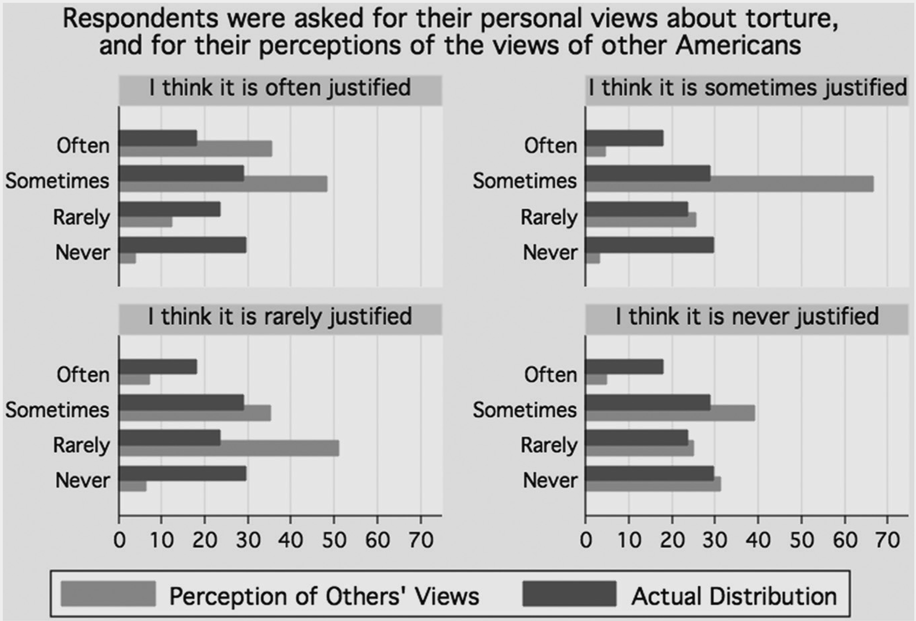
(2) Torture supporters vastly over-estimated the number of people who agreed with them, while torture opponents had a far more realistic sense of how public opinion lined up:
Sides summarizes the introductory paragraphs thus [emphasis added]:
Many journalists and politicians believe that during the Bush administration, a majority of Americans supported torture if they were assured that it would prevent a terrorist attack....But this view was a misperception...we show here that a majority of Americans were opposed to torture throughout the Bush presidency...even when respondents were asked about an imminent terrorist attack, even when enhanced interrogation techniques were not called torture, and even when Americans were assured that torture would work to get crucial information. Opposition to torture remained stable and consistent during the entire Bush presidency. Even soldiers serving in Iraq opposed the use of torture in these conditions...a public majority in favor of torture did not appear until, interestingly, six months into the Obama administration.
The Obama presidency, of course, is just when this this madness should have ended. We did, after all, hear from:
(A) FBI interrogator Ali Soufan who testified about the failure of torture to get important information from Abu Zubaydah, which he was able to get rather quickly using established rapport-building FBI techniques.
(B) Senator Sheldon Whitehouse, who gave an impressive speech, in which he conclued that "measured against the information I have been able to gain access to, the story line we have been led to believe--the story line about waterboarding we have been sold--is false in every one of its dimensions."
"What I have learned is that as the administration authorized harsh interrogation in April and May of 2002--well before the Justice Department had rendered any legal opinion--its principal priority for intelligence was not aimed at pre-empting another terrorist attack on the U.S. but discovering a smoking gun linking Iraq and al-Qa'ida."
And yet, this was when a majority finally came to support torture!
A majority supporting torture did not emerge until June 2009, six months after the inauguration of President Barack Obama, and simultaneous with the reappearance of former Vice President Dick Cheney on the public stage to defend the use of coercive interrogation techniques. The appearance of a public majority who favors torture is a very recent phenomenon. We believe that torture may have become a partisan symbol, distinguishing Republicans from Democrats, that demonstrates hawkishness on national security in the same way that being supportive of the death penalty indicates that a person is tough on crime. A survey conducted by World Public Opinion in June 2009 supports this hypothesis. The most notable aspects of this survey are its findings of a considerable contraction in opposition to torture among Republicans, from 66% in 2004 to 59% in 2009, and an increase of those who said a ban on torture would be too restrictive, from 30% to 39%.3 Ironically, however, when asked about specific coercive techniques that Republicans endorse, more Republicans have become more restrictive in terms of what they regard as acceptable (WorldPublicOpinion.org 2009).
Of course, charging those responsible with war crimes--particularly those at the top--could have seriously altered this dynamic, particularly if someone like conservative Reagan Administration lawyer Bruce Fein had been appointed special counsel to run the investigations and prosecutions. But that would have been "looking backward", which the Obama Administration has decided should only be reserved for those who expose war crimes, not for those who commit them.
As for the military, attitudes toward torture are even more negative there--and for good reason [emphasis added]:
Soldiers in Iraq are surely among those people who have the strongest interest in approving torture. They, more so than the policymakers in Washington, are in harm's way. They often must take swift and sometimes violent action to save the lives of their fellow soldiers.
One might therefore think that this group would be especially likely to endorse torture, but they do not-and wisely so, given that torture has a high cost for soldiers who are asked to perform it (Rejali 2007). Studies of Greek, French, and Brazilian torturers show that participating in torture may induce atrocity-related trauma, as well as leading to, among other outcomes, alcoholism, suicide, and inexplicable violence toward others. The more directly involved a person is with the conduct of torture, the more likely they are to develop posttraumatic stress disorder, depression, or anxiety. These soldiers also experience job burnout and family problems, and sometimes participate in asocial or criminal behavior. Even those soldiers who merely witness torture but do not participate in it can develop these problems. Torture causes all these effects by inducing toxic levels of guilt and shame. Alarming reports of atrocity-related trauma and suicide rates among returning veterans have already emerged (Phillips 2010; Montgomery and Phillips 2009; Benjamin and de Yoanna 2009).
Table 2 shows the opinions on torture of members of the U.S. military currently serving in Iraq.
Military personnel oppose torture in even higher numbers than do civilians. Above all, people who are asked to torture by politicians feel a deep sense of betrayal by those who ask them to do terrible things that are beyond what can or should be demanded of a professional soldier. Military leaders are aware of the strong deprofessionalization effects of torture, and that soldiers who have been involved in torture are harder to assign to other responsibilities. Other soldiers do not accept them back into their ranks because they are perceived as undisciplined and lacking in ethical values.
We used to believe that America doesn't torture. We used to believe that we were better than that.
And others used to believe that about us as well.
But Osama bin Laden believed that he could scare us into showing the world who we really were.
And Dick Cheney happily obliged.
But it took Barack Obama "looking forward, not backward" (except, of course, to punish whistleblowers) to confirm that this was actually the true face of America, and not just some partisan aberration.

 STATE BLOGS


 Powered by: SoapBlox