The number of Americans who believe -- wrongly -- that President Obama is a Muslim has increased significantly since his inauguration and now accounts for nearly 20 percent of the nation's population.
Those results, from a new Pew Research Center survey, were drawn from interviews done before the president's comments about the construction of an Islamic cultural center near Ground Zero, and they suggest that there could be serious political danger for the White House as the debate continues.
The president's religion, like his place of birth, has been the subject of Internet-spread rumors and falsehoods since before he began his presidential campaign, and the poll indicates that those rumors have gained currency since Obama took office. The number of people who now correctly identify Obama as a Christian has dropped to 34 percent, down from nearly half when he took office.
....
More than a third of conservative Republicans now say Obama is a Muslim, nearly double the percentage saying so early last year. Independents, too, are now more apt to see the president as a Muslim: Among independents, 18 percent say he is a Muslim, up eight percentage points.
More than anything, what suggests to me is the severe danger that comes from lying to the American people. The Bush Administration did it all the time. Obama promised to clean things up. But he didn't. He lied about that. He thought that if he just played nice, the Republicans would play nice, too. So there was no need to "look backward", and examine all the sordid, mean, and nasty--not to say lethal and illegal--things the GOP had done.
Well, he was wrong. Because there was no catharsis, the bile just kept on building up. And my fear is that now things are just about to get really nasty.
While this is obviously good news in itself, it also begs the question, since there are similar trends with respect to civil rights and women's rights, but we're still dominated by rightwing nonsense political discourse and can't get much of anything done despite having a significant Democratic trifecta, (a) What the fuck does it mean anyway? and (b) Why doesn't it mean more?
The answers, I indicated, lead back to the recent paper by Hacker and Pierson, "Winner-Take-All Politics: Public Policy, Political Organization, and the Precipitous Rise of Top Incomes in the United States", about which more to come later this week.
But first, a glance at some trend data showing what I was talking about regarding civil rights. While the most intense part of the struggle occured before the advent of the General Social Survey in 1972, there was still some very important shifts in attitude that the GSS managed to capture. And not the least of these was the shift that left Rand Paul's defense of private discrimination in the dust-bin of history. Lest anyone still buy his "I would have marched with Martin Luther King" shtick, here's how actual attitudes toward the "right to discriminate" were gradually turned from the overwhelming white majority position to a margin view:
"We are all in it together" was the sentiment portrayed in last week's opinion polls on the extension of the unemployment benefits. The passing of the bill last week Tuesday was a decision supported by the majority of Americans across the board, regardless of income, race or political orientation.
• According to the CBS News poll, 52% of respondents said Congress should extend unemployment benefits for people currently out of work, even if it meant increasing the budget deficit.
• According to an ABC News/Washington Post poll 62 percent of respondents said Congress should approve another extension.
Some opinions that have been overlooked by the media in the last couple of weeks:
• According to an AP/Gfk poll (PDF), 49% of Americans believe that police crackdowns on undocumented or illegal immigrants unfairly target Hispanics
•The same poll found that 79% of Americans believe that it is somewhat, very or extremely likely that police in Arizona will wind up stopping and questioning Hispanics who are U.S. citizens or legal immigrants as they try to enforce this law and 65% considers this a serious problem
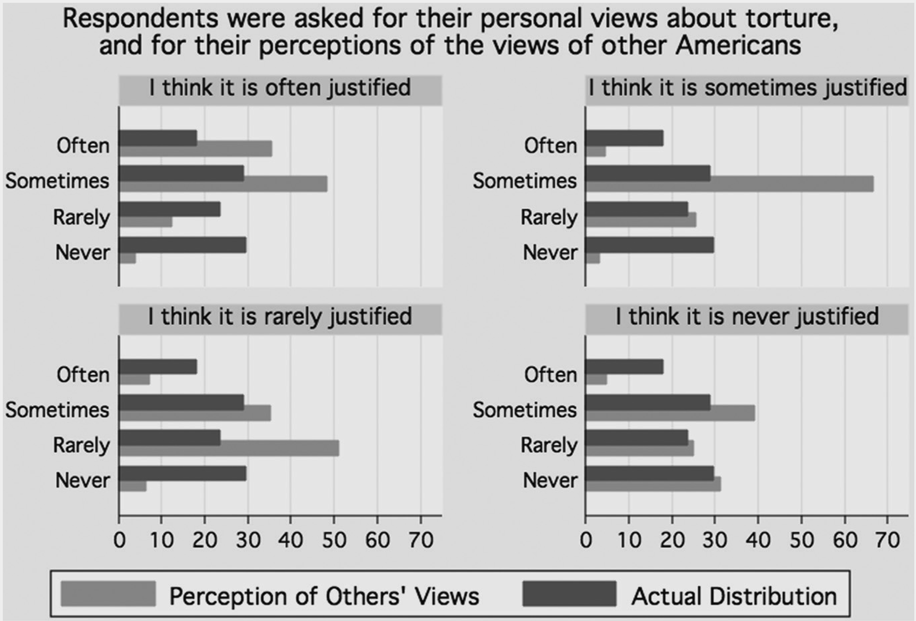
At the Monkey Cage, (h/t Digby), John Sides writes "A False Consensus about Public Opinion on Torture", regarding a new report "U.S. Public Opinion on Torture, 2001-2009". Two big take-aways for me:
(1) Throughout the Bush era, a majority always opposed torture, it was only after Obama took office that a majority expressed support.
(2) Torture supporters vastly over-estimated the number of people who agreed with them, while torture opponents had a far more realistic sense of how public opinion lined up:
Sides summarizes the introductory paragraphs thus [emphasis added]:
Many journalists and politicians believe that during the Bush administration, a majority of Americans supported torture if they were assured that it would prevent a terrorist attack....But this view was a misperception...we show here that a majority of Americans were opposed to torture throughout the Bush presidency...even when respondents were asked about an imminent terrorist attack, even when enhanced interrogation techniques were not called torture, and even when Americans were assured that torture would work to get crucial information. Opposition to torture remained stable and consistent during the entire Bush presidency. Even soldiers serving in Iraq opposed the use of torture in these conditions...a public majority in favor of torture did not appear until, interestingly, six months into the Obama administration.
The Obama presidency, of course, is just when this this madness should have ended. We did, after all, hear from:
(A) FBI interrogator Ali Soufan who testified about the failure of torture to get important information from Abu Zubaydah, which he was able to get rather quickly using established rapport-building FBI techniques.
(B) Senator Sheldon Whitehouse, who gave an impressive speech, in which he conclued that "measured against the information I have been able to gain access to, the story line we have been led to believe--the story line about waterboarding we have been sold--is false in every one of its dimensions."
"What I have learned is that as the administration authorized harsh interrogation in April and May of 2002--well before the Justice Department had rendered any legal opinion--its principal priority for intelligence was not aimed at pre-empting another terrorist attack on the U.S. but discovering a smoking gun linking Iraq and al-Qa'ida."
And yet, this was when a majority finally came to support torture!
Americans are known, for better of for worse, for their strong support of “capitalism” and hesitancy towards “socialism.” A recent poll by Pew Research Center confirmed this notion, although perhaps not with the intensity one would expect. When asked what their first reaction to the word “socialism” was, 59% gave a negative response and only 29% responded positively. Their reaction to the word capitalism was exactly the opposite, 52% gave a positive response, and 37% responded negatively.
Today, the Proposition 8 trial in San Francisco Federal Court will hear its long-awaited closing arguments - as gay marriage advocates prepare to return to the ballot. And a new study conducted by the Haas Jr. Foundation looks at pre-election polling data from 33 states that passed anti-gay marriage initiatives. It concludes (a) we always do worse than what polls say, and (b) voters don't change their minds about this issue during campaigns. The lesson, of course, is that we must work harder to move hearts and minds - and that work can't be done in a short election season. Sadly, the implications of this study will strike many as discouraging - was all the money, time and energy we spent in California and Maine somehow a waste? It's true gay marriage is a sensitive topic that voters develop hard feelings about that can't be changed overnight. But the study did not focus on the small sliver of "persuadable" voters in each election who decide the outcome.
While it would be unwise for any politician to govern by focus group, a recent New York Times/CBS News poll offers some support and some clear suggestions for future action for the White House. The poll, which was conducted in early February 2010, had 1,084 respondents – certainly a small group to be determining policy for 308 million Americans – but the results do resonate.
With or without government intervention? Public Opinion and Facts
Following a pro-longed debate over health care reform, a new legislative battle over financial regulation is under the way. What remains consistent in the public discourse and in Washington is the bone of contention: the role of government.
But what is it that we really argue about it? It could be many things such as the wellbeing of the people, the financial health of the country or America's leading role in world politics. In the bigger picture, a lot of what we are arguing and fighting for are embodied in the idea of the American Dream, that "dream of a land in which life should be better and richer and fuller for every man, with opportunity for each according to ability or achievement" (James Truslow Adams).
As the Copenhagen conference rolls on, American concern for global warming appears to have reached a nadir. Poll after poll indicates that Americans are more skeptical of global warming; meanwhile the Senate cap and trade bill appears to be going nowhere fast.
Most pundits attribute this skepticism to partisan politics. The theory goes something like this: with partisan bickering at an all-time high, Republicans are tending to reflexively oppose any Democratic proposal, and vice versa. Because preventing climate change has become associated with liberals, Republican voters are now automatically treading against it. This Times article exemplifies the strain of thought; it is titled "Rising Partisanship Sharply Erodes U.S. Public's Belief in Global Warming."
On the surface, there is a certain credence to this claim. Most would agree that partisanship is "rising." Belief in global warming is also undeniably falling. Add consistent conservative disbelief of global warming, and everything links together.
There is only one problem with this theory: it is not true.
According to a 2007 poll, Americans define human rights as the rights to equal opportunity, freedom from discrimination, a fair criminal justice system, and freedom from torture or abuse by law enforcement. Despite the current political wrangling over how to reform it, a majority of Americans even believe that access to health care is a human right.
There was a time when America’s leaders echoed those sentiments. President Franklin D. Roosevelt embraced them when he told Congress, “Freedom means the supremacy of human rights everywhere.” And in 1957, President Dwight D. Eisenhower signed into law the Civil Rights Act, forming the U.S. Commission on Civil Rights. The Commission was intended to conduct critical reviews of social needs and public policy – in essence, to be the conscience of the nation. Regardless of circumstances or leadership, the body was to operate as an independent voice for the broad range of civil rights issues facing the country.
The upcoming November elections draw near, both Democrats and Republicans are in an election state of mind. Both parties are focusing on trying to appease their voter base, while Obama and his administration push forward to make due on some promises such as health care reform and the repeal of the ‘Don't Ask, Don't Tell’ military policy.
According to recent surveys 32% of Americans affiliate with the Democratic Party and 26% self-identify as Republican, while 39% identify as independents. Regarding the upcoming fall election, 34% of Americans say that they will definitely vote Democratic, while 37% say that they definitely will not.A majority of the public view both Democrats and Republicans unfavorably. 51% of the public view the Democratic Party negatively, and 57% for Republicans. Three- quarters of the American public disapproves of Congress, which is their highest disapproval rating since 1977. Additionally, half of the public would like to see the filibuster rule changed, in order limit back and forth politics of Congress, and ensure sure legislation actually can be passed.
Americans perception of today's affairs and recent important events, such as the failed terrorist attack on Christmas Day, the President’s State of the Union Address, and the persistent effects of the recession form their agenda for 2010. Although the public's top priorities for the Administration and Congress laid out by recent surveys show that priorities remain similar to last year (jobs and the economy), there have been some notable shifts. These shifts will have an impact on what will gain enough public pressure to get legislation passed in an election year. Let's take a more careful look at how Americans think about the economy, terrorism, health care, and immigration.
Reflecting on Americans' concerns, Obama promised that jobs will be the number one priority in 2010, and demanded a job-creating bill from Congress. According to a poll conducted during the State of the Union Address, mention of the ‘job’s bill’ was one of the president’s highest scoring lines across all political factions. When asked which bills of those mentioned in the SOUT should be prioritized, 70% of respondents chose a job-creating bill, and 49% were in favor of a deficit reduction plan (NPR Survey). At the same time, slightly more voters think that Obama and the Democrats are more concerned with bailing out Wall Street (49%) rather than creating jobs for ordinary Americans (41%), according to a Democracy Corps survey.
The State of the Union speech given last Wednesday by President Obama was a major event and the focus of several polls. Though Gallup reported that, historically, support for the President is not affected by the State of the Union, a before-after survey conducted by CNN shows that the address bolstered viewers confidence in the administration. How long this boost will last, and whether it can be generalized to the entire public, remains to be seen. Another significant upcoming event receiving increasing attention is the decennial census which will be conducted in March.
STATE OF THE UNION
Just before President Obama's State of the Union speech, CNN conducted and released a poll to gauge which issues were most pressing to Americans, and what they were expecting from the President's address. It is not news that people have grown increasingly pessimistic about the direction of the country, and CNN's poll showed over the past year there has been a steep decline in those expressing that the country is headed in the right direction:
•67% in February 2009
•63% in May 2009
•52% in August 2009
•49% in January 2010
Obama's sudden lurch to the right is all in accord with one of Versailles' most treasured, and most bogus narratives, the claim that America is a "center-right" country, and thus that it's both natural and necessary for any Democrat to attack the party's base and trample the things it believes in. After all, they're just a bunch of DFHs, whose views are hated and despised by real Americans (who read David Brooks religiously to know what they should think).
I'll have more to say about the center-right premise in another diary...
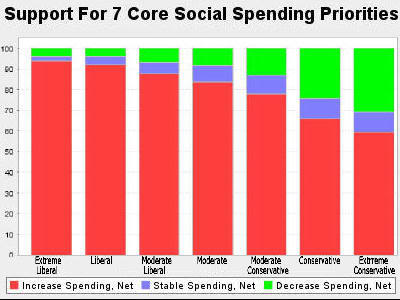
Well, this is that diary. I want to go back to the same data source I used before, the General Social Survey (GSS), which is the most thorough long-term survey of American public opinion, administered 26 times since 1972. The GSS is the gold standard when it comes to American public opinion research, and is cited more frewuently by social scientists than any other data source except the US Census. The data I've drawn from it relates to social spending, and it shows remarkably consistent findings across all the times it has been administered. There are fluctuations, to be sure, but even when the public is in its most conservative frame of mind, support for these programs remains remarkably robust-and not just among liberals and moderates. This data provides undeniable evidence of conservative support for welfare state social spending.
The first thing I'm going to do is look at a combined index of spending preferences, a slightly different one than the one I used in my earlier diary, since this one includes Social Security, which the GSS did not start polling for until 1984. Since then, majority of extreme conservatives (self-identified 7 on a 1-7 scale) said we were spending too little on a combined measure (call it NatWelfComp) of whether people think we're spending too little, too much or about right on seven different areas-Social Security, welfare, "improving [the] nation's education system," "improving & protecting [the] environment," "improving & protecting [the] nations health," "improving the conditions of blacks," and "solving problems of big cities." The number of extreme conservatives who thought we were spending too little on one or more programs (net: i.e. "too little" on two, but "too much" on one is a net of "too little" on one) was nearly twice the number of extreme conservatives who thought we were spending too much: 59.3% to 30.7%. This can be seen in the last column of the chart below: