|
Have you ever had a conversation with your boss? Maybe not. "Do this!" "Do that!" "You're fired!" is not what the dictionary defines as a "conversation."
But if you have, then you probably know how it goes for most people most of the time: You talk about whatever the boss wants to talk about. In fact, the only reason you have a conversation at all is because the boss wants to have one. If he's not interested in having a particular conversation, then it just doesn't happen. Period.
That's what the oligarchy is like--the folks who own/run/control the dominant big businesses in America. They're the boss in America, and if they don't want to have a conversation, it doesn't happen. And when you do have a conversation, it's limited to what they're interested in talking about.
That's why we have the Catfood Commission in the first place. Back in 2001, when Bush was installed as President, we didn't have a deficit, we had a surplus. And we had a projected debt-reduction path that would eventually bring our debt down to zero. That doesn't mean it was necessarily going to happen. But it was at least foreseeable that it very well could happen, if that's what we decided to do.
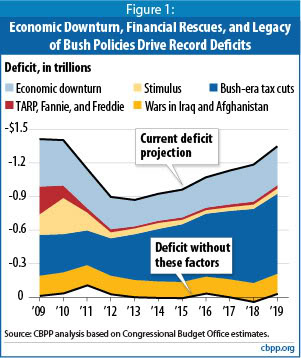
Then Bush pushed through his massive tax cuts, got us into two wars (that had nothing to do with 9/11, except they were just the sort of response that bin Laden was hoping for), and crashed the economy. While he was doing all this, no one cared about the deficit. His VP, Dick Cheney, even said, "Ronald Reagan proved that deficits don't matter." The boss didn't want to talk about deficits or the debt. So we didn't. And it looked like this:
And the situation it left Obama in looked like this (if he was lucky):

Or this:
But, of course, that bit about crashing the economy brought us something new to worry about: the Great Recession....
|
And to recover from that--not just restore some corporate profits, but actually recover, in the sense of putting people back to work again, restoring incomes, consumer spending, etc., what was needed was massive government spending--as we learned way back during the Great Recession.
But the boss didn't like that. "Spend money to help restore the economy for you? Why should I should I restore the economy for you? I've got my bailout. You know what the real problem is? It's not that you don't have a job right now. It's not that you're being kicked out of your home. It's not that the streetlights are being turned off all over America. It's not that we're firing your kids' teachers, and closing the nearest fire department. You know what the real problem is? The real problem is that if we spend money now, then the debt might get to be too high three or four decades from now. So guess what? Let's have a conversation about that!"
But, you know, the whole underlying reason we've got a problem in the first place is that the boss got too powerful, too bossy, and then got carried away with himself. Here's what it looks like in pictures, comparing the fate of the top 1% in income to all the rest of us . First, how we brought down our enormous WWII debt during a period of broadly-shared prosperity from WWII through about 1975:
(The debt/GDP ratio is a measure of the debt compared to the size of the economy. It's a far more meaningful measure than the debt alone, since it compares the debt to the resources available to service or even pay off the debt.)
And here's what's happened to us since 1975, a period of flux that "stabilized" when the oligarchs elected Regan to give them their first really massive tax cut, and they've been gaining ground on the rest of us ever since:
Then how both periods combined look, showing that even now we still have a lower debt/GDP ratio than we did after WWII:
And, finally, a little reminder about just how little even higher education matters as away out of the non-oligarchs dilemma:
That's why oligarchs don't listen to scientists about global warming, or economists about the Great Recession. If they don't like what the experts tell them, they just put out a "help wanted" add until they find someone who tells them what they want to hear.
So they can have the conversation that they want to have.
Which is, as I said in the beginning, why we've got the Catfood Commission in the first place, in the middle of the worst recession since the Great Depression, when interest rates are almost zero and long-term debt is the last thing we should be worrying about....
Except, of course, that that's what the boss wants to talk about.
p.s. Don't forget, the tax structure of state and local governments makes things even worse, since the top 1% pay less than half the tax rate of the bottom 10%:
|


