Authoritarianism & Polarization

by: Paul Rosenberg

Sun Nov 29, 2009 at 12:30


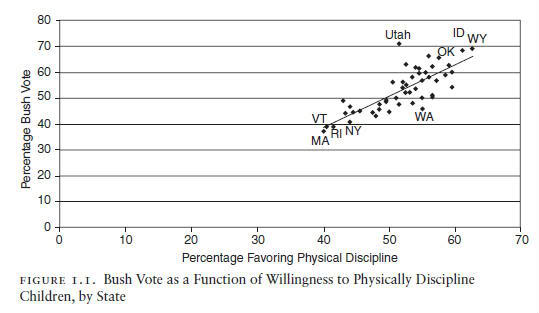
This week, I'm going to be participating in a discussion of Authoritarianism and Polarization in American Politics at TPM Cafe.  I previously highlighted the following chart from the book in a pair of diaries, "Health Care, Racism & The Authoritarian Divide-Part 1" and "Hissy Fits In Historical Context--Health Care, Racism & The Authoritarian Divide-Part 2":

That chart certainly caught my attention, in no uncertain terms.

In the book, the authors, Marc J. Hetherington and Jonathan D. Weiler, explain:

Of course, we do not argue that preferences for disciplining children are causally related to individuals' vote choice. It is absurd to think that spanking children led people to vote Republican in 2004. Indeed, if favoring corporal punishment actually caused people to vote for the more conservative candidate, liberals never would have been elected president. It is only very recently that alternatives to spanking children have been widely employed. Instead, support for spanking likely emanates from a particular worldview which that has a range of ramifications, including political ones.

By worldview, we mean a set of connected beliefs animated by some fundamental, underlying value orientation that is itself, connected to a visceral sense of right and wrong. Politics cleaved by a worldview has the potential for fiery disagreements because considerations about the correct way to lead a good life lie in the balance. Specifically, we demonstrate that American public opinion is increasingly divided along a cleavage that things like parenting styles and "manliness" map onto. We will call that cleavage authoritarianism.

Although authoritarianism in general has long been associated with the right, the authors refine their definition and their argument to such an extent that they capture a distinct phenomena that's noticably different from the broader race- and gender-based culture wars first set in motion in the 60s.  They focus on using the NES (National Election Study) four-item authoritarianism index introduced in 1992.  It asks people to choose between desired pairs of attributes in children:

The pairs of attributes are independence versus respect for elders, obedience versus self-reliance, curiosity versus good manners, and being considerate versus being well behaved. Those who value "respect for elders," "obedience," "good manners," and "being well behaved" score at the maximum of the scale. Those who value "independence," "self-reliance," "curiosity," and "being considerate" score at the minimum.

In particular, the authors show a great deal of recent movement on issues they show are connected to authoritarianism.  One of their most striking tables of data comes from an analysis of items on two Pew Surveys, from 2003 and 2007, in which there is clear evidence of increased polarization on 10 of the 14 items related to authoritarianism, while the other items show a slight average decrease in polarization.  I reproduce it on the flip.

Paul Rosenberg :: Authoritarianism & Polarization
Table 7.7 Differences between Partisans on Authoritarian-Structured versus Traditional Issues, 2003 and 2007, Nonblack Respondents
200320072007-2003
Authoritarian-Structured Values and Preferences
School Boards Should Fire Gay Teachers16215
Police Should Be Able to Search Known Drug Dealer w/o Court Order 11817
Have Old-Fashioned Values about Family and Marriage20200
There Are Clear Guidelines about Good and Evil12197
Free Speech Should Not Extend to Neo-Nazis and Other Extremists7125
Books with Dangerous Ideas Should Be Banned from School Libraries495
Concerned Gov't Is Gathering too Much Info about People like Me21254
Newcomers Threaten Traditional American Customs11209
Improve Position of Blacks even Providing Preferences2825-3
Should Do More to Restrict People Coming into the Country8135
Discrimination against Blacks Is Rare7158
Hasn't Been Much Improvement in the Position of Blacks in US2825-3
Best Way to Ensure Peace Is through Strength29356
Willing to Fight for Country, whether It Is Right or Wrong17258
Mean Change14.920.15.2
Traditional Political Values and Preferences
Businesses Strike Fair Balance between Profits and Public Interest17203
Too Much Power Concentrated in a Few Big Companies2421-3
Businesses Make Too Much Profit2822-6
Unions Are Necessary to Protect Working People24262
Often Worry about the Chances of Nuclear War167-9
Today Rich Are Getting Richer, Poor Poorer3635-1
I Often Don't Have Enough Money to Make Ends Meet17181
I Think the Tax System Is Unfair to People like Me8124
Poor Have Become Too Dependent on Gov't Assistance Programs23274
Government Must Take Care of Those Who Can't Care for Themselves22231
Gov't Should Help More Needy People Even if It Means More Debt32364
Government Should Guarantee All Enough to Eat and Place to Sleep36360
Government Regulation of Business Does More Harm than Good173-14
Federal Gov't Should Run ONLY Things that Can't Be Run at Local Level164-12
Mean Change22.520.6-1.9
Source: Pew Research Center for the People and the Press Values Study, 1987-2007

The differences between the two batteries of questions speak for themselves. While there's a great wealth of information in the book, what should make every political junkie interested in it is the simple fact that it uncovers and explains a great deal about a major shift in American politics that's gone on right under our very noses, virtually undetected.

The table above and the chart above the fold are two of the clearest indications of what is going on here. Conservatives and Republicans understand that intuitively.  It's part of the basic logic of authoritarianism--to see the world in black and white terms, in terms of omnipresent threat, and to rally round a perceived strong leader, no matter what.  Non-authoritarianism, which the authors argue is much more important than generally realized, is much less determinate in the sort of behavior it produces.  If we're going to successfully organize the non-authoritarian side of the increasingly polarized political world we live in, we've going to have to understand it first. And so I invite everyone here to come follow--and join into--the discussion this week.

I promise to followup here next weekend with some further reflections on the book and the disucssion it generates.


Tags: , , (All Tags)
Print Friendly View Send As Email
Is the non-authoritarian model (0.00 / 0)
tied to the post-materialist one?  That one has been notoriously difficult to organize around, with (to my knowledge) the German Green party being the only real success story in the developed world of being able to convert post-materialist goals into political power.


I Wouldn't Say "Tied To" But There's Certainly A Relation (0.00 / 0)
And I wouldn't even call it a model.  But the authors do identify positive traits that characterize non-authoritarians, so it's a start, since that seems to be rarely talked about.

In fact, that difficulty is one of the things I plan on discussing at TPM.

The problem is that both are related to the emergence of higher need orientation as basic survival threats are overcome.  They are well suited to dealing with the world beyond the level of mere immediate necessity, but they aren't well suited to dealing with authoritarianism.

And why should they?  They represent expressions of our basic biological nature, which evolved over millions of years in small groups, in which the power of authoritarians was necessarily quite limited.  The authoritarian threat that's developed since people started living in large groups--agriculture-based civilizations first, then industrial, now post-industrial--is simply much too recent to have had time for biologically-rooted coping orientations to take hold.

"You know what they say -- those of us who fail history... doomed to repeat it in summer school." -- Buffy The Vampire Slayer, Season 6, Episode 3


[ Parent ]
is there an authority on authoritarianism? (0.00 / 0)
It's part of the basic logic of authoritarianism--to see the world in black and white terms, in terms of omnipresent threat, and to rally round a perceived strong leader, no matter what.

Authoritarianism is tricky [or can be] because it is easy to become entangled in means and ends. The most dangerous of authoritarians are those convinced one can define...and then instantiate...an authoritarian set of moral and political values; and then once so circumscribed [by God, by ideology] this justifies pursuing any means to achieve them.

Morality, however, is just a word we invented to acknowledge that when interacting socially, politically and economically [and emotionally and psychologically] we are forced to reconcile the manner in which the behaviors we choose might collide with the behaviors of others. We have to construct some sort of ethical narrative [codified into laws in more modern cultures] otherwise it is a dog eat dog, might makes right, survival of the fittest world.

Some folks try to make human ethics more than that. They try to reconfigure it into an epistemological contraption that is said to reflect the most rational manner in which a normative agenda can be broached. And this contraption, of course, becomes the "authority".

Then some [like Kant] become intent on embodying it further into a deontological agenda.

But describing human behavior in terms of one's "moral duty" is meaningless unless it is assumed that we owe our duty only to someone or something that can be said to reflect the ultimate authority on the matter.

Indeed, when we try to instantiate this analysis by grounding it in an actual existential interaction involving conflicting assesments of moral or immoral behavior, the limitiations of these words [of language itself] becomes more readily manifested.

For example, a debate about the rightness or the wrongness of Obama's Afghan policy...or about abortion, gay marriage, economic justice, gender roles etc.

That's why authoritarians ground their own arguments instead in the received knowledge of God...or Marx or Smith or Hitler...or The Market...or The People.

Authoritarianism is a psychological agenda disguised as a "spiritual" or "political" narrative instead. It can only be exposed if we start by exposing the nature of psychological defense mechanisms. That and political economy, of course.

The power of prose and the prose of power. All jumbled up in, say, Freud?


There's Pretty Good Evidence That It's Basically Biological (4.00 / 1)
Your discussion is way too far out into disembodied intellect land to match up with what's been learned about authoritarianism over the past 70 years or so--not that that body of knowledge is all too coherent in and of itself. But' it is advancing, and it's well worth while to let the empiricists have their say.


"You know what they say -- those of us who fail history... doomed to repeat it in summer school." -- Buffy The Vampire Slayer, Season 6, Episode 3

[ Parent ]
No Altemeyer reference? (0.00 / 0)
Indeed, let the empiricists have their say.

[ Parent ]
Altemeyer Never Investigated This Deeply (0.00 / 0)
There were clearly parent/child correlations, but determining if it was biological or cultural was beyond the scope of his research.

I'd naturally expect it was both.

"You know what they say -- those of us who fail history... doomed to repeat it in summer school." -- Buffy The Vampire Slayer, Season 6, Episode 3


[ Parent ]
repost (0.00 / 0)
Sorry, I should have inserted this post here. Not used to the "REPLY" feature yet.

Your discussion is way too far out into disembodied intellect land to match up with what's been learned about authoritarianism over the past 70 years or so

Well, the closer we get to the biological the closer we get to determinism. And Kant at least allowed both the empiricists and the rationalists to get a word in edgewise; but not before, in the end, grounding them both in the transcendental. In God, in other words.

The authority of choice going back thousands of years.

The more secular facsimiles merely substitute Reason for God.

Or as John Dean broached it among the more conservative swaths:

Authoritarianism is not well understood and seldom discussed in the context of American government and politics, yet it now constitutes the prevailing thinking and behavior among conservatives. Regretably, empirical studies reveal, however, that authoritarians are frequently the enemies of freedom, antidemocratic, antiequality, highly prejudiced, mean-spirited, power hungry, Machiavellian and amoral.

george:

How is this not just empiricism folding its hand and caving in to The Word? And how is this really to be understood except through an understanding of human psychology?

That's the paradox of authoritarianism in my view. The world around us is so immensely complex...so ever entangled in the evolving ambiguities and uncertainties of contingency, chance and change...that the mind yearns time and again to reduce it all down to one or another rendition of The Whole Truth. The irony here being that the so-called rational mind is put on this leash over and again.

Anything to avoid the consequence of nihilism, right?

I am myself a moral relativist so I struggle with this futility everyday in every way. In the absense of God, all things are permitted. And what is this but another way of saying that any and all human behaviors can be rationalized.

So we must nip this at the bud [whether through mind or matter] by insisting all can be explained if only we know how to grasp the nature of the authority behind it.

If anyone wishes to explore this less abstractly, well,  merely choose a moral conflagration [from "just war" in Afhanistan to the nature of human life in the abortion debate] and I can demonstrate the futility of ever "resolving" anything.

--------------------------------------------------------------------------------


[ Parent ]
Look I Was A Philosophy Major For A While (4.00 / 1)
So it's not like I can't hack the stuff.  More like I just don't want to.  There's not a whole lot of cheese down that tunnel. I've been there before.  I know.  It may have been very necessary at one time to blast through a whole lot of rotten assumptions, but we really don't need to go through all that stuff one. more. time.

To say that it's biologically based is not to say its determined, either, because (a) folks can and will struggle with themselves, always have, always will, and (b) authoritarianism is always just one factor in all the analyses presented, multiple factors always contend.

But we do have to realize that in many respects it's a virtually instinctual force we're dealing with here. And we have to recognize that motivations like that are not the same sort of thing as policy "preferences."  They're a whole lot closer to demonic possession, and need to be treated accordingly.  

"You know what they say -- those of us who fail history... doomed to repeat it in summer school." -- Buffy The Vampire Slayer, Season 6, Episode 3


[ Parent ]
I hope you're not dissing Philosophy Majors, Paul (4.00 / 1)
I might take offense to that. :p

Altermeyer did actually do a bit of research into the sources of Authoritarianism, which he talked about in Chapter 2 of his book.  He concluded that the thing that most affected it was life experience: did you tend experience authority as being good or bad?

There's definitely a biological component, but IMO, the main "instinctual" cause of Authoritarianism would be a higher propensity to fear.  That's not based on any research of course, just that fear seems to be the thing that links all the facets of an Authoritarian personality together.

How to deal with Authoritarianism is a much more complicated issue, and I can't even pretend to know anything about that.

Important topic.


[ Parent ]
No Disrespect (0.00 / 0)
It's just that, well, it was quite embarrassing, really, to see how totally the leading lights in the field had misunderstood one another over the years.  After a while one does tend to have ones doubts.  And in the case of Quine, it seemed like he admitted at one point that he hadn't even understood himself.

No wonder I once considered writing a paper titled, "The Elimination of Metaphysics By Bugsy Malone."

And as I recall from The Authoritarian Specter, he came up with a big fat "undecided."  You're probably referring to the The Authoritarians, which has some additional material, but not nearly in comparable detail.

"You know what they say -- those of us who fail history... doomed to repeat it in summer school." -- Buffy The Vampire Slayer, Season 6, Episode 3


[ Parent ]
Heh, fair enough (0.00 / 0)
There's a lot wrong and little right with modern analytic philosophy, I'm definitely with you there.  And Quine isn't the only philosopher who didn't understand himself--Rousseau didn't, either.

Then again, according to Socrates, none of the great artists understand their work, so...

I was referring to The Authoritarians.  I'm not saying there isn't a lot of research that should still be done into the root causes of the personality--there definitely is--but it's going to be complicated and uncertain.  Hard to get certainty in social science.


[ Parent ]
reason, biology and concommitant confusion (0.00 / 0)
On the contrary, we can never go too far in exploring the limitations of language in examining human value judgments.

Authoritarianism, after all, revolves precisely around the assumption that we can.

The exploration stops with the limitation placed on the authority. But it is always boundless isn't it?

But abstract analysis like this can always be demystified once we ground the discussion in an actual existential quandary.

For example: Is abortion immoral? No one knows. Why? Because in the absense of God no one can know. And if no one can know how do we go about authorizing one legal prescription rather than another? By grappling with the issue in moderation...and through ceaseless negociation and compromise.

Democratically, in other words. Democracy is nothing if not the most practical antidote to authoritarian personalities. And here who is say where biology stops and all the rest of it starts?

So, tell me, what is "instinctual" here in debating the moral and political parameters of abortion? Or any other issue in which intense emotional and psychological reactions must be reconciled with "reasonable arguments"?


[ Parent ]
Does this mean (0.00 / 0)
But we do have to realize that in many respects it's a virtually instinctual force we're dealing with here. And we have to recognize that motivations like that are not the same sort of thing as policy "preferences."  They're a whole lot closer to demonic possession, and need to be treated accordingly.

that you subscribe to the "objective enemy" concept?

Even if you believe in some notion of "free will" regarding policy opinions, there certainly is none where it comes to inner demons.

http://attempter.wordpress.com


[ Parent ]
It Means (0.00 / 0)
you can't argue with a man possessed.

Or woman, either.

And when someone calls you a bastard, you don't respond by showing them your birth certificate.

"You know what they say -- those of us who fail history... doomed to repeat it in summer school." -- Buffy The Vampire Slayer, Season 6, Episode 3


[ Parent ]
Thinking (0.00 / 0)
Republicans are very often observed as being Authorians.  I tend to think that they have a rather narrow set of idiological ideas and almost all of their policies/ideas are variations of those themes.  This give the semblance of unity or Authorianism.

From what I've read, the Greens also have a central thought or thrust, thus the look of unity from the outside.  

Conservative......CNN news:Nopenhagen: US PRES 2 WKS LATE ATTEND 1 DAY, GORE JOURNEY BY TRAIN.


[ Parent ]
Impressive. (4.00 / 4)
Both the graph and the charts are really striking.

Also, perhaps there's a slogan here somewhere, "Don't beat your kids, they'll become Republicans"


And maybe an addendum for the truly obtuse (4.00 / 2)
"And do you want Republicans taking care of you when you're old?"

Montani semper liberi

[ Parent ]
Not if I beat them as children (4.00 / 1)
that's for sure

"It sounds wrong...
     ...but its right."


[ Parent ]
the futile (0.00 / 0)
Your discussion is way too far out into disembodied intellect land to match up with what's been learned about authoritarianism over the past 70 years or so

Well, the closer we get to the biological the closer we get to determinism. And Kant at least allowed both the empiricists and the rationalists to get a word in edgewise; but not before, in the end, grounding them both in the transcendental. In God, in other words.

The authority of choice going back thousands of years.

The more secular facsimiles merely substitute Reason for God.

Or as John Dean broached it among the more conservative swaths:

Authoritarianism is not well understood and seldom discussed in the context of American government and politics, yet it now constitutes the prevailing thinking and behavior among conservatives. Regretably, empirical studies reveal, however, that authoritarians are frequently the enemies of freedom, antidemocratic, antiequality, highly prejudiced, mean-spirited, power hungry, Machiavellian and amoral.

george:

How is this not just empiricism folding its hand and caving in to The Word? And how is this really to be understood except through an understanding of human psychology?

That's the paradox of authoritarianism in my view. The world around us is so immensely complex...so ever entangled in the evolving ambiguities and uncertainties of contingency, chance and change...that the mind yearns time and again to reduce it all down to one or another rendition of The Whole Truth. The irony here being that the so-called rational mind is put on this leash over and again.

Anything to avoid the consequence of nihilism, right?

I am myself a moral relativist so I struggle with this futility everyday in every way. In the absense of God, all things are permitted. And what is this but another way of saying that any and all human behaviors can be rationalized.

So we must nip this at the bud [whether through mind or matter] by insisting all can be explained if only we know how to grasp the nature of the authority behind it.

If anyone wishes to explore this less abstractly, well,  merely choose a moral conflagration [from "just war" in Afhanistan to the nature of human life in the abortion debate] and I can demonstrate the futility of ever "resolving" anything.


That all assumes that it's unacceptable to accept provisional (4.00 / 2)
resolutions. And also it just plain ignores that polling on public sentiment on each of those "moral conflagrations" has shifted over time. Clearly, there are many not wholly intractable viewpoints involved. In fact, abortion as performed by midwives was deemed fully acceptable in early America, and it was the evolving medical profession in the 19th C. that lobbied for its ban. It's a complete fiction that these issues are immutable.

[ Parent ]
Eternal Truths (0.00 / 0)
change with times.  That's an eternal truth.

"You know what they say -- those of us who fail history... doomed to repeat it in summer school." -- Buffy The Vampire Slayer, Season 6, Episode 3

[ Parent ]
Can you provide evidence? (4.00 / 1)
You claim:

Well, the closer we get to the biological the closer we get to determinism.

Yet, from my perspective from within the community of research science, specifically in the area of describing the flexibility and adaptive potential of biological systems, this statement is a relic from the days before folks began to understand how instincts, biology and evolution work.

"It sounds wrong...
     ...but its right."


[ Parent ]
For example (0.00 / 0)
Epigenetics.

Maybe Lamarck was just too impatient?


"It sounds wrong...
     ...but its right."


[ Parent ]


USER MENU


blog advertising is good for you

Donate to Open Left

Senate Forecast

National House Ballot All Polls


Without Rasmussen


SEARCH


Advanced Search