With Democrats set to lose seats in the 2010 midterm elections, there is a vigorous, pre-postmortem debate taking place about the cause of those anticipated losses. At the risk of oversimplifying, the basic frame of this debate is between those on the center-left who argue Democrats are in trouble because the economy is still in a shambles (see my article on that here), and those on the right who argue Democrats are in trouble because of ideological policy overreach on spending and health care. (On Monday, Sean Treade presented the most intellectually informed version of the right-wing position.)
To go deeper into this debate, for this article I took a closer look at the history of President Obama's approval rating, combined with a look at models that project President Obama's approval rating based only on the state of the economy. What I found was that the health care debate last summer did cause real, short-term political problems for Obama and Democrats, but that President Obama's current approval rating is little different from where it would have been if the health care debate had not taken place at all. Effectively, the health care debate accelerated a decline in Obama's approval rating that would have taken place anyway given the state the economy.
First, check out these startling numbers. Most of the decline in President Obama's approval rating took place during a 95-day stretch from May 20, 2009 to August 22, 2009. During those 95 days, his approval on Pollster.com fell by 9%, from 60% to 51%. The trendline is remarkable:
Presidnet Obama, Approval Rating, Pollster.com, April 1 through September 30, 2009
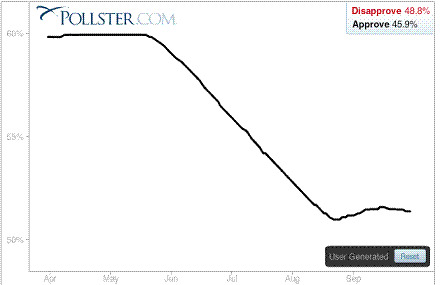
After a 9% decline in 95 days, President Obama's approval rating has dropped by only 5% over the next 326 days--a pace six times slower. As such, the events of those 95 days clearly had an effect on his overall approval rating,and thus on Democratic electoral hopes.
What caused that decline? A survey of the Pew News Interest Index quickly shows that the health care debate was the answer. The health care debate emerged as a major new story in mid-May of 2009, just before the start of President Obama's precipitous approval decline. By the end of July, it became the top news story in America, a position which it held throughout the duration of the 95-day period in the graph above. Here are the trends from Pew:
Percentage of Americans following health care debate "very closely" or "fairly closely," Mid-May through late August, 2009

This simply cannot be a coincidence. A story which emerged just before the start of the approval decline, and which continued to rise in prominence throughout the decline, must have caused the 9% drop in President Obama's approval rating. (Granted, there are other possible causes. In the extended entry, I look at the effect that eight other news stories from those 95 days had on President Obama's approval rating).
However, there is a catch. While the health care debate caused President Obama's approval rating to rapidly decline in the short-term, the economy would have caused Obama's approval to reach its current low point even if the debate had not taken place. In his article, Sean Trende's own chart's demonstrate this. Here is the chart Trende uses to project President Obama's approval rating since January of 2009 using only economic factors:
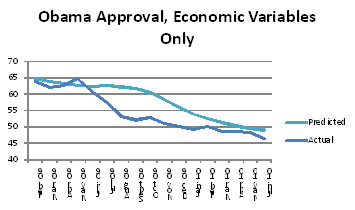
This model projects Obama at a 49% current approval rating based on only economic factors, which is not much different from the 46% approval rating Obama's currently sports. That 3% difference is not much of a difference at all, and appears even smaller when one considers that there are other models out there which project Obama right at the 46% mark based on only economic factors. A difference of 0-3% is not statistically significant.
Effectively, because of the health care debate, President Obama shed soft supporters that he would have shed anyway during a negative economy--he just lost them faster. This likely had a negative effect on Democratic candidate recruitment, on the prospects for progressive legislation after August of 2009, and also on Democratic morale. All of those things had a negative impact on Democratic electoral prospects in 2010, making health care debate an important factor in the current electoral mess Democrats find themselves.
However, none of this changes the fact that the economy is still the primary factor driving this election. With or without the health care debate, Democrats are right where a governing party should expect to be, given the state of the economy. If there had been a 3-4% improvement in real disposable income for Americans over the last 11 months, Democrats would be sitting pretty for a third electoral landslide in 2010, or at least to maintain nearly all of their current majorities.
As an addendum to this post, in the extended entry I look at other possible causes for the steep decline in Obama's approval ratings during those fateful 95-days in the summer of 2009. I consider five that likely had no impact, and three others that were probably minor contributors. Please, be sure to check it out.
|
Five news stories that likely played no role in President Obama's rapid approval decline in the Summer of 2009
- The Energy / Climate bill that passed the House: In his article, Trende argues that this bill was a cause for Obama's decline in the summer of 2009. However, a closer inspection shows this to be highly improbable. According to Pew, the climate bill that passes the House in June of 2009 was never the stop top for more than 6% of the country, and peaked at a pitiful 45% of the country following it "very closely" or "fairly closely" in mid-June. Its numbers were usually in the mid-30s. The week that is passed the House, significantly more people nationwide followed the crash of a Metro train in D.C., than followed the health care bill. Plus the bill was, and still is, quite popular. Further, even in the recent Democracy Corps poll (PDF) Trende cites in his article, quite literally no one seems to have mentioned it as a reason for their disapproval of President Obama. There is just no frakking way this was a cause of the downward spike in President Obama's approval.
- Sonia Sotomayor: Sonia Sotomayor's nomination to the Supreme Court was a another major political story during these 95 days. However, Polling Report shows no poll where more than 36% of the country opposed Sotomayor. The vast majority of polls showed national opposition to her nomination being at 30% or less. While she received more interest than the climate bill (see here, PDF, page, 4) overall the country paid nowhere near as much attention to her as they did to the economy and the health care debate during the summer of 2009. She simply could not have been much of a factor.
- Other possibilities: Some other big stories of the summer of 2009 that likely had no effect on President Obama's approval rating, or Democratic electoral chances, include worries about swine flu, the death of Michael Jackson, and the uprising in Iran.
Three likely minor, non-health care related causes for Obama's slide in mid-2009
- Economy: More Americans followed news about the economy than health care during these 95 days (the only story that drew more attention than health care during that 95-day stretch). However, there was no increase in the number of Americans following news about the economy from previous months, and thus it really cannot serve as an explanation for a sharp decline in Obama's approval rating. It was probably a partial cause though, and President Obama's approval would have suffered a slow downward trend in mid-2009 due to the economy if there were no other major political stories at the time
- Henry Louis Gates incident: This likely hurt President Obama's approval rating, and thus Democratic electoral chances. It drew more attention than the Sotomayor nomination (peaking at 61% "very closely" or "fairly closely" following). Also, President Obama received a sharply net negative approval rating for the incident. That is a pretty bad combination, and must have had an effect. However, since the trend started before the incident, and continued after it, there is no way it was the major cause.
- GM and Chrysler bailout. Financial problems in the auto industry were huge news at the start of the 95 day decline in President Obama's approval rating. After General Motors filed for bankruptcy on June 1st, an average of 69% of the country followed the stories "very closely," or "fairly' closely for the next three weeks. The earlier bailout of GM and Chrysler had been deeply unpopular, opposed by a clear majority of the country, sometimes by 2-1 margins. As such, having this story in the news simply could not have been beneficial to the Obama administration, as Americans were reminded of an Obama administration action they overwhelmingly disapproved of. With the government owning a controlling share in GM during this time, President Obama likely took a hit in the polls.
|


