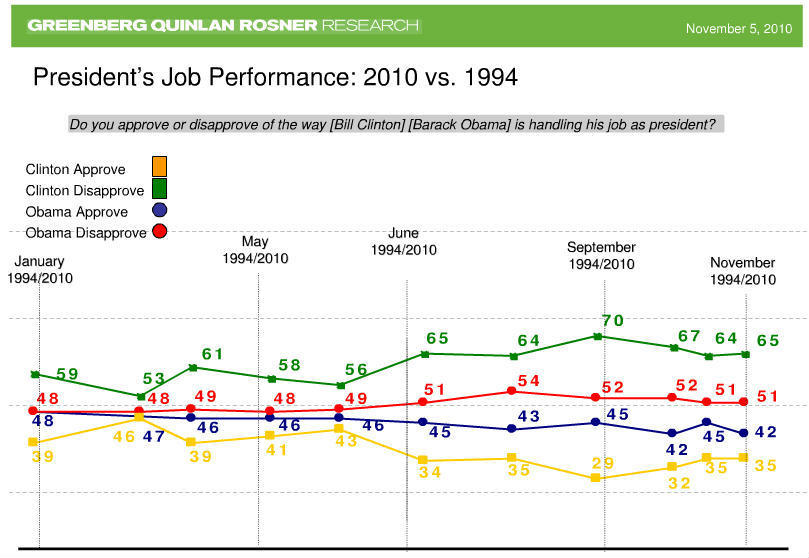
Here are the key bullet points released along with presentation:
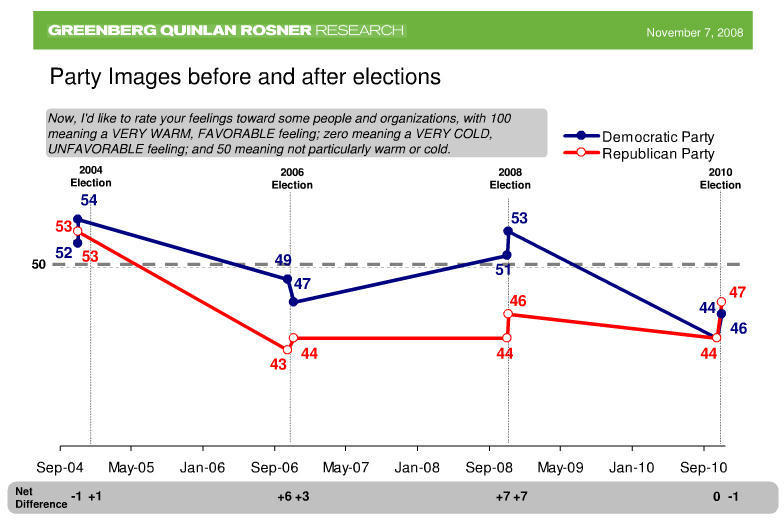
•Fifty-eight percent of respondents who voted said they were trying to send a message about how dissatisfied they are with things in Washington. But they were not necessarily embracing the Republican party and its policies: Both political parties received equally poor favorability ratings, as did the Tea Party movement. Twenty-six percent of voters said they were trying to send a message to "both parties" with their vote, while only 20 percent cited President Obama and 15 percent said Democrats in Congress.
•"Too much bickering in Washington" was the top complaint of voters in the poll (39 percent), followed by "too much spending, taxes and deficits" (35 percent).
•Fifty-eight percent of voters said they were much or somewhat more likely to vote for a candidate that promised "to change Washington for the middle class. That means eliminating the special deals and tax breaks won by corporate lobbyists for Wall Street, paid for by American taxpayers and workers' outsourced jobs. Republicans have pledged to protect those breaks. We should cut taxes for the middle class and small business to create jobs."
•Compared to a candidate who attacked Democrats for the economic stimulus and health care reform, 57 percent of voters said they were much or somewhat more likely to support a candidate with a "made-in-America" campaign message that points out that Republicans have "pledged to support free trade deals and protect tax breaks for companies that send American jobs to India and China."
•Eighty-nine percent of those surveyed agreed with the statement that "America is falling behind" in the global economy and that "we need a clear strategy to make things in America, make our economy competitive, and revive America's middle class."
•Sixty-nine percent said that "politicians should keep their hands off Social Security and Medicare" as they attempt to address the national deficit.
•A majority opposed the Republican plan to cut $100 billion from domestic spending programs while extending the Bush tax cuts to those earning more than $250,000, while 51 percent said they agreed that those top-end tax cuts should expire and with proposals offered by Democrats to reduce the deficit over time.
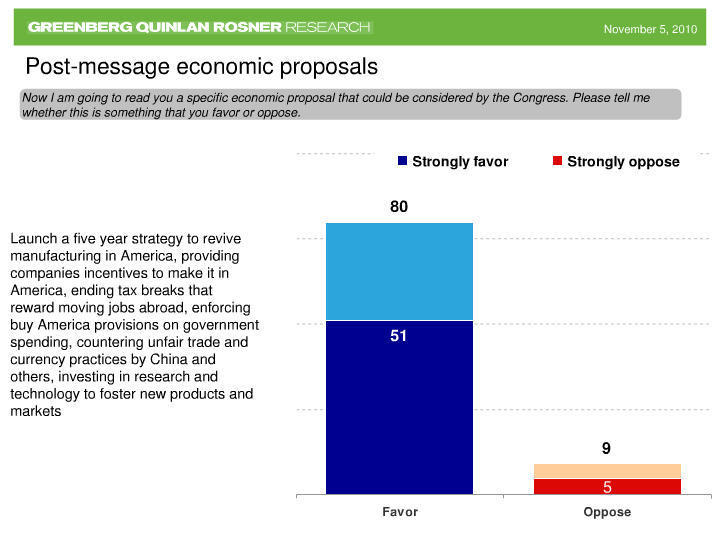
•Significant majorities in the poll supported new investments in infrastructure through a national infrastructure bank, a five-year strategy for reviving manufacturing in America
A shift away from neo-liberalism, and back toward the traditional social democratic core values of the Democratic Party holds up well, as reflected in a number of different alternatives presented. Bear in mind, this is an extremely conservative electorate that's endorsing these traditional Democratic alternatives in the following pairings:
First, hands off Social Security:
[Click to Enlarge in New Window]
Then, a Democratic approach to tax cuts and deficit reduction:
[Click to Enlarge in New Window]
Things get more muddled combining the two (but remember, this is VERY conservative electorate):
[Click to Enlarge in New Window]
But the Democratic advantage emerges quite strongly when the frame of comparison is expanded:
[Click to Enlarge in New Window]
The immigration issue (again--conservative electorate) again tips Republican, in part because it's a narrower frame once again:
[Click to Enlarge in New Window]
And "free trade" fares more poorly against a more robust alternative:
[Click to Enlarge in New Window]
Than in this alternative:
[Click to Enlarge in New Window]
These are some of the component attitudes that all combine to produce the enormously popular alternative presented above the fold, which I just can't resist concluding with again:
[Click to Enlarge in New Window]
Democrats still hold a winning hand, if only they're willing to play it. |