This morning I participated in a briefing with pollster Stan Greenberg and Campaign for America's Future co-director Robert Borosage, based on an election post-mortem poll done by Greenberg's firm, Greenberg Quinlin Rosner, which Greenberg has been doing every election since 1996. From the advance press release:
"Democrats and the President paid a big price for failing to make a case for bold action on the economy, and for continuing Bush's Wall Street policies," said Borosage.
"Those suggesting this election represents an ideological shift are simply wrong," said Greenberg. "Voters are not buying what Republicans are selling, particularly cuts in Social Security and Medicare, education and the environment. And, voters are offended by the partisan posturing which Republicans will have a hard time transcending even with the House majority. Americans are still looking for answers, and not happy with the ones they've been getting from either party."
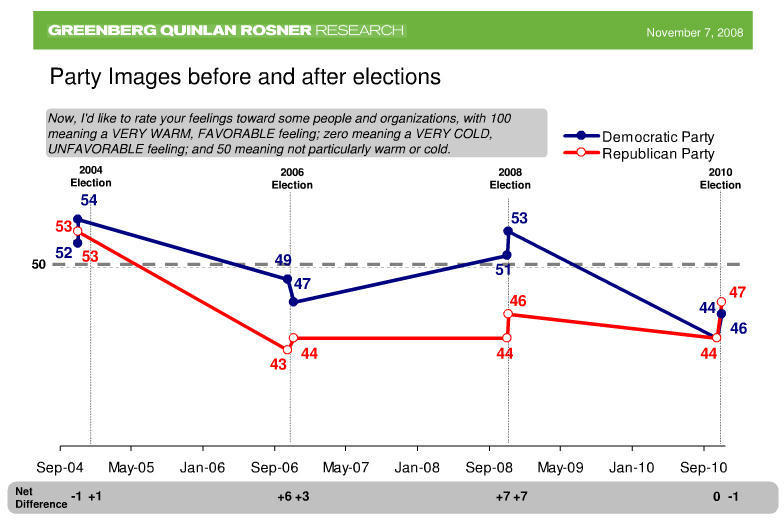
The main thrust of their presentation was that this was a protest-the-way-things-are-going-in-Washington election rather than an ideological one. Indeed, what's happened since Democrats came to power is that their failure to change how Washington works has eroded support for them, without substantially improving the Republicans' standing:
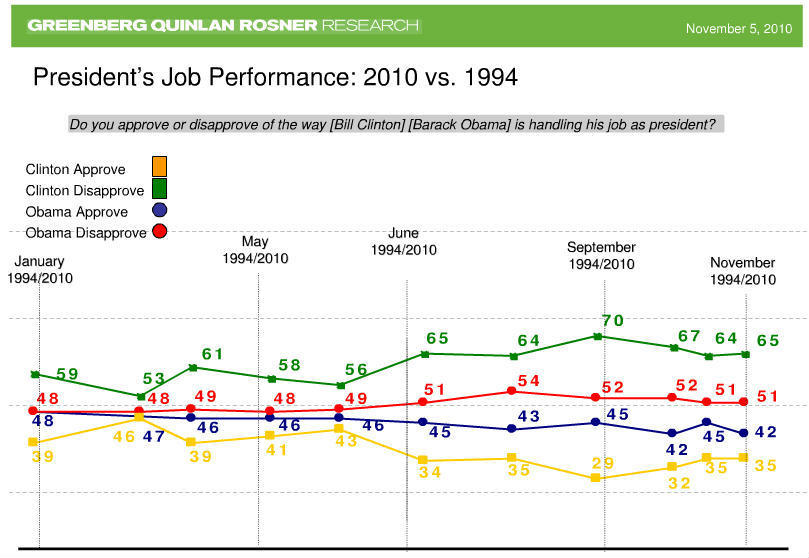
While Obama's approval rating has declined this year because of his failure to overcome how Washington works, he's still in much better shape than Clinton was in 1994:
How's that Wall Street bailout working out for you?
Even after Wall Street panicked Congress into approving up to $700 billion to buy "toxic" mortgage-backed securities, the stock market continued to plunge and credit markets tightened. But a week after Treasury Secretary Henry Paulson reportedly told President Bush "There is no Plan B," it turns out there is one: The Federal Reserve, on its own authority, plans to buy unsecured short-term debt ("commercial paper") to corporations needing credit to maintain operations.
"This will keep the credit markets working even if the zombie banks aren't up to the task," Dean Baker of the Center for Economic and Policy Research wrote at Prospect.org (Oct. 7). "In other words, the threat of a complete meltdown in the absence of a bailout was nonsense and the media once again got taken for a ride by the Bush administration."
Baker, like many progressive economists, favored a direct injection of capital into the banking system instead of overpaying for bad assets, as Paulson proposed.