Even though I worry a lot about climate change, and was as horrified by the BP spill as any incident in recent years, I have not written much at all about environmental issues. I don't like to write about things that I don't know a fair amount about, and my focus in my work has always been politics and economics, so that is mostly what I write about. However, I feel compelled to drop a note about the controversy that has flared up the last couple of days, in part because it does relate directly to something I do have experience in, which is how White Houses operate.
I'm not going to spend time on the technical details of the working paper from the National Commission on the BP Deepwater Horizon Oil Spill and Offshore Drilling. That paper suggests that the administration vastly underestimated the amount of oil going into the gulf in spite of contrary information from scientists using other methodologies. The traditional media, which loves to assume the worst, has written stories implying the reasons for this was that the White House wanted to cover this data up. Robert Gibbs gave this response yesterday:
MR. GIBBS: Look, I think it is important to understand that our response attacked the oil spill in an unprecedented way. It was the largest environmental disaster that we have ever faced and we attacked it with the largest federal response. We did all that was humanly possible in the most challenging of environments.
The report that NOAA sent over did not include in its modeling -- it's not a flow-rate document -- in its modeling did not include any activity that was being done, as I just mentioned a minute ago, to mechanically recover, skim, to burn, to disperse, to boom oil from spreading along the coast and up the Eastern seaboard, which we now know it didn't do.
No information was altered. No information was withheld. And nothing in the report had anything to do with the robust response.
OMB is a regular part of a process that reviews government documents before they're released. NOAA, as we put out in a statement yesterday, understood that the analysis did not include that, went back and included that, and that report was released and is on the Internet for anyone to read today.
Q Okay, but -- so OMB did deny a request from NOAA, just not that request?
MR. GIBBS: OMB sent the report back to NOAA to include that in the 500 different modeling analysis that were done on shoreline impact. That report is on the Internet now for people to look at. The worst-case scenario -- and if you look at those maps, the worst-case scenario was oil off the coast of what looks like probably the Hilton Head/Charleston area in South Carolina, which is, as you know, several hundred miles, maybe a thousand or so miles from where the oil actually did get to because the response prevented it from spreading.
Q One of the fundamental points that the working documents make is that the optimistic expression of information from the administration showed the government was either not fully competent to handle the spill or not fully candid. Was it either of those?
MR. GIBBS: This was an unprecedented environmental disaster met with an unprecedented federal response, which prevented any of the worst-case scenarios to coming to fruition. It prevented the spread of oil along the East Coast.
When we had information, we gave it to the public. That was -- that has always been our charge. We were -- throughout this process, we got better information. When the rig exploded and the blowout preventer failed 5,000 feet below the ocean, nobody could see what was happening. Through the course of several months, we got better information. We got cameras 5,000 feet below the surface. We enhanced the video that we saw. We were able to do more three-dimensional modeling. And then we directed, at Secretary Chu's insistence, BP to install pressure monitors at the site to get the best available data on the flow rate. And that's what we did. We always sought to provide the best information as we were engaged in the most robust federal response that we've ever seen to an accident of this magnitude ever.
I am quite inclined to believe Gibbs on this one, because I look at it from the perspective of what would benefit the White House short and long term. At the time all this was going down, there was a confusing swirl of facts and a high urgency crisis going on. There was no benefit to the White House to downplay the problem, and it would have been silly for them to try: everybody understood that this was a huge deal- environmentally, politically, and in every other way. If anything, it seems to me like the White House would be trying to underscore how monumental the challenge was. Look at it this way: if the spill got solved fast, even if it was a huge disaster, they get all the more credit. If the problem dragged on, which is what ended up happening, they get less blame if the public understands just how big a blowout this was.
Here's the other thing: everyone who has served at a White House knows that on something with this level of media and political scrutiny, it does not pay over the long term to gloss over or minimize problems, because if you do it will be found out.
The Obama White House had no political incentive at the point in the crisis being discussed. What was happening was a thousand different scientists from dozens of agencies were desperately and urgently trying to figure this out, and estimates were all over the place. As Gibbs indicated, even the reports being sent over from agencies like NOAA did not include certain kinds of things in its modeling that were being included in other models. It is not surprising that one set of scientists might get their nose out of joint because their numbers weren't the ones being used at that particular point, but there certainly doesn't seem to be any ill intent on the part of the White House on this one.
Now was the White House response to the BP spill overall perfect? Of course not. I wish they had been more aggressive with BP from the beginning. But this draft report from the commission strikes me as a tempest in a teapot. I'd love to hear from those of you who know more about the science here than I do if you think I'm wrong, because like I said I am always uncomfortable venturing into an area I don't know much about. But on the political motivations of the White House, I feel pretty confident I'm right.
Whispers whirled around the White House, on The Hill, within the Department of Justice, and finally filtered down to the streets. In truth, talk could be heard on the avenues, where average Americans roam, long before declarations came from above. Should BP CEO Tony Hayward Go to Prison? The public wonders. What would the Obama Administration do. Countless clamored; with full knowledge that President Bush's DOJ Killed a Criminal Probe Into BP. It was believed that the potential indictments threatened the most senior officials. More recently, words of warrants have become a distinct possibility. Criminal charges are being considered against BP in regards to the Gulf oil rig tragedy.
The Sacramento Bee reported yesterday that "BP, the energy giant responsible for the largest offshore oil spill in history, helped develop [California's] framework for teaching more than 6 million students about the environment."
That's right; the same people who brought you the Gulf of Mexico oil disaster are helping to shape the education of millions of students. In fact, the environmental education curriculum will be used in "kindergarten through 12th-grade classes in more than 1,000 school districts statewide."
The thought of BP - or any big oil company - playing a role in designing education on environmental issues makes me very nervous. In California, we've got Texas oil companies spending millions of dollars trying to kill our landmark clean energy and climate law. That's bad enough; we certainly don't need a British oil company writing our kids' education materials.
Dollie Forney, a mother of three from San Jose said, "This is outrageous. Now our schools and officials are so cash-strapped and unimaginative and desperate we are allowing Big Oil to write our children's curriculum? "
The fact is, over the years, BP has rightly earned the title of having "the worst safety and environmental record of any oil company operating in America." Of course, that's not much of an honor, especially when you consider how BP came by its miserable environmental reputation. This includes being slapped with "the two largest fines in OSHA history -- $87.43 million and $21.36 million -- for willful negligence that led to the deaths of 15 workers and injured 170 others in a March 2005 refinery explosion in Texas." BP also "agreed to pay a $50 million fine and plead guilty to a felony violation of the Clean Air Act, and was fined "a total of $21 million for manipulating the California electricity market, Enron-style."
It's not a pretty picture. All of which raises the question, why would anyone even think of giving this company a say in designing education materials on the environment, of all topics? As Lisa Graves of the Center for Media and Democracy says, "I'd hate to see how a section in future textbooks mentioning the BP oil spill will look."
I am one of those people who will actually watch those boring, boring, hearings on C-SPAN that most of us flip right on past while watching TV, and this past week I've been watching one of the longer events the channel broadcasts...but it's been far from boring.
The Coast Guard and what used to be the MMS were in Houston looking into what caused the Gulf oil spill and they're taking testimony from representatives of the involved parties...and let me tell you, this is more than just an accident inquiry-it's also a warm-up for the lawsuits that are surely going to follow.
This is the sixth article in a continuing series by the NRDC Action Fund on the environmental stances of candidates in key races around the country.
Today, we examine Ohio's 15th Congressional District, which includes downtown Columbus and parts of neighboring Franklin, Madison and Union counties. Columbus is home to the Ohio State University and has the highest proportion of young professionals, aged 25-34, of any city in the country. In 2008, Mary Jo Kilroy became the first Democrat elected in the district since 1982, when she narrowly (by less than 2,500 votes) defeated Republican Steve Stivers. Kilroy and Stivers will be matched up again this fall.
Since coming to Washington, Rep. Kilroy has consistently voted for environmental protections and moving America to a clean energy economy. In her first year in the House, she received a perfect 100% rating from the League of Conservation Voters, which means she voted the right way on every environmental vote. This includes voting for the historic American Clean Energy and Security Act (ACES), the first climate bill to ever pass in a chamber of Congress. In a statement following the vote, Kilroy said "The clean energy economy is the future of our country and of central Ohio...We are seeing the consequences of not investing in the next big idea with our auto industry. [ACES] secures Ohio's strong position to make the solar panels and wind turbines that will power our nation in the very near future. It will also benefit Ohio's agricultural sector, which can provide the plant material needed for the bio mass products that boost energy production." She added, "This bill puts the central consumers first and insulates them from shifts in prices. For less than a trip to the movie theater, Americans are going to create 1.7 million (jobs), end the stranglehold foreign countries have on energy and work to save our planet."
In sharp contrast, Steve Stivers falsely calls cap and trade a "job killer" that will lead to higher electricity bills for Ohio families. In reality, strong clean energy and climate legislation would create a net of 1.9 million jobs, according to in-depth study by the University of Illinois, Yale University and the University of California. In Ohio, this would mean 61,000 new, good-paying jobs created over the next ten years. And, as analysis by the experts in the nonpartisan Congressional Budget Office shows, the effect of ACES on electricity bills will be, as Rep. Kilroy said, less than going to the movies once a month.
Stivers doesn't just stop at opposing clean energy and climate legislation, he also "disagree[s]" with the statement, "Man-made global warming is a scientific fact and immediate action to lower CO2 emissions is necessary to prevent an environmental catastrophe." And, if denying the unassailable science behind climate change wasn't enough, Stivers also opposes our right to hold the government accountable in court for protecting our public health and environment.
Stivers' strong anti-environmental views are not so surprising when you consider the sources of his campaign cash, such as oil and coal services giant Koch Industries, Murray Energy and Rep. Joe Barton's Texas Freedom PAC. What's wrong with these companies and PACs?
Koch Industries is privately owned by Charles and David Koch, who, according to Greenpeace, have "quietly funneled [$50 million] to climate-denial front groups that are working to delay policies and regulations aimed at stopping global warming." Robert Murray, the head of Murray Energy, is an outspoken climate denier, who said in testimony before the Senate Environment and Public Works committee that global warming is "one of the biggest con jobs in the history of the Republic." Murray continued to criticize the legacy of Rachel Carson, saying that "She and her environmental followers killed millions of human beings around the World with the ban on DDT." Murray concluded by claiming that climate change legislation will "result in no environmental benefit." Finally, the Texas Freedom PAC is headed by Joe Barton, who infamously apologized to BP, and who also called the BP escrow fund that will pay businesses that lost money because of the Gulf disaster a "$20 billion shakedown."
These are a few of Stivers' big donors, all major polluters or supporters of major polluters, which makes you wonder what they think they're getting for their large donations to the Steve Stivers for Congress campaign.
The NRDC Action Fund believes that it is important for the public in general, and the voters of specific Congressional districts, be aware of this information as they weigh their choices for November.
(Waiting on Democratic strategists to figure out what to do is simply a passive way of committing suicide. Nuts to that. - promoted by Paul Rosenberg)
The following is the culmination of something I've been working on for several weeks. I've put a great deal of my time into this so whatever you do please make sure you watch the video.
This is the third article in a continuing series by the NRDC Action Fund on the environmental stances of candidates in key races around the country.
Today, we examine Ohio's 1st Congressional District, which encompasses Cincinnati and parts of nearby suburbs. Cincinnati is home to the Reds, but in the House it's represented by the self-described "raging moderate," Democrat Steve Driehaus. A longtime member of the Ohio legislature, in 2008, Driehaus won election to the House seat his father unsuccessfully sought 40 years ago. This November he is being challenged by former Republican Congressman Steve Chabot, whom Driehaus unseated in 2008 despite being outspent by nearly $1 million.
When a district is home to the company that makes products like "Mr. Clean," one would hope that its Congressional representative would champion clean energy. Rep. Driehaus has been a reliable environmental champion. In his first year in Congress, he received a perfect score from the League of Conservation Voters, meaning that he cast a pro-environmental vote at every opportunity. Most notably, Driehaus voted for the historic American Clean Energy and Security Act (ACES), the first global warming bill to ever pass a chamber of Congress. After the vote, Driehaus said, "Ohio has the resources and workforce to be at the cutting edge as we move our nation toward a clean energy economy, and [ACES] will promote investments that will bring the potential of clean energy development into our community...This bill will help us end our addiction to imported oil, which threatens our security and sends too much American money overseas. I'm proud to stand with my colleagues today to do the right thing for the future of America's economy and security."
In sharp contrast, in 2008 -- Chabot's last year in Congress -- the League of Conservation Voters gave him a bottom-of-the-barrel 8% rating on environmental issues. Chabot earned his low rating by voting against renewable energy, against removing oil and gas exploration subsidies, against keeping a moratorium on offshore oil drilling, against raising fuel economy standards for vehicles, against prohibiting oil drilling in the Arctic National Wildlife Refuge and against implementing the Kyoto Protocol. In short, Steve Chabot voted against the environment at pretty much every opportunity.
Chabot's position hasn't changed since leaving Congress. On the campaign trail, he's said that he "strongly oppose[s] cap and trade," citing fuzzy math claiming that it will "cost the average American family an additional $1,770 a year in higher energy costs." The truth, according to the experts in the nonpartisan Congressional Budget Office (CBO), is that the net economy-wide cost of the cap-and-trade program would be about $175 per household" -- or one-tenth of what Steve Chabot is claiming.
Furthermore, the CBO's estimate doesn't include the benefits of reducing global warming, such as mitigating the record-setting heat and drought conditions we're already seeing around the world.
And just as important, Chabot is ignoring the positive job impact of passing ACES, which would create an estimated 1.9 million jobs, according to a study by the University of Illinois, Yale University and the University of California." In Ohio, this would mean 61,000 new good-paying jobs created over the next ten years.
Chabot doesn't just oppose legislation to move to clean energy, he mocks the unassailable science demonstrating global warming. On his blog, Chabot claims that the absence of hurricanes hitting the United States in 2009 represented an "inconvenient truth" to "environmental alarmists" on global warming. And he promotes conspiracy theories, such as "climategate" -- a non-scandal pushed by climate change deniers and fossil fuel interests, now completely debunked.
Chabot's fiercely anti-environmental views are not so surprising when you consider the sources of his campaign cash - Rep. Joe Barton's Texas Freedom PAC ($6,000) and oil and coal services giant Koch Industries ($5,000), for instance. Rep. Barton is one of big oil's best friends in Congress. You may remember his recent apology to BP when it set aside money to pay small businesses that have lost money because of the Gulf disaster. And Koch Industries is notorious for having "quietly funneled [$50 million] to climate-denial front groups that are working to delay policies and regulations aimed at stopping global warming is no joking matter."
The NRDC Action Fund believes that it is important for the public in general, and the voters of specific Congressional districts, be aware of this information as they weigh their choices for November.
Yesterday, Rep. Ed Markey (D-MA) took Obama administration officials to task for encouraging Americans to believe that the majority of the oil in the Gulf of Mexico had dispersed.
"People want to believe that everything is OK and I think this report and the way it is being discussed is giving many people a false sense of confidence regarding the state of the Gulf," Markey said.
Belief, after all, is powerful force. As coal baron Don Blankenship says, "You have to have your own beliefs, your own core beliefs, your own strengths and do what you think is right. You can't do what others believe is right, you have to do what you believe is right."
But what if your beliefs, even those backed up by science, are wrong? If you believed government officials who reported the oil in the Gulf of Mexico had dispersed-wrong. If you believed McDonald's or Sara Lee really was helping save the planet-wrong. (Does anyone actually believe that one?) And if you believed you were conserving tons of energy by flicking off the light switches when you left the room-wrong again!
Gullible Greens
Wait, what? Yes, it turns out that environmentally friendly folk don't know how little energy they save by line-drying clothes, recycling bottles, or turning off the lights, Mother Jones' Kevin Drum writes. Don't worry! Those activities still conserve energy. Just not as much as you might have thought.
Drum's evidence comes from a study that asked people to estimate the amount of energy they were saving by engaging in a given activity. Green-minded people tended to miss the mark on how much energy certain activities conserved. Perhaps they want to believe their conservation activities have a more dramatic impact, the studies' authors suggested.
There's a kicker, though. "The most accurate perceptions about energy use, it seems, are held by numerate, conservative homeowners who don't bother trying to save energy," Drum writes. Ouch. Apparently, knowing how much energy they'll save, conservatives decide it's not worth it to even try.
"A green-tinged fog"
But perhaps energy conservationists aren't to blame for their own confusion. After all, as Anna Lappé writes at Yes! Magazine, corporations increasingly are using green messaging to sell their products:
McDonald's recently launched an "Endangered Species" Happy Meal, "to engage kids in a fun and informative way about protecting the environment," explains project partner Conservation International.... Earlier this year, Sara Lee unleashed with much fanfare a new line of "Earth Grains" bread that promotes "innovative farming practices that promote sustainable land use" as part of what the company calls its "Plot to Save the Earth."
Lappé calls the confusion created by these campaigns "a green-tinged fog" that consumers can get lost in. And in the same way that green advertising is increasing, tips for green living are proliferating, which could explain the confusion about which ones are actually useful.
Government spin
But for the government, there's no excuse for spreading misinformation. For instance, earlier this month, the National Oceanic and Atmospheric Administration (NOAA) released a report showing that most of the oil in the Gulf had either been collected or dispersed. Scientists questioned the report from the very first day of its release, and this week evidence is mounting that the report misrepresented the situation in the Gulf.
At the Washington Independent, Andrew Restuccia writes that a group of scientists in Georgia have released a report countermanding the claims of the government's study, and that other scientists have found a 21-mile smear of oil still in the Gulf.
Riki Ott reports at Chelsea Green on a more vivid argument against the Obama administration's claims that the oil in the Gulf is no longer a problem:
Off Long Beach, Mississippi, on August 8, fisherman James "Catfish" Miller tied an oil absorbent pad onto a pole and lowered it 8-12 feet down into deceptively clear ocean water. When he pulled it up, the pad was soaked in oil, much to the startled amazement of his guests, including Dr. Timothy Davis with the Department of Health and Human Services National Disaster Medical System. Repeated samples produced the same result.
How'd it happen?
So what is the government's excuse? Right now, NOAA is standing by its analysis, Restuccia reports. Bill Lehr, a senior scientist with the agency, said yesterday that NOAA will release more documentation supporting its claims in two months.
"I assure you it will bore everybody except those of us that do oil spill science," he said, according to Restuccia.
But as Ott explains, part of the government's issue is the standard they're using to evaluate the fate of the oil to begin with:
The problem is the 'rigorous safety standards' are outdated. The protocol relies on visual oil. What of the underwater plumes? The chart produced by NOAA last week shows, in effect, that over 50 percent of the oil (not to mention dispersant) is still in the water column as dispersed or dissolved oil. Scientists have found that the oil-dispersant mixture is getting into the foodweb.
In other words, just because you can't see it, doesn't mean it's not there. And in this case, what NOAA believes is less important than the scientific facts on the ground. To deal with the oil spilled in the Gulf, NOAA and its partners might have to admit that they were wrong.
This post features links to the best independent, progressive reporting about the environment by members of The Media Consortium. It is free to reprint. Visit the Mulch for a complete list of articles on environmental issues, or follow us on Twitter. And for the best progressive reporting on critical economy, health care and immigration issues, check out The Audit, The Pulse, and The Diaspora. This is a project of The Media Consortium, a network of leading independent media outlets.
You think you're done being mad at BP? You're over the fact that it's still getting piles of U.S. taxpayer subsidies, including subsidies on what it promised to pay for the cleanup? Jim Hightower, the Texas populist and scourge of misbehaving corporations, tells us that BP isn't just hiring out-of-work Florida Pandhandle folks--it's using semicamouflaged prison labor, and the scary fellas come with a subsidy of $2,500 per head:
In the early days of the cleanup, crews suddenly appeared wearing scarlet pants and white T-shirts with bold red letters spelling out, "Inmate Labor." Investigative reporter Abe Louise Young writes that the sight of prison laborers outraged the local community, so they were removed.
Not the inmates, the uniforms. Now they wear BP shirts, jeans and rubber boots with no prison markings, and they are moved to and from the job in unmarked white vans. No officials with BP or the feds could or would tell Young how many inmates are being used or what they're being paid. However, a local sheriff's official told Young, "They're not getting paid - it's part of their sentence."
But guess who is getting paid for this convict labor? BP. It's getting paid by you and me. Under a little-known tax provision passed during the Bush regime, corporations can get a "work opportunity tax credit" of $2,400 for every work release inmate they hire.
Then he totes up a bunch of other subsidies, including $10 billion from all of us because BP can deduct its costs of paying for the cleanup from its U.S. tax bill.
On second thought, it's not BP that deserves a new dose of outrage, it's Congress, which pounds on BP in hearings and in speeches, but sits on its hands rather than touch the tens of billions of dollars in tax breaks that the whole oil industry gets. Clean energy, meanwhile, is stuck on a roller-coaster of now you see it, now you don't federal investment.
-----------------------
Posted by Judy Dugan, research director for Consumer Watchdog, a nonpartisan, nonprofit organization dedicated to providing an effective voice for taxpayers and consumers in an era when special interests dominate public discourse, government and politics. Visit us on Facebook and Twitter.
Is the IV Bag half-empty or half-full? Theda Skocpol, the author of a forthcoming book on President Barack Obama's health care reforms, argues in the Nation that progressives are underrating reform.
For the last several days I've watched and read a steady stream of media coverage on the miraculous disappearance of more than a hundred million gallons of oil from the waters of the Gulf of Mexico.
Since the Deepwater Horizon exploded and sank on April 20 killing 11 workers the NOAA estimates that 206 million gallons of "light sweet crude" spewed from BP's Macondo well field, fouling the waters of the Gulf, shutting down much of the commerce of the surrounding region and creating a giant toxic bouillabaisse in which now swim whatever critters managed to survive poisoning, suffocation, or being roasted alive.
The Feds now say, as reported by the NYT,
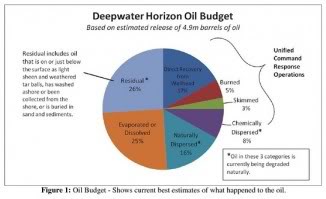
that 76% of the mess has either been picked up on the beaches, skimmed from the surface, captured by the containment process or burned off. (I suppose breathing this stuff in the air as particulates is "perfectly safe.")
At the risk of seeming a "Chicken Little" I'd like to point out that even if the reports of this "great disappearing" are true what is left is something on the order of 50 million gallons of crud in the Gulf or about the same as 5 Exxon Valdez spills.
So, while BP, the Government and our happy-go-lucky news media are fighting for places on the "where did all the oil go" bandwagon I see no cause for celebration.
I completely understand that everyone in the area wants to look out their windows and see people thronging to the beaches and fighting for restaurant reservations.
They naturally "want their lives back," and deservedly so, but because I have long experience (due to my status as a "geezer") listening to lies from government, lies from business and lies from the media, I'm not buying it just yet.
On the eve of President Obama's birth date, thoughts turn to his time in office. As a man, countless admire the person, Barack Obama, and yet, feel that they cannot fully celebrate his performance. Hope has all but disappeared. Audacity appears vanquished. Still, some are sure that there is reason to believe. People ponder potentials not fully realized. Prospects for change loom large. Several may be shared in the sentiments offered on this auspicious occasion.
Dreams have yet to die. The desire to write to the President on the anniversary of his birth or converse with him personally is strong. Most will only be able to meet Mister Obama circuitously. Nonetheless, millions will try to talk to the man in the White House. People, such as esteemed Educator, Doctor Cornel West has addressed the President profoundly though the airwaves. "One of America's most provocative public intellectuals," West speaks of what is needed for a genuine success. The Princeton Professor ponders aloud; if only President Obama advanced classlessness.
Annabell Park, founder of the Coffee Party was at Netroots Nation, and presented part of the following video, which is strikingly direct at centering attention on the devastating community-wide impact that BP oil spill is having:
This is one of a series of videos generated by the Coffee Party as a result of its "Journey into the Gulf of America":
There is a lot of people hurting in America. Millions whose benefits have run out and now have no income. Millions who have lost homes and jobs in this recession. Millions who served or had family members serve in the two wars dealing with injuries and casualties. Now the millions of residents along the Gulf witnessing and feeling the destruction of their way of life.
There are many news reports that people are canceling their vacations to the Gulf Coast and the tourism industry there is dying. And there are reports of people committing or contemplating suicide and entire communities such as the Vietnamese fishermen struggling to get by day to day.
Unless we recognize all the hurting and the profound need for healing in our country, we are creating a cultural Gulf in America. On one side, there are people directly impacted and suffering and on the other side, people who want to avert their eyes and distance themselves from the pain.
Nor do we want the kind of Gulf of America where our nation's dreams, wishes and hopes go and get buried by fear and uncertainty so that we can no longer recognize them.
The Gulf Coast should not be a place to avoid. It should be a place to go to support the people there hurting from this tragedy. Their way of life is getting destroyed daily.
We need to elevate the dialogue about the Gulf Oil Spill beyond the political to a place that shapes our humanity. We need to emotionally and conceptually process how big this situation really is.
Obviously, the Versailles media is incapable of reporting on this. And this is the perfect sort of thing for a group like the Coffee Party to focus on--although the concluding part of the video, where Annabell goes in to talk to BP shows ssomething about their limitations--at least when working alone.
Call me late to the party, but I heard what has apparently become the song of the summer, Billionaire," for the first time this past weekend. Actually, I heard it three times this weekend, including twice in situations where I had no choice but to actually sit and listen to all the lyrics.
Carl Safina gives this moving recap of the Gulf oil spill catastrophe, and ends with some outstanding commentary linking the oil spill to the financial crisis, the deregulation fad, and observing the parallel between today's "we can't afford to get off oil" entrenched interests and those that said it would be too expensive to stop using another past immoral energy source; slavery.