We at Open Left are taking the New Year's weekend off. Golden Oldies will run in their place. Regularly Scheduled programming will resume on January 4th--Chris Bowers
A Paul Rosenberg Golden Oldie From Sat Jan 17, 2009. Original here.
Did you know that Obama has a mandate to slash Medicare and Medicaid? Probably not, I'd wager. But it seems that Obama believes he has such a mandate, according to an item at the Washington Posts' website ( h/t Digby ), that reads, in part:
Obama To Hold Fiscal Responsibility Summit
President-elect Barack Obama will convene a "fiscal responsibility summit" in February designed to bring together a variety of voices on solving the long term problems with the economy and with a special focus on entitlements, he said during an interview with Washington Post reporters and editors this afternoon.
"We need to send a signal that we are serious," said Obama of the summit.
Those invited to attend will include Senate Budget Chairman Kent Conrad (N.D.), ranking minority member Judd Gregg (N.H.), the conservative Democratic Blue Dog coalition and a host of outside groups with ideas on the matter, said the president-elect....
Obama said that he has made clear to his advisers that some of the difficult choices--particularly in regards to entitlement programs like Social Security and Medicare - should be made on his watch. "We've kicked this can down the road and now we are at the end of the road," he said.
This is not just something he didn't run on. It is, in fact, the exact opposite of what he ran on-or at least appeared to, as can be seen from economist Dean Baker's op-ed in The Guardian, a few days earlier, in which he wrote:
Although Social Security is paid for long into the future, Medicare does face problems due to the explosion of private sector health care costs. The way to address Medicare's shortfall is to fix the private health care system, as President Obama has pledged to do.
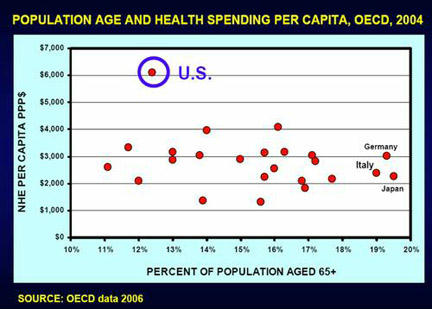
The truth of Baker's statement is readily apparent from the following chart, which I presented in my diary from last April, "Medicare Myths--Don't Blame The Boomers". Our medical costs are far higher than other countries with a significantly larger share of older citizens:
Not only is Obama's "fiscal responsibility" kick at odds with his actual mandate and his own health care proposals, it reflects a deeply ideological worldview that--far from being bipartisan or "post-partisan"--is strongly opposed by solid majorities across the political spectrum. It is the very essence of Versailles insiderism.
Two key lawmakers on the House Financial Services Committee, Reps. Alan Grayson (D-FL) and Ron Paul (R-TX), are pushing to authorize a full, comprehensive audit of the Federal Reserve. The plan has sparked fury from both the Fed and the corporate banking industry, but the proposal is so appealing that the controversy is almost laughable.
The Federal Reserve is one of the most powerful economic institutions in the world, but most of its operations are conducted in total secrecy. The Fed's rescue activities have dwarfed the $700 billion Troubled Asset Relief Program, but without any public accounting. Some of these efforts may have been entirely appropriate, but we don't even know who the Fed is helping. That fact is a major barrier to establishing effective and fair economic policy.
"The Fed is a typical Washington institution that operates un-democratically and in virtually total secrecy, and a Congressionally-mandated audit that they (and much of the DC establishment) desperately oppose would be a serious step towards changing the dynamic of how things function. At the very least, it would provide an important template for defeating the interests which, in Washington, almost never lose."
Under the Grayson-Paul plan, which is offered as an amendment to the Financial Stability Improvement Act of 2009, the Government Accountability Office would be given the authority to audit all of the Federal Reserve's activities, just as it can audit other public programs and institutions.
Last week, the House Financial Services Committee approved the audit-the-fed bill, despite opposition from panel Chairman Barney Frank (D-MA), who tried to gut the plan. Even on the Financial Services Committee, where the banks concentrate their campaign contributions, Grayson was able to convince 14 other Democrats to stand up to the financial establishment.
The vote of approval scarcely registered on mainstream media's radar, and even then, the Grayson-Paul legislation was portrayed as an assault on the Fed's "political independence." As Dean Baker notes for Talking Points Memo, it's hard to see how a simple, public accounting can be construed as a political hit on the Fed's policy-making.
By setting interest rates, the Fed has enormous power to do almost anything under the economic sun, from fueling quick growth to destroying jobs. All of these powers have useful functions under the right circumstances, and we really don't want Congress to make decisions about the economy based on the interests of powerful lobby groups. The Grayson-Paul bill wouldn't do anything of the sort. As John Nichols explains for The Nation, audits of sensitive economic policy decisions would be subject to a six-month lag before they could be publicly released. If the Fed needs to act fast, Congress won't be able to get in its way. The public will eventually know how its own money is being spent, however, and learn how a public institution is conducting itself.
"In other words, this is about simple transparency, which everyone should favor," Nichols writes.
The White House and the Congressional Democratic leadership need to support a full and comprehensive audit of the Federal Reserve. It's an issue of basic democratic accountability. There is no good reason why economic policy should be conducted in secret.
This post features links to the best independent, progressive reporting about the economy by members of The Media Consortium. It is free to reprint. Visit the Audit for a complete list of articles on economic issues, or follow us on Twitter. And for the best progressive reporting on critical economy, environment, health care and immigration issues, check out The Mulch, The Pulse and The Diaspora. This is a project of The Media Consortium, a network of leading independent media outlets.
Unemployment figures in the U.S. are staggering: The official rate stands at 10.2%, the highest in 26 years. A broader measure that includes people who are involuntarily working part-time or who have given up looking for work is at 17.5%. That's a full-blown economic emergency.
But, as Joshua Holland explains for AlterNet, President Barack Obama's response to the unemployment crisis has not matched the urgency of his response to the crisis on Wall Street. This isn't just unfair, it's bad economics.
"It's important to understand that the economic crisis in which we find ourselves is not just a function of a shaky financial system but of a crash in consumption that's come along with the evaporation of $14 trillion worth of the wealth of American families," Holland writes.
Widespread joblessness can be every bit as damaging to the economic structure as a financial crisis. When people are out of work, they buckle down on household expenses. When several million people cut back at the same time, the economic machine grinds to a halt. If people are not buying and selling stuff, the economy isn't working.
As Mary Kane explains for The Washington Independent, about 40% of families don't have enough money to cover expenses through a three-month stretch of unemployment-even if one member of the household is receiving unemployment benefits. Kane highlights a Brandeis University study that reveals the haggard state of the American household and the unfair distribution of wealth along racial lines. A full 66% of African-American and Latino families can't afford three months without work. At a time when 5.6 million workers have been jobless for at least six months, the study highlights just how dire finances have become for many households.
GRITtv's Laura Flanders discusses potential labor market remedies with economist Dean Baker and The Nation's John Nichols. Baker suggests a work-share arrangement, in which employers cut back on their workers' hours to allow more people to work. To prevent losses for households, the government would step in and pay for the shortfall in hours. Employers would have more part-time jobs available, but the government would make sure everyone was paid as if they were working full-time. Baker also endorses a public jobs program, which he says could be especially useful in cities like Detroit and Cleveland that have been hit particularly hard by the economic downturn.
Nichols highlights the political consequences of failing to fix the unemployment mess. Unemployment directly affects the lives of voters. If widespread joblessness persists through November 2010, Democrats will net huge Congressional losses. If Obama thinks it's hard to garner bipartisan support for his legislative priorities now, imagine a few dozen more Republican obstructionists.
It's not that Obama failed to respond to the unemployment crisis. He did. That's what the stimulus package was all about. Today's 10.2% unemployment is a catastrophe, but it would be more like 12% without the stimulus package. But, given the seriousness of the issue, Obama is not giving unemployment enough attention.
In fact, Obama's economic priorities are a mirror-image of his campaign promises, as Robert Scheer argues in both a column for TruthDig and an interview with Amy Goodman on Democracy Now! After talking tough about reining in recklessness on Wall Street and making the financial system more accountable, Obama has hired many of the very policy makers who pushed through the deregulatory agenda back in the 1990s. Top Obama administration officials like Larry Summers, Timothy Geithner, Gary Gensler and Neal Wolin helped make this mess in the first place.
"This is not a minor criticism," Scheer says. "I think the guy is betraying his own presidency."
Obama's timid efforts to rein in Wall Street and heal the ailing job market are setting the stage for a political disaster. If Obama and Congressional Democrats can't take strong action to fix the economy, they will find themselves with much narrower majorities next November. The economy, and the public institutions that support it, are supposed to work for everyone, not just the financial elite.
This post features links to the best independent, progressive reporting about the economy by members of The Media Consortium. It is free to reprint. Visit the Audit for a complete list of articles on economic issues, or follow us on Twitter. And for the best progressive reporting on critical economy, environment, health care and immigration issues, check out The Mulch, The Pulse and The Diaspora. This is a project of The Media Consortium, a network of leading independent media outlets.
Obama's economic policy has been justly criticized for the lack of transparency, regulations and accountability in dealing with Wall Street and its accomplices. But the flip side of this has been almost total neglect of the main street side of the equation--inadequate attention to foreclosures, loss of home equity value, and employment deficits that belie the purported "good news" of economic recovery. A couple of recent papers from Dean Baker at the Center for Economic Policy Research (on co-authored, one solo) help to bring the relatively neglected side of the situation into focus. Together, these two papers indicate potentially substantial benefits to be gained from vigorous federal action.
"CBO Projects More Severe Downturn" (pdf) looks at at the August CBO's Update of its Budget and Economic Outlook, and discusses its implications. The 5-page report features the following chart illustrating the magnitude of economic loss we face:
Of course, the lost output is to the whole economy, while the health care cost is restricted to the federal budget. But the federal taxes on the lost income, plus reduced federal costs because of such activity pretty much indicate that if we did not face that magnitude of lost economic activity, that alone would produce enough federal revenue to pay for the $1 trillion in health care spending.
The last paragraph of the report concludes:
These new projections from CBO suggest that the downturn will be far more severe and prolonged than in its projections from January. The projection of a more severe downturn should draw considerable attention from the Obama administration and Congress. It implies a much more dire situation than the one envisioned when the stimulus package was crafted in February. Presumably, the President and Congress will want to adjust their policy in light of the new information in this report.
By comparing home prices to rents, as suggested by basic economic theory, this paper finds that while most of the nation's metropolitan housing bubbles have deflated and many markets never had one to contend with, there is the possibility of a persistent housing slump in the years ahead. An appropriate response to this problem involves:
1) Stimulating the fundamental demand for housing through acting to lower unemployment and raise wages;
2) Recognizing a leading role for rental housing in federal foreclosure mitigation and
neighborhood stabilization policy, including allowing foreclosed homeowners to remain in
their homes as renters; and
3) Adequately funding the National Housing Trust Fund to capitalize on current low prices,
ensure long-term affordability in a recovery, absorb excess housing, and stimulate
employment.
It's bad enough to be jobless for a few weeks; it's much worse being unemployed for months or years. Yet that's exactly what will happen to millions of Americans if the average forecast is right -- which means that many of the unemployed will lose their savings, their homes and more. To head off this outcome -- and remember, this isn't what economic Cassandras are saying; it's the forecasting consensus -- we'd need to get another round of fiscal stimulus under way very soon. But neither Congress nor, alas, the Obama administration is showing any inclination to act.
Not much about macro-economics is obvious, and even mathematical economists who subscribe to exactly the same sub-division of economic ideology can radically disagree about factors as fundamental as the fiscal multiplier.
Likewise even the definitions of terms like "unemployment" are so complicated and indefinitely qualified that even the most official of all official measures of unemployment by the Bureau of Labor Statistics is immediately fractured into six "alternative measures of labor underutilization," and there wouldn't be much hope for the average person to understand anything about the statistical measures of unemployment if all those different indicators weren't moving in exactly the same direction.
Zoom!
One of many unpleasant aspects of depression and recession economics is what you might call a snowball effect, and as more and more people lose jobs, the salesmen who formerly sold them boats goes under, and then the worker who built the boats, and so on.
Prescriptions for dealing with similar phenomena have been incorporated into the folk-wisdom of all times and places, in the form of nostrums like "an ounce of prevention is worth a pound of cure" and "a stitch in time saves nine," but American political economics possesses a peculiar un-wisdom of its own, and although one or two "stitches in time" could have prevented the whole mess ten years ago when Brooksley Born was ringing alarms all over Washington, and Larry Summers was making sure nobody listened, now the same little snowball which Ms. Born detected in its very beginnings has doubled its snow-mass again and again and again and turned into a regular avalanche.
But not every avalanche is a roaring monster consuming skiers and chalets and tiny Swiss villages on its way to the bottom of the mountain, because mountainsides all over the world are terraced with avalanche-fences to stop little avalanches before they grow, and almost every avalanche-fence in the world is located somewhere between the top of a slope and the middle, because by the time an avalanche gets anywhere near the bottom of a mountain, you need something more like the Great Wall of China than any kind of fence to stop it.
This is a picturesque translation of the arguments Paul Krugman and Joseph Stiglitz and Dean Baker and many other honest economists made for applying a realistic stimulus to the American economy before our current recession/depression developed too much momentum, but instead we got a feeble and slow-motion stimulus full of tax-cuts, like a rickety fence that wouldn't even stop a rabbit, much less an avalanche, and the American economy is still bleeding ten or fifteen or twenty thousand jobs every day.
Two weeks ago, I wrote a diary, "The Recovery Myth", warning about the risks of ignoring longer-term economic prospects for short term upticks. This diary continues that theme (and is fully in tune with Mike's recent diary, "We Need a Jobs Package, Not a Stimulus Package").
A rising tide of voices are warning that optimism over a coming recovery--the promise of "green shoots"--is looking increasingly questionable. Typical of these are Dean Baker's "The Green Shoots Are Dead", hence my diary title. The subhead to his article explains:
The latest jobless figures show America's economy is stuck in the doldrums. The US urgently needs a new stimulus injection
Krugman argues along similar lines in his July 9 column, "The Stimulus Trap"
As soon as the Obama administration-in-waiting announced its stimulus plan - this was before Inauguration Day - some of us worried that the plan would prove inadequate. And we also worried that it might be hard, as a political matter, to come back for another round.
Unfortunately, those worries have proved justified. The bad employment report for June made it clear that the stimulus was, indeed, too small. But it also damaged the credibility of the administration's economic stewardship. There's now a real risk that President Obama will find himself caught in a political-economic trap.
But Robert Reich is even more pessimistic, as noted by William Timberman in Quick hits. Reich writes:
When Will The Recovery Begin? Never.
The so-called "green shoots" of recovery are turning brown in the scorching summer sun. In fact, the whole debate about when and how a recovery will begin is wrongly framed....
In a recession this deep, recovery doesn't depend on investors. It depends on consumers who, after all, are 70 percent of the U.S. economy. And this time consumers got really whacked. Until consumers start spending again, you can forget any recovery....
This economy can't get back on track because the track we were on for years -- featuring flat or declining median wages, mounting consumer debt, and widening insecurity, not to mention increasing carbon in the atmosphere -- simply cannot be sustained.
Meanwhile, Bonddad is on a counter-contrarian kick at DKos, writing "The Economic Free Fall is Over", which I believe is instructively mistaken. It's true in one sense, but it misses the point in a larger one (after all, FDR reversed the downward plunge of the GDP within his first two years, but unemployment remained crushing until WWII came along). More on all of these viewpoints--and more viewpoints as well--on the flip.
(Reposted from TPMCafe, where Dean Baker may be answering it right now!)
Wouldn't it be useful if there was something, anything, in the realm of economic jargon that meant the same thing as the everyday meaning of the same words, insofar as those words even have an everyday meaning?
According to Dean Baker, unemployment is either 8.1% or 9.5%, and this means the current recession is almost tied with 1982 for "worst since the Great Depression." Unemployment has an everyday meaning, recession doesn't, and neither word is likely to convey to the average reader what it conveys to Dean Baker, one of the few economists who has actually been right about anything lately.
Even the most excellent economists are constantly having problems with the jargon, and Paul Krugman, another lonely member of the Dean Baker "right about something" school of economics, says "I think quantitative easing (it's really qualitative easing, but I give up on trying to fix the terminology) is the right way to go."
Enough with this jeremiad, and now... a question for Dean Baker, whom I imagine hovering over his keyboard just waiting to answer a query from some economic illiterate on TPMCafe:
Interest rates are so close to zero that the usual neo-Wicksellian games with money supply don't work, for the banks, but...
What about the rest of us?
If you increase my money supply, and lower my interest rates to zero on my mortgage, it would for damn sure have a noticeable effect on me.
So why is Team Obama still trying to get a pulse out of stone-dead banks, and inventing ever more exotic ways to resuscitate those corpses, when the rest of us who are actually still alive continue to pay interest that's way higher than the bank premium, and we could actually use an increase in our money supply and some relief on the interest we still pay the banks?
Forget the dead middlemen! Stimulate us, instead of an economy that nobody can even describe without incomprehensible jargon
We all saw Jon Stewart make the case against CNBC -- showing how they served as a PR machine for Wall Street instead of holding Wall Street accountable.
I've also made this case before -- calling out Erin Burnett's often-absurd analysis.
So, here's a question. Is it possible to reform CNBC? Can we turn them into a force for Wall Street accountability?
Today, a crew of economists, journalists, and progressive leaders took action in that direction -- launching an "Open Letter to CNBC" and inviting the public to sign.
Americans need CNBC to do strong, watchdog journalism - asking tough questions to Wall Street, debunking lies, and reporting the truth...
CNBC should publicly declare that its new overriding mission will be responsible journalism that holds Wall Street accountable.
I helped put this effort together over the weekend, and was pleasantly surprised that so many respected people in the economic and journalism communities thought reforming CNBC was possible--and were willing to add their names to the cause.
If the public agrees, and 5,000 people sign the open letter, it will be delivered to CNBC's headquarters...always a fun spectacle.
Anyway, what do you think? Does Jon Stewart's intellectual case plus people-powered activism make reform of CNBC possible?
The situation we find ourselves in at this moment is very strongly reminiscent of the situations we've seen many times in places we don't like to think of ourselves as being similar to. It's Russia or Indonesia or a Thailand type situation, or Korea. And, yet, we somehow find ourselves in the grip of the same sort of crisis and the same sort of oligarchs.
The Obama/Summers/Geithner neo-liberalist response to this economic crisis will only make it much worse. Post-election I had been stupidly hopeful that Obama would do the right thing, somehow allow the mega-banks to fail -- perhaps gracefully but fail, THEY MUST FAIL! - and then deal concretely with an economic crisis that -- on the real, not financial side - is at bottom, a 2-3-4 year overbuilt property market (and so a depressed construction industry). That, to me, meant massive deficit spending on construction. And, with sugar pops and candy canes dancing in my head, I thought, "What the hell, let's strike huge blows against global warming and for energy efficiency over this 2-4 years of government-jacked-up construction!"
Dealing with the real economic crisis had nothing to do with bailing out all the big financial sector players/gamblers. But that's not how the financial kingpins feel, and they've gotten it all from Obama: we have the most reactionary possible, the most neo-liberal, big banker oriented response possible. I'm talking about the 'mortgage (banker) rescue plan installment 1' announced yesterday. I'm talking about the big banker bailout bill, installment 2 referenced a few days ago by Timothy Geithner. The 'stimulus' bill was admittedly a mess and didn't satisfy my dreams, but it will do a lot of good and is not a right-wing plutocratic piece of legislation. These other two are.
Most importantly, they will make our economic crisis much worse. I said exactly the same thing about the Bush big bankers' bailout bill, that $700 billion dollar waste of money, with a chorus of smart (i.e., they correctly predicted the current economic crisis) economists behind me, and I say so again. But now the money figures, the debt impossible to repay, will be that much larger. Out of whose hides will these trillions of dollars be taken? Mirror! Are we truly committed to rescuing all the big banks, keeping them private and making them solvent again, without any regulatory reform or writing off of debts? I.e., are we truly committed to the Geithner/Obama plan?
Do we realize that we don't need to rescue the giant banks? That there are hundreds of smaller U.S. banks who sensibly did not base lending practice on obscuring, bundling, and selling off bad loans? Only the 'stupid' and/or irresponsible banks did that, the big ones who 'knew' they could buy, with campaign donations, a bail out for whatever their stupidity and irresponsibility might get them into.
Now is the time to hear from the left, the most important moment since the 1930s. But where are the voices on the left opposing this giveaway? (Is there a left here?) Where are the voices opposing Obama and pointing out a better way? I mean, I can link to non-right-wing economists, but where are the politicians, the activists, the union leaders?
The plutocrats' army has critically breached the defenses of the middle and working classes, Obama leading the charge. Yet still, leaders who are labeled progressive shout, "Hold your fire!"
Essential reading (bold added), and notice the repeated reference to the sooner than you imagine apparent end game, the U.S. getting the IMF ('structural adjustment') austerity treatment:
President Obama unveiled his $75 billion Homeowner Stability Initiative today, which could be a start to ending the foreclosure crisis that plagued 2.3 million Americans last year. While Obama acknowledged his plan won't be able to save every home, he claimed it would stop "the worst consequences of this crisis from wreaking even greater havoc on the economy."
To that end, Obama's plan will help those homeowners facing mortgages more costly than the price of their homes, along with borrowers on the verge of foreclosure. That would be key to enabling 4-5 million Americans currently "under water" refinance their mortgages, and another 4 million people avoid foreclosure. The plan also "will provide forward-looking confidence" for Fannie Mae and Freddie Mac, as Treasury Secretary Timothy Geithner said.
But the question still remains how soon this money will get to the people who need it most, considering 10,000 Americans go into foreclosure every day. As Arianna Huffington recently put it, "'The banks are too big to fail' has been the mantra we've been hearing since September. But when you consider the millions of American homeowners facing foreclosure, aren't they also too big to be allowed to fail?"
My earlier diary, "Obama's 'Mandate' To Slash Medicare, Medicaid & Social Security", focused attention on the fact that Obama's potential intention to slash Medicare, Medicaid and Social Security is wildly at odds with what his great mass of supporters wanted, and consciously voted for. Now I want to pivot, and focus attention on the small handful of folks who stand to gain exactly what they wanted from him, even though it went diametrically against the overwhelming majority of his supporters. It is, in large measure, the presence of such people in high levels of influence that substantially heightens my concern that Obama might actually take this sort of ill-advised action.
Fortunately, I don't have to do anything at all, except to quote liberally from an op-ed earlier this week, by economist Dean Baker, co-directeor of the Center for Economic and Policy Research (CEPR), in The Guardian Unlimited, "Redefining Chutzpah: Wall Street Goes After Social Security, Again". Baker begins:
The classic definition of "chutzpah" is the kid who kills both of his parents and then begs for mercy because he is an orphan. The Wall Street crew are out to top this. After wrecking the economy with their convoluted finances, and tapping the Treasury for trillions in bailout bucks, they now want to cut Social Security and Medicare because we don't have the money.
That paragraph pretty much says it all, in terms of laying out the basic foundations of this fight. In fact, given how tenacious, how vicious, and how deeply entrenched these bastards are, we're going to be fighting them for a good long time, so you may want to print it out and tape it to you refrigerator. Or tattoo it onto your eyelids. Because they will do everything imaginable to make you forget that simple truth.
Did you know that Obama has a mandate to slash Medicare and Medicaid? Probably not, I'd wager. But it seems that Obama believes he has such a mandate, according to an item at the Washington Posts' website ( h/t Digby ), that reads, in part:
Obama To Hold Fiscal Responsibility Summit
President-elect Barack Obama will convene a "fiscal responsibility summit" in February designed to bring together a variety of voices on solving the long term problems with the economy and with a special focus on entitlements, he said during an interview with Washington Post reporters and editors this afternoon.
"We need to send a signal that we are serious," said Obama of the summit.
Those invited to attend will include Senate Budget Chairman Kent Conrad (N.D.), ranking minority member Judd Gregg (N.H.), the conservative Democratic Blue Dog coalition and a host of outside groups with ideas on the matter, said the president-elect....
Obama said that he has made clear to his advisers that some of the difficult choices--particularly in regards to entitlement programs like Social Security and Medicare - should be made on his watch. "We've kicked this can down the road and now we are at the end of the road," he said.
This is not just something he didn't run on. It is, in fact, the exact opposite of what he ran on-or at least appeared to, as can be seen from economist Dean Baker's op-ed in The Guardian, a few days earlier, in which he wrote:
Although Social Security is paid for long into the future, Medicare does face problems due to the explosion of private sector health care costs. The way to address Medicare's shortfall is to fix the private health care system, as President Obama has pledged to do.
The truth of Baker's statement is readily apparent from the following chart, which I presented in my diary from last April, "Medicare Myths--Don't Blame The Boomers". Our medical costs are far higher than other countries with a significantly larger share of older citizens:
Not only is Obama's "fiscal responsibility" kick at odds with his actual mandate and his own health care proposals, it reflects a deeply ideological worldview that--far from being bipartisan or "post-partisan"--is strongly opposed by solid majorities across the political spectrum. It is the very essence of Versailles insiderism.
74-25 in the Senate and 263-171 in the House. And yet still the people whine, but on obscure blogs and and pseudonymously [projection alert!] so their bosses don't notice. Others, addled by campaign advertising paid for by those who are screwing us, fantasize populism among capital's wretched servants. (Bold added throughout.)
Oct. 27 (Bloomberg) -- Five straight quarters of losses and a 70 percent slide in its stock this year haven't stopped Merrill Lynch & Co. from allocating about $6.7 billion to pay bonuses.
Goldman Sachs Group Inc. and Morgan Stanley, . . . have set aside about $13 billion for bonuses after three quarters, down 28 percent from a year ago. Even some employees at Lehman Brothers Holdings Inc., which declared the biggest bankruptcy in U.S. history last month, will get the same bonus they received a year ago. . . .
"There should be a moratorium on bonuses," Barney Frank, chairman of the House Financial Services Committee, told reporters last week. "If nobody gave them, there wouldn't be a competitive aspect." ['SHOULD', f%#@!kin' asshole?!? Why wasn't a moratorium put into the bailout passed this month by you and the rest of the cravenly subservient to financial kingpins one-party government?!?}
In Zurich, protesters blocked UBS AG's private-banking branch on Paradeplatz last week to seek curbs on executive pay after Switzerland's largest bank was forced to ask for government aid.
"I'm just flabbergasted that the financial community has failed to show any sense of leadership on this issue and doesn't seem to understand how angry people are at them," said Nell Minow, editor of Corporate Library, a Portland, Maine-based corporate-governance research firm. "They are just a bonus away from having the villagers come after them with torches."
New York-based Goldman, Morgan Stanley, Merrill, Lehman and Bear Stearns Cos. awarded their employees a cumulative $145 billion in bonuses from 2003 through 2007, according to estimates based on company reports. That's more than the annual gross domestic product of the Philippines. Last year the firms paid out a record $39 billion.
Here's Dean Baker recently, all about that nightmare for the rest of us, the Washington Post (one of the many pillars of the mainstream media, btw, who have allied themselves with Barack Obama):
Robert Samuelson Displays Bad Logic Skills In the Washington Post
Robert Samuelson desperately wants to cut Social Security and Medicare. To advance this agenda, he is pushing nonsense to young people, telling them that they should be furious about their parents and grandparents' Social Security and Medicare (seriously).
While young people have ample grounds to be angry at people like Samuelson and his wealthy friends who have rigged the rules to shift the bulk of the country's wealth into their pockets (e.g. the $700 billion bank bailout), it is close to lunacy to be angry at their parents and grandparents for getting their modest Social Security benefits. Of course Medicare is getting expensive, but that is because papers like the Washington Post protect the interests of the insurance industry and the drug companies, thereby making health care far more expensive in the United States than anywhere else in the world.
Keeping up with the media lies and distortions, notes and quotes on the worst theft in U.S. history:
The LIBOR Card
Probably the major corporate media lie is the credit freeze lie, pushed all day long by all the big corporate media. The sophisticated believer in those lies plays his LIBOR card and what is an advocate for 'duh people' to do? Well, if you are reading Dean Baker, you'd know that in fact the LIBOR is actually not at a very high level right now:
Bloomberg reports that the three month London Interbank rate (LIBOR) closed at 4.05 percent on Tuesday. In the same chart, we can find that it was 5.23 percent a year ago. Those interested in a little more history can find that the LIBOR rate was over 8.0 percent for most of 1990 and actually topped 9.0 percent on some days in September of 1989.
Also, as Baker points out, while it's true the overnight interbank lending rate is at a 'record' level now, records have only been kept since 2001! And then there's the relevance of the bailout to loosening credit, but that's another note.
The Big Picture
Horrifically, the bill does nothing for the big economic picture, pulling a severely distorted economy out of what looks like a severe recession. Here is that big picture as described by Paul Craig Roberts, with a key focus on how financial assets are now a way overboard multiple of the real economy:
Beat the Press blog had this three days ago, but the slash Social Security and Medicare advocacy continued yesterday in the Washington Post (see further down the page):
The Post Uses Crisis to Attack Social Security
Those waiting for any mea culpas from the Washington Post editorial page (remember all those news stories and columns warning about the housing bubble? [NOT - fairleft]) will have to wait a bit longer. Instead of acknowledging its failure to report accurately on the circumstances that led up to this crisis, the Post is using it as an opportunity to push its agenda for cutting Social Security and Medicare.
The reasoning powers of the Post's editors are still lacking. The loss of trillions of dollars of equity in housing has just wiped out most of the wealth of baby boomers nearing retirement. Their dependence on Social Security and Medicare will be greater than ever as a result (and these people vote). That's what happens when you rely on David Lereah (the former chief economist of the National Association of Realtors) as your main source on the real estate market.
The Post was at it again yesterday, advo-reporting established power's desire to attack Medicaid and Medicare (and by implication Social Security):
The sheer size of the bailout could give the next president political cover to address long-festering fiscal problems, such as the burgeoning costs of Medicare and Medicaid, yet neither of the men vying for the job has shown an interest in taking advantage of it, they say.
Note the devastating bipartisanship on display as the Post 'news report' continues:
As an anti-spam measure, there is a 24-hour waiting period after registering before new users can comment. blog advertising is good for you
blog advertising is good for you