There's a lot of rigidity visible in how many people's thinking has remained remarkably unaffected by the virtually unprecedented behavior of the GOP over the past year-plus. The rigidity itself would make an interesting topic to focus on, but it's more like the appetizer as far as I'm concerned, and I want to head straight for the entree: What people should have learned by now about liberals vs. conservatives, the left vs. the right. I've written about this before, how the right/conservatives see politics as war, while the left/liberals see politics as problem-solving. But I'm ready to tackle it again.
To do so, I'd like to step back a bit and take a look at really macro-history, courtesy of Tyler Cowen at Marginal Revolutiopn, in a mid-week post, "Why did it take so long for humans to have the Industrial Revolution?" It wasn't his purpose to answer the question about the origins of left/right attitudes towards politics for us, but he did so, whether he realized it or not. Here's the crux of the matter:
extended periods of economic growth require that technologies of defense outweigh technologies of predation. They may also require that the successful defender, at the same time, has good enough technology to predate someone else and accumulate a sizable surplus. Parts of Europe took a good deal from the New World and this may have mattered a good deal.
Building a strong enough state to protect markets from other states is very hard to do; at the same time the built state has to avoid crushing those markets itself. That's a very delicate balance
Of course other things are important. Cowen also cites Britain's geography, and the influence of Christianity, especially as it evolved into Protestantism, some commentators cited the Enlightenment, which Cowen rightly notes came too late to explain how it got started, but is not so far-fetched if one sees it as the tail end of a secularizing, empiricizing and rationalizing triple-play: the Renaissance, the Reformation and the Enlightenment. And, of course, the start of the modern information age via the printing press also gets noted in comments.
All these "secondary" explanations are importatnt, of course, but they're secondary in the sense that if predation could not be kept relatively at bay for long enough, none of them would have made a difference. It was the core power dynamic in the passage I quoted above that created the opportunity space in which the other factors could take hold. Without them, the Industrial Revolution wouldn't have happened. But with the core dynamic in place for long enough, it seems arguable that sooner or later good enough social/institutional factors would have enabled the start of the Industrial Revolution.
What's this got to do with left & right, liberal & conservative, you ask? Well, simple: the aristocracy is the core of the right, and it's based on two things: predation and inheritence. The European aristocracy is Europe's warrior class, and their values, outlook, social practices and habits define what it means to be conservative. (This is strongly reflected in the American South as well.) Of course, they aren't alone. But they're at the very core, along with the institutions they have long controlled--most notably, the Catholic Church.
Liberalism primarily evolved out of the city-based "middle classes", based in trade, small-manufacture and the professions--the bourgeoisie, although skilled workers (Tom Paine, anyone?) and even freed slaves (Frederick Douglass) played a part as well. In turn, socialism/social democracy evolved primarily out of the working class, although disaffected members of the bourgeoisie (Marx & Engels, anyone?) played a significant role as well.
The Marxist method of dialectical materialism highlighted the tendency for old forms to persist in new ones, in altered forms via the dynamic of thesis-antithesis-synthesis, so there was sensitivity to the fact that the liberal bourgeoisie had more in common with the aristocracy than it generally realized. (Particularly when it took over the functions of running the state, setting up empires, running slave trades, etc.) But in fact, this analytically method actually understates the degree to which all sides tend to reflect one another in various ways, nor does it adequately account for similarities between the proletariat and the aristocracy, such as a tendency toward embodied forms of reason, and a more conflictual view of politics. Still, that does not negate the fact of profound differences in the basic logic of different social groups, nor the fact that generally speaking proletarian politics are to the left of bourgeois politics.
Things got quite a bit more mixed up in America, what with the lack of a national aristocracy, the presence of both an indigenous population to be predated and the imported slave population as a product of predation, and the post-Civil War emergence of monopoly capitalists whose essential logic was much more predatory than earlier capitalists had been, as well as the complex politics of race, ethnicity and region. But the last half century has been a period in which America's political parties--and its politics more generally--has become more aligned along traditional left/right divides--though some new forms were developed to facilitate this.
There has been a lot of talk lately about bipartisanship, particularly with respect to the healthcare bill. Paul Krugman in the New York Times recently described how bipartisanship is impossible because moderate Republicans have been driven out of the Republican party. I'd like to take the analysis a step further.
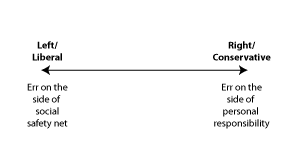
When we talk about the political spectrum, we usually talk about it as though it is a line with a left and a right, like this:
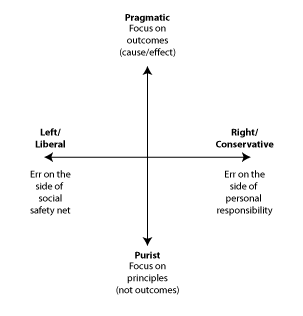
But that's inadequate to describe a lot of the political dynamics that are playing out. There's another axis perpendicular to the first that's become very important recently, which I have been referring to in conversations as the cause-effect axis:
Bipartisanship at the federal level is impossible in any meaningful way right now because there are almost no elected Republicans in the upper right quadrant.
To organize hatred of something, you need to give it a label. For the political right, the label for what they organize against has, for the last 30 years, been "liberal." What should the political left call its enemy? "Conservative" appears to be emerging as the word of choice. But is it the right choice?
A word can, of course, be turned into a pejorative simply be saying it with a sneer in the voice. If a man with a yarmulke is walking down the street and someone yells from a passing car, "Jew," it is fairly safe to say that the motivation for the shout was not simply a predilection for publicly identifying the religion of pedestrians. Despite thousands of years of such unfortunate incidents, however, unlike liberals, Jews have not shied away from the label. There is nothing intrinsically bad connoted in the word "Jew." A Jew is a Jew and that's either a bad thing, a good thing, or a neutral thing depending on a person's biases (or lack there of). Running from the label would be running from who one is.
Other labels, however, have intrinsic positive or negative connotations. There is a reason we see automobile manufacturors name their cars "Achieva," "Integra," "Trailblazer," "Vibe" and even "Testarossa." Who would drive a "Failura," "Impotencia" or "Fraudblazer?" I once knew someone whose first and middle names were "Joseph" and "Stalin." He didn't make much use of his middle name. In the political realm, Gary Hartpence became Gary Hart.
A third category of labels are those that lack intrinsic meaning but which are basically made-up words intended to be insults. "Yankee," "Redneck," "Mormon" and "Quaker" come to mind. The pattern with these examples is that the recipients de-fang them by adopting them for themselves. Nifty trick if you can stomach it.
But what about "conservative?" I once sat next to a Democratic legislator from South Dakota on an airplane as we both headed home from the annual meeting of the National Conference of State Legislatures. We got into a conversation and at one point he said "I'm a Democrat and a conservative." This was a man who favored expanding government programs to address societal problems, raising taxes progressively, boosting the minimum wage and opposed discrimination by race, sex or sexual preference. We didn't go through the entire litany of issues, so I don't know if he passed every liberal litmus test. But it was pretty evident to me that he didn't meet any definition of a political conservative that I would use. What he meant by "conservative" was more personal. He thought that people should behave morally (by traditional standards), be honorable, restrained and responsible. He believed that children ought to be taught values, that you should honor your debts and not live extravagantly or drink to excess. He didn't seem evangelical about this code of conduct but, in his eyes, the fact that he lived by it made him a "conservative." For someone like him, using the word "conservative" as a pejorative for political views wouldn't make sense.
"Liberal," of course, has its own virtuous connotations--generous and open-minded, for example. But, as David Kusnet (as insightful a man as there is on political rhetoric) recently pointed out to me, more people value the personal characteristics associated with "conservative" than those associated with "liberal." "Liberal" in the personal context, even before it acquired the negative political meaning, had come to mean something much closer to "libertine" than "generous." Leading a "liberal" lifestyle evokes free-spending, wife-swapping and drug use more than generosity as the hat is passed in church or a willingness to listen. It's Vegas, Hollywood and Manhattan, not the suburbs, exurbs, church-goers, Peoria, Knoxville or Fargo. "Respectable" citizens (and voters) live conservative lives. When the right picked their label for the left they had more to work with in "liberal" than the left has to work with in "conservative." "Liberal" started closer to "Impotencia" or "Fraudblazer."
That doesn't mean "conservative" can't become a pejorative. It helps that right now Republicans themselves are using it to describe the more extreme elements of their political party. Nevertheless, they are embracing it. Beat them up enough, connect it to all the bad things that the right is doing, and it may become a bad word. But the baggage it comes with is positive not negative. I'm not sure it becomes any more pejorative than yelling "Jew" at a man in a yarmulke. It may be used derisively, but it's nothing to be ashamed of. And that makes me doubt that we'll get as far with "conservative" as the right did with "liberal." How about "reactionary," "extreme right" or "regressives?" Words that marginalize from the start. Any other ideas?