"Is it ever 'the right time' to pass immigration reform and a path to legalization?" asks Maribel Hastings at New America Media. The short answer? Yes. Our national economic situation dictates that we are smart about the resources available to us all. It's also a moral imperative to adjust our laws to protect the most vulnerable of us.
Hastings runs through the complications, campaign promises, and opportunities facing the Obama administration in regards to immigration reform. While acknowledging the nature of our government as "a complex organism," Hastings nonetheless signs off with a warning: There are many awaiting action today, people "who voted for Democrats with the expectation that they would make comprehensive immigration reform a reality."
This year is primed for immigration reform. Activists worldwide are pushing for a "record number of ratifications" to The International Convention on the Protection of the Rights of All Migrant Workers and Their Families (ICRMW), as Oneworld.net reports. The ICRMW was adopted by the United Nations in 1990, and "sets standards for humane working and living conditions for migrants." To date, 42 countries have are signatory to the ICRMW and 15 more have taken "preliminary steps to approve the convention." While the U.S. debates reform, protecting and supporting migrants should be at the front of the list.
The Washington Independent looks back at 2009, a year in which immigration was never center stage, and yet it managed to impact every other major issue on the table, from health care reform to the economy. Daphne Eviatar profiles five individuals who shaped the immigration debate for good or bad in 2009. Characters such as the infamous Sheriff Joe Arpaio of Arizona, and commentator Lou Dobbs, formerly of CNN are included in the list, but admirable women like Dr. Dora Schriro also made the cut. Dr. Schriro's reports on the Immigration and Customs Enforcement (ICE) detention system led directly to "a major commitment" to overhaul it.
In the light of policy and compacts, it is important to remember that there is a dark and often violent side to the immigration reform debate. Luis Ramirez was beaten to death by multiple local youth in Shanendoah, PA. The local police worked to obscure the facts of the murder and thwart justice, but their complicity and hand in the judicial process has been uncovered, as RaceWire reports.
Former Shenandoah mayor Thomas O'Neill's description of the police department reads, essentially, as a gang felled by hubris: "If they want to help somebody, they will, If they want to hurt somebody, they'll hurt them. There's nothing they could do that they couldn't get away with. That's what they thought."
Another incident that exposes the inadequacy of current immigration laws can be found in the case of Haitian community activist Jean Montrevil, who now faces deportation, as Democracy Now! reports. Montrevil is a working father of four, married to an American woman, a "longtime community leader," is very involved with local immigrants rights groups and checks in with Immigrations and Customs Enforcement (ICE) regularly and voluntarily. During one such check in Montrevil was detained and marked for deportation.
ICE is removing a tax-paying and productive member of society for a 20 year-old drug conviction for which Montrevil did his time-11 years in prison. There is no chance of a legal appeal, though ICE has the power to defer the deportation. If it isn't halted, Montrevil's wife Jani will be left alone with their four children. Before 1996 immigration reforms passed by Congress and signed into law by Bill Clinton, a judge would have had discretion to consider the effect of such a deportation on the children.
Melissa del Bosque reports for the Texas Observer on the violent fallout from Mexican President Felipe Calderón's continued drug war "on the Mexican side of the [U.S.-Mexico] border." del Bosque notes a disturbing trend: A growing number of uninvolved people in the proximity of State- or cartel-initiated violence in Mexico are being impacted by the violence. This is an important balance to mind, as law and State forces are designed to help the populace thrive. Various sources place the death toll in Mexico between 9,000 and 13,000.
We conclude this week's Diaspora with a big shout out to Wiretap, which is closing its doors. Wiretap was a well-written, vibrant, and relevant collection of writing by younger people. Their writing on immigration was original, provocative, and useful. We wish them well. You will be missed!
This post features links to the best independent, progressive reporting about immigration by members of The Media Consortium. It is free to reprint. Visit the Diaspora for a complete list of articles on immigration issues, or follow us on Twitter. And for the best progressive reporting on critical economy, environment, and health care issues, check out The Audit, The Mulch, and The Pulse. This is a project of The Media Consortium, a network of leading independent media outlets.
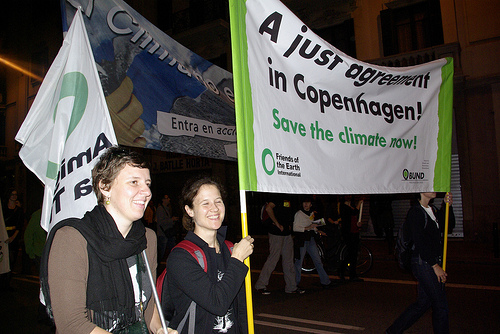
As the climate conference in Copenhagen hobbled towards a close Friday night, the United States, in a strong-arm move, slammed through the “Copenhagen Accord" – a weak, loose, and potentially backstepping agreement negotiated by a small subset of nations involved in negotiations under the UN Framework Convention on Climate Change (UNFCCC). The process for striking this accord was so undemocratic and peripheral to the official UN process that in the end, the parties to the UNFCCC didn’t even know what to do with it, and finally decided to “take note” of the accord. The implications of “taking note” will be discussed and hashed out by lawyers for days, if not months, to come.
OBAMA'S GAME OF BRINKSMANSHIP
The way this agreement came into being is a study in political brinksmanship. Around 9 p.m. Friday, President Obama announced to an exclusive group of reporters that an agreement had been reached. After the story that the U.S., China, India, Brazil, and South Africa had struck a deal circulated in a number of online news stories, the United States called a press conference and President Obama announced publicly that a deal had been reached, and that “most of the text has been completely worked out.” He then left to go back to Washington in advance of the imminent snow storm that hit on Saturday. It turned out that President Obama had called it a done deal before any agreement was actually reached. All these announcements seem to have happened before some countries had even had a chance to see the text under discussion.
When the text was finally presented, a number of countries spoke out strongly against it – and particularly against the manner in which it was determined by a few countries behind closed doors and then thrust upon the 192 countries participating in the official plenary session. Into the morning on Saturday, the plenary adjourned and reconvened, attempting to determine what had happened and what the implications were.
Now that the conference is offically over, those implications are still not entirely clear. It looks like a number of countries will flat out refuse to sign the Accord. The UN operates by consensus -- and there's certainly no consensus that this weak accord is the best way forward.
WHAT'S IN THE COPENHAGEN ACCORD?
While the Accord endorses the two existing tracks of negotiations that are the focus of the UN process, it appears to set its own course when it comes to how countries would actually move forward on the key issues on which those tracks are supposed to yield agreement, including pledges for reductions in greenhouse gas emissions and pledges to provide financial support to developing countries so they have the capacity to deal with the impacts of climate change.
All in all, the Accord looks like a deal that requires nothing.
More details on exactly how hollow it is in the extended version.
When I and about 50 other Friends of the Earth representatives from around the world showed up at the Bella Center (site of the climate negotiations) over the course of about an hour this morning, the security staff who scanned our UN ID cards told us that they were not valid and we would not be allowed in.
Given that all of us had appropriate accreditation, as well as the "secondary badges" the UN is now requiring for admission so it can restrict the number of people inside the Bella Center at any given time, we were surprised and confused by our inability to get in.
We'd planned to spend the day monitoring the process of negotiations, working to generate media coverage of the need for a strong and just agreement, and working with delegates from developing countries to draft text that could form such an agreement.
But instead, we were denied access. UN staff told Friends of the Earth International's chair, Nnimmo Bassey, that we were considered a security threat. This begged the question of why we were singled out from the many other peaceful non-governmental organizations taking part in the talks.
In this video, our team provides an on-the-ground narrative of how the day unfolded.
When about 15 members of the UN security team surrounded us, and then asked us to leave, we refused, sitting down in the registration area and demanding that we be let in and be provided with an explanation for the UN's refusal to admit us.
UN climate chief Yvo de Boer came out and spoke to us after a while and said access had been restricted because there was not enough room in the Bella Center and that he wanted to resolve the situation.
A few of our representatives went to talk to UN officials while we sat there, but our lack of access remained unresolved. We had both a member of the Norweigan and a member of the Canadian parliament come speak to us to lend us their support. Initially there were a lot of reporters, but the UN then cordoned us off and closed access to media.
Eventually they made us an offer to allow a small portion of our delegation into the conference, even though the full delegation met all the entry requirements that had allowed other groups (except Avaaz, which had also been kicked out) to gain admission.
The UN still has yet to give us a coherent reason for our having been denied access. It's hard to see how de Boer's "no room" explanation makes sense, as the UN continued to allow other NGO observers to enter even as we were denied access. And as for the security threat, we're a bunch of policy wonks and youth activists who have been participating in the negotiations every day for two weeks and represent no threat at all.
One of the key roles Friends of the Earth has played at the conference has been to advocate for climate justice and the interests of the poor countries that have done the least to cause the climate crisis but will feel some of its strongest impacts. Negotiators from those countries are tremendously under-resourced here. For example, I've worked with negotiators who have no media officers (I do media work) to help them communicate their position. They are totally outgunned by the massive delegations of the rich countries, and now thanks to the UN's decision to exclude us, they will have even less support inside the Bella Center to fight for a fair agreement. An agreement that already feels so far out of reach. It's really frustrating, and shameful.
It's been a discouraging day. But even if negotiators fail to produce a strong agreement this week, there is something we can be proud of. We're not backing down in our calls for climate justice, and we're not alone. The international climate justice movement is growing.
Tuvalu's ambassador, Ian Fry, pleaded with the UN assembly to save his country this weekend. He said it was "an irony of the modern world that the fate of the world is being determined by some senators in the U.S. Congress," noting that climate change is the "greatest threat to humanity, ... the greatest threat to security." He got no response when the US ambassador spoke soon after:
The fifteenth Conference of the Parties, as many other very important gatherings are, should be known for what it is: just another place where the poor have to come begging for their lives while the wealthy make a big show of having been generous enough of their time to be present for this grimly polite supplication.
"We [are] here in Copenhagen to fight for our identity, for our culture, and for our very right to exist," she said tearfully. "All the hopes and dreams of my generation rest on Copenhagen."
As that Guardian article goes on to note, Wickham's comments were followed by very important people talking about the many reasons why nothing can be done to answer her. Hedegaard's response to the arrest of a small anachist contigent among the 100,000 or so peaceful protestors, was fascinating, saying that they didn't "have to use that kind of violence to be heard."
Well, fine. Granted. Maybe she should tell it to her own country's police forces, who detained hundreds of peaceful marchers on the ground for hours on a day when it started snowing not too long after sunset.
But seriously, wtf will it take to be heard? I don't know whether everyone's fresh out of ideas or if the jerks in power are just that deaf.
Will Hedegaard really listen to the 10 million people who signed the petition Wickham delivered to her, or the 99,000 people, give or take, who showed up peacefully with candles and signs and chants and a burning sense of urgency that brought them to Copenhagen in December where they were outside for hours in the freezing cold? Will the eminences of the G20 hear the church bells that rang 350 times today to call the world to climate justice? Will Gordon Brown and Barack Obama listen? Will the media listen? Will the haughty finance leaders who tell these presidents and ministers when they're allowed to sit down, stand up and break to scratch their bums listen to the people whose lives and futures they're destroying?
What will it take?
Because we're never going to get anywhere if industrialized and wealthy nations keep playing a destructive game of trying to get the other person to give more, first. Each nation must commit to do what's right, and they should stick to that because it would shame them to look back on this time and say that they did nothing to prevent all the suffering that's only at its beginning. They must look to find their national honor in the greatness of their souls and the depths of their humanity instead of the heights of their office towers.
If they won't do what's right, their citizens had better break through our creativity blocks to figure out a way to convince them that they can't ignore. Time is fleeting. Physics is unforgiving.
(This post is part of Friend's of the Earth sponsoring Open Left. Please check out the Friend's of the Earth website here--promoted by Chris Bowers - promoted by Chris Bowers)
Hi – I’m writing from Barcelona, where the final round of negotiations prior to the UN climate summit in Copenhagen came to a close on Friday. It’s been a tense five days here, with time running out for world leaders to get their act together. I want to share some of my reactions to what’s going on here—and in Congress back in the U.S.
This week, two very different types of stand-offs marked political negotiations over solutions to global warming, one cowardly and one courageous.
U.S. Senators Back Away from Real Action
In the U.S. Senate, Republican members of the Environment and Public Works Committee boycotted the scheduled mark-up of the climate and energy bill, complaining that Chairwoman Boxer (D-CA) was not giving them enough time to assess the economic impacts of the legislation. This came after Sen. Boxer had already given tardy Republican committee members an extension to offer amendments to the bill. The Republican ploy was childish, and almost certainly was an attempt to further weaken a bill that, as passed out of the committee Thursday, is already too weak to protect our climate.
African Delegates Stand Up for Real Action
Across the Atlantic in Barcelona, negotiators from African countries initiated a different sort of boycott — one with a much more constructive aim and a very urgent plea.
Monday, the first of five days of talks in Barcelona, African negotiators announced that they would not continue with formal discussions on other topics until rich countries made some real progress with their own emissions reduction targets. (These targets refer to the reductions in greenhouse gas pollution that rich (Annex I) countries commit to make by 2020.) Millions of people in developing countries are already being affected by climate change impacts such as floods and droughts. Developing countries and communities have historically had practically no fault in the creation of climate change, yet they already face devastating impacts.
The African delegation’s action was a strategic and brave move, designed to pressure rich countries to finally step up and commit to new, deep emissions reductions targets under an internationally binding agreement. With so few formal negotiating days left before Copenhagen, time is running out for rich countries to start cooperating. Rich countries’ continued shirking of their legal and moral responsibility to set new, strong and binding targets drove developing countries to this dramatic action.
More on how it all played out in Barcelona in the extended version.
The disease, for which no effective treatment was ever developed, killed as many as 30% of those infected. Between 65-80% of survivors were marked with deep pitted scars (pockmarks), most prominent on the face.
In some ancient cultures, smallpox was such a major killer of infants that custom forbade the naming of a newborn until the infant had caught the disease and proved it would survive. WHO fact sheet on smallpox
In a conservative estimate by experts, in the 20th Century, smallpox killed 300 million people. More than Hitler, Stalin and Mao combined. It left about twice as many as it killed, scarred (literally) for life. By 1967, there had been a number of failed efforts to eradicate diseases from humanity, including an effort at US behest on malaria. Defying expectations, a shoestring operation run out of that inefficient and (if you listen to conservatives) useless organization, the United Nations, managed to organize a program of vaccination and isolation that resulted in smallpox afflicting its last victim in 1977 (excepting a tragic case in a British research lab).
If the UN never did another useful thing (it has done many), this alone would justify its existence. It is past time that liberals remember this marvellous achievement, and begin to reference it more often. This is the potential of big (read: "effective") government, and speaks to the proven capacity for coordinated global cooperation to solve humanity's most pressing (and depressing) problems.
It's time, once again, to bring you the news that is not yet news.
For those not yet aware, there will be a climate change conference in New York City next week, conducted under the auspices of the United Nations.
The 100 world leaders who will be participating in the conference will be arriving on Monday, and if you're in New York City the same day, you have a chance to participate in a not-to-be-forgotten "welcome event" and pranking opportunity.
Follow along and I'll tell you how to get involved-and if you do, they'll even send you home with a lovely parting gift.
The faux religious zealots like to go around spouting about a "culture of death" in our country because we let women make their own decisions about their bodies. However the real culture of death in this country is the unjust death penalty. We join beacons of justice China, Iran, Iraq, Pakistan and Sudan in accounting for 90 percent of all executions. 133 countries around the world have abolished the death penalty. And yet we stick on to this culture of death. However great news has been coming out in recent days for those who wish to end this injustice. Two days ago New Jersey Governor Jon Corzine on Monday signed a law abolishing the death penalty, the first state to ban it in 42 years. And then yesterday on a 104 to 54 vote, with 29 abstentions the U.N. General Assembly passed a nonbinding resolution on Tuesday calling for a moratorium on the death penalty.
As an anti-spam measure, there is a 24-hour waiting period after registering before new users can comment. blog advertising is good for you
blog advertising is good for you