This may be one of the most important things anyone's said yet about the Waxman-Markey climate bill, or ACES. Ken Ward Jr. writing at The Charleston Gazette shares a quote from the communications director of the United Mine Workers of America, Phil Smith:
As it stands now, the amount of money dedicated to coal in this bill is remarkable, and the future of coal will be intact.
There's also this, highlighted by David Sassoon at Solve Climate, from Rep. Rick Boucher (D-VA), a "lead negotiator for coal state Democrats on the House Energy and Commerce Committee":
I've been working extensively to fashion a controlled program that Congress can adopt which will preserve coal jobs, create the opportunity for increasing coal production and keep electricity rates in regions like Southwest Virginia affordable. The compromise that I have reached with Chairman Waxman achieves those goals.
It doesn't seem unreasonable, as many have pointed out, that industry's weeping and wailing about this bill in public hides the fact that they know it's the best deal they're going to get.
Via free pollution permission slips and the curbing of the Environmental Protection Agency's recently granted authority to regulate greenhouse gases, carbon dioxide in particular, this bill secures a bright future for the industry that rains carcinogens into our water, puts mercury into our tasty fish, flattens towns while they're still in use, levels our mountains and kills 24,000 Americans every year.
Indeed, the EPA is one of the few government agencies that's done anything constructive to push us away from the destructive, outmoded coal industry. As the indispensible David Sasson reports, they did so just yesterday:
In a previous post, I wrote about how the coal industry got its way with ACES, the Waxman-Markey climate bill. Much of their victory had to do with sharply limiting the authority of the Environmental Protection Agency, whose chartered purpose is to protect the environment, and therefore, public health.
The agribusiness industry won a similar victory. When Rep. Collin Peterson (D-MN), chair of the House Agriculture Committee and point person for an alliance of rural and coal state Democrats seeking to weaken the bill, put his foot down and said, "I'm pretty sure that any role for EPA in agriculture is a deal breaker."
Rep. Peterson's main complaint about the first draft of ACES, and what seemed to be the general complaint of the House Agriculture Committee, was that the legislation didn't give farmers enough money for things they were already doing. Throw more money at us based on no scientific evidence whatsoever, he said, or no deal.
House leadership took Peterson at his word. Like, for example, this word:
Joseph Romm is one of the most respected writers on climate policy. Here is a summary of his thoughts on what is necessary to avert catastrophic warming:
We have to bring down the amount of CO2 in the atmosphere to between 350-450 parts per million (ppm) to avoid the hellish worst of climate change. Economically and technologically, this is quite doable. However, it is not plausible in the current political climate. Because the alternative is unacceptable, we will get there, but to do so we must all become familiar with the best solutions, and then loudly push our political leaders toward them.
Stingy credit markets and high regulatory hurdles have spurred Houston-based Dynegy to step back from new coal-fired power plant projects by ending a joint venture with LS Power Associates.
Dynegy will keep the right to expand its 27 existing coal, natural gas and oil-fired plants in 13 states, and it retains stakes in a pair of Texas and Arkansas coal projects.
But Dynegy will pay New York-based LS Power $19 million as part of the split and let it take full ownership of new projects under consideration in Arkansas, Georgia, Iowa, Michigan and Nevada.
Shares of Dynegy closed up 38 cents, or 19 percent, to $2.38 on Friday.
Dynegy Chairman and CEO Bruce Williamson said the power plant development landscape has changed since the company entered into the joint venture with LS in the fall of 2006. Funding new projects is much more difficult given the worldwide credit crunch and the possibility of new climate change legislation under the Obama administration.
"In light of these market circumstances, Dynegy has elected to focus development activities and investments around our own portfolio where we control the option to develop and can manage the costs being incurred more closely," Williamson said in a statement.
According to local news reports millions of yards of ashy toxic sludge broke through a dike at TVA's Kingston coal-fired plant Monday, covering hundreds of acres, knocking one home off its foundation. Coal ash can carry toxic substances that include mercury, arsenic and lead, according to a federal study.
Greenpeace is calling today for there to be a criminal investigation into the matter. "Every facility like this is supposed to have a spill contingency plan to prevent this kind of disaster," said Rick Hind, Greenpeace Legislative Director.
This is not an ordinary environmental disaster; 500 million gallons of toxic coal ash spilling into the drinking water of Kentucky, Tennessee, and Alabama is going to kill a lot of people. Eastern Kentucky saw a similar spill in 2000 due to negligence from coal companies, and the Bush administration covered it up.
The region still hasn't recovered, with much of the waters and lakes unable to support fish or wildlife. And it may never recover. Just watch the video above, it's rather breathtaking. 500 million gallons of mercury, arsenic, and coal dust is now a permanent part of Tennessee's ecosystem, and probably part of the DNA of the people that live there and drink the water.
The Sierra Club has just won a case before the EPA appeals board which will make it very hard to build new coal plants unless they actually have carbon mitigating technology in place. Looks like we're headed to clean coal or no coal (of course with the requisite caveats that this case isn't set in stone, blah blah blah). I often criticize the electoral strategy of the Sierra Club, but their legal work and anti-coal work does bring results. Kudos.
One of the claims of the coal industry - that there's some capacity to use coal without emitting carbon dioxide using fancy new technology - is about to be tested in a big way. One sign to look for is squealing; if the industry gets very upset, it means they weren't really telling the truth about the ability to use clean coal technology in the first place. If they don't squeal, then it looks like we're going to get a whole bunch of coal plants that don't emit carbon.
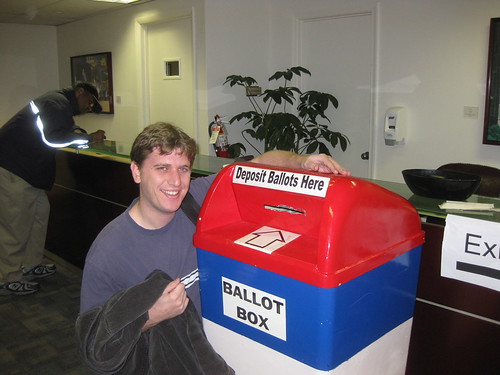
That's me in the foreground, and another voter in a partial tron costume to the left.
I'm in DC to cast my vote, after having spent a bunch of time in a suburban area. And what struck me is how urban politics is just so fundamentally different than suburban politics. In cities, you stand around in crowded places and meet candidates, and encounter lots and lots of people. In the suburbs, you're a pod person with a car and you never have to actually deal with anyone except by choice. It's really quite lonely and unnatural.
Juan Enriquez is prepping a whole lot of 'good liberals' for drastic cuts in entitlements. I love the pain caucus. Meanwhile, the economy is falling off a cliff.
Big coal is screaming through the right-wing blogs that Obama is going to drive the industry out of business. That's not actually what he's going to do, he's just going to force coal to compete with renewables and pay the costs of carbon emissions. If coal can win in the marketplace, great. But they can't. And they know. Hence, hissy fit.
The telecom sector is similarly very very upset.
"Probably the thing that scares the industry the most about a Democratic administration is regulating the Internet," Dan Hesse, chief executive of Sprint Nextel, said in a speech in Washington on October 24.
Doug Schoen is a wanker.
Earl Blumenauer to be Secretary of Transportation? Awesome. He's in the bike caucus.
Go vote for Zack Exley's proposal to the Knight Foundation. If he pulls it off, this project could be a fundamental shift in how we organize our society.
Twittervotereport.com is actually a really neat election day project. Election day is usually really boring, with lots of poll-watching and sign holding and waiting around until vote counting starts. If there are problems with voting machines, well, then it gets a bit, um, exciting? This site should be very useful for such incidents and for run of the mill reportorial info.
One of my biggest frustrations with Democratic leaders is their refusal to embrace the energy policy Al Gore outlined this summer, which could "end our reliance on carbon-based fuels" in the next decade.
Barack Obama has offered an energy policy that's a big improvement on what George Bush has done. Unfortunately, Obama still supports more investment in so-called "clean coal" and has not ruled out expanding nuclear power.
On the plus side, Obama also calls for generating 10 percent of our country's electricity from renewable sources by 2012--which sounds great until you learn that the U.S. has already surpassed that goal.
I love Seattle, though the traffic is pretty horrible. With mass transit it'd literally be the perfect city.
Public campaign found some stunning numbers on oil and coal companies in the election.
Today Public Campaign Action Fund, a nonprofit, nonpartisan organization dedicated to improving America's campaign finance laws, released a new analysis finding that the oil and coal industries spent $427.2 million so far this year of the year to shift public opinion and to capture the eyes, ears, and support of Congress on critical energy issues.
The rumors are that Obama is going to announce his VP this week.
McCain is going to name his VP on August 29th, the day after the Democratic National Convention.
Bob Woodward has a new terrible book coming out on September 8 called The War Within. Get ready for lots of gossip around the Bush administration. Hopefully it'll reflect badly on Bush and co, but if it does, it'll do so in a way that was obvious to us years ago.
This is why Google was being attacked by AT&T; yesterday.
Google and other technology giants like Microsoft, Intel and Dell, have long pushed for a plan to allow soon-to-be-vacant broadcast spectrum to be used to provide new high-speed wireless Internet access networks. The airwaves, known as "white spaces," will be unused after TV stations switch to all digital broadcasts next February, and the Federal Communications Commission is expected to decide their fate soon.
Musharraf resigns.
In Oklahoma, Andrew Rice has cut Inhofe's lead substantially, and Jonathan Singer comments. Georgia's Senate Democratic candidate Jim Martin is behind Saxby Chambliss by five points.
It's primary day in Washington's eighth. Vote!
Todd Beeton comments on McCain's vulnerabilities.
Newt Gingrich says that inflating tires helps big oil.
Being the sole Democratic candidate for President with executive branch experience, voters can evaluate Bill Richardson from the unique stand point of an actual record of implementing policy on key issues, not merely the speeches he has given.
On the issue of climate change, Richardson has offered the most aggressive plan of any candidate, proposing to cut greenhouse gas emissions by 90% by 2050. But will Richardson be true to his word if he's elected President? Richardson is proving by his actions as Governor of New Mexico on global warming that the answer is yes.