The US faces disaster on at least three main fronts due to utterly discredited conservative ideology, with a variety of flashpoints on mini-fronts. The Democratic establishment can't even muster an argument that 2+2=4. It doesn't poll well with independents, apparently, since independents have never been polled on it.
(1) We continue the disastrous neo-con "long war" strategy supposedly in response to 9/11, but actually planned beforehand and completely at odds with the nature of the 9/11 attacks and the danger they represent. Our "full spectrum dominance" mentality currently has us facing armed--potentially nuclear--confrontation in Korea, enmeshed in an ever-deepening conflict with Iran, backing a lawless, racist and suicidal Israeli imperialist project, and unable to sustain a stabilizing nuclear weapons treaty with Russia. We are, on all fronts, at war with the very concept of national security. The discredited notion that security comes always and only from total military victory has not had a clear record of success in the American experience since WWII, which ended more than 60 years ago.
(2) Following an undersized stimulus package conceived two years ago, we have essentially reverted to a uncordinated, spasmodic mixture of feeble economic gestures reminiscent of the failed Herbert Hoover Administration of 80 years ago. As Brad DeLong wrote Saturday, in "Foreign Policy: The Four Horsemen of the Teapocalypse":
But we are now into the "recovery," and 2010 has been a very different year. Its horsemen are of a different breed entirely. Where Keynes and his ilk were optimistic believers in the power of technocratic governments to do good, this year's horsemen are practitioners of more dismal sciences: believers that the market metes out judgments that we must suffer -- and that it is our own flawed nature that makes us believe so. In short, it has been a year for Austrian economists Friedrich von Hayek and Joseph Schumpeter, for plutocrat and Great Depression-era Treasury Secretary Andrew Mellon -- and, above all, for Friedrich Nietzsche.
There was silence in the seminar room. Richard Kahn broke it. "Do you mean to say," he asked, "that if I were to go out tomorrow and buy a new overcoat, that it would increase unemployment?"
"Yes," said the man in the front of the room, Friedrich von Hayek, "but it would take a long and complicated mathematical argument to explain why."
That is how historian Robert Skidelsky describes Hayek's visit to the proto-Keynesian economists of Cambridge University. It was the 1930s, and Hayek had met them in London to convince them that depressions were not to be avoided or cured, but rather endured. In his thinking, they were righteous karmic payback for past sins against the gods of monetary orthodoxy. Any attempts to cut them short or make them shallower would produce only temporary palliation, at the cost of a fiercer, deeper, and nastier further depression in the future.
Hayek's fellow countryman, Joseph Schumpeter, went further: "Gentlemen!" he announced to his students at Harvard University (there were no ladies). "A depression is healthy! Like a good ice-cold douche!" If depressions did not exist, Schumpeter thought, we would have to invent them. They were "the respiration of the economic mechanism."
Agreeing with Schumpeter was Herbert Hoover's Treasury secretary, Andrew Mellon. In his memoirs Hoover was bitter toward many, but bitterest of all toward Mellon, whom he called the head of the "leave it alone liquidationists." Hoover quotes Mellon: "It will purge the rottenness out of the system. High costs of living and high living will come down. People will work harder, live a more moral life. Values will be adjusted, and enterprising people will pick up the wrecks from less competent people." Hoover opposed Mellon's policies, he said, and worked to undermine them. But what could he do? He was, after all, only the president. And Mellon was Treasury secretary.
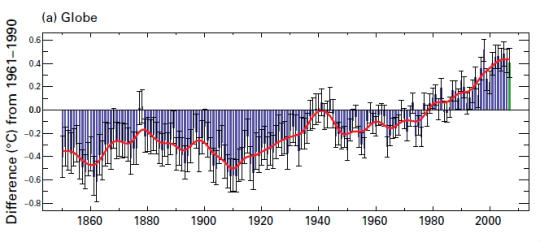
(3) Global warming denialism is rampant among new GOP members of Congress. While the actual record of global mean temperatures over the past 150-plus years looks like this:
The conservative fantasy of "natural fluctuations" would imply something wildly different, on the order this:
There is, quite simply, no relationship between what conservatives imagine the climate record to be and what it actually is. They are delusional. And yet, the Democratic establishment, which knows better has not even attempted to mount a serious public education effort to drive the conservative lies out of the "marketplace of ideas".
Meanwhile, the UN Climate Change conference in Cancun opens to almost totaly US media blackout, and Democracy Now! reports:
The story of the golden calf in Exodus is the perfect allegory for the conservative movement's rapturous worship of the free market uber alles. In their religious fervor, the free market is always good, and therefore corporations- no matter their size, power, or history of malfeasance- are always good too, and all government is always bad, all of the time, no matter what. They worship their idol of gold no matter what actually happens in the world around them, and nothing can change their religion. The economy can collapse in a terrible financial panic on their watch, and it still doesn't shake their faith in their golden idol. The big banks can commit fraud and create massive bubbles they know will pop and it still doesn't shake their faith- they still don't want financial regulations. Mine accidents can kill people, and they still don't want more safety inspectors. Toys with lead in them can kill toddlers, and they still don't want stronger consumer protections. The number of people killed from E Coli can rise to record levels, and they still don't want stronger food safety rules. Bridges can collapse, and the still don't want to raise taxes to pay to rebuild our infrastructure. 40,000 people a year can die from a lack of health insurance, millions can be denied coverage because of pre-existing conditions, Medicare can prove to be a popular and effective way of delivering health care to people, and they still don't want government involved in health care. Social Security can lift generations of senior citizens out of abject poverty, and they still want to get rid of it.
I could go on and on and on, because heaven knows conservatives do. But the government is always bad, corporations are always good, religion is going to cost them politically on the banking issue. Republicans are threatening to filibuster a bill to regulate the big banks and hedge funds that trashed our economy and that would be the greatest gift they could possibly give Democrats. Filibuster to your heart's content, Sen. McConnell. Let's have this debate go on and on and on. Let it drag on for weeks, or even better, months. I know you will keep repeating Frank Luntz's talking points word for word about how reining in the power of these mega-banks would lead to more bailouts, but voters are already seeing through the act. Even tea partiers, as anti-government as they are, hate the big banks, so go ahead and do your ritual incantations at your altar of gold, and we'll see how this debate plays out.
I'm happy to have this debate, I'm happy to have the debate over whether people want to repeal the ban against insurance companies not covering people with pre-existing conditions, and I'm happy to have the debate over whether to worship corporate America and the free market in all situations. Progressives understand that businesses, big and small, and entrepreneurs of every type, have a centrally valuable role in building our economy. But we also understand that government has a valuable role to play as well, and that sometimes corporations do abuse their power and hurt people. Conservatives want to leave each of us on our own to deal with corporate oligopolies without any help or support from our government. If we get hurt, so be it, because after all, as Glenn Beck puts it, in nature the lions will eat the weak. Progressives believe that power is corrupting- government power, yes, but also corporate power- and that government should be on the side of the little guy instead of on the side of the richest and most powerful in society.
So let's have this debate. Mitch McConnell wants to make the debate this week about big banks and whether government should play any role in holding them accountable and reining them in. I'm good to go on that debate- and I want to have it on all those other issues as well.
It's time to melt down the golden calf of the free market above all else. That golden calf has turned into golden bull, and it's time to stop worshipping it.