Digby, Amanda Marcotte and Krugman traded thoughts recently on what exactly it is about climate science that so sets off the right in opposition.
It's an important question. The right, while opposed to environmentalism in most regards, could in past at least see what side of the bread is buttered. The Montreal Protocol to protect the ozone layer, after all, was negotiated and ratified in the era of Reagan, Thatcher and even in Canada, Mulroney. Thatcher herself was an early believer in the need for concerted action to address Climate Change. Why (aside from her education in chemistry) is she basically alone on this? I like Krugman's answer the best of the three, but even so I think he comes up short, particularly on the anti-intellectualism angle.
What's really happening is that anthropogenic climate change is a fundamental assault on right wing ideology and the solution requires a worldwide implementation of liberal policies that will undercut right wing ideas at every level well into the future. Right wingers maybe do not grasp this fear consciously, but intuitively everything about this issue stinks for them. Denial is the only way to save their worldview.
Fifth in a series of interviews with farmers affiliated with La Via Campesina, an alliance of international peasant farmer organizations. This interview was conducted with the assistance of an LVC translator. Also, even if farming isn't your usual interest, I encourage you to read this, on account of how we in the US might soon need to learn a thing or two from the world's peasant farmer and landless peasant movements.
Renaldo Chingore João works a 5-7 acre farm with his family. There, they grow maize, beans and vegetables, keeping 15 cows for meat and milk, as well as draft labor. Though it's a small farm, João and his family don't face the world alone.
They're part of a community that's organized itself for advocacy and mutual support, both within Mozambique and the larger global community of peasant farmers.
As the climate conference in Copenhagen hobbled towards a close Friday night, the United States, in a strong-arm move, slammed through the “Copenhagen Accord" – a weak, loose, and potentially backstepping agreement negotiated by a small subset of nations involved in negotiations under the UN Framework Convention on Climate Change (UNFCCC). The process for striking this accord was so undemocratic and peripheral to the official UN process that in the end, the parties to the UNFCCC didn’t even know what to do with it, and finally decided to “take note” of the accord. The implications of “taking note” will be discussed and hashed out by lawyers for days, if not months, to come.
OBAMA'S GAME OF BRINKSMANSHIP
The way this agreement came into being is a study in political brinksmanship. Around 9 p.m. Friday, President Obama announced to an exclusive group of reporters that an agreement had been reached. After the story that the U.S., China, India, Brazil, and South Africa had struck a deal circulated in a number of online news stories, the United States called a press conference and President Obama announced publicly that a deal had been reached, and that “most of the text has been completely worked out.” He then left to go back to Washington in advance of the imminent snow storm that hit on Saturday. It turned out that President Obama had called it a done deal before any agreement was actually reached. All these announcements seem to have happened before some countries had even had a chance to see the text under discussion.
When the text was finally presented, a number of countries spoke out strongly against it – and particularly against the manner in which it was determined by a few countries behind closed doors and then thrust upon the 192 countries participating in the official plenary session. Into the morning on Saturday, the plenary adjourned and reconvened, attempting to determine what had happened and what the implications were.
Now that the conference is offically over, those implications are still not entirely clear. It looks like a number of countries will flat out refuse to sign the Accord. The UN operates by consensus -- and there's certainly no consensus that this weak accord is the best way forward.
WHAT'S IN THE COPENHAGEN ACCORD?
While the Accord endorses the two existing tracks of negotiations that are the focus of the UN process, it appears to set its own course when it comes to how countries would actually move forward on the key issues on which those tracks are supposed to yield agreement, including pledges for reductions in greenhouse gas emissions and pledges to provide financial support to developing countries so they have the capacity to deal with the impacts of climate change.
All in all, the Accord looks like a deal that requires nothing.
More details on exactly how hollow it is in the extended version.
If we continue business as usual, we will not be able to see our grandchildren.
--Maldives President Mohamed Nasheed
A decade ago, the coalition of "Teamsters and turtles" that disrupted the WTO talks created some space for developing nations to more effectively oppose the agenda being pushed by US and other advanced industrial nations. But many of those nations were not that prepared for opposition. Ten years later, in Copenhagen, the what had been a fairly adventitious and partial convergence had matured to the point where the official representatives of the underdeveloped nations have become some of the most eloquent and advanced advocates for a fundamental transformation in how the world works. Here are a few examples.
Maldives President Mohamed Nasheed addressed the UN climate summit on Wednesday. Here is what he said, as broadcast on Democracy Now!:
PRESIDENT MOHAMED NASHEED: Developed countries created the climate crisis. Developing countries must not turn into a calamity. Therefore, I invite the leaders of big developing countries to recognize their responsibilities. I urge them to come forward at Copenhagen with quantifiable and verifiable actions to reduce emissions 30 percent below business as usual by 2020.
Let me be plain. We urgently need to move forward. Giving us intensity targets that are close to business as usual is not acceptable at this stage.
Ladies and gentlemen, I believe that you should not ask others to do something you are not prepared to do yourself. The Maldives has pledged to become carbon neutral by 2020.
And I have been hugely encouraged by the steps already taken by least developed countries and small island states to begin getting their economies green. At the recent Climate Vulnerable Forum in Male, eleven states pledged to raise their ambitions in leading the world towards carbon neutrality. This is an enormous opportunity to reduce future emissions before fossil fuel infrastructure is built. But it cannot be done without the financial support from rich countries. I say to the industrialized world, you have the finances and much of the technology; please help us go green.
When we say this, please bear in mind that climate change negotiations have nothing, nothing at all, to do with money. Maldives is a very small state. We have never received aid from European Union countries. Whatever we have been able to do, we have been able to do with our friends and neighbors, and we have been able to fend for ourselves. Climate change negotiations have, for me and for our country, everything to do with our grandchildren. I have two daughters. I want to see grandchildren. If we continue business as usual, we will not be able to see our grandchildren. To assume that climate change has anything to do with money, in my mind, is the height of arrogance.
I am also encouraged by regional climate initiatives in places like California and Quebec, where true leadership is being shown. Outside the rim of the nation state, their standards, their ambitions are much, much higher than the center. Climate change, I do understand, is an issue that transcends nationality, that trandscends the nation state. And what we have on offer from the centers, from heads of states, falls far shorter than what we are seeing from sub-regions or from provinces and from states.
Ladies and gentlemen, Kyoto divided the world. It divided us between rich and poor, developed and developing, Annex I and Annex II. Our task now is to unite the world behind the shared vision of low carbon growth. The Maldives is trying to lead the way. I call upon every country in this room to join us, not just for the sake of the Maldives, but for the sake of the entire planet. If we are not able to seize this opportunity, and if we are not able to come to an understanding during the course of next forty-eight hours, I'm afraid we might very well be doomed. I hope that that is not what we are contemplating. Thank you very much.
In his reaction to Obama's speech in Copenhagen announcing the postponement of any legally binding treaties, climate campaigner Bill McKibben said that Obama "chose the Senate over the UN tonight."
Obama told the world tonight that the US had come to the table "with an ambitious plan to reduce our emissions" but that the US also couldn't "turn on a dime" and so refused to make any commitments that it might not be able to keep. Yet as Naomi Klein said tonight, he could easily have used the stimulus money to jumpstart a clean economy in a way that would have given the US "inspiring emissions cuts" to show the world and chose not to.
Though Obama made comments about wanting to act based on the science and leave a better world for our children and grandchildren, his refusal to commit to a firm target kept the rest of the world from doing so. Now, the agreement will include only voluntary goals from each country that will be added in an appendix to the document.
Klein said that while the Obama administration was trying to make much of his having brought China, India, Brazil and South Africa along on an agreement, it had been their position from the beginning that they didn't want to be spoilers and would agree to binding cuts if the US was willing to do so.
Klein pointed out that in spite of Obama's claim not to want to move things backwards, the world went from having a legally binding agreement signed by most countries to a non-binding agreement signed by four countries. Obama may not have wanted to create "frustration and cynicism", but McKibben added that there wasn't even a numerical target in the new document and that he doubted George Bush could have gotten away with so forcefully brushing aside the UN.
While complaining about logjams and looking backwards, Obama said that the world needed more time to build trust and that the "US was coming to this with ... a clean slate." And at that point, there was a shocking sense for me of campaign deja vu, where women and the LGBT community and social justice advocates were told to look forward and forget old divisions. Then once he got into office, all that talk of hope was replaced with using fine words to smooth over the continuing sell out of the poor to the powerful. wash, rinse, repeat. At least he's consistent.
Phil Bloomer of Oxfam commented earlier today that rich countries' governments were captured entirely by "massive, vested interests" and that wealthy countries "care more about their banks than ... our shared destiny." Rarely has this been more on display than in this president, tonight, who acted, as Avaaz' Ben Wikler said today that the US often did, to lower our national ambitions based on the power of the coal and oil industries.
Obama said tonight that, "climate change threatens us all." Yet he seemed frankly more afraid of letting anyone in the US think he'd signed up to an international treaty, closing by very awkwardly noting that there was a question of whether there even could be a signature on a document that wasn't legally binding.
Fourth in a series of interviews with farmers affiliated with La Via Campesina, an alliance of international peasant farmer organizations. This interview was conducted with the assistance of an LVC translator.
Baramee Chaiyarat is responsible for organizing the seven networks that make up Thailand's Assembly of the Poor and his background as the son of a subsistence farmer and a teacher made him well-suited to this work.
The Assembly of the Poor represents villagers affected by either dam construction or forestry policy, the landless, alternative agriculturalists, small scale fisher folk, slum dwellers and injured workers. They're a non-partisan organization that's deeply suspicious of all the country's political parties. At one point, they were all separate, and Chaiyarat said they all "felt tired and out of energy" after many years of unsuccessful work. He doesn't even know who first thought of bringing them all together, and that it took several years of face to face forums before everyone trusted each other enough to establish the AoP, which organizes mass mobilizations in the capital and community-backed lending circles.
Chaiyarat said he and his colleagues "came to let the world know that the solutions being proposed at Bella Center are false solutions. We feel the real way to solve the problem is through the principle of food security," he said, and supporting small scale farmers who work in harmony with nature.
One proposal that particularly concerns Chaiyarat is the REDD (Reducing Emissions from Deforestation and Forest Degradation)standard, which is said to be close to a final deal. He said that without adequate protections for indigenous peoples, "it will be one of the most vicious sorts of programs around," allowing the government an additional pretext to drive villagers out of their ancestral lands.
President Barack Obama's much-anticipated arrival in Copenhagen today has turned from a hopeful sign of success into a grim reality check. Immediately after arriving this morning, Obama joined an unscheduled meeting with 18 other world leaders before the most high-profile session of the United Nations Climate Change Conference (Cop15) began. The deal depends on the United States and China, the world's leading emitters of greenhouse gas emissions to reach an agreement on a course of action.
There's a somber mood in Copenhagen on the last day of climate negotiations, with prospects for a strong and fair agreement feeling further and further out of reach.
A leaked UN document shows current proposals would add up to an alarming 3 degree C temperature rise and the U.S. is still refusing to budge.
Indeed, it now seems increasingly possible that rich countries' leaders may not even be able to piece together the weak, fig leaf of a "political" rather than "binding" agreement that most observers had been anticipating.
There's been some important news here over the last 24 hours.
LEAKED UN DOCUMENT EXPOSES HOW CURRENT PROPOSALS ADD UP TO CATASTROPHIC WARMING
First, a secret UN analysis of countries' current emission reduction proposals was leaked to the media. That analysis concluded that, when put together, the proposals now on the table would likely result in a global temperature rise to 3ºC above pre-industrial levels -- a catastrophic rise that would put small island states under water and cause suffering and death for millions of people.
Small island states that are fighting for their very survival are calling for limiting warming to 1.5ºC, and almost all countries -- including the U.S. -- have said that more than a 2ºC rise would pose unacceptable risks. So it's nothing short of scandalous that while calling for a 2ºC rise, rich countries' proposed actions would actually lead to 3ºC. This is the real climate gate. Indeed, this document shows that developing nations are actually proposing deeper emissions cuts at this point than developed ones. That's abhorrent.
NEW SECRET RICH COUNTRY TEXT ALSO LEAKED
One of the key dynamics at the negotiations has to do with process and lack of transparency. There are two key formal negotiating tracks here -- one under the Kyoto Protocol and one for all signatories to the United Nations Framework Convention on Climate Change, which includes those countries that have not signed onto Kyoto (the U.S. falls into this second group). But it seems like most of the real negotiating has gone on behind closed doors between rich countries and a few hand-picked poorer ones. The world's poorest nations have done the least to cause climate change but face some of its worst impacts. It's a shame that they're being cut out of the process.
During the first days of the climate summit, we learned that secret pre-negotiations had produced a "Danish text" -- a proposed draft text for an agreement that could be substituted for the text being formally negotiated in the conference if talks fell through. When the existence of that text was exposed, developing country representatives were outraged and the text was ditched.
But this morning, a new secret draft text assembled by a group of 26 countries -- primarily wealthy ones -- has leaked. Friends of the Earth's policy team has already analyzed it. We found that, while the draft still has many blanks that need to be filled in, it's already clear that it would shift the burden of paying for adaptation to climate change impacts away from rich countries, effectively selling out the world's poor. Basically, the draft isn't worth the paper it's written on. But reports from negotiators in the Bella Center indicate that this draft -- and an updated version being worked on -- could be the likely basis for any eventual political agreement.
(More on President Obama's flop of a speech in the extended entry.)
If you're still reading, you're a DFH. Respectable people who try to change policy aren't called activists, they're called lobbyists and donors.
Are you wearing a suit? Doesn't matter. Have you been working peacefully and professionally towards your goals? So what. Are you a law-abiding citizen who's trying to engage in a participatory democratic process with people who are making decisions about your future? Big whoop. Did you cut your hair, put on a tie, get a job? Sucker.
The governments of the world and the United Nations would like you to know that if you're too sympathetic with the oppressed, care about democracy, and value people more than money, you can go ahead and do absolutely everything right like we told you that you had ought to do.
And we will still punch you in the face.
You're welcome,
Your Overlords
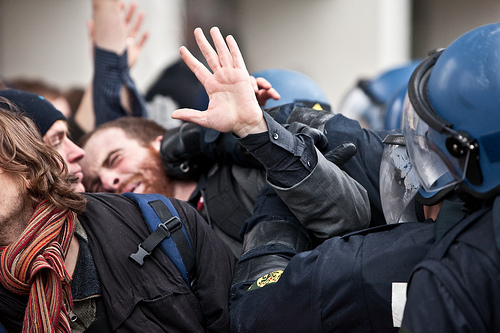
Photo credit and note: Kris Krüg on Flickr. See the red stripe near the man's suit collar? Other photos clearly show it's a UNFCCC delegate's lanyard, which means the man holding up his hand in self-defense and getting punched in the face by police had to pass the registration security checks, register at the Bella Center convention hall in person and to have been issued a valid COP15 badge.
Witnesses have reported that the man had been inside the convention at least most of the previous week, and there had not been any reported security incidents caused by alarming attendee behavior at Bella Center before the NGO lock out. We were all, apparently, just a bit too unsightly to have around when actual heads of state came to Denmark to do our business.
When I and about 50 other Friends of the Earth representatives from around the world showed up at the Bella Center (site of the climate negotiations) over the course of about an hour this morning, the security staff who scanned our UN ID cards told us that they were not valid and we would not be allowed in.
Given that all of us had appropriate accreditation, as well as the "secondary badges" the UN is now requiring for admission so it can restrict the number of people inside the Bella Center at any given time, we were surprised and confused by our inability to get in.
We'd planned to spend the day monitoring the process of negotiations, working to generate media coverage of the need for a strong and just agreement, and working with delegates from developing countries to draft text that could form such an agreement.
But instead, we were denied access. UN staff told Friends of the Earth International's chair, Nnimmo Bassey, that we were considered a security threat. This begged the question of why we were singled out from the many other peaceful non-governmental organizations taking part in the talks.
In this video, our team provides an on-the-ground narrative of how the day unfolded.
When about 15 members of the UN security team surrounded us, and then asked us to leave, we refused, sitting down in the registration area and demanding that we be let in and be provided with an explanation for the UN's refusal to admit us.
UN climate chief Yvo de Boer came out and spoke to us after a while and said access had been restricted because there was not enough room in the Bella Center and that he wanted to resolve the situation.
A few of our representatives went to talk to UN officials while we sat there, but our lack of access remained unresolved. We had both a member of the Norweigan and a member of the Canadian parliament come speak to us to lend us their support. Initially there were a lot of reporters, but the UN then cordoned us off and closed access to media.
Eventually they made us an offer to allow a small portion of our delegation into the conference, even though the full delegation met all the entry requirements that had allowed other groups (except Avaaz, which had also been kicked out) to gain admission.
The UN still has yet to give us a coherent reason for our having been denied access. It's hard to see how de Boer's "no room" explanation makes sense, as the UN continued to allow other NGO observers to enter even as we were denied access. And as for the security threat, we're a bunch of policy wonks and youth activists who have been participating in the negotiations every day for two weeks and represent no threat at all.
One of the key roles Friends of the Earth has played at the conference has been to advocate for climate justice and the interests of the poor countries that have done the least to cause the climate crisis but will feel some of its strongest impacts. Negotiators from those countries are tremendously under-resourced here. For example, I've worked with negotiators who have no media officers (I do media work) to help them communicate their position. They are totally outgunned by the massive delegations of the rich countries, and now thanks to the UN's decision to exclude us, they will have even less support inside the Bella Center to fight for a fair agreement. An agreement that already feels so far out of reach. It's really frustrating, and shameful.
It's been a discouraging day. But even if negotiators fail to produce a strong agreement this week, there is something we can be proud of. We're not backing down in our calls for climate justice, and we're not alone. The international climate justice movement is growing.
The United Nations Climate Change Conference (Cop15) turned ugly today when police officers beat back hundreds of demonstrators, including a group of 50 to 100 delegates that were trying to meet with the protesters.
More than 250 people were arrested, including spokespeople for Climate Justice Action (CJA), a global network of NGOs that organized a walkout at the Bella Center today. CJA's spokesperson Dan Glall told Mantoe Phakathi at Inter Press Service that "as a condition for going back to the negotiations, we demand industrialized nations uphold the Kyoto Protocol, commit adequate funds to adaptation and reduce greenhouse gas emissions significantly."
OneClimate has video (below) of today's walkout.
"More than 1,000 people have been arrested, detained and released over the course of the past week," Jennifer Prediger writes for Grist. "Some were made to sit on freezing sidewalks for six hours in a nasty version of time out. The people who threw rocks and set cars on fire were rightfully detained. But the droves who were dragged in last night for dancing awkwardly in Christiana? Seems like overkill to me."
The chaos outside reflects the increasing pressure inside the Bella Center, as delegates turn to the United States and China for leadership in the final days of the summit. Together these countries account for 42 percent of the world's carbon emissions.
In order to finalize a global climate agreement in Copenhagen, both countries need to take a big step forward, as David Doniger and Barbara Finamore report for Grist. For the U.S., this means aid for the world's poorest and most vulnerable people; for China, this means making steady progress to meet the country's carbon reduction goals.
The U.S. has already committed to pay its share of a $30 billion fund to last through 2012. "But to lead in Copenhagen, the U.S. needs to back even larger investments to meet these core needs for the longer-term-2015 or 2020," Doniger and Finamore write. "China has the opportunity to enhance its standing as a responsible world leader by building global confidence in the implementation of its carbon reduction goals."
But as David Corn reports for Mother Jones, China and the U.S. are apparently "stuck in a standoff." An Obama administration official insisted that it's not about the money: "'We have to get the developing nations into an international agreement,' the official said... Yet China has forcefully resisted the idea of incorporating their self-professed emissions goals (essentially, slowing the growth rate of emissions) into a binding agreement. China has also repeatedly said that it will not submit its performance to official outside vetting."
Corn writes, "But with 115 heads of states beginning to arrive, the Copenhagen talks have left some fundamental gaps for the last minute. Even if those gaps are bridged, the resulting agreement could fall far short of what experts say is necessary to redress the dire consequences of rising global temperatures. Just ask the scientists roaming the halls."
Secretary of State Hillary Clinton arrived in Copenhagen today in a last minute appearance. Clinton has booked a full day of meetings on Thursday and will join President Barack Obama in negotiations when he arrives Friday. Like Obama's schedule switch at the conference (he originally planned to be there last week and instead will arrive Friday), Clinton's arrival could indicate the U.S.'s intention to seal a deal by the end of the week.
For live updates of the negotiations and protests, check out The Uptake's live video stream from the Bella Center.
<This post features links to the best independent, progressive reporting about the environment by members of The Media Consortium. It is free to reprint. Visit the Mulch for a complete list of articles on environmental issues, or follow us on Twitter. And for the best progressive reporting on critical economy, health care and immigration issues, check out The Audit, The Pulse, and The Diaspora. This is a project of The Media Consortium, a network of leading independent media outlets.
Third in a series of interviews with farmers affiliated with La Via Campesina, an alliance of international peasant farmer organizations.
Michel David's father was a farm worker, and in 1991, he gave up his own job as a social worker to start farming himself. He now runs a 40 hectare (around 100 acres) organic farm on woody, hillside land where he raises 20 cows among his apples and chestnuts, and came to Copenhagen representing the Confederation Paysanne.
Every year, David says competition from abroad and EU policies that reward large farms close about one farm a day in France, or about 300-400 farms per year. He said the land goes either to bigger farms or to tourist venues and "it's hard for small farms to resist."
David added that international competition could be very unequal, pitting small farms like his against Brazilian ranches with 20,000-100,000 cows, or small sheep farms against 20,000 animal operations in New Zealand.
Of course, David said, there was industrial agriculture in France, as well. He said animals there were often fed genetically modified soy from Brazil or the US, importing 4.5 million tons per year from large industrial farms that hurt small farms in their regions and take protein away from the global South.
I asked David if it wouldn't be better for industrial agriculture to replace all these small farms, if it would be more efficient. He said industrial agriculture "is not efficient at all," that it takes up too much petrol and outside resources. A small farm like his, he said, used up very few resources, ensured the animals were treated well and was "better for the health of the people and the food." He said organically managed soils also captured more carbon and this is better for the climate.
Farming ecologically and encouraging farmers to first feed the people of their own country should be normal, David said. "We have enough to feed the people of each country," he said, and that it wasn't necessary to pit farmers in different countries against each other.
For all that it seems unusual for someone to leave the office for the farm, David enjoys his work very much, responding when I asked about it with an enthusiastic, "Yes, of course!" He said that sometimes he'd like more money, but added, "I like to know the people I feed and I like to feed them properly."
Second in a series of interviews with farmers affiliated with La Via Campesina, an alliance of international peasant farmer organizations.
Elvira Baladad, a mango orchardist visiting Copenhagen to represent La Via Campesina affiliate Paragos Phillipinas in the COP15 civil society discussions, told me that she didn't want to talk about mangos. She was far more concerned about the wild weather the Phillipines have been having, with such an extended rainy season that she said it seems like they don't have summer anymore, and the destruction of what she estimated was 70-80 percent of the country's rice crop by typhoons Katsana and Parma.
Baladad said that rice varieties that were resistant to flooding and could survive long periods in standing water were no use to them, how could they dry it? She gave the example of how the Phillipines had a hard time buying rice from Cambodia anymore because the harvested grain was too wet for the kind of facilities they had, so they had to sell theirs to Vietnam where it could be processed for market.
"We're a rice eating people, ..." Baladad said, "If [this weather] is to continue, what is to happen to us?"
Baladad worried that if the country has to import rice from Vietnam or Thailand and they won't sell, as happened in 2008, that there might be uprisings or a return of dictatorship. She seemed certain that such a turn of events would hurt rural people the most, particularly economically marginal women who are responsible for feeding their families.
Through Baladad's membership in the National Coalition of Rural Women, Baladad is also aware of issues among other rural populations in the region. She explained how the REDD initiative to reduce deforestation emissions from developing nations meant that, for example, Australia could lease Indonesian forest land for emission credits, but that meant no one else could live there. She said they had to first evict all the indigenous peoples who lived in the forest before there could be a deal.
I asked Baladad if that was a problem in the Phillipines and she said no, Phillipine law forbade it. "We acknowledge their rights over their ancestral land. They have prior rights over this land." She said that, in countries without such laws, implementing REDD without acknowledging indigenous rights would mean many of them will be kicked out of their homes.
The land use problems that concerned Baladad in the Phillipines was the 100,000 hectares (about 250,000 acres) of farm land leased to the Chinese to grow food for export to China so they could continue converting agricultural land to industrial use. While naming China and Saudi Arabia, she said many countries were leasing land from the governments of developing nations for farming or biofuel projects, often displacing local peoples and over their objections.
When local people in the developing nations are hungry because their crops fail in unpredictable weather, Baladad said she expected these foreign-leased farms would be raided by the desperate.
Baladad was urgent about the need for action to stabilize the climate, and for the US to be involved. "If the US doesn't sign on like they didn't with Kyoto, this will be a total failure and nobody will want to reduce emissions. ... They can't stop China from emitting so much right now if they can't agree to an amount everyone has to reduce," said Baladad.
Baladad seemed to think it might also be a question of experience. "We're saying maybe if these floods happened in the US," she said, "the US would sign up."
Along with Natasha, who is also in Copenhagen, Friends of the Earth will be blogging live from the Climate Change conference on Open Left over the next two weeks--make sure to keep coming back for more first-hand reporting!--Chris
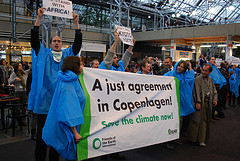
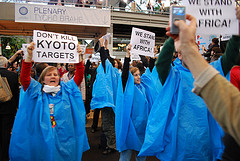
Several different morning marches, including Friends of the Earth's Flood for Climate Justice featuring 10,000 global citizens from countries ranging from Denmark and the UK to Malawi, Uruguay and Sri Lanka, fed into the main march in the afternoon. I and the other Friends of the Earth activists came dressed in blue rain ponchos. Many had their faces painted the color of the ocean. We held signs demanding climate justice and an end to carbon offsetting. Here's some video of the march put together by our Friends of the Earth U.S. contingent (including me):
Despite the cold, there was a lot of excitement in the crowd, and it felt moving and empowering to be part of this march -- a reminder that, regardless of the outcome of the negotiations inside the Bella Center, there is a growing movement for climate justice among activists that can hopefully produce truly just and sustainable solutions to the climate crisis in the future.
Amid the chants and signs, "climate doctors" carried planet earth on a stretcher -- attached to an IV and a stethoscope in an attempt to treat our climate emergency. Activists dressed as Wall Street traders, with sinister faces and flashy suits, tried but failed to sell the crowd on carbon derivatives trading.
The energy (clean, of course) of our climate justice movement was electric.
The vast vast majority of marchers were peaceful, something that might not have been apparent from reports in the media.
After the marches joined, the combined 100,000 marched to the official United Nations climate conference center on the outskirts of the city. Negotiators in the conference halls gathered around televisions to watch the events outside, keenly aware that our calls for real action and a fair outcome were reverberating throughout the world.
For some more inspiring footage of the growing climate justice movement, here's another video of the "flood" from Young Friends of the Earth Europe:
Along with Natasha, who is also in Copenhagen, Friends of the Earth will be blogging live from the Climate Change conference on Open Left over the next two weeks--make sure to keep coming back for more first-hand reporting!--Chris
****
Over the weekend, a new round of secretive climate negotiations started in Copenhagen -- the "Greenland Dialog." These talks, held outside of the Bella Center, which is the official UN meeting place here, were not open to everyone but were limited to approximately 40 to 50 countries picked via an unclear process. They mostly represented rich country interests.
The whole point of the UN process is to give all parties to the UNFCCC a voice, and these side negotiations, instead of moving discussions forward in a productive way, have stalled progress by excluding and marginalizing the perspectives and demands of developing countries.
Following the weekend's "Greenland Dialog" (similar to equally undemocratic "green room" negotiations at the World Trade Organization), today the Danish government, which is presiding over the climate conference, made a procedural move that appeared to be an attempt to kill off the Kyoto Protocol, making it easier for rich countries to avoid making needed emissions reductions.
The primary developing country negotiating bloc declined to play this game and demanded that the Kyoto Protocol be protected and its concerns be addressed before negotiations procede.
Friends of the Earth International activists participated in "flash mob" interventions (captured in the pictures above) in the Bella Center during the suspension of talks to stand in solidarity with the demands of Africa and other developing countries.
Nnimmo Bassey, chair of the Friends of the Earth international network, responded with this statement:
We support African countries' demands for Kyoto targets and mandatory emissions reductions for rich countries. We denounce the dirty negotiating tactics of rich countries which are trying to change the rules and tilt them in their own favor. Developed countries are stalling these negotiations as Africa attempts to move them forward.
You can watch Nnimmo Bassey explain why we're standing with Africa to a reporter inside the Bella Center and catch some footage of one of the "flash mobs" in action:
UPDATE: Negotiations stalled today in Copenhagen when African nations walked out in protest of perceived attempts by rich nations to kill the Kyoto Protocol, Talking Points Memo reports. The talks are back in session now. Watch Link TV's live stream from Copenhagen for more on this story as it develops.
On Saturday, December 12, climate activists rallied to call for a binding climate agreement. Vigils, fasts, and protests were held around the world, and in the largest environmental demonstration in history, 100,000 activists marched in downtown Copenhagen from the Christiansborg Palace to the Bella Center, where the United Nations Climate Change Conference (Cop15) is being held.
Overall, the march was peaceful and positive, ending with a vigil outside the Bella Center, where the demonstrators were greeted by South African Archbishop Desmond Tutu. However, Danish police detained more than 500 activists at the back of the line, where European "black bloc" anarchists were trying to infiltrate, as Jacob Wheeler and Chuck Olsen report for The UpTake.
Kumi Naidoo, the first African leader of Greenpeace, is optimistic and enthusiastic about a deal in Copenhagen-and the role activists will play in making it happen. In an interview with Madeline Ostrander for Yes! Magazine, Naidoo says that the "... summit itself would not be taking place had it not been for groups like Greenpeace and others who have fought for a very, very long time. The fact that we are here is in itself an expression of innovation, courage, and willingness to speak truth to power."
According to Naidoo, activists are putting pressure on leaders by working both inside and outside the negotiations, and "delegations are reaching out to us as they try to figure out what's happening. Sometimes we civil society folks get to know what these countries are doing and thinking before some of the other negotiators do." Without the "sweat of activist groups," Naidoo says, Copenhagen wouldn't even be happening.
OneClimate posted a video overview (below) of demonstrators' work at the Cop15 climate march on Saturday. "People are not in Copenhagen to bury the climate treaty, " said Vandana Shiva, Director of Navdanya, a women-centered movement for the protection of biological and cultural diversity. "They are here to implement it! Let this be the time where, you, marching to the Cop15, tell the leaders, 'We have the power... we will be the change we want to see, and no one is going to stop us.'"
In other news, Tuvalu and other small island nations introduced a proposal that would commit the world's developed nations to reducing greenhouse gas emissions enough to keep their islands habitable. They want Cop15 to produce two binding agreements: One to extend the Kyoto Protocol and make it stricter, and another that would require the United States to reduce its greenhouse gas emissions.
Tuvalu's lead negotiator, Ian Fry, made an impassioned plea to the U.S. Senate, President Barack Obama, and the entire UN climate conference Saturday, telling them that his country's very survival depends on the decisions they make in the next week, as Jeffrey Allen reports for OneWorld. Fry's speech brought other nations' officials to tears.
"The fate of my country rests in your hands," Fry told the other delegates.
This weekend's action helped set the stage for an exciting second week in Copenhagen, as Geoffrey Lean writes for Grist. "If the conference is successful, then the more than 100 world leaders due to come to the Danish capital this week will initiate the biggest economic change since the Industrial Revolution."
There are still arguments over the details of any final deal, such as how the measures to cut greenhouse gas emissions will be monitored and verified, who will fund it, and how to retain and improve the Kyoto Protocol.
"The likeliest outcome is a toughened Kyoto Protocol, with a linked treaty covering the United States and developing countries (at present excluded from its provisions) and new agreements made in Copenhagen," Lean writes. "... It will be one big package, or nothing. And it may all come down to the last few hours of the last day-or night, since no one wants to move until the last minute. The outcome of the Copenhagen talks is going to be a cliffhanger."
This post features links to the best independent, progressive reporting about the environment by members of The Media Consortium. It is free to reprint. Visit the Mulch for a complete list of articles on environmental issues, or follow us on Twitter. And for the best progressive reporting on critical economy, health care and immigration issues, check out The Audit, The Pulse, and The Diaspora. This is a project of The Media Consortium, a network of leading independent media outlets.
In talking further with members of the African civil society delegations about the current effects of climate change in their region, Robert Chimambo of Zambia's Civil Society Climate Change Network said that his central African nation of Zambia was "getting rains like we've never seen," while Kenya was experiencing terrible droughts.
Chimambo said his country "needed help yesterday, people are drowning now." He explained that the rains were flood much of the crops that were planted, while waterlogged soils were keeping people from planting crops and undermining the foundations of homes.
His comments were echoed by Tolbert Jallah, a Liberian working in Togo with the Fellowship of Christian Councils and Churches in West Africa. He said nations in western Africa also used to have a six month dry season followed by a six month rainy season, but "now we have 10 months of rain."
Jallah described the situation in failed state of Togo, where part of the country is in drought, while the northern areas bordering Burkina Faso are flooded out. He said the drought had created such hot, dusty conditions that even someone like himself from a nearby country found it intolerably hot and dusty.
Both conditions are worsening Togo's food security. Jallah described animals being drowned and washed away in one region and being suffocated by the same heat that's dried up their water and forage in drought-stricken regions.
In his native Liberia, Jallah said that the city of Buchanan (like Togo's capital, Lome) was in danger of being inundated by the rising Atlantic ocean. Many seaside coconut plantations have already been inundated and he said he thought people on the beach would lose everything, "because we never know when the water will come at night." Floods from heavy rains also washed garbage into the cities, posing a health risk particularly to children.
Jallah also said that agriculture was at much at risk in Liberia as in Togo. He said rains often prevent farmers from clearing brush or getting to their farms when the creeks overflow. And forget planting in the rain.
Jallah and I talked a bit about the holdup with climate legislation in the US Senate. I told him that we were having problems getting them to do anything, and that some Senators didn't believe in global warming. He was well shocked.
"If any person says climate change is not real, I think that prson is sick," said Jallah, "I think that person can only be healed when he comes and sees the reality in the continent of Africa. ... The ocean is coming. What can these countries do to stop the ocean?"
Jallah added that he was "not impressed with the US government," or Obama's statements, saying that the US president doesn't show emotional intensity on climate change as he has on other issues. "President Obama, where is the world leadership," he asked.
Emphasizing his belief that it was a much of a concern for all faith-based organizations, as well as a moral country like the US, Jallah said that "if we turn a blind eye to climate change ... it's declaring one side of the world a graveyard."
Jallah said rich countries should offer an equitable deal, at least $20 billion per year in aid, instead of the "chicken feed money" that's on the table now.
First in a series of interviews with farmers affiliated with La Via Campesina, an alliance of international peasant farmer organizations.
Prabina Pradhan works in Kathmandu, Nepal's capital, as an advocacy organizer for the All Nepal Peasants Federation. She talked with me about the economic and climate situations in her country, and how people's lives are being affected.
Pradhan explained that most people in Nepal have small kitchen gardens to provide much of their food, and may earn some money selling any extra harvest at market. Agriculture there is mostly rainfed and highly dependent on a changing climate cycle.
"The crop cycle is getting shorter now", said Pradhan. Also, the growth range for tropical crops is moving into higher latitudes of the Nepalese mountains that formerly were good for temperate crops. Add in food imports mandated by WTO agreements, often sold below production costs, and it becomes hard for the typical Nepalese to thrive.
What did she think of the climate agreements, like the Clean Development Mechanism or the REDD forest funding program, would they help? "Earning money is not the solution if the land and water and environment [are] polluted," said Pradhan, "we can't have clean air by money."
While Pradhan thought there should be compensation to poorer nations for the environmental damage they're seeing alreeady, that they shouldn't have to trade with their environments for the sake of developed nations who refused to cut their emissions. She said she thought the rich nations didn't want to spend a lot money to reduce their own emissions, but instead wanted to give only a little money to reduce emissions in other countries.
I told Pradhan that I've heard people in the US say that it's better for subsistence agriculture, like that in Nepal, to go away anyhow. That it would be better for people to get other jobs and not worry about agricultural problems caused by climate, like the ones she's seeing.
"But we don't have other jobs!" she exclaimed, saying further that 67 percent of Nepalese depend on agriculture and most of the people are illiterate. She said they couldn't just push all that away. "In the United States," she said, "... people can do anything they like, but we can't."
Tuvalu's ambassador, Ian Fry, pleaded with the UN assembly to save his country this weekend. He said it was "an irony of the modern world that the fate of the world is being determined by some senators in the U.S. Congress," noting that climate change is the "greatest threat to humanity, ... the greatest threat to security." He got no response when the US ambassador spoke soon after:
The fifteenth Conference of the Parties, as many other very important gatherings are, should be known for what it is: just another place where the poor have to come begging for their lives while the wealthy make a big show of having been generous enough of their time to be present for this grimly polite supplication.
"We [are] here in Copenhagen to fight for our identity, for our culture, and for our very right to exist," she said tearfully. "All the hopes and dreams of my generation rest on Copenhagen."
As that Guardian article goes on to note, Wickham's comments were followed by very important people talking about the many reasons why nothing can be done to answer her. Hedegaard's response to the arrest of a small anachist contigent among the 100,000 or so peaceful protestors, was fascinating, saying that they didn't "have to use that kind of violence to be heard."
Well, fine. Granted. Maybe she should tell it to her own country's police forces, who detained hundreds of peaceful marchers on the ground for hours on a day when it started snowing not too long after sunset.
But seriously, wtf will it take to be heard? I don't know whether everyone's fresh out of ideas or if the jerks in power are just that deaf.
Will Hedegaard really listen to the 10 million people who signed the petition Wickham delivered to her, or the 99,000 people, give or take, who showed up peacefully with candles and signs and chants and a burning sense of urgency that brought them to Copenhagen in December where they were outside for hours in the freezing cold? Will the eminences of the G20 hear the church bells that rang 350 times today to call the world to climate justice? Will Gordon Brown and Barack Obama listen? Will the media listen? Will the haughty finance leaders who tell these presidents and ministers when they're allowed to sit down, stand up and break to scratch their bums listen to the people whose lives and futures they're destroying?
What will it take?
Because we're never going to get anywhere if industrialized and wealthy nations keep playing a destructive game of trying to get the other person to give more, first. Each nation must commit to do what's right, and they should stick to that because it would shame them to look back on this time and say that they did nothing to prevent all the suffering that's only at its beginning. They must look to find their national honor in the greatness of their souls and the depths of their humanity instead of the heights of their office towers.
If they won't do what's right, their citizens had better break through our creativity blocks to figure out a way to convince them that they can't ignore. Time is fleeting. Physics is unforgiving.
A big U.S. congressional delegation is arriving here at the climate summit in Copenhagen next week, and it includes notorious climate science deniers Sen. James Inhofe (R-Big Oil/Oklahoma) and Rep. Joe Barton (R-Big Oil/Texas).
But one of the world's most prominent science deniers -- "Nobel Laureate" "Lord" Christopher Monckton, who provides the "scientific" analysis upon which Barton, Inhofe, and other members of the anti-science crowd depend -- is already here and he's already generating embarrassing headlines for their movement.
Before getting into how Monckton is exposing the anti-science movement's truly fringe character in Copenhagen, I should explain my use of quotes in the previous sentence. Monckton did campaign to become a member of the British House of Lords, but he lost and is not and has never been one. He has no formal scientific training (more on that here). And his "Nobel Peace Prize" was awarded to him not by the Nobel Prize Committee but by "the Emeritus Professor of Physics at the University of Rochester, New York" (presumably Robert Sproull, a member of the board of the anti-science Marshall Institute), who presented Monckton with a fake Nobel pin made of gold. Monckton now calls himself a "Nobel Laureate" on his organization's website, because he "contributed" to an Intergovernmental Panel on Climate Change report sounding the alarm about global warming (even though Monckton claims there is no alarm to be sounded).
As an anti-spam measure, there is a 24-hour waiting period after registering before new users can comment. blog advertising is good for you
blog advertising is good for you