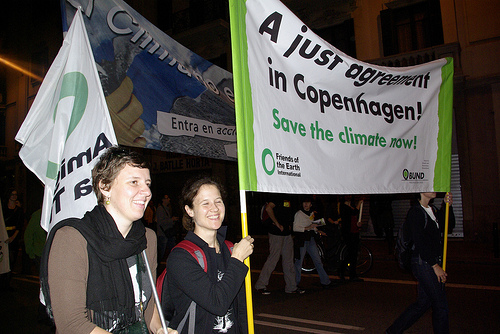
A big U.S. congressional delegation is arriving here at the climate summit in Copenhagen next week, and it includes notorious climate science deniers Sen. James Inhofe (R-Big Oil/Oklahoma) and Rep. Joe Barton (R-Big Oil/Texas).
But one of the world's most prominent science deniers -- "Nobel Laureate" "Lord" Christopher Monckton, who provides the "scientific" analysis upon which Barton, Inhofe, and other members of the anti-science crowd depend -- is already here and he's already generating embarrassing headlines for their movement.
Before getting into how Monckton is exposing the anti-science movement's truly fringe character in Copenhagen, I should explain my use of quotes in the previous sentence. Monckton did campaign to become a member of the British House of Lords, but he lost and is not and has never been one. He has no formal scientific training (more on that here). And his "Nobel Peace Prize" was awarded to him not by the Nobel Prize Committee but by "the Emeritus Professor of Physics at the University of Rochester, New York" (presumably Robert Sproull, a member of the board of the anti-science Marshall Institute), who presented Monckton with a fake Nobel pin made of gold. Monckton now calls himself a "Nobel Laureate" on his organization's website, because he "contributed" to an Intergovernmental Panel on Climate Change report sounding the alarm about global warming (even though Monckton claims there is no alarm to be sounded).
In a Wednesday session on using biochar as a climate stabilization measure, Nathaniel Mulcahy of World Stove explained that over 2 billion people worldwide cook on open fires. Constant open fires not only pose a carbon emissions problem, they pose a health risk, increasing respiratory distress and incidences of asthma. If they cooked their meals on a simple pyrolysis stove, instead of an open flame, they could sequester between 1-3 tons of carbon per person, per year, which is about what you'd get from an acre of pine forest, and significantly reduce indoor particulate.
Along the same lines, Mulcahy noted that 20 million tons of rice straw were just burned in Egypt every year. Ash from open fires retains as little as 3-5% of the original mass of carbon in the original plant material, and the nutrients are used up quickly. Char produced through pyrolysis, on the other hand, can retain 20-50% of the original mass of carbon, which can then stay in soil a long time and improve fertility.
And here, I should mention the ways in which combustion (burning things), digestion and decomposition are all similar. Each of these processes take carbon that was originally breathed in by plants, solidified by those plants into sugars, possibly eaten by a series of animals, and then returned to a gaseous state in the form of carbon dioxide (CO2) or methane (CH4). Having mentioned digestion and decomposition separately, I should proceed directly to tell you that decomposition is a word for digestion by microbes (bacteria and fungi,) and so while we think of it separately, it works about the same and isn't some inevitable, mechanical process.
At the United Nations Climate Change Conference in Copenhagen (Cop15), global leaders aren't just negotiating a climate deal-they're positioning to avoid blame if the talks fail.
David Corn reports for Mother Jones that as soon as U.S. climate change envoy Todd Stern arrived at the Bella Center this Wednesday, he quickly listed all of the Obama administration's actions to address climate change: The Clean Air Act, the proposed reduction in emissions, boosted fuel economy standards, and so on. Stern then changed the subject to China, observing that "by 2020, China's emissions will top those from the United States' by 60 percent, and then by 80 percent in 2030."
Stern's message is clear: If the talks don't succeed, it's not America's fault. Corn writes that "with fundamental questions unresolved-particularly the obligations of China and the other major developing nations-it's quite possible the talks could collapse and yield an orgy of accusation. Thus, the need for governments to fret about Plan B, as in Plan Blame. The real problem is, if such a worst-case scenario does occur, each of the major players will indeed have plenty of cause to point fingers at the others."
But are we really in a position to point fingers? The United States spent an average of $130 billion a year on the wars in Afghanistan and Iraq from 2003 to 2009. The Obama administration has requested $138.6 billion for 2010, plus approximately $30 billion more for the additional troop surge.
When the Congressional Budget Office estimated the cost of a climate bill several months ago, it came up with a dramatically different sum: $22 billion per year.
As Matthew Yglesias writes for The American Prospect, "the United States has in the recent past undertaken initiatives that cost dramatically more than a strong climate initiative. We did it because we could afford it, and because the political elite in the United States takes military ventures seriously and wants to see them succeed. Well, averting catastrophic climate change is important too. ... Whether we leave a legacy of leadership that meets that challenge will be determined largely by what happens at Copenhagen and what the Senate does to live up to whatever commitments the Obama administration makes there."
The final deal needs to be inclusive of all people. Mantoe Phakathi of Inter Press Service writes that the deal needs to account for gender rather than simply classifying women as "vulnerable groups," a term used in climate change policies in many countries, including South Africa and Kenya.
"Gotelind Alber, a researcher for the U.N.'s agency for housing, UN-HABITAT, said women in city slums are more vulnerable after natural disasters-women are often last to hear warnings of coming disasters, unable to move quickly while safeguarding children in their care, and in the breakdown of order that typically follows, exposed to violence."
Finally, in the largest demonstration so far at Cop15, hundreds of youth created a "climate storm" inside the Bella Center yesterday, as Joshua Kahn Russell reports for Grist. The young activists clapped, snapped, and pounded their feet in representation of the typhoons and hurricanes that have ravaged communities around the world this year [Video below].
This post features links to the best independent, progressive reporting about the environment by members of The Media Consortium. It is free to reprint. Visit the Mulch for a complete list of articles on environmental issues, or follow us on Twitter. And for the best progressive reporting on critical economy, health care and immigration issues, check out The Audit, The Pulse, and The Diaspora. This is a project of The Media Consortium, a network of leading independent media outlets.
Today is "Young and Future Generations Day" here at the International Climate Negotiations in Copenhagen, and I'm here with my wife Wahleah and our two-year-old daughter Tohaana. Along with thousands of other young people, we're doing everything in our power to convince world leaders to commit to a fair, ambitious, and legally binding international agreement based on a target of 350 parts per million (ppm), which is the safe upper limit of carbon dioxide in the atmosphere.
Less than 400 miles away in Oslo, Norway, President Obama is accepting the Nobel Peace Prize "for his extraordinary efforts to strengthen international diplomacy and cooperation between peoples." If ever there was a time and place to live up to that honor, now, in Copenhagen is it.
Four former Nobel Peace Prize winners have endorsed a target of 350ppm. On December 12th, 2008, at the international climate talks in Poznan, Poland, Al Gore (2007 winner) said to a huge crowd: "Even a goal of 450 parts per million, which seems so difficult today, is inadequate. We need to toughen that goal to 350 parts per million."
The Mulch: 10 Million Strong, and Growing
By Alison Hamm, Media Consortium Blogger
It's one of the largest petitions in history-and the biggest climate-related petition ever delivered. Organized by the TckTckTck campaign, 10 million people called for leaders to sign a fair, ambitious, and legally binding climate treaty at the 15th United Nations Climate Change Conference in Copenhagen (Cop15).
After the opening press conference on Monday, young people from around the globe handed the petition to Yvo de Boer, head of the United Nations agency organizing Cop15, and Connie Hedegaard, Danish Climate Minister and President of Cop15. More than 220 leading civil society organizations from environmental, development, labor, and health fields came together for the campaign.
Richard Graves of Yes! Magazine reports on the event: "Although the number of people that had signed the petition is a staggering figure, what really captivated the crowd was the short speech by Leah Wickham, 24, of Fiji, who spoke about the 'hopes and dreams' of the ten million people that had signed the petition. Her heartfelt talk silenced the room. Small island nations like her own, she said, are on the front line of climate change."
According to Wickham, the Copenhagen climate treaty "'represents our hopes and dreams for all the generations that will be ... Fifty years from now, my children will be raising their own families and it is my biggest hope that they will still be able to call our islands home. ... In the end, climate change will not discriminate.'"
Yvo de Boer promised to deliver, saying, "This is not just about U.N. decisions and treaties, this is about people, culture, and countries' survival. The talking needs to stop and the action needs to begin."
The U.S. Environmental Protection Agency (EPA) also added incentive for a deal. On Monday, the EPA announced that greenhouse gases endanger human health and the environment and must be regulated. As Marjorie Childress reports for the New Mexico Independent, the endangerment finding means that the EPA can set stronger emissions requirements in the future.
In Grist, David Roberts debunks a leaked draft agreement that has caused a media flurry. He writes: "It's now become clear that the supposedly new draft is one of several old drafts that have been floating around for weeks. For the most part [the drafts] are boring and practical, though the anti-World Bank crowd is pissed. Regardless, the draft is of no particular significance in and of itself; it reflects longstanding points of tension between rich and poor countries but did not cause them."
People want a climate deal, now. In an interview with the Uptake's Jacob Wheeler (video below), Naomi Klein of The Nation warns against the idea of "Hopenhagen," saying, "There's no point in hoping for something that is not on the negotiating table." Instead, she discusses what we can realistically expect from the climate talks.
This post features links to the best independent, progressive reporting about the environment by members of The Media Consortium. It is free to reprint. Visit the Mulch for a complete list of articles on environmental issues, or follow us on Twitter. And for the best progressive reporting on critical economy, health care and immigration issues, check out The Audit, The Pulse, and The Diaspora. This is a project of The Media Consortium, a network of leading independent media outlets.
Along with Natasha, who is also in Copenhagen, Friends of the Earth will be blogging live from the Climate Change conference on Open Left over the next two weeks--make sure to keep coming back for more first-hand reporting!--Chris
****
Monday marked the first full day of climate negotiations in Copenhagen. In spite of pleasant words at the opening sessions, deadlock continues around the key issues of emissions reductions and money on the table for developing countries.
Wealthy, industrialized countries have thus far refused to agree to aggressive emissions reductions. And they are making underwhelming offers for funds to support developing countries as they deal with climate impacts and transition to clean energy.
Unfortunately, rumors are that Denmark, as host and "president" of the conference, has worked with the United States and some European Union countries to draft secret text for an agreement. The text purportedly would put in place a weak deal that plays into the U.S. strategy of encouraging countries to choose their own emissions reductions and removes key legal compliance provisions currently in the Kyoto Protocol agreement.
A number of groups signed a letter expressing concern over the actions of the Danish presidency and calling for a fair process.
HOW AN NGO OPERATES AT THE NEGOTIATIONS
Friends of the Earth is working inside and outside the Bella Center where the talks are taking place (see the guided video tour of the center embedded in this post) to make sure our voices are heard and the voices of developing countries are amplified.
We've been meeting with individual delegates, and inside the plenary hall on Monday, Friends of the Earth El Salvador’s Ricardo Navarro delivered an "intervention" -- a brief formal speech from a non-governmental organization -- highlighting our collective concerns about the direction of the negotiations.
For an example of the type of outside activity we're engaging in, check out this melting mermaid produced by Friends of the Earth Germany near the entrance of the Bella Center calling for climate justice in Copenhagen.
(The mermaid is an iconic figure in Denmark due to a prominent statue in Copenhagen depicting the main character from Danish writer Hans Christian Andersen's "The Little Mermaid.")
You can read more from Friends of the Earth U.S.'s delegation at foe.org/copenhagen and via the Friends of the Earth International blog http://www.foei.org/en/blog.
Over 15,000 people from 192 countries began to work towards an international climate deal today in Copenhagen. These discussions are part of the largest and most important United Nations climate change summit in history. After two years of contentious negotiations, heads of states are convening through Dec. 18 to curb greenhouse gases, encourage the development of clean energy, and transfer hundreds of billions of dollars to help developing nations curb climate change.
It's going to be a lively 11 days. Jacob Wheeler has already posted video of a demonstration to save the climate for In These Times' blog, The ITT List. For live coverage of the Cop15 summit, make sure to check out video streams hosted by The UpTake and OneWorld.
Robert Eschelman reports in The Nation that Cop15's probable outcome will be a draft agreement. But what will this potential deal look like? "Four issues will dominate the negotiations taking place inside Copenhagen's Bella Center. First, developed nations, such as the United States, must commit to significant reductions in their greenhouse gas emissions. Second, developing countries like India and China will have to reduce the rate at which their emissions increase over the next several decades. Third, developed countries will have to provide clean energy technologies and funding to developing nations as they address the effects of climate change. And, finally, negotiators will have to agree on how to monitor and enforce an international climate agreement."
The U.S. has taken some good first steps to reaching such an agreement. Last week, President Barack Obama announced the country's commitment to a global fund that will mobilize $10 billion per year by 2012 to support developing countries that are already experiencing the effects of climate change. It's an important first step. But as Yes! Magazine reports, using the World Bank and the International Monetary Fund to manage this money isn't a good idea. "Both have track records of saddling poor countries with debt, requiring government spending cuts that undermine national economies, and handing lucrative contracts to transnational corporations."
President Obama has also changed the timing of his Copenhagen visit from this Wednesday, Dec. 9, to the conference's big finale on Friday, Dec. 18. Grist consulted with a panel of experts regarding the significance of the schedule switch. They all agree: It's a big deal. Obama's arrival on the last day "changes the game," according to Kenneth P. Green, resident scholar at the American Enterprise Institute. "It suggests that a 'deal' is already in the bag, and Obama's expecting that he'll get to bask in the glow of a new global agreement, flagrantly repudiating the position of the Bush administration in previous climate negotiations." Andrew Light, a senior fellow at the Center for American Progress, believes that Obama's appearance at the end of the conference will "transform the Copenhagen climate conference into the largest summit yet of world leaders focused on global warming."
Scientists warn that without such an agreement in Copenhagen, the Earth will face ever-rising temperatures, flooding of coastal cities (about half of the human race lives within 100 miles of a coastline), more extreme weather events, and the spread of diseases.
Air America features a comprehensive look at what's at stake in Copenhagen. "The change in U.S. administrations a year ago had aroused hopes the long-running climate talks might finally produce an all-encompassing package in 2009 to combat global warming and help its victims. Too little time and too little agreement, however, especially between rich and poor countries, mean the 192-nation Copenhagen conference is likely to produce, at best, a framework - a basis for continuing talks and signing internationally binding final agreements next year."
This post features links to the best independent, progressive reporting about the environment by members of The Media Consortium. It is free to reprint. Visit the Mulch for a complete list of articles on environmental issues, or follow us on Twitter. And for the best progressive reporting on critical economy, health care and immigration issues, check out The Audit, The Pulse, and The Diaspora. This is a project of The Media Consortium, a network of leading independent media outlets.
We fight, even against insurmountable odds, because sometimes we win.
As I get ready to head to Copenhagen this Saturday for the international climate negotiations, I'm thrilled to see the success of The Leadership Campaign and their efforts to have Massachusetts use 100% clean electricity by 2020.
On Monday, Representative William Brownsberger will file their bill, An Act to Re-power Massachusetts, in the Massachusetts House, calling on Gov. Deval Patrick to create a task force to formulate a plan to get Massachusetts to100% clean electricity by 2020.
Today, on November 30, one week before the UN climate negotiations in Copenhagen open, and on the 10th anniversary of the World Trade Organization (WTO) protest in Seattle in 1999, major demonstrations, teach-ins and civil disobedience are taking actions place in cities around the North America. Reports are now starting to come in from all over...
After a revolt by his own caucus for supporting PM Rudd's Emissions Trading Scheme (ETS), the Opposition leader has been replaced with one (Tony Abbott) who opposes the bill.
Due to the undemocratic nature of their Senate (sound familiar?) the governing Labor party does not have even a plurality of Senators and needed some of the Opposition to support the bill in the Senate. Now that won't happen, as the new leader will use strict party discipline to defeat the bill in the Upper chamber.
Rudd can call a snap "double dissolution" election where both chambers of Parliament go up for re-election. Assuming he wins (BBC says polling favours him), and the Senate defeats the bill again, he can call a joint session of Parliament, where they vote on the bill as a combined chamber (and the House's numerical advantage will mean it passes easily).
This has happened only once before. It was what Labor had to do to get universal health care passed the conservatives in the Senate in 1974.
Down under, Senates, and conservatives, suck too. At least the Aussies built in some kind of Lower house trump card to override them on major issues. Oh, and they pass bills by majority vote too.
Australia passing a Cap and Trade system ahead of Copenhagen would have added useful momentum and credibility to the effort. It would also have bolstered efforts to get the US emissions bill passed its House of Lords. Australian tea baggers have succeeded in hurting the chances of something meaningful coming out of Copenhagen.
On Wednesday, President Obama pledged to cut U.S. carbon emissions "in the range of" 17% below 2005 levels by 2020. Obama also confirmed that he will attend the international climate conference in Copenhagen next month, as Aaron Wiener notes for the Washington Independent. But here's the catch: It's a one-day deal. Obama is only planning to stop by Copenhagen on Dec. 9 before flying to Oslo to accept his Nobel Peace Prize. The climate talks, on the other hand, span Dec. 7 to Dec. 18.
You may have read that a prestigious climate research organization (the CRU) out of the University of East Anglia in England was attacked by "hackers" and had a significant volume of emails between the scientists leaked to some climate change denial blogs.
The theft was discovered when the hackers attempted to sabotage realclimate.org to post the emails. This was thwarted, so the thieves evidently decided to send the emails to some friendly bloggers who eagerly posted them. RealClimate provides the definitive rebuttal to the farcical claims of the deniers:
More interesting is what is not contained in the emails. There is no evidence of any worldwide conspiracy, no mention of George Soros nefariously funding climate research, no grand plan to 'get rid of the MWP', no admission that global warming is a hoax, no evidence of the falsifying of data, and no 'marching orders' from our socialist/communist/vegetarian overlords. The truly paranoid will put this down to the hackers also being in on the plot though.
We're talking about leading climatologists talking behind the scenes in private emails, and somehow they never admit to any of the conspiratorial claims of the deniers all these years. Of course this means the deniers shout "see, this proves what they've been saying all along!"
Today, the story took a new twist as the attack shifted to New Zealand's government climate research group, the National Institute of Water and Atmospheric Research (or NIWA, and their response is found at that link) for "manipulating" some data which demonstrates the steady warming curve observed in New Zealand over the past 100 years. This attack is sourced to New Zealand's "Climate Science Coalition" (no link for them), which as Deltoid notes, "(Note: New Zealand Climate Science Coalition contains no actual climate scientists.)"
Last weekend in Singapore, President Barack Obama acknowledged that a comprehensive international climate deal will not be reached during the climate change summit in Copenhagen. While many might view this as a letdown, lowering expectations might actually be a good thing, as Matthew Yglesias notes for the American Prospect. According to Yglesias, the conference can now be framed as a relative success whatever happens, and that will keep the momentum for climate action going after Copenhagen.
Recently, world leaders announced some deeply disturbing news: they gave up on reaching a binding climate deal at the upcoming Copenhagen conference. [1]
A major impediment was the refusal of President Obama and Congress to enact tough cuts in greenhouse gas emissions.
We've got to turn that around. Immediately.
Tell Obama and Congress to commit to a 40% reduction in greenhouse gases below 1990 levels by 2020.
Right now, the most ambitious target that Obama has endorsed is a 3.5% reduction in emissions by 2020. [2]
That's pathetic, compared to the 25-40% reduction that we need to have a 50:50 chance of avoiding disastrous runaway global heating, according to the International Panel on Climate Change. [3]
The United States ought to lead by example. We can do it with strong emission reductions.
Tell Obama and your Members of Congress to commit to tough emissions reductions today.
(This post is part of Friend's of the Earth sponsoring Open Left. Please check out the Friend's of the Earth website here--promoted by Chris Bowers - promoted by Chris Bowers)
Hi – I’m writing from Barcelona, where the final round of negotiations prior to the UN climate summit in Copenhagen came to a close on Friday. It’s been a tense five days here, with time running out for world leaders to get their act together. I want to share some of my reactions to what’s going on here—and in Congress back in the U.S.
This week, two very different types of stand-offs marked political negotiations over solutions to global warming, one cowardly and one courageous.
U.S. Senators Back Away from Real Action
In the U.S. Senate, Republican members of the Environment and Public Works Committee boycotted the scheduled mark-up of the climate and energy bill, complaining that Chairwoman Boxer (D-CA) was not giving them enough time to assess the economic impacts of the legislation. This came after Sen. Boxer had already given tardy Republican committee members an extension to offer amendments to the bill. The Republican ploy was childish, and almost certainly was an attempt to further weaken a bill that, as passed out of the committee Thursday, is already too weak to protect our climate.
African Delegates Stand Up for Real Action
Across the Atlantic in Barcelona, negotiators from African countries initiated a different sort of boycott — one with a much more constructive aim and a very urgent plea.
Monday, the first of five days of talks in Barcelona, African negotiators announced that they would not continue with formal discussions on other topics until rich countries made some real progress with their own emissions reduction targets. (These targets refer to the reductions in greenhouse gas pollution that rich (Annex I) countries commit to make by 2020.) Millions of people in developing countries are already being affected by climate change impacts such as floods and droughts. Developing countries and communities have historically had practically no fault in the creation of climate change, yet they already face devastating impacts.
The African delegation’s action was a strategic and brave move, designed to pressure rich countries to finally step up and commit to new, deep emissions reductions targets under an internationally binding agreement. With so few formal negotiating days left before Copenhagen, time is running out for rich countries to start cooperating. Rich countries’ continued shirking of their legal and moral responsibility to set new, strong and binding targets drove developing countries to this dramatic action.
More on how it all played out in Barcelona in the extended version.
Senate Democrats in the Environment and Public Works Committee (EPW) finally squelched Republican boycotts and passed a version of the climate bill yesterday morning. Last week, Republican Senators refused to show up to committee hearings in an attempt to stall the bill. Brian Beutler of Talking Points Memo notes that EPW has now set "the stage for other panels to amend the legislation."
Seventy days before the international climate summit in Copenhagen, hundreds of government officials and business leaders met in New York City on Monday to kick off Climate Week. On Tuesday, President Obama affirmed his commitment to action when he spoke to the United Nations General Assembly at the UN Climate Summit. Despite delays in passing a cap-and-trade bill, Obama highlighted U.S. efforts to curb climate change over the past year, including stimulus investments in renewable energy and efficiency, extension of tax credits for renewable energy, new automobile emissions standards and partnerships with other major emitters like China and India. Kate Sheppard of Mother Jones reports that Obama pledged to also address climate change with other leaders at G20 meetings later in the week.
In last week’s New Yorker, Malcolm Gladwell wrote a fascinating article, "How David Beats Goliath: When Underdogs Break The Rules." In his patented style Gladwell weaves together story after story of underdogs who defied convention to defeat much stronger opponents. From the Biblical story of David defeating Goliath, to a junior league basketball team of twelve year-old girls, to the armies of George Washington, Gladwell offers us examples of how an underdog is only an underdog when he plays by his opponent’s rules. He also offers the research of Ivan Arreguín-Toft, a political scientist who analyzed every war fought over the last two hundred years between strong and weak combatants.
The Goliaths, he found, won in 71.5 percent of the cases. That is a remarkable fact. Arreguín-Toft was analyzing conflicts in which one side was at least ten times as powerful—in terms of armed might and population—as its opponent, and even in those lopsided contests the underdog won almost a third of the time...What happened, Arreguín-Toft wondered, when the underdogs likewise acknowledged their weakness and chose an unconventional strategy? He went back and re-analyzed his data. In those cases, David’s winning percentage went from 28.5 to 63.6. When underdogs choose not to play by Goliath’s rules, they win..."
What an intriguing piece of data. Gladwell’s article got me thinking about the movement to build a clean energy economy and what we can do to turn the tables and put the odds in our favor. By most measures, we face an indomitable opponent. We seek to transition the economy off of fossil fuels, which represent the core business of the largest industry in the history of human civilization. In just the first three months of 2009, these companies spent $79 million lobbying Congress versus $4.6 million by our side--a 16:1 ratio--and a Common Cause study released yesterday shows that members of the critical Energy and Commerce Committee (where the climate and energy bill is currently being watered down) received an average of $107,230 from the energy sector in the last election. 16 to 1. 16 to 1. Those are tough numbers.
I wonder what would happen if we acknowledged our weaknesses and adopted an unconventional strategy. After reading The New Yorker article, I see four principles of a winning underdog strategy that we can apply to the climate movement:
1. Make it a battle of wills, not a battle of skills 2. Empower people to think and act in real time 3. Attack your opponent where they are weak 4. Defy social convention (and be ready to do what is socially horrifying)
Below the fold, I give my take on what some of the implications of these principles are for our movement's strategy.
As an anti-spam measure, there is a 24-hour waiting period after registering before new users can comment. blog advertising is good for you
blog advertising is good for you