The US faces disaster on at least three main fronts due to utterly discredited conservative ideology, with a variety of flashpoints on mini-fronts. The Democratic establishment can't even muster an argument that 2+2=4. It doesn't poll well with independents, apparently, since independents have never been polled on it.
(1) We continue the disastrous neo-con "long war" strategy supposedly in response to 9/11, but actually planned beforehand and completely at odds with the nature of the 9/11 attacks and the danger they represent. Our "full spectrum dominance" mentality currently has us facing armed--potentially nuclear--confrontation in Korea, enmeshed in an ever-deepening conflict with Iran, backing a lawless, racist and suicidal Israeli imperialist project, and unable to sustain a stabilizing nuclear weapons treaty with Russia. We are, on all fronts, at war with the very concept of national security. The discredited notion that security comes always and only from total military victory has not had a clear record of success in the American experience since WWII, which ended more than 60 years ago.
(2) Following an undersized stimulus package conceived two years ago, we have essentially reverted to a uncordinated, spasmodic mixture of feeble economic gestures reminiscent of the failed Herbert Hoover Administration of 80 years ago. As Brad DeLong wrote Saturday, in "Foreign Policy: The Four Horsemen of the Teapocalypse":
But we are now into the "recovery," and 2010 has been a very different year. Its horsemen are of a different breed entirely. Where Keynes and his ilk were optimistic believers in the power of technocratic governments to do good, this year's horsemen are practitioners of more dismal sciences: believers that the market metes out judgments that we must suffer -- and that it is our own flawed nature that makes us believe so. In short, it has been a year for Austrian economists Friedrich von Hayek and Joseph Schumpeter, for plutocrat and Great Depression-era Treasury Secretary Andrew Mellon -- and, above all, for Friedrich Nietzsche.
There was silence in the seminar room. Richard Kahn broke it. "Do you mean to say," he asked, "that if I were to go out tomorrow and buy a new overcoat, that it would increase unemployment?"
"Yes," said the man in the front of the room, Friedrich von Hayek, "but it would take a long and complicated mathematical argument to explain why."
That is how historian Robert Skidelsky describes Hayek's visit to the proto-Keynesian economists of Cambridge University. It was the 1930s, and Hayek had met them in London to convince them that depressions were not to be avoided or cured, but rather endured. In his thinking, they were righteous karmic payback for past sins against the gods of monetary orthodoxy. Any attempts to cut them short or make them shallower would produce only temporary palliation, at the cost of a fiercer, deeper, and nastier further depression in the future.
Hayek's fellow countryman, Joseph Schumpeter, went further: "Gentlemen!" he announced to his students at Harvard University (there were no ladies). "A depression is healthy! Like a good ice-cold douche!" If depressions did not exist, Schumpeter thought, we would have to invent them. They were "the respiration of the economic mechanism."
Agreeing with Schumpeter was Herbert Hoover's Treasury secretary, Andrew Mellon. In his memoirs Hoover was bitter toward many, but bitterest of all toward Mellon, whom he called the head of the "leave it alone liquidationists." Hoover quotes Mellon: "It will purge the rottenness out of the system. High costs of living and high living will come down. People will work harder, live a more moral life. Values will be adjusted, and enterprising people will pick up the wrecks from less competent people." Hoover opposed Mellon's policies, he said, and worked to undermine them. But what could he do? He was, after all, only the president. And Mellon was Treasury secretary.
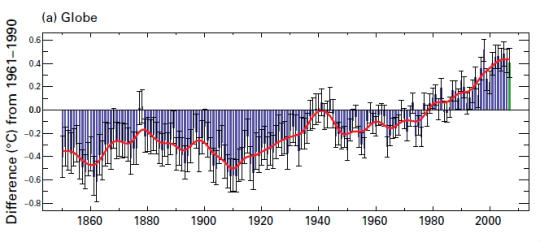
(3) Global warming denialism is rampant among new GOP members of Congress. While the actual record of global mean temperatures over the past 150-plus years looks like this:
The conservative fantasy of "natural fluctuations" would imply something wildly different, on the order this:
There is, quite simply, no relationship between what conservatives imagine the climate record to be and what it actually is. They are delusional. And yet, the Democratic establishment, which knows better has not even attempted to mount a serious public education effort to drive the conservative lies out of the "marketplace of ideas".
Meanwhile, the UN Climate Change conference in Cancun opens to almost totaly US media blackout, and Democracy Now! reports:
As a perfect snapshot of the brain rot affecting America's ruling class, consider the following juxtaposition:
TPM reports:
Gingrich Calls For Federal Ban On Shariah Law In US
Evan McMorris-Santoro | September 18, 2010, 12:05PM
The second morning of speeches at the Values Voter Summit here in DC was dominated by a man who is swiftly becoming the nation's spokesperson for Islamophobia -- former House speaker Newt Gingrich. Fresh off the release of his Islam-focused film "America At Risk," Gingrich told the crowd at VVS that it's time to take federal action to prevent Shariah Law from infiltrating courtrooms in the US.
"We should have a federal law that says sharia law cannot be recognized by any court in the United States," Gingrich said to a standing ovation from the audience. The law will let judges know, Gingrich said, that "no judge will remain in office that tried to use sharia law."
Gingrich made a not-so-subtle reference to the right wing meme about freshly-minted Supreme Court Justice Elena Kagan which claims that Kagan is "sympathetic" to Shariah and -- as some suggested during her confirmation hearings -- might allow it to be recognized as law in the United States.
But beyond the Kagan hit, Gingrich's anti-Shariah talk inserted him directly into the most extreme end of the Islamophobic push-back against mosque projects all over the country.
Opponents of Islamic building projects in New York City, Tennessee and Temecula, California and Florence, Kentucky have often raised fears that the goal of Muslims seeking to build new houses of worship is to slowly make America comfortable with Shariah before using political power to allow it to become the law of the land.
Of course, there is zero evidence of sharia law having any influence on American law. And zero chance that it could have any such influence, not least because of the First Amendment, and the separation of church and state. But that's not the point. As the above report makes clear, the purpose of this absurd meme is to "justify" the bigoted attacks on American Muslims exercising there First Amendment rights. As a matter of history, religious minorities have always been the staunchest opponents of imposing religious doctrines on others, for a very simple reason: They're the minority, stupid!
OTOH, global warming--which could wipe out entire low-lying countries and whose reality is supported by the entire peer-reviewed scientific community--is not a problem according to all the GOP Senate candidates, according to Think Progress:
GOP Senate Candidates Oppose Climate Science And Policy
by Brad Johnson, ThinkProgress Wonk Room Climate Editor
Updated September 14. View the original version here.
A comprehensive Wonk Room survey of the Republican candidates for the U.S. Senate finds that nearly all dispute the scientific consensus that the United States must act to fight global warming pollution. In May, 2010, the National Academies of Science reported to Congress that "the U.S. should act now to reduce greenhouse gas emissions and develop a national strategy to adapt to the inevitable impacts of climate change" because global warming is "caused largely by human activities, and poses significant risks for - and in many cases is already affecting - a broad range of human and natural systems."
This finding is shared by scientific bodies around the world. However, in the alternate reality of the fossil-fueled right wing, climate science is confused or a conspiracy, and policies to limit pollution would destroy the economy.
Remarkably, of the dozens of Republicans vying for the 37 Senate seats in the 2010 election, no one supports climate action, after climate advocate Rep. Mike Castle (R-DE) lost his primary to Christine O'Donnell. Even former climate advocates Sen. John McCain (R-AZ) and Rep. Mark Kirk (R-IL) now toe the science-doubting party line.
Many of the Senate candidates are signatories of the Koch Industries' Americans For Prosperity No Climate Tax pledge and the FreedomWorks Contract From America. The second plank of the Contract From America is to "Reject Cap & Trade: Stop costly new regulations that would increase unemployment, raise consumer prices, and weaken the nation's global competitiveness with virtually no impact on global temperatures."
And, of course, it's not just the Senate, as Think Progress identified "The Top Climate Races This November"
Seven key climate races in the Senate (with the 538.com estimated likelihood of a Republican pickup):
(92%) PA: Joe Sestak v. Pat Toomey
(72%) CO: Michael Bennet v. Ken Buck
(52%) NV: Harry Reid v. Sharron Angle
(42%) CA: Barbara Boxer v. Carly Fiorina
(33%) WI: Russ Feingold v. Ron Johnson
(30%) WA: Patty Murray v. Dino Rossi
(20% Democratic pickup) NH: Paul Hodes v. Kelly Ayotte
Eight key climate races in the House:
(76%) NM-2: Harry Teague v Steve Pearce
(63%) IA-3: Leonard Boswell v Brad Zaun
(63%) IL-14: Bill Foster v Randy Hultgren
(62%) CA-11: Jerry McNerney v David Harmer
(58%) IN-9: Baron Hill v Todd Young
(43%) FL-22: Ron Klein v Allen West
(26%) NM-1: Martin Heinrich v Jon Barela
(26%) IL-17: Phil Hare v Bobby Schilling
The pervasive disconnect from reality wxhibited by this juxtaposition indicates that today's GOP is operating more like a cult than a traditional political party.
Brad DeLong rolls his eyes at the folly of Ross Douthat over global warming, as refuted by David Leonhardt. Douthat is arguing that conservatives had good reason to kill global warming legislation, based on formative experiences of the 1970s, when predictions of near-term resource depletion ultimately proved unfounded--a fact highlighted by a famous bet between Paul Erhlich and Julian Simon. Leonhardt, an economist, argues that economic analogy simply doesn't apply. Leonhardt is right, of course, but there's more going on here than his sort of critique--invaluable as it certainly is--can reveal. From his privileged perch at the NYT editorial page, it's Douthat's job to recast all the cynical lies and distortions of the conservative movement as eminently reasonable. He is, in effect, a sort of tag-team member who works in partnership with a vast array of professional deceivers, making them look respectable.
In this case, he's working with a crowd that includes a hard core of ideological scientists, the subject of a new book, Merchants of Doubt: How a Handful of Scientists Obscured the Truth on Issues from Tobacco Smoke to Global Warming by historians of science Naomi Oreskes and Erik M. Conway. From the publisher's blurb:
Merchants of Doubt tells the story of how a loose-knit group of high-level scientists and scientific advisers, with deep connections in politics and industry, ran effective campaigns to mislead the public and deny well-established scientific knowledge over four decades. Remarkably, the same individuals surface repeatedly-some of the same figures who have claimed that the science of global warming is "not settled" denied the truth of studies linking smoking to lung cancer, coal smoke to acid rain, and CFCs to the ozone hole. "Doubt is our product," wrote one tobacco executive. These "experts" supplied it.
This is the realworld context for reading Douthat, which we'll return to below. But first, Leonhardt's critique gets the ball rolling:
I think there are two big reasons to doubt that we're on another Ehrlich-Simon path when it comes to global warming.
The first is basic economics. When the problem is resource scarcity, companies and individuals have a powerful incentive to become more efficient. It keeps their costs down. Mr. Simon understood this, and it's the fundamental reason he won the bet.
But global warming is different. The fact that carbon emissions are warming the planet doesn't make it more expensive to produce those emissions. So companies do not have an ever-increasing incentive to emit less - the way they would if the problem were, say, a lack of oil. Global warming doesn't solve itself the way that resource scarcity does.
The second reason is the accumulation of evidence. Almost as soon as Mr. Ehrlich and Mr. Simon made their bet in 1980, Mr. Simon's prediction started looking good. In 1981, as Mr. Tierney wrote, "grain prices promptly fell and reached historic lows during the 1980s, continuing a long-term decline." (Mr. Tierney noted that an ally of Mr. Ehrlich ignored this trend at the time and focused instead on "blips in the graph.")
In recent years, though, anyone who had bet against global warming would look as wrong as Mr. Ehrlich did. The Greenland and Antarctic ice sheets are shrinking at an accelerating rate. Scientists have recently revised upwards their predictions of sea-level rises. The planet's 10 hottest years on record, according to NASA, are: 2005, 2007, 2009, 1998, 2002, 2003, 2006, 2004, 2001 and 2008. This year is on pace to displace 2005 as No. 1.
Now, Leonhardt's argument is absolutely correct so far as it goes. But it also misses the essence of what Douthat is up to. He's not making a rational argument for why global warming should be ignored. He's deploying a smokescreen to obscure the actual conservative record, which is one of vehement ideological opposition in the face of overwhelming facts. The scientists studied in Merchants of Doubt provide a pseudo-scientific facade--as Oreskes first showed, back in 2004 ("Beyond the Ivory Tower: The Scientific Consensus on Climate Change"), their "doubts" appear nowhere in the peer-reviewed literature. With that in mind, let's turn to Douthat, as he tries to make the conservative position seem reasonable, by arguing--against mountains of scientific evidence to the contrary--that global warming would be good for us:
Global warming denialism reached a fever pitch this last year, with pathological liar George Will leading the way, thanks to a high-profile platform with the mendacious Washington Post. Back in March, I added my voice to the mix:
George Will , Washington Post: Traitors To Humanity
January 2007 was the warmest January since global surface records were instituted.
But now, NASA has announced that 2009 was tied for the second hottest year ever recorded, and the 2000s were the hottest decade. It's not even close to being close:
[Author's calculations from NASA data]
This chart of decadal averages filters out a great deal of the year-to-year noise that global warming deniers--George Will one of the most prominent among them--have tried to use to confuse matters. But there was never really any doubt, as one can see from the chart I included in my March post, just below the passage I quoted above:
No rational person can pretend that there's any doubt about global warming. It's way too late for that. By now it's clear that the "let's hear both sides" crowd is openly pro-lie, and in fact, pro-end-of-human-civilization. They are moral monsters. Period.
What's really happening is that anthropogenic climate change is a fundamental assault on right wing ideology and the solution requires a worldwide implementation of liberal policies that will undercut right wing ideas at every level well into the future. Right wingers maybe do not grasp this fear consciously, but intuitively everything about this issue stinks for them. Denial is the only way to save their worldview.
All the above would be true if conservatives really understood it, but they do not. Most importantly, the "instinctively feel" version, which you present, doesn't really improve the argument. It only creates our own "just so" story. (Or a "rational reconstruction" of irrational attitudes, if you will.)
I think the answer is much simpler: conservatives deny global warming because (a) liberals talk about it and (b) conservative blowhards have been demonizing liberals for talking about it for about 20 years now. In short, global warming denial has become an integral part of conservative identity politics...
It was an off-the-cuff remark (even though I went on to quote from a 2006 MyDD diary) that made an important point, I think. But simply stressing a broad-brush picture of how the conservative base came to assimilate global warming denialism into conservative identity gives a very incomplete picture. After all, there are reasons why liberals talk about global warming, and why this is a particularly fertile ground for demonization by conservative blowhards.
This weekend, I want to discuss a social science approach to risk-perception that can shed a good deal of light on identity and ideology, and how they figure into the case of global warming denialism. It's going to take three diaries to do this properly. First, this diary will introduce the broad outlines of the approach, known as "Cultural Cognition", whose work is centered at The Cultural Cognition Project at Yale Law School. Cultural Cognition is an interpretation of the Cultural Theory of Risk (CTR), first articulated by anthropologist Mary Douglas and political scientist Aaron Wildavsky in their 1982 book, Risk and Culture: An Essay on the Selection of Technological and Environmental Dangers. In this diary, I'll discuss the broad outlines of CTR, and how Cultural Cognition differs from earlier articulations of CTR. One of those differences is the specific mechanisms of culture cognition. I will desrbie several of them in this diary. Diary number two will then deal those specific mechanisms in some detail,illustrating how they work. Diary number three will then look specifically at global warming, as well as some unresolved issues of more general importance.
In his diary from Copenhagen, "The Orly Taitz of Climate Change? 'Lord' Monckton in Copenhagen ", Nick wrote about the top of the pyramid of global warming denialism. I'd like to follow up with some thoughts about the base--not the material base of the big oil and coal companies with so much money at stake, but the large mass of rightwing folks with no material connection, similar to the Birthers, who seem passionately attached to denialism as a kind of belief system. Digby recently wrote a diary,"Knowingly False", in which she wrote:
Following up on posts of the last few days asking why the global warming deniers are global warming deniers, Mike the Mad Biologist offers up another explanation, which is very intriguing:
I think Fred Clark at the Slacktivist hits on a key point in these two posts: "It isn't intended to deceive others. It's intended to invite others to participate with you in deception"
He then excerpts Clark's discussion an earlier right wing rumor that ran rampant on the right about Procter and Gamble being a satanic cult (seriously) culminating with this observation:
Are you afraid you might be a coward? Join us in pretending to believe this lie and you can pretend to feel brave. Are you afraid that your life is meaningless? Join us in pretending to believe this lie and you can pretend your life has purpose. Are you afraid you're mired in mediocrity? Join us in pretending to believe this lie and you can pretend to feel exceptional. Are you worried that you won't be able to forget that you're just pretending and that all those good feelings will thus seem hollow and empty? Join us and we will pretend it's true for you if you will pretend it's true for us. We need each other.
I think that's getting to the heart of this. And for those who observed the chauvinistic fantasies of the keyboard commandos after 9/11, you will recognize some of the same impulses.
I read Clark's original two posts with great interests, and they contain a good deal of insight. I think he's definitely onto something quite important. However, I don't completely buy this argument in one important regard: Clark argues that, for the most part, people just can't be that stupid. They have to know that what they are saying isn't true. It's driven by malice, he argues, not stupidity. I take a more complicated view: many people--including even you and me at some points in our lives--don't really have such clear sense what's believable and what's not, what's self-contradictory and what's not, what's real and what is not. Most of us in the reality-based community like to think that we're not like that, but anyone who's ever fallen in love knows that's just not true. Intense dysfunctional relationships make this painfully obvious, but even the fairy-tale version has the capacity to melt what we think we know of the world. And charlatans from time immemorial have found ways to use this and related aspect of human nature to make people believe all manner of absurd things.
My difference with Clark is a significant one, but it doesn't really come to the fore until after one absorbs the insight in his posts, and the thrust of the argument he makes, which I sort through on the flip.
This week brought disappointing news that Asian-Pacifie world leaders--including President Obama--do not foresee a climate change treaty being signed in Copenhagen next month. This set-back comes on top of a legislative process in Congress that shares many of the shortcomings of the health care reform legislative process. The two are obviously related, as both represent major needed changes in direction that a deeply opposed by entrenched special interests with enormous economic and political clout.
In my previous diary, "Finding the keys," I argued that what we need to be about is building progressive hegemonic power, and that expecting to win pristine major victories right away--such as single-payer health care--was, unfortunately, not only unrealistic (I'm all for demanding the impossible), but also very likely to misdirect us in terms of long-term strategic thinking. The same thing applies to the struggle to combat global warming.
It's not that I don't want the best legislation possible--I wrote several diaries promoting the work of 350.org, which I think is utterly invaluable. But we have to seriously grasp the extent of what we're up against and the extent of the deficits we have in order to be effective over the long haul. 350.org is particularly valuable because it's about shifting the whole framework of debate, and that's arguably the most important thing we need to do. But we also need to connect the shifting framework to everything within the macro-framework as well.
Toward that end, I want to step back from the disappointing big news for a moment to focus on three different story fronts that merit attention in order to reflect on the broader strategic struggle to bring rational decisionmaking to the fore, and put special interest propaganda campaigns in their place. These three fronts are denialism (which involves two different stories), nuclear (concerning a study that undermines claims about the role it can play) and coal (concerning a study that shows its true cost makes it uneconomical even for coal-producing regions). None of these stories is closely coupled with the intricacies of ongoing Congressional action, all are intimately related to the basic conditions in which those intricacies play out.
TPM first called my attention to the incredible stupidity that is Joe Barton (R-TX).
This is stupidity so deep it's invincible-stupidity far too stupid to ever be capable of realizing it might not have all 52 cards. After all, how can you realize that, when the whole damn deck is missing?
Here's the deal: Barton asks Nobel Prize-winning Energy Secretary Steve Chu a dumb-ass question: "Where does Alaska's oil come from?" Then he proudly posts the exchange on YouTube, bragging on Twitter:
But, of course, Chu wasn't the least bit baffled-except, perhaps, as to why this clown was asking him such an irrelevant question. Barton was just way too full of himself with delight at his "coup" that he didn't even bother listening to what Chu said--and even if he had, there's no way on God's green Earth he could have understood it. He's just far too dumb:
Making an ass of himself and then pointing at the other guy is, apparently, about as bright as Burton gets. A few folks around the blogosphere have had some fun things to say about him, but I wanted to underscore that upside-downism may well be his own particular style of dumb. You see, back in early 2006, when the oiligopoly had driven prices through the roof, and Hugo Chavez used Venezuela's ownership of CITGO to lower prices to low-income communities in the US, Barton decided to go after CITGO (and only CITGO), using the cover story of investigating potential anti-trust violations. Waaay too stupid to know how stupid he is.
Grand Theft. Pathological Lying About Global Warming. Attempted Genocide.
Back in February, George Will went into a paroxym of lies about global warming, and WaPo editor Fred Hiatt and Ombudsman Andy Alexander both vigorously defended him. I wrote about this (as well as the work of debunkers--Hilzoy, The Wonk Room) in "George Will, Washington Post: Traitors To Humanity". Now Will is up to his same old tricks. A deeper look is called for this time around--a look into Will's class-based criminal pathology.
George Will is a criminal. In 1980, he helped Ronald Reagan prepare for the presidential debate with Jimmy Carter, using a stolen Carter debate book. Receiving stolen property is a crime. The value of the stolen debate book was incalculable. Possibly enough to cost an election. But certainly enough to qualify as grand theft. That makes receiving it a felony. And George Will is guilty of it. One should always remember this about George Will: He is a criminal. A felon. An unrepentant one. But, then, he is a member of a criminal class--the aristocracy.
When I wrote a diary about narcissistic personality disorder (NPD) last weekend, several commentators made the point that the aristocracy as a class suffered from NPD, and while there are certainly plenty of individual exceptions, the point is most certainly true. And a perfectly straightforward way to show what this means is to look at George Will, and his steadfast refusal to acknowledge any error whatsoever when he gets absolute everything wrong about global warming.
Sane, mature adults make factual claims based on facts, to the best of their knowledge. When challenged in a reasonable manner, they either defend their claims by marshaling facts in support of those claims, or they admit to having made a mistake. But narcissists cannot be bothered with any of this. Engaging in good faith arguments is beneath their exalted sense of dignity. Indeed, the only way that aristocrats know how to settle factual disputes is the same way they settle all disputes: by dueling. Which is to say, by ritualized attempted murder.
Attempts to get George Will to act like a responsible interlocutor on the issue of global warming have failed once again, and this is the simple reason why: he is psychologically incapable of being a responsible interlocutor. He does not recognize anyone else's factual claims. He is an aristocrat. The only thing he recognizes is an offense to honor, from another aristocrat. Nobel Prize-winning scientists be damned. The fricken human race be damned. He is a lord of the realm. Only we don't have such things in America. It's time we remembered that and started acting accordingly. Because George Will is damn sure never going to.
January 2007 was the warmest January since global surface records were instituted.
Extended quote:
Global temperatures during 2007
The analyses made by leading climate centres rank the year 2007 amongst the ten warmest years on record. The Met Office Hadley Centre analyses showed that the global mean surface temperature in 2007 was 0.40°C (0.72°F) above the 1961-1990 annual average (14°C/57.2°F) and hence marks the seventh warmest year on record. According to the National Climatic Data Center of the National Oceanic and Atmospheric Administration, the global mean surface temperature anomaly was 0.55°C (0.99°F) above the twentieth century average (1901-2000) of 13.9°C (56.9°F), which ranks 2007 the fifth warmest year in its record.
January 2007 was the warmest January since global surface records were instituted.
I'll say one thing for George Will: at least the guy believes in recycling--when it comes to global warming lies, that is. Because that's his entire shtick in his most recent columns on the subject, "Dark Green Doomsayers" (Feb 15) and "Climate Science in A Tornado" (Feb 27), both of which have been widely and thoroughly debunked, perhaps most succinctly here at the Wonk Room, which also takes note of the Post's Fred Hiatt's dishonest defense of Will's lies as 'inferences.' (Hilzoy at Obsidian Wings, provides the lowdown on the Post Ombudsman Andy Alexander's shameful performance here.)



 Grand Theft. Pathological Lying About Global Warming. Attempted Genocide.


