Dearest Doctor, I have come to my senses. Days ago, when you offered your diagnosis, I died. No, not literally. Had you done me in, I would not be here to write what I hope will help inform your bedside manner. Well, in my case only the way in which you approach a patient who merely sits in an examining room chair near you is the concern. You may recall our time together began so innocently. We sat down to review the results of annually scheduled blood-work. I had not felt sick all year or on that day. You had even expressed, it had been so long since we last saw each other. You scanned the pages, and proclaimed, that I must have returned to my bulimic ways. My spirit perished. I had done nothing of the sort! Yet, you said you were sure I had.
I'm running for Congress against Stephen Lynch in the Democratic Primary (MA-9) because we don't just need more Democrats -- we need better Democrats. And to get Better Democrats, we need to do more to hold those "Democrats" who vote against the interest of working families accountable.
During his time in Congress, Stephen Lynch has taken some pretty bad votes. Whether it was to deny health care coverage to tens of millions of Americans, to send our troops to war in Iraq, or to restrict a woman's right to choose, Stephen Lynch's bad votes have hurt our community -- and our nation.
Today our campaign is launching a new website to get the facts out there about Stephen Lynch's bad votes, and the harm that's come from those votes. After all, if you can't judge a Congressman based on his voting record, what CAN you judge him on?
by Catherine A. Traywick, Media Consortium blogger
After decades of misguided policies and patchwork practices, the high human costs of our disordered immigration system are only starting to emerge. Stricter immigration policies and overcrowded detention centers aren't making our streets safer or our social services more accessible.
Is the IV Bag half-empty or half-full? Theda Skocpol, the author of a forthcoming book on President Barack Obama's health care reforms, argues in the Nation that progressives are underrating reform.
Sometimes stories happen because of planning; other times serendipity intervenes, which is how we got to the conversation we'll be having today.
In an exchange of comments on the Blue Hampshire site, I proposed an idea that could be of real value to unions, workers...and surprisingly, employers.
If things worked out correctly, not only would lots of people feel a real desire to have unions represent them, but employers would potentially be coming to unions looking to forge relationships, and, just to make it better, this plan bypasses virtually all of the tools and techniques employers use to shut out union organizers.
Since I just thought this up myself, I'm really not sure exactly how practical the whole thing is, and the last part of the discussion today will be provided by you, as I ask you to sound off on whether this plan could work, and if so, how it could be made better.
It's a new week...so let's all put our heads together and rebuild the labor movement, shall we?
Weekly Pulse: Uncovered Abortions, Toxic Mani-Pedis, and Kagan's a Go
by Lindsay Beyerstein, Media Consortium blogger
Last week, the Obama administration preemptively caved to the anti-choice lobby by declaring that new high-risk insurance pools, a byproduct of recent health care legislation, will not cover abortions, even if states or patients pay for that coverage with their own money. Under health care reform, states must create high-risk insurance pools for people with preexisting conditions. These pools will be phased out in 2014 when the new insurance exchange comes online.
Last week, the Obama administration preemptively caved to the anti-choice lobby by declaring that new high-risk insurance pools, a byproduct of recent health care legislation, will not cover abortions, even if states or patients pay for that coverage with their own money. Under health care reform, states must create high-risk insurance pools for people with preexisting conditions. These pools will be phased out in 2014 when the new insurance exchange comes online.
As you may recall, the Nelson amendment to the health care reform bill says that the federal government can't pay for abortion coverage in the exchanges, but it doesn't mention the high-risk pools. There is no overarching ban that would preclude federal funds for abortion coverage in the high-risk pools. The Obama administration's ruling is purely a lack of political courage. In fact, as Jessica Arons explains at RH Reality Check, the pool rules are even stricter than Nelson's rules for the exchange.
Hey, you! Outta the high-risk pool!
The Nelson amendment was hailed as a compromise because it gave women the option of buying their own abortion coverage. Now, the Obama administration has taken that option away from women in high-risk pools. This is especially troubling because high-risk pools are supposed to help people with chronic medical conditions-who might be more likely to need an abortion. That means that more women with diabetes and cancer will have to pay out of pocket for abortions to preserve their health.
Michelle Chen of ColorLines accuses the Obama administration of selling out women of color to avoid the wrath of the anti-choice lobby. She predicts that women of color will be disproportionately affected by these restrictions because they are more likely to end up in the high-risk pools in the first place.
Nail in the Coffin
In the latest of a series of videos on occupational health and safety, Brave New Films shines a spotlight on toxic chemicals in the nail salon industry. Currently, there are almost no federal regulations on what manufacturers can put in professional beauty products. The nail care industry is booming. There over a hundred thousand manicurists in California alone, most are female, and a large percentage are Vietnamese immigrants. Salon workers breathe a toxic soup of chemicals, many of which have never been tested on humans. Brave New Films is circulating a petition calling on Congress to protect workers by supporting safe cosmetics legislation. youtube]
Kagan gets the nod
The Senate Judiciary Committee approved Elena Kagan's nomination to the Supreme Court by a vote of 13-6. The outcome of Tuesday's vote was never in doubt. Many were mildly surprised to see that Sen. Lindsay Graham (R-SC) voted in Kagan's favor. Steve Benen of the Washington Monthly predicts that the vote will ensure that Graham will get a conservative primary challenger. But Benen also doesn't see what all the fuss is about.
[...] I still find the right's outrage over Graham to be pretty silly. He's voting for a qualified Supreme Court nominee? The horror! Ruth Bader Ginsburg was confirmed on a 96 to 3 vote when her nomination was sent to the floor. How many of those Republicans were threatened with primary challenges because of it?
This post features links to the best independent, progressive reporting about health care by members of The Media Consortium. It is free to reprint. Visit the Pulse for a complete list of articles on health care reform, or follow us on Twitter. And for the best progressive reporting on critical economy, environment, health care and immigration issues, check out The Audit, The Mulch, and The Diaspora. This is a project of The Media Consortium, a network of leading independent media outlets.
With Democrats set to lose seats in the 2010 midterm elections, there is a vigorous, pre-postmortem debate taking place about the cause of those anticipated losses. At the risk of oversimplifying, the basic frame of this debate is between those on the center-left who argue Democrats are in trouble because the economy is still in a shambles (see my article on that here), and those on the right who argue Democrats are in trouble because of ideological policy overreach on spending and health care. (On Monday, Sean Treade presented the most intellectually informed version of the right-wing position.)
To go deeper into this debate, for this article I took a closer look at the history of President Obama's approval rating, combined with a look at models that project President Obama's approval rating based only on the state of the economy. What I found was that the health care debate last summer did cause real, short-term political problems for Obama and Democrats, but that President Obama's current approval rating is little different from where it would have been if the health care debate had not taken place at all. Effectively, the health care debate accelerated a decline in Obama's approval rating that would have taken place anyway given the state the economy.
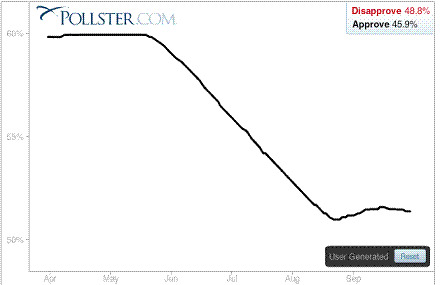
First, check out these startling numbers. Most of the decline in President Obama's approval rating took place during a 95-day stretch from May 20, 2009 to August 22, 2009. During those 95 days, his approval on Pollster.com fell by 9%, from 60% to 51%. The trendline is remarkable:
Presidnet Obama, Approval Rating, Pollster.com, April 1 through September 30, 2009
After a 9% decline in 95 days, President Obama's approval rating has dropped by only 5% over the next 326 days--a pace six times slower. As such, the events of those 95 days clearly had an effect on his overall approval rating,and thus on Democratic electoral hopes.
What caused that decline? A survey of the Pew News Interest Index quickly shows that the health care debate was the answer. The health care debate emerged as a major new story in mid-May of 2009, just before the start of President Obama's precipitous approval decline. By the end of July, it became the top news story in America, a position which it held throughout the duration of the 95-day period in the graph above. Here are the trends from Pew:
Percentage of Americans following health care debate "very closely" or "fairly closely," Mid-May through late August, 2009
This simply cannot be a coincidence. A story which emerged just before the start of the approval decline, and which continued to rise in prominence throughout the decline, must have caused the 9% drop in President Obama's approval rating. (Granted, there are other possible causes. In the extended entry, I look at the effect that eight other news stories from those 95 days had on President Obama's approval rating).
However, there is a catch. While the health care debate caused President Obama's approval rating to rapidly decline in the short-term, the economy would have caused Obama's approval to reach its current low point even if the debate had not taken place. In his article, Sean Trende's own chart's demonstrate this. Here is the chart Trende uses to project President Obama's approval rating since January of 2009 using only economic factors:
This model projects Obama at a 49% current approval rating based on only economic factors, which is not much different from the 46% approval rating Obama's currently sports. That 3% difference is not much of a difference at all, and appears even smaller when one considers that there are other models out there which project Obama right at the 46% mark based on only economic factors. A difference of 0-3% is not statistically significant.
Effectively, because of the health care debate, President Obama shed soft supporters that he would have shed anyway during a negative economy--he just lost them faster. This likely had a negative effect on Democratic candidate recruitment, on the prospects for progressive legislation after August of 2009, and also on Democratic morale. All of those things had a negative impact on Democratic electoral prospects in 2010, making health care debate an important factor in the current electoral mess Democrats find themselves.
However, none of this changes the fact that the economy is still the primary factor driving this election. With or without the health care debate, Democrats are right where a governing party should expect to be, given the state of the economy. If there had been a 3-4% improvement in real disposable income for Americans over the last 11 months, Democrats would be sitting pretty for a third electoral landslide in 2010, or at least to maintain nearly all of their current majorities.
As an addendum to this post, in the extended entry I look at other possible causes for the steep decline in Obama's approval ratings during those fateful 95-days in the summer of 2009. I consider five that likely had no impact, and three others that were probably minor contributors. Please, be sure to check it out.
Would enforcement of age discrimination laws change the unemployment equation?
In 'Too Young Not to Work but Too Old to Work', The Washington Independent takes a look at age discrimination,
The unemployment rate for over-55s is at the highest level since 1948. Since the recession started, both the number of older people seeking work and the rate of unemployment for over-55s have increased more sharply than for all other demographic groups. And older workers comprise a high share of the long-term unemployed. In May, the average duration of unemployment for older job-seekers climbed to 44.2 weeks, 11 more weeks than the national average. Nearly six in ten older job-seekers have been out of work for more than six months.
If national trends are anything like what I see here in Silicon Valley, where many of the waves of layoffs specifically targeted older workers because they have higher health-care costs and are paid more, then enforcement could make a difference. People could begin to find jobs with healthcare, and start meeting their mortgage and other obligations again.
Companies here in Silicon Valley shed their older workers during the years of Bush-era non-enforcement of labor laws. They were forced to sign "waivers" saying they would not complain about the age discrimination, told if they did not sign they would not receive any severance that was available or would be denied unemployment compensation.
Now, during the Obama-era non-enforcement of labor laws many companies around here flat-out will not hire people over "a certain age" (varies by profession) and everyone knows it. The unemployment rate is lower because so many older people understand the situation and are not "actively" looking for work. They are still unemployed but not counted in the statistics.
Seventeen percent of sexually active teenage girls said they used the rhythm method as a means of birth control in 2008, up from just 11% in 2002, according to the latest report from the CDC. For most of these girls "rhythm method" means guessing the least risky day to have unprotected sex. You and I both know that one in five teenage girls isn't taking her temperature every day and charting the consistency of her cervical mucus on the calendar.
Not so ab-fab
Amanda Marcotte of RH Reality Check blames abstinence-only propaganda for the trend. She points out that abstinence-based curricula rely heavily on shame to discourage kids from having sex. Teens who are ashamed don't necessarily abstain, but they are less likely to use birth control when they do have sex. Claiming to use the rhythm method is an excuse not to use real birth control. Marcotte points out that abstinence-only curricula also promotes stereotypes of female passivity and male dominance, which makes it even harder for girls to negotiate condom use.
There is a glimmer of hope, Robin Marty of RH Reality Check reports that the Obama administration is shifting gears on sex ed. For the first time in many years, school districts will be eligible for federal funds to teach evidence-based, comprehensive sex ed. Abstinence-only funding hasn't gone away, but at least districts will have the option.
Recession-based bedroom blues
Interestingly, teens are having slightly less sex overall, according to the CDC. The abstinence-only crowd is trying to take credit, but as Stephanie Mencimer of Mother Jones notes, the recession seems to be putting a damper on the sex lives Americans of all ages. The latest sex survey by the AARP showed that Americans over 45 are having less sex than they were in 2004 and enjoying it less as well.
Looking at the same study, Wendy Strgar of Care2 notes that that teen motherhood has become much more socially acceptable among adolescents, perhaps due to highly publicized teen moms like Bristol Palin and Jamie Spears.
The war on choice
Michelle Chen of RaceWire reports that hundreds of anti-choice bills have been introduced in state legislatures around the country since the passage of national health care reform. Missouri's new Abortion Restriction Act requires abortion clinics to post signs offering state assistance if she has the baby. Too bad the Missouri legislature slashed the funds that would have provided most of those services.
Two moms = healthy kids
In other health news, a new study forthcoming in the journal Pediatrics shows that lesbian couples raise healthier children than straight couples. Gabriel Arana of TAPPED suggests that maybe lesbians do better on average because they are a self-selected group of highly motivated parents that had to overcome obstacles in order to raise their kids. Or maybe two moms are better than one.
As Arana notes, the politically important thing about this study is the finding that same-sex parents are doing at least as well as opposite sex parents. Conservatives opposed to gay rights have often justified second-class citizenship for gays in terms of protecting children from allegedly harmful same-sex parents. Now, science is showing that same-sex families are at least as healthy as more traditional family units.
This post features links to the best independent, progressive reporting about health care by members of The Media Consortium. It is free to reprint. Visit the Pulse for a complete list of articles on health care reform, or follow us on Twitter. And for the best progressive reporting on critical economy, environment, health care and immigration issues, check out The Audit, The Mulch, and The Diaspora. This is a project of The Media Consortium, a network of leading independent media outlets.
Shortly before Congress voted on health care reform, I posted here highlighting Bill Halter's challenge to Blanche Lincoln part of a pattern of primary challenges in Democratic primaries this year.
Now, the pattern shows signs of turning into a progressive wave, with Joe Sestak's win in the Pennsylvania US Senate primary, the results that day in Kentucky, and leading to the runoff between Halter and Lincoln coming up this Tuesday.
On of the most notorious yes-to-no vote switchers on health care was Massachusetts' Stephen Lynch. Although the woman who was publically mulling a run against him at the time decided against it, it was clear that there would be a challenger, and there is: Mac D'Alessandro.
Barely a third of likely Democratic primary voters in his district say that Steve Lynch deserves re-election, according to April poll numbers obtained by the Boston Phoenix.
Lynch, a relatively conservative Democrat, has been criticized by some liberals for voting against the final health care reform bill earlier this year. In the past, he has also received criticism for his positions on social issues like abortion, and for his vote to authorize the war in Iraq.
However, he has never had difficulty winning re-election. This year, he is being challenged in the primary by Mac D'Alessandro, northeast political director for the Service Employee International Union (SEIU).
I recently met Mac, and my latent frustration with Stephen Lync quickly gave way to a real excitement that this man may go to Congress. I believe he could be one of the best members of Congress we'll have.
This week's health care news was full of mind-bending paradoxes: Prostate health is girly, abstinence-only education works through failure, "principled" libertarian Rand Paul would protect all-white lunch counters but ban private abortion clinics, and more.
In 1993, anti-choice extremists murdered a doctor, burned 12 buildings, set off a bomb, and blockaded 66 abortion clinics. The following year, President Bill Clinton signed the Freedom of Access to Clinic Entrances (FACE) Act. FACE made it a federal crime to obstruct a clinic or intimidate patients and providers.
Wendy Norris of RH Reality Check reports that, in the intervening 16 years, the Justice Department has only prosecuted 19 civil and 45 criminal cases under FACE. Abortion provider Dr. George Tiller was assassinated last year by a hardcore clinic protester, and many asked if the FACE Act was being enforced.
Norris's story is part of a series on FACE published by RH Reality. The next installment will explore how one radical anti-choice protester has managed to terrorize the same clinic for 30 years with apparent impunity. Kudos to the Guggenheim foundation for funding this important and timely series, and to the John Jay College Center on Media, Crime and Justice for providing editorial input.
The Pill and I
May 9th is the 50th anniversary of the FDA's approval of Enovid, the first birth control pill. Care2 contributor Ann Pietrangelo, who recently celebrated her own 50th birthday, reflects on how the Pill changed history:
I went through my entire reproductive life in a way that my female ancestors, indeed my own mother, could scarcely have imagined. The Pill and other contraceptive choices were always available to me. I have never had to face the dreaded abortion decision, but throughout my reproductive years, I had the peace of mind of knowing that such a decision, difficult though it would be, was mine to make. I, and millions of women of my age group and younger have been most fortunate. We've lived a different kind of life than would have been possible in another time and another place.
Anti-"personhood" coalition kicks off
A new group has united to fight Colorado's proposed "egg as person" ballot initiative, Joseph Boven of the Colorado Independent reports. The organization calls itself Protect Families, Protect Choices (PFPC). If Amendment 62 passes, it would effectively outlaw abortion, stem cell research, and even some forms of contraception. Women who drink, use drugs, or attempt suicide could face criminal charges if the ballot initiative becomes law.
The Colorado measure is one of of many similar measures proffered by anti-abortion activists in state legislatures around the country. The last time Coloradans voted on whether to give fertilized ova the full complement of rights under state law, 73% voted against the measure. If the bill passes, will frozen embryos be able to own property? Could Coloradans evade their creditors by signing their houses over to zygotes?
Will health care reform save Democrats?
In TheNation, Katherine S. Newman and Steven Attewell tackle the question on everyone's mind: Will health care reform change the political fortunes of President Barack Obama and the Democrats? They warn that Democrats shouldn't expect short-term political gains, even if reform is ultimately regarded as a success story:
For some time to come we can expect the firestorm of opposition to health care reform that is unfolding today to persist, even from people who stand to benefit from the provisions of the new law. The rose-colored glasses through which we sometimes view the legacy of the New Deal and the Great Society often obscure how contentious the debates were or how long they continued after the passage of key legislation. We should not be deterred by the noise coming out of the Tea Party. The weight of history is against them.
Passive aggressive red states
Suzy Khimm of Mother Jones sees trouble ahead: So far, at least 15 states have refused to create high-risk health insurance pools. The refusniks are red states hostile to health care reform. High-risk pools are a stopgap to provide coverage for people with preexisting conditions. Insurers are free to discriminate against sick people until 2014, and high risk pools are supposed to cover those who can't buy coverage in the meantime.
Khimm explains that the federal government will have to step in and create high-risk pools if states aren't willing to do so. Health care reform left a great deal of power in the hands of states. The stage has been set for a grim power struggle, a bureaucratic battle of attrition.
This post features links to the best independent, progressive reporting about health care by members of The Media Consortium. It is free to reprint. Visit the Pulse for a complete list of articles on health care reform, or follow us on Twitter. And for the best progressive reporting on critical economy, environment, health care and immigration issues, check out The Audit, The Mulch, and The Diaspora. This is a project of The Media Consortium, a network of leading independent media outlets.
The economy is supposedly recovering. Corporate profits are up. The stock market is waaaayyyy up. And Wall Street bonuses. And the Fed is holding interest rates at zero which is a huge tax on people who save money and especially those who thought they might live off of savings instead of loans.
But unemployment and COBRA benefits are running out. Actually they ran out, then Congress passed a very short extension, and it hasn't been heard from since.
And not only COBRA subsidies are running out, COBRA itself starts running out soon. Under the COBRA law you can buy your employee health insurance (at extra cost above what the company pays) for 18 months and then you are at the mercy of the preexisting conditions. The health care bill was supposed to cover this and provide something for people in the interim before the full package kicks in (ordering all of us to give money to the big insurance corporations) but it didn't and it doesn't. So COBRA is running out for millions, never mind the subsidies. And the Washington elites are enjoying Washington's nice restaurants.
Since the U.S. recession began in December 2007, Congress has extended the length of unemployment benefits for the jobless three times. Now, the lawmakers may have reached their limit.
They are quietly drawing the line at 99 weeks of aid, a mark that hundreds of thousands of Americans have already reached. In coming months, the number of those who will receive their final government check is projected to top 1 million.
Atrios reminds us this means more foreclosures, too. (If you can imagine more.)
Yes, my wife and I are on COBRA and we're over 50. Like millions of others. Why, is it something I said?
From the Bloomberg story: "Some Republicans say cutting off aid will spur people to find work."
Once again, the states are leading the way on health care reform. This past week, the Vermont House and Senate passed two versions of a bill that would essentially get a consultant to design three systems for health care in Vermont: something similar to Canadian single payer, something similar to a private system with a public option, and something similar to the recently passed federal health insurance bill.

 STATE BLOGS





 Powered by: SoapBlox