For the past few months, we've been collecting information about agricultural innovations from all over the world (survey in English and French). We shared the initial responses in September and even more responses in November, but continue to receive interesting information and recommendations from farmers, NGOs, research groups, and policymakers in a multitude of countries. Below are a few tidbits we'd like to share.
The following projects, already featured on the Nourishing the Planet blog, have recently provided information for our survey, further describing their agricultural innovations and helping us as we seek to define innovations that best nourish people as well as the world in our upcoming report, State of the World 2011.
From our friends at the Developing Innovations in School Cultivation project in the Mukono District, Uganda: Describing the innovation as spreading a "passion for producing local foods to the next generation," Edward Mukiibi helped flesh out the details of his project by filling out the survey after Danielle's visit. You can read more here: Cultivating a Passion for Agriculture, Conversations with Farmers: Discussing the School Garden with a DISC Project Student, and How to Keep Kids "Down on the Farm."
From Never Ending Food in Lilongwe, Malawi: The Nordins are educating others about permaculture and growing indigenous crops to increase income and improve food security. You can read about Danielle's visit to their home and farm here: Malawi's Real "Miracle" and Sweeping Change.
Please continue to share your agriculture innovations with us. We look forward to featuring your success stories on our blog and in Nourishing the Planet. Stay tuned for more updates from the survey-maybe next time it will be your innovation we highlight!
Mokolodi Wildlife Reserve used to be known more for raising livestock than protecting wildlife. But after years of ranching degraded the land, the owner decided to devote the area to protecting elephants, giraffes, impala, kudu, crocodiles, hippos, ostrich, warthogs, and various other animals and birds. But the reserve hasn’t stopped raising food.
In addition to teaching students and the community about conserving and protecting wildlife and the environment, they’re also educating students about permaculture. By growing indigenous vegetables, recycling water for irrigation, and using organic fertilizers—including elephant dung—the Reserve’s Education Center is demonstrating how to grow nutritious food with very little water or chemical inputs. (See Malawi’s Real “Miracle” and Emphasizing Malawi’s Indigenous Vegetables as Crops.)
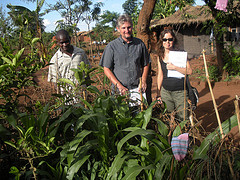
I met with Tuelo Lekgowe and his wife, Moho Sehtomo, who are managing the permaculture garden at Mokolodi. Tuelo explained that the organically grown spinach, tomatoes, onions, lettuce, green peppers, garlic, basil, parsley, coriander and other crops raised at the garden are used to feed the school groups who come regularly to learn about not only animals, but also sustainable agriculture. Tuelo and Moho use the garden as a classroom, teaching students about composting, intercropping, water harvesting, and organic agriculture practices. The garden also supplies food for the Education Center and Mokolodi's restaurant, feeding the hundreds of students and tourists who visit the non-profit reserve each week.
The Mokolodi Reserve is another example of how agriculture and wildlife conservation can go hand-in hand.
Factory food sickens humans, livestock and the environment
What we eat has changed more in the last 50 years than in the last 10,000. So asserts Robert Kenner's new film, FOOD, Inc., which opens nationwide June 19th. The vast bulk of food production is now controlled by just a few mega-corporations with one value: profit. Relying on genetic engineering, pesticides and antibiotics, factory food is cheap, requiring little land. But the external costs to our health, the environment and the natural food industry are enormous.
Director: Robert Kenner
Producers: Robert Kenner and Elise Pearlstein
Co-Producer: Eric Schlosser
Released by Magnolia Pictures, with Participant Media and River Road Entertainment
93 minutes
FOOD, Inc. is the single most important film of the decade. Transcending hype and industry muzzling, the film exposes some of the cruel and unnatural aspects of industrial farms and food processing. It links epidemic rates of US obesity and diabetes with our intake of genetically engineered food.
NPR called it this summer's "suspense thriller."
The film condemns how workers and animals are abused. Illegal immigrants, who cannot complain about working conditions, comprise most of the workers at industrial food plants. They are vulnerable to raids and deportation. No corporate executives are arrested.
Well researched and well scored, the film debunks the pastoral fantasy spin. Industrial food is not grown, raised or processed on a farm. The animals see no sunshine, are kept immobile in cages, and are genetically or chemically modified. Those that are somewhat mobile are bioengineered to plump their bodies faster than their bones and muscles can support. They flop helplessly to the floor when trying to move.
Read the full review, with images, at http://snipurl.com/k4s6d
It's a safe bet that diabetics outnumber crackheads in the U.S. by a big fat margin, but the corn cartel's got carte blanche to fill us (and our gas tanks) with their Beltway-blessed by-products. So U.S. drug policies focus more on coke addicts than Coke addicts, despite the fact that soda's the more abused substance.
We've got a knack for waging the wrong wars, lately, and we can't even keep our conflicts from conflicting. Just look at how the War on Terror has undermined the War on Drugs; last year, according to the Globe and Mail, Afghanistan's poppy crops hit a historic high, if you will, providing more than 92 percent of the world's opium and heroin. U.S. officials estimate that the Taliban derives anywhere from 20 to 40 percent of its income from opiate exports.
Poppy production skyrocketed after we invaded Afghanistan in 2001; at a time when shortages of rice and wheat are shaking things up all over the world, the Globe and Mail reports that this year's poppy crop "will produce 40 per cent more than the world demand - which means that huge quantities will be stockpiled somewhere."
Afghanistan's farmers would actually prefer to grow onions than opiates, but the warlords and the Taliban have pretty much hijacked their fields, forcing them to grow poppies. Talk about a Catch 22-we can't root out the poppies till we uproot the warlords, whose power is fueled by those fields of fuzzy pods.
And our proposed solution to this problem is to carpet-bomb Afghanistan with an herbicide called glyphosate, aka Roundup, a Monsanto-manufactured weed killer. Ah, the military-industrial complex-is there any world crisis that Monsanto can't solve?
John McCain's all in favor of using Roundup to rein in the poppy posse, but the locals look darkly on the prospect of being under a cloud of chemicals. American officials insist that glyphosate is "one of the world's safest herbicides," according to the New York Times, which cites a State Department fact sheet claiming that glyphosate is "less toxic than common salt, aspirin, caffeine, nicotine and even vitamin A."
But Britain, which heads the anti-narcotics effort in Afghanistan, thinks this tactic's toxic in more ways than one, as does the Afghan government. So the search for a solution drags on while the buds and the bad guys flourish.
OK, so we're totally losing on the heroin/opium front in the Golden Crescent, but aren't we making some progress in our efforts to curb South American coke production?
Well, funny story, actually; our campaign to convince South America to stop growing coca leaves and switch to legitimate crops hasn't made a dent in the world's cocaine supply, but it's just about destroyed America's asparagus farmers.
Sadly, the MSM's too busy focusing on the follies of those other American Spears, Britney and Jamie Lynn, to soil its shallow soul by reporting that the American asparagus farmer is an endangered species. So it's left to us lefty, dirt-encrusted bloggers to tell you about the superb "stalkumentary," Asparagus!, which I'm delighted to announce is now available on DVD after reaping a bumper crop of prizes and plaudits; New York magazine called it "oddly brilliant."
Asparagus! documents the alternately hilarious and heartbreaking saga of Oceana County, Michigan, which was the asparagus capital of the world for thirty years. Then came the Andean Trade Preference Act, which gave Peru the right to export its fresh asparagus into the U.S. tax-free as an incentive to discourage drug production and trafficking. Thanks to this obscure bit of legislation, Peru's now overtaken Oceana to become "the world's largest asparagus industry," and the good farmers of Michigan are facing bankruptcy.
Filmmakers Anne De Mare and Kirsten Kelly put a poignant and compelling face on this freakish case of collateral damage, letting the local folks weave their tale of War On Drug-induced woe in an entertaining and infuriating film that will leave you shouting "S.O.S.", as in Save Our Spears!
Ironically, there's $15 million in aid to American asparagus farmers tucked into the current Farm Bill, in order to offset the unforeseen consequences of the Andean Trade Preference Act. See Asparagus!, and you'll see why Bird's Eye is right on target, while Wal-Mart misses the mark. Just say no, indeed! To Peruvian asparagus, that is.
There are simple carbohydrates, complex carbohydrates, and then there's the Twinkie, made from military industrial-complex carbohydrates. It's got some of the same ingredients as tracer bullets and artillery shells, as I learned from reading Steve Ettlinger's Twinkie, Deconstructed.
Ettlinger's book, just out in paperback, documents the 39 ingredients it now takes to make a Twinkie, many of them minerals and chemicals, some derived from crude oil. This petroleum-based pastry is about a million food miles removed from your grandma's yellow sponge cake, which had a shelf life of maybe two days, max.
Today's Twinkie, on the other hand, stays frighteningly "fresh" for an unnaturally long time (officially, 25 days, but we all know it's really more like 25 months.) Real butter turns rancid too fast, so the Twinkie gets its butter-like taste and texture from petrochemical-based ingredients like diacetyl, a close cousin to acetylene welding gas, and butyric acid, a flavor which Ettlinger gleefully informs us is "a natural component of Parmesan cheese, rancid butter, and, unbelievably, vomit and perspiration."
Twinkie, Deconstructed may amaze and appall you, but the fact is that while a Twinkie is not particularly good for you, it's not all that bad for you, either. It's just an amalgam of industrial ingredients and artificial flavors posing as an actual pastry. How did we ever fall for this oily oblong cake with the mystery "cream" filling?
Take a trip down Madison Avenue's memory lane via YouTube with the classic seventies Twinkie ad at the top of this post and you'll find out. Watch the housewife-on-a-budget vow that no matter how tight money gets, she'll never deprive her kids of "fresh, wholesome" Hostess Twinkies, because "you can't skimp when it comes to your children."
Fast forward to this series of Flickr photos taken last month entitled "It's What's For Breakfast," in which a visibly disgusted mom in Portland, Oregon documented five days of the hot "food" served free to kids at her local public school in the morning before school. Stuff like "Bagel-ers," which are some kind of bagel and cream cheese concoction, and a pancake-sausage-breakfast-sandwich that "tastes like sugar," and a cereal bar made of whole grain oats glued together by "corn syrup, sugar, high fructose corn syrup. . . followed by a long list of other ingredients most of them with names only a chemist would understand."
Or Steve Ettlinger. Twinkie, Deconstructed is not a Fast Food Nation/Omnivore's Dilemma-style indictment of our food chain; it's a science writer's agenda-free foray into the peculiar world of processed foods, an odyssey Ettlinger embarked on in response to his daughter's innocent question, "Daddy, what's polysorbate 60?"
Washington, D.C. - "A sound compromise that no one is satisfied with, but nevertheless represents real reform." - From Rep. Collin Peterson's (D-MN) opening statement today on the 2007 Farm Bill.
The first House Agriculture Committee markup session on the 2007 Farm Bill began with Rep. Collin Peterson's opening statement, followed by everyone else's. Peterson said that Americans were fortunate to enjoy low, stable food prices, and food that meets the highest standards of quality and safety.
No markup, or voting on specific amendments, actually took place during today's session. The last changes to the legislation weren't made until late last night, and today was the first chance most members got to see the final versions, though Rep. Peterson said that the changes were minor in comparison to the version released a little over a week ago.
As an anti-spam measure, there is a 24-hour waiting period after registering before new users can comment. blog advertising is good for you
blog advertising is good for you


 The following projects, already featured on the Nourishing the Planet blog, have recently provided information for our survey, further describing their agricultural innovations and helping us as we seek to define innovations that best nourish people as well as the world in our upcoming report, State of the World 2011.


