Annabell Park, founder of the Coffee Party was at Netroots Nation, and presented part of the following video, which is strikingly direct at centering attention on the devastating community-wide impact that BP oil spill is having:
This is one of a series of videos generated by the Coffee Party as a result of its "Journey into the Gulf of America":
There is a lot of people hurting in America. Millions whose benefits have run out and now have no income. Millions who have lost homes and jobs in this recession. Millions who served or had family members serve in the two wars dealing with injuries and casualties. Now the millions of residents along the Gulf witnessing and feeling the destruction of their way of life.
There are many news reports that people are canceling their vacations to the Gulf Coast and the tourism industry there is dying. And there are reports of people committing or contemplating suicide and entire communities such as the Vietnamese fishermen struggling to get by day to day.
Unless we recognize all the hurting and the profound need for healing in our country, we are creating a cultural Gulf in America. On one side, there are people directly impacted and suffering and on the other side, people who want to avert their eyes and distance themselves from the pain.
Nor do we want the kind of Gulf of America where our nation's dreams, wishes and hopes go and get buried by fear and uncertainty so that we can no longer recognize them.
The Gulf Coast should not be a place to avoid. It should be a place to go to support the people there hurting from this tragedy. Their way of life is getting destroyed daily.
We need to elevate the dialogue about the Gulf Oil Spill beyond the political to a place that shapes our humanity. We need to emotionally and conceptually process how big this situation really is.
Obviously, the Versailles media is incapable of reporting on this. And this is the perfect sort of thing for a group like the Coffee Party to focus on--although the concluding part of the video, where Annabell goes in to talk to BP shows ssomething about their limitations--at least when working alone.
Carl Safina gives this moving recap of the Gulf oil spill catastrophe, and ends with some outstanding commentary linking the oil spill to the financial crisis, the deregulation fad, and observing the parallel between today's "we can't afford to get off oil" entrenched interests and those that said it would be too expensive to stop using another past immoral energy source; slavery.
The federal government has begun to acquire an almost reflexive opposition to transparency. Many of the usual explanations for that may be true, but there could be a more philosophical reason as well.
For more on pruning back executive power see Pruning Shears.
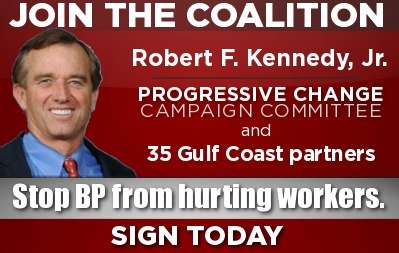
Good afternoon, I'm Forrest Brown, senior organizing fellow at the Progressive Change Campaign Committee.
This morning, we sent out an email to PCCC members letting them know that BP blocked workers cleaning up the oil disaster in the Gulf from wearing protective respirators.
In just 8 hours, more than 23,000 Today more than 27,000 people have joined our coalition. Can you help us keep up the momentum? Join here.
On June 15, 2010 the US Department of Energy announced that a group of federal and independent scientists convened by Secretary of Energy Steven Chu, Secretary of the Interior Ken Salazar, and Chair of the National Incident Command's Flow Rate Technical Group (FRTG) Dr. Marcia McNutt (Director of the U.S. Geological Survey) had developed a new estimate for the amount of oil gushing from the ruptured well in the Gulf of Mexico that indicated the leak could be spewing up to 2.52 million gallons of crude oil per day into the waters of the Gulf of Mexico from British Petroleum's Macondo Well.
"This estimate brings together several scientific methodologies and the latest information from the sea floor, and represents a significant step forward in our effort to put a number on the oil that is escaping from BP's well," said Chu, who then expanded with "As we continue to collect additional data and refine these estimates, it is important to realize that the numbers can change. In particular, the upper number is less certain - which is exactly why we have been planning for the worst case scenario at every stage and why we are continuing to focus on responding to the upper end of the estimate, plus additional contingencies."
Estimates from both BP and from the US Government of the amount of oil gushing from the blown out wellhead on the gulf seabed have been almost continually revised upwards since the well blowout and leak began on April 20, with widespread suspicions that BP has deliberately understated the leak rate in attempts to limit liability for the company.
It now appears that Chu may have been somewhat prescient with his statement that "it is important to realize that the numbers can change", and that the estimate of oil leaking into the Gulf of Mexico may need to be increased again, since an undated internal BP document (.PDF) obtained by Chairman of the House Select Committee on Energy Independence and Global Warming Congressman Ed Markey (D-MA) was released by Markey on Sunday June 20 showing that BP's own internal analysis believed that a worst-case scenario, based on damage to the well bore, could result in a leak rate from the well of 55,000 to 100,000 barrels of oil per day.
On July 4th, Americans are supposed to celebrate their independence. We may no longer have to worry about a greedy, distant monarch. But our country is still held in thrall to powerful interests that prize profit over individuals and their freedom-the energy industry comes to mind. As Jason Mark puts it at AlterNet:
"We're in an abusive relationship and unable to leave our abuser. The plight of the people in Louisiana proves the point. Louisianans have been punched in the face by the hand that feeds them, and yet their biggest worry is that the oil and gas industry is going to walk out the door and leave them."
Where's the love?
It's clear that BP, for instance, isn't playing carefully with our country or its resources. At Mother Jones, David Corn relates the latest example of the company's callousness. Its recovery plan had no stipulations about handling even a small storm like the one that stopped clean-up this week. It did, however, include plans to save sea life that hasn't lived in the Gulf for millions of years. As Corn put it, the company was "prepared for walruses, not prepared for hurricanes."
The biggest problem, of course, is that BP wasn't prepared to handle a blow-out to begin with. The leak has gone on for so long that governmental officials are now taking unprecedented measures to protect the wildlife most vulnerable to its effects. Beth Buczynski reports at Care2 that official are going to dig up about 700 sea turtle nests on Alabama and Florida beaches that are at risk from the oil.
"Once the eggs have hatched, the young turtles will be released in darkness on Florida's Atlantic beaches into oil-free water," she writes. "Translocation of nests on this scale has never been attempted before."
Halliburton
No matter how badly these companies treat us, it seems we can't get rid of them. Take Halliburton. The company has latched its talons into the country and will not let go. It is second only to BP in shouldering responsibility for the Deepwater Horizon spill. As Jason Mark reports for the Earth Island Journal, just before the oil spill, Halliburton took over Boots & Coots, a company that deals with oil-well blowouts; that company now has a contract with BP to help with the relief well.
"Halliburton is essentially making money from causing the accident and then helping to repair it," Mark writes. "Halliburton's many-fingered tentacles is just the latest illustration of how powerful the company is."
Wimpy Washington
Washington isn't strong enough to fight back against that sort of corporate power. Over the past year, energy interests have whittled down the climate change legislation to a tepid half-step. Right now it looks most likely that a bill that passes will regulate only the utilities sector.
"We believe we have compromised significantly, and we're prepared to compromise further," Sen. John Kerry (D-MA) told Politico this week after a White House meeting on the bill.
"If you're looking for the sorry state of American energy politics distilled into one line, there it is," writes Jonathan Hiskes at Grist. "Kerry fights harder for clean energy than just about any national politician."
Still, if anything passes the Senate, Washington will celebrate. As Aaron Wiener explains at the Washington Independent, "For all the disappointment among environmentalists over the repeated compromises Democrats have made on climate legislation to win over moderates, some argue that a utilities-only cap would achieve most of the goals of an economy-wide carbon pricing scheme. The question now is whether Democratic leaders in the Senate can muster 60 votes for even a weakened bill to overcome a Republican filibuster."
Our friends abroad
On an international level, our governing bodies might be doing a better job, but not by much. Inter Press Service reports that the countries at the meeting promised to scale back taxpayer subsidies of fossil fuels. Even that promise is limited, however. "Countries agree to phase out "inefficient fossil fuel subsidies" but each country decides what those are," IPS reports. "Some countries like Japan, Australia, Italy and others have already said they don't have any."
Johnson spoke to Kim Carstensen, who leads the World Wildlife Fund's Global Climate Initiative, who compared this meeting's report to that of the last G20 summit and found that climate issues had dropped off the radar. "There were eight references to clean energy in the final report from Pittsburgh (the last G20 Summit) and they have been completely vacuum cleaned," he said. "That is kind of scary."
Fight back
In situations like this, it takes massive pressure from outside to move the political apparatus forward. At AlterNet, Heetan Kalan has some ideas about how to progress-reach beyond the environmental community; enlist "doctors, nurses, public health officials and patients speaking out about the connection between consumers of coal energy and their immediate health concerns." Kalan writes:
"After all, climate change is not solely an environmental problem - it is a human/planetary problem. If we are going to rely on a small base of environmentalists to carry us through this crisis, we are in trouble. Our spokespeople on this issue have to come from a wide spectrum of citizens and leaders."
Certainly, they have to come from somewhere, and as Steve Benen writes at The Washington Monthly, whoever is speaking on this issue now, they're not speaking loud enough.
"Lawmakers aren't facing much in the way of public pressure," he writes. "The polls look encouraging, suggesting the public is inclined to back the Democratic proposals, but that support hasn't translated into aggressive advocacy - phone calls to lawmakers' offices, letter-writing campaigns, district meetings, sizable rallies, etc....If engaged constituents want more, Congress will have to feel considerably more heat than they are now."
In other words, if America wants to be free of coal, oil, gas, and the energy industry, we're going to have to fight for it.
This post features links to the best independent, progressive reporting about the environment by members of The Media Consortium. It is free to reprint. Visit the Mulch for a complete list of articles on environmental issues, or follow us on Twitter. And for the best progressive reporting on critical economy, health care and immigration issues, check out The Audit, The Pulse, and The Diaspora. This is a project of The Media Consortium, a network of leading independent media outlets.
I think the oil spill is getting us to think more about about what humankind has done to the other living creatures that make up the Gulf's biosphere. As I was searching for something completely different (the source of the joke "Death or Moobli" which I laughed heartily over as a read a book on conversation that I picked up at the Shepherdstown Library... I'll repeat it further down the post), I discovered this small video entitled "Tortoise helps tortoise":
It is by now obvious that even after we stop the gentle trickle of oil that's currently expressing itself into the Gulf of Mexico (thank you so much, BP) we are not going to be able to get that oil out of the water for some considerable length of time--and if you think it could take years, I wouldn't bet against you.
While BP is the legally responsible party, out on the water it will be up to the Coast Guard to manage the Federal response, and to determine that BP is running things in a way that gets the work done not only correctly and safely, but, in a world of limited resources, efficiently.
Which brings us to the obvious question: can the Coast Guard manage such a complex undertaking?
While we hope they can, you need to know that the Coast Guard has been trying to manage the replacement of their fleet of ships and aircraft for about a decade now...and the results have been so stunningly bad that you and I are now the proud owners of a small flotilla of ships that can never be used, because if they go to sea, they might literally break into pieces.
It's an awful story, and before we're done you'll understand why Deepwater was already an ugly word around Headquarters, years before that oil rig blew up.
I guess we'll know tomorrow with his "speech to the nation," as it is being called by the TV Pundits. It's been 56 days now since the explosion that started the oil eruption under water and just about everything that has been tried has been functionally useless (there's a cap of sorts taking our a small percentage of the flow, but not enough to make a difference, and two relief wells are being drilled to cut off the leak itself, but we're about two months away from it happening).
For more than a century, in unison, the planets' population proclaimed, thankfully petroleum flows. Oil powers our machines. The refined product has helped us manufacture massive quantities of clothing, aluminum sheet, and photovoltaic (PV) solar cells. "Plastics." As was professed in a popular film decades ago, "There's a great future in plastics." Presently, and in the past, BP understood this and much more. The company's Executives knew petroleum could and would provide endless profits, power, and a perpetual presence.
Many people are looking for a way to pitch in and help in response to an emergency. The last time it happened the opportunity slipped away; will it this time?
"There's a dead dolphin on this beach," Mother Jones' Mac McClelland, wrote yesterday in Louisiana. It's one snapshot of the harm visited on the Gulf Coast by the BP oil spill. Back in Washington, the Senate climate bill, which would put the country on a path to cleaner energy consumption, is on its last legs.
You'd think that after a seemingly unstoppable oil spill in the Gulf of Mexico (official estimates are up to 50,000 barrels a day, as of yesterday) and the hottest spring on record (hello, climate change!), U.S. citizens and elected representatives would recognize that our country's thirst for resources has consequences.
It's not just that oil is spilling into the Gulf, even after BP hit on a fix. Besides the blow-out that has dominated headlines, another, more routine spill showed up near the Louisiana coast. The Deepwater Horizon spill is now the larger of two spills in the Gulf Coast, according to Care2. A week ago in Pennsylvania, a natural gas well owned by EOG Resources (formerly Enron) shot a geyser of chemical-laced water 75 feet into the air; and on Monday, in West Virginia, another natural gas well, this one owned by Chief Oil and Natural Gas, also exploded, as AlterNet reports.
Yet BP is still supplying the Pentagon with oil and gas, as Jeremy Scahill writes at The Nation. Senators are still supporting natural gas exploration and off-shore oil drilling. The White House has also abandoned any intention of pushing for strong legislation that would push for better, cleaner energy.
Lifestyle vs. lives
Americans aren't willing to give up their lifestyle, so wild animals are giving up their lives. One casualty of the BP spill in the Gulf might be bluefin tuna. Their population is 20% of what it was 40 years ago, Inter Press Service reports. Although the effects of the oil spill won't be entirely clear for a few years, scientists are worried.
"Biologically, bluefin are already unlucky," IPS writes. "The fish - which can be as long as and faster than a sports car - only spawn once a year and only in certain locations."
Schools of the tuna, IPS reports, are headed now towards the Gulf of Mexico.
"The spill has been going on during their peak spawning period in the only place the western population spawns, so in timing and location it's probably the worst place you could have it and during the worst time," Lee Crocket, director of federal fisheries policy at Pew Environment, told IPS.
"There were dead Portuguese man o'war jellies-one of the few species that weather the travails of the dead zone that afflicts these waters each summer. The dead zone is an area around the outflow of the Mississippi River made hypoxic by too many nutrients flowing downstream, mostly from farms and ranches. If you're a jellyfish, a dead zone is survivable. Apparently an oiled zone is not."
BP's shroud of secrecy
BP has been remarkably cagey with the public about what's going on in the Gulf. In addition to keeping reporters away from soiled area, the company hasn't shown much interest in understanding exactly how much oil it's spilling into the ocean. Initial estimates of 1,000 barrels per day have blossomed into estimates, on the low end, of 25,000 barrels. On Democracy Now!, scientist Ira Leifer said that the company is being more forthcoming with information now than it was originally. But he'd like a fuller picture:
"What there really should be at these kind of sites is some acoustic methods, whether it's sonar or passive listening devices, or other approaches that continuously are monitoring and waiting for something to happen and then would provide a nonstop, steady data stream, so we could actually learn from what happens....These things, they're not steady states. They belch. They have large eruptions."
What that means, Leifer said, is that it's not necessarily accurate to talk about a definitive rate at which the oil is pouring out. In his words, "the flow today is not necessarily the flow tomorrow." What's more, the attempts to stop the spill can make it worse. One concern is that the rock surrounding the pipe could "give out," Leifer says. In that scenario, the oil would not just come from the pipe but from many sites in the surrounding sea bed.
"This reservoir is massive, and it could easily flow that kind of oil for the next twenty or thirty years, if it was left to go unattended," Leifer said. "So the amount of oil that could end up in the environment if measures are not successful is at what I would call unimaginable."
Spin, BP, spin
Given that sort of doomsday scenario, it's not surprising that BP has plans to promise as little as possible to the spill's victims. As Justin Elliott reports at TPMMuckraker, the company's plan for oil spills instructs its spokespeople not to promise anything.
BP's June 2009 Gulf of Mexico Regional Oil Spill Response Plan reads: "No statement shall be made containing ... Promises that property, ecology, or anything else will be restored to normal," Elliott writes.
Solutions
How to move beyond these horror stories? This week, Sen. Lindsey Graham (R-SC) completely disowned the climate legislation he was working on before, and both Mother Jones' Kevin Drum and The Washington Monthly's Steve Benen bemoaned the climate bill's fate.
Yesterday, the Senate narrowly defeated an amendment offered by Sen. Lisa Murkowski (R-AK) that would have stripped the Environmental Protection Agency of its power to regulate carbon. Although the amendment failed, support from Democrats like Arkansas' Blanche Lincoln signals that the support isn't there for even unambitious climate legislation. And at this juncture, it seems like the U.S. has done more harm than good in the international arena.
Coping with Copenhagen
International leaders are at Bonn this week, trying to pick up the pieces from last November's climate change negotiations in Copenhagen.
"Copenhagen was a pretty horrible conference," conceded Yvo de Boer, the executive secretary of the United Nations Framework Convention on Climate Change (UNFCCC), as IPS reports. "This year it's about restoring trust."
For the U.S., passing climate legislation would help.
This post features links to the best independent, progressive reporting about the environment by members of The Media Consortium. It is free to reprint. Visit the Mulch for a complete list of articles on environmental issues, or follow us on Twitter. And for the best progressive reporting on critical economy, health care and immigration issues, check out The Audit, The Pulse, and The Diaspora. This is a project of The Media Consortium, a network of leading independent media outlets.
As you know, Floridians are disproportionately affected by the actions of British Pretoleum that led to the Deepwater Horizon oil spill in the Gulf of Mexico. I'm talking to Floridians every day who enraged at BP and want to make sure that BP pays the full price for it's actions. I'm listening.
I also want to listen to you. I'm going to be one of the leading voices in holding BP accountable. I want your feedback. Tell me actions you'd like to see taken to make sure that BP pays the price for this oil spill.
A cap placed over a severed pipe is siphoning some oil from the broken BP well in the Gulf Coast, the company said today. The company's CEO said this morning on CBS that it was possible that this fix could capture up to 90% of the oil, but that it will take 24 to 48 hours to understand how well this solution is working. Adm. Thad Allen, the former Coast Guard chief and oil spill incident commander, called the cap "only a temporary and partial fix."
That any ban on offshore drilling would be lifted last week, as the BP disaster only got worse, is difficult to fathom. Unfortunately, that is exactly what the Obama administration did, which today has resulted in the approval of a new offshore oil well in the Gulf of Mexico. Seriously:
Federal regulators have approved the first new Gulf of Mexico oil well since President Barack Obama lifted a brief ban on drilling in shallow water.(...)
Obama has extended a moratorium on wells in deep water like the BP one that blew out in April and is gushing millions of gallons of oil. But the president quietly lifted a brief ban last week on drilling in shallow water.
Ironically, this new oil well was approved not only as the BP disaster continues to unfold, but as President Obama is set to deliver a big speech today at Carnegie Mellon University on the state of the economy. The speech will also focus on the need to invest in renewable energy and the passage of energy / climate change legislation. For example, here is an excerpt:
The catastrophe unfolding in the Gulf right now may prove to be a result of human error - or corporations taking dangerous short-cuts that compromised safety. But we have to acknowledge that there are inherent risks to drilling four miles beneath the surface of the Earth - risks that are bound to increase the harder oil extraction becomes. Just like we have to acknowledge that an America run solely on fossil fuels should not be the vision we have for our children and grandchildren.(...)
The time has come, once and for all, for this nation to fully embrace a clean energy future. That means continuing our unprecedented effort to make everything from our homes and businesses to our cars and trucks more energy efficient. It means tapping into our natural gas reserves, and moving ahead with our plan to expand our nation's fleet of nuclear power plants. And it means rolling back billions of dollars in tax breaks to oil companies so we can prioritize investments in clean energy research and development.
Great. However, while talk of renewables is nice, the actual action coming from the Obama administration on energy today involves approving a new offsore oil well in the Gulf of Mexico. It would be an understatement to say that is a case of the Obama administration sending mixed signals on the BP disaster and on renewable energy.