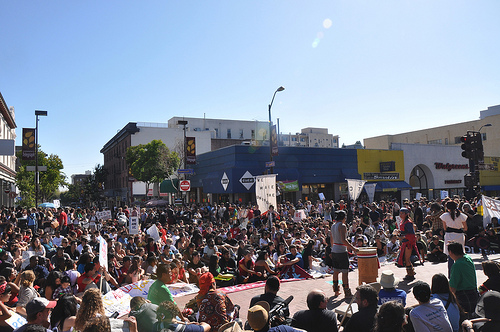
On Thursday, March 4th, California's college students staged statewide protests that were the epicenter of an international day of action against the mindless bipartisan war on public education. The actions were called for coming out of student protests last November, and were joined in by teachers and staffs from K-12 as well as all three branches of California's higher education system, along with student-lead actions in 30 other states and some countries overseas. At Democracy Now, Juan Gonzales reported:
Students and teachers held hundreds of demonstrations on Thursday as part of the National Day of Action to Defend Public Education. Hundreds of thousands took part in what was the largest day of coordinated student protest in years.
Much of the day's focus was on the university and state college campuses of California, where students face a 32 percent tuition hike. Thousands of California students staged a one-day strike and took part in rallies from San Diego to Sacramento to Humboldt County.
At UC Santa Cruz, students blocked both entrances to the school before 7:00 a.m., essentially shutting down the campus for the day.
At UCLA, 300 students staged a five-hour sit-in outside the chancellor's office.
The blog StudentActivism.net, written by Angus Johnston, a historian of student activism and student government, offers a great wrap-up of the day (not that things are necessarily wrapping up). California -- not to mention the rest of the country -- saw a ton of activity today. A huge day for students.
But the real challenge is what happens tomorrow. As Johnson writes --
Today was more about activists talking to each other, working with each other, than it was about talking to or working with -- or working to overthrow -- university power structures.
At Calitics, Courage Campaign Public Policy Director Robert Cruickshank (aka "Eugene" or "Robert in Monterey")--also a speaker at one of the protests--reported:
From Anger To Action
Yesterday's outpouring of protest against the deliberate decision to destroy California's public education system was characterized by one dominant emotion: anger. And that was exactly as it should be. If you're not angry at the collapse of our schools, colleges, and universities, and the stealing of an entire generation's future, then you're really not paying any attention.
I spent the day at Cal State Monterey Bay, hearing student after student take the microphone to express their anger at what has happened to their dreams. This was not a violent anger, but instead the kind of deeply rooted anger that anyone would quite rightly feel when they have been betrayed. The state of California has betrayed these students, having asked them to work hard to succeed in school and promising an affordable quality education, only to yank that promise away from them in order to deliver tax cuts to huge corporations.
On other campuses, anger was clearly the dominant emotion, such as the students at UC Santa Cruz who shut down the campus, or the students at UC Davis who tried to block Interstate 80 in order to show the rest of the state what it feels like to have your life disrupted by forces beyond your control.
Anger can be a very healthy emotion. It focuses the mind, and can create a sense of determination. That too was on display at the events I attended - a belief that this anger was being expressed in order to build a mass movement of students, faculty, staff, parents, and other Californians who know that this state has no chance whatsoever at prospering in the 21st century if these cuts are not reversed. It is further evidence of how effective and valuable the March 4 actions were.
Students now understand what is happening to them and why. Their education is being gutted and their already meager financial resources are being stolen from them by a state government that believes corporations matter more than students. That propping up the failed status quo matters more than building California's future. Most of the speakers I heard understood this very clearly, almost instinctively. It has been beaten into them these last two years.
On Thursday, September 24th, an estimated five thousand people attended a rally on Sproul Plaza at the University of California, Berkeley. The rally and subsequent march through campus and downtown Berkeley-scheduled to coincide with and planned in support of the University of California (UC) Faculty Walkout that took place on all ten UC campuses-brought together undergraduate and graduate students, faculty, university workers and alumni to protest the budget cuts at Berkeley and stand up for public education across California.
Along with all the other doomsday scenarios describing a gradual collapse of momentum to establish a national health service, it's also possible that Democrats will produce a minimal system of national healthcare that gradually gets worse.
Republicans won't just lie down and die if some form of national healthcare becomes a reality...
What they will inevitably do instead is cut away at the core of the program by highlighting anything that can be sold to the public as a "problem," or by selecting a few specific sub-programs to pillory as extravagances that only benefit a few patients, and so on.
Republicans didn't destroy public education in California by declaring war on it. Republicans were always totally in favor of quality education for everybody!
But in these hard times do we really need music education? In these hard times do we really need a library in every school? And gradually schools were transformed into prisons, with 50 kids in a high school classroom, and who are you to say that 50 is too many?
Republicans will inevitably try to do exactly the same thing to any kind of national healthcare, large or small, and with the unlimited support of corporate media conglomerates, and the collapse of newspapers, and marginalization of the progressive blogosphere, which is already marginal enough...
The Republicans will probably win again.
This is a nation of tax-cutters right down to the bone, because every day and in every way the media conglomerates are selling a picture of taxes as essentially wasteful, and almost entirely useless, and without the disaster-Presidency of the obviously inept George W. Bush, and a war that turned into an obvious fiasco, it's hard to believe that Democrats could have won their majorities on both sides of Congress, and a whole big chunk of those majorities is Blue Dog tax-cutters anyway.
As long as the media are mainly controlled by right-wing corporations, (and what other kind of corporation is there?) we can only look forward to perpetually renewed and eventually successful attacks on every government program that benefits the average citizen.
De-consolidating the media may not be the sexiest theme in Washington, but without it, every other element of the progressive agenda will eventually be suppressed, including national healthcare and public education.
In addition to his segment on Obama's Vietnam this Friday, Bill Moyers also focused on funding for public education with Vartan Gregorian. The situation with public education is virtually identical with that of public infrastructure-30 years of underfunding and neglect, thanks largely to the movement conservative "tax revolt." In fact, the two are really one and the same, since an educated public is the human infrastructure on which our country is built. And conservatives don't give a damn about any of it.
BILL MOYERS: All across the country it's the same. State governments are staring down the barrel at $300 billion worth of deficits for the next two years. Twenty-six states already have either cut their budgets for higher education, raised tuition fees, or done both. When it comes to college affordability, this report from The National Center for Public Policy and Higher Education gives a failing grade of "F" to 49 of the 50 states. Tuition at public four-year colleges is up an average of more than $6,500, at two-year schools, almost $2,500. Yet even with the increases, THE CHRONICLE OF HIGHER EDUCATION reports that many college buildings are outdated, inefficient, even crumbling. So what's to be done? Some took hope when President Obama spoke up for higher education in his inaugural address.
PRESIDENT BARACK OBAMA: And we will transform our schools and colleges and universities to meet the demands of a new age.
BILL MOYERS: If the colleges and universities do wind up big winners in Washington, no one will be happier than this man, or more responsible. Long a dynamo for the cause of public education, Vartan Gregorian bears testament to the value of a lifetime of learning.... Last October, Gregorian convened a group of educators to urge whoever would become our next president to invest in higher education. Their meeting later resulted in this two-page newspaper ad, an open letter to then President-elect Obama asking that whatever economic stimulus package comes out of Washington, five percent of it - around 40 to 45 billion dollars - go to higher public education.
Considering that the Treasury and the Fed combined have already given trillions to the financial sector, $40-50 billion to higher public education is less than a pittance. It's an insult, really. But it's what they're asking for.
The campaign schedule has been pretty intense over the last week and will continue to be so until the BIG day on Tuesday, November 4th. I want to congratulate everyone for putting so much effort into this year's election, not just for an individual campaign, but for the entire Democratic ticket. I've seen people in every community throughout the 5th district working to make sure the message is getting out.
I want to remind everyone it is important that we finish strong. Don't take anything for granted, ignore the polls and work like the polls show our candidates 5 points down. Remember, while all indications show Barack Obama will be our next president, if we believe the polls, Al Gore would be concluding his second term or we would be working to re-elect President John Kerry right now.