Wave bye-bye? What if there is no GOP wave in November?
When Hurricane Katrina hit New Orleans, and George Bush was photographed posing with a guitar and giving John McCain a birthday cake, I had one happy thought to offset all the horror that was unfolding before us: I was convinced that the Democrats would win back Congress in 2006 with a wave election, and win a second wave election in 2008, along with the White House. It would be, I believed, a classic realigning election. Howard Dean was already out there working on his 50-state strategy, which was absolutely huge. But the Katrina disaster finally punctured the bubble of Versailles ass-covering for conservative failures. My only regret, looking backward, was that I didn't write more systematically about what I felt. While I was right about the shape of elections to come, the waves were not as large as I had hoped, nor were the policy consequences--due largely to Barack Obama's manic embrace of discredited conservative ideas. This has helped enormously in extending the hegemonic continuity of Nixon-Reagan Era.
First off, it should be clear that I didn't actually argue "that Barack Obama has manically embraced 'discredited conservative ideas' and 'helped enormously in extended the hegemonic continuity of [the] Nixon-Reagan Era'" I simply offered that as a characterization. In fact, as I wrote it, I briefly thought about the idea of making the argument for that characterization in a future post. This is not that post, but hopefully this post can provide good enough justification for my characterization, so that we can have a more enlightening discussion than has happened so far.
Instead, I want to keep the focus where it was in my post-a focus on the context of politics, which is a vital part of what changes when one party system succeeds another. How we contextualize things goes a long way toward determining how we see them (it's that damn framing thing again), and unless we take note of that fact we will continually talk about things that we take to be the same, but that are actually quite different, because of the larger contexts in which they are embedded. For example, is this a face?
Or a landscape?
So the first order of business has to be a clarification of contexts and the meanings that flow from them. We can only discuss the claim I made after we understand these differing contexts, and gaining that understanding is quite enough work for one diary.
Realignments, Failed Realignments & Political Context
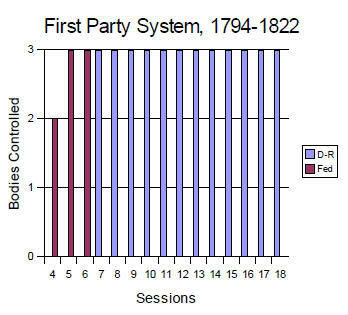
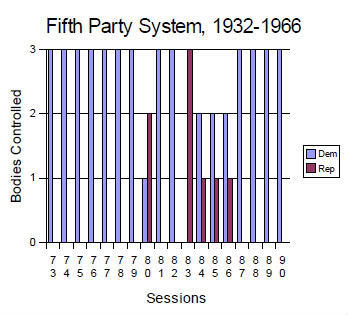
First we must start with a quick review of party systems and realignments. The pattern of party systems is perhaps most readily grasped through the following table:
Partisan Balance In US History
Through Six Party Systems
Control of Presidency, House & Senate
| 
Dem-Reps: 12 / Feds: 2 / Split: 1 | 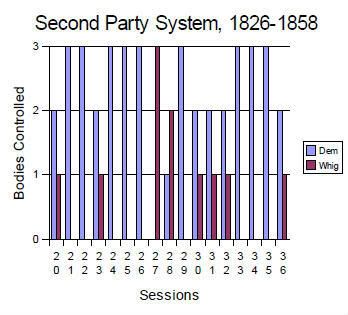
Dem-Reps: 9 / Whigs: 1 / Split: 7 | 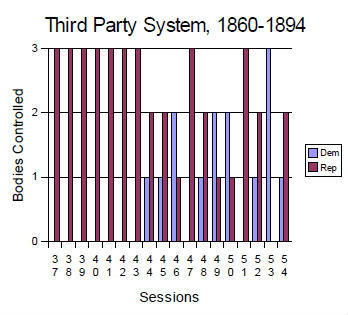
Dems: 1 / Reps: 9 / Split: 8 | 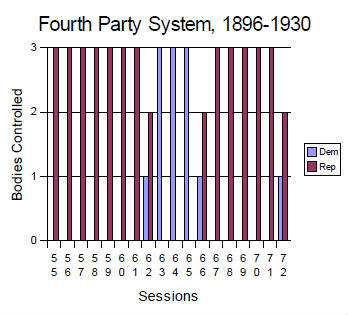
Dems 3 / Reps: 12 / Split: 3 |
Dems: 13 / Reps: 1 / Split: 4 | 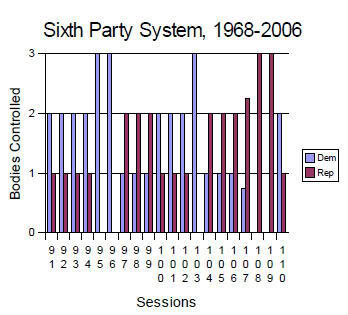
Dems: 3 / Reps 2.25 / Split: 13.75 |
what we see in this succession of systems is one dominant pattern, with minor variations, and two other patterns covering the first and last cycles. The dominant pattern is that of one-party dominance for more than three presidential elections, followed by a more mixed period. The first party system differed because it began without well-defined parties, much less a defining election. The election of 1800 served as the only example of a realigning election within a party system, and it could just as well be argued that the pre-1800 period should be seen a separate, very short "no-party system" of its own. What's also different is that once the Democratic-Republicans defeated the Federalists in 1800, the Federalists never recovered. The Sixth Party System is even more radically different, because it is the only party system in which neither party dominates. Rather divided government dominates. What's more, it was not the result of a classic realigning election, but rather what's been called a de-aligning election. There was no significant House wave associated with it, much less two consecutive wave elections, which is what we find normally.
Looking at the four party systems where the dominant pattern holds, we see there is always a point where the sub-dominant party manages to win power, but it never manages to consolidate that power. This is why I call these "failed realignments". The Whigs in the Second Party system, the Democrats in the Third and Fourth, and the Republicans in the Fifth, all managed to break the other party's stranglehold on power, but never managed to fundamental alter the basic terms of political debate. This limitation is esquisitely captured by President Eisenhower--the only Republican President of the Fifth Party System, in a letter to his brother that's been somewhat widely quoted in recent years:
Should any political party attempt to abolish social security, unemployment insurance, and eliminate labor laws and farm programs, you would not hear of that party again in our political history. There is a tiny splinter group, of course, that believes you can do these things. Among them are H. L. Hunt (you possibly know his background), a few other Texas oil millionaires, and an occasional politician or business man from other areas.5 Their number is negligible and they are stupid.
The line Eisenhower draws here, excluding a small fringe whose ideas are beyond the pale, is a reflection of the political context. Those who think outside the contextual framework of the political system will simply not be taken seriously in the end.
The sharp dividing line that Eisenhower draws here is arguably not so sharply drawn in all cases. In the Third Party System, for example, the Democratic Party resurgence eventually resulted in the removal of federal troops from the South, and the re-establishment of a new form of legal racial subjugation that for many purposes function as a form of "slavery lite". However, the counter-argument can simply be made that the very fact that it was "lite" shows the sharp line-it's just not where the Radical Republicans and African-Americans wanted it to be. Similarly, although the Whigs not only gained political power during the Second Party System, but also saw their industrial model of development come to dominate, they could not re-establish a centralized national bank or other such centralizing institutions.
We are now in a position to hazard a theory about the Sixth Party System, and the atypical de-aligning election that brought it about,and that theory is this: the de-aligning election of 1968 represented a sort of mega-failed realignment. The conservative movement that first consolidated behind Goldwater in 1964 wanted to roll back the New Deal. Although Nixon himself wasn't focused on this, he was focused on trying to destroy the New Deal political system. His deep hatred for the Democratic Party is well known-his inability to control that hatred ultimately destroyed his presidency. However, Richard Reeve's biography, Richard Nixon: Alone in the White House draws significantly on Nixon's own writings, and argues that Nixon really wanted to create a third party, to free himself from Republican establishment, which seemed to hate almost as much as he hated the Democrats. And, of course, this hatred was shared by the movement conservartives who backed Goldwater in 1964, and Reagan in 1980.
In short, we can hearken back to Eisenhower's letter, and see how the entire period from 1968 to 2008 can be seen as a failed conservative attempt to break the bounds that Eisenhower saw so clearly. It was, in short, a failed attempt to completely overturn the mixed-economy New Deal order. However, as the more perceptive conservatives finally realized the futility of their quest (reflected, for example, in the widespread support for social spending programs in the conservative base), they hit upon another approach: instead of getting rid of the welfare state, they would repurpose it for the benefit of conservative elites, creating a strange American reflection of the conservative welfare state vision of Otto Von Bismark. Of course, they wouldn't abandon their strategy of totalistic rhetorical attack on the welfare state-that was far too important for keeping the base fired up (even if many of those fired up were themselves on the government dole, one way or another). But they would no longer really be interested in winning that battle. Not only was it futile, they now recognized, it was also better motivating for their base if they didn't win.
Objectively, a turning point came with the Bush Administration. For the first time since the 1920s, conservatives controlled all the levers of power in government. They were finally free to do whatever they wanted to. And did it they did. And the results were utterly catastrophic. It was just the sort of catastrophe that realigning elections are made of, as Bush's abysmal poll numbers confirmed.
This brings us up to date historically--up to the point of my description in my diary that got this whole discussion rolling. But it doesn't address the difference Chris sees between his take on Obama and mine. I would argue that that difference is largely semantic, and relatively superficial, compared to the encompassing context. That context encompasses a continuation of most of the Bush-era policies, and even an extension of them beyond what Bush dated imagine, especially when it comes to cutting entitlements such as Medicare and Social Security, where Obama seems quitely determined to cut far more deeply than Bush ever dreamed of.
The Third "Third Way" In Context
In his diary, Chris went on to say:
Personally, I differ a bit from Paul in that I lean toward the Ed Kilgore analysis that the Obama administration is governing largely from a Third Way ideological perspective distinct from either contemporary progressivism or Nixon / Reagan conservatism. However, that perspective still renders the approach of the Obama administration distinct from the laundry list of progressive / liberal goals articulated by Matt Yglesias back in February.
Chris linked to this same piece by Kilgore back in February, in his diary "Great exchange between President Obama and Senator Lincoln", in which he used the example of that exchange to illustrate the difference between Blue Dogs and New Dems. It was a good example, which Chris characterized thus:
Lincoln offers no policy solutions at all. In fact, she explicitly argues against any new policies, instead favoring "predictability." Keep all policies the same, attack the left in public, and get lots of photo-ops and co-sponsored bills with Republicans (bills that don't change any policy, of course). This is an identity-based ideology, just as Blue Dog-ism itself is an identity based ideology entirely about publically differentiating oneself from the left....
There are no policies here. There are no principles. Being a Blue Dog is just about appearing anti-left. That is the founding, essential tenet of Blue Dog philosophy.
With surprising forcefulness, President Obama responded to Senator Lincoln that reaching out to Republicans, and adopting their policies, isn't going to do any good for Democrats. This is because Republican policies have have failed, and caused real economic problems that are making voters angry.
However, as Chris went on to point out toward the end of his diary, the policy solutions that Obama proposes, based on a rhetoric of "what works" and shunning what he calls "ideology" are themselves not only ideological, but also based on failed policies of the past. (Chris uses the example of financial deregulation championed by Larry Summers in 1999.)
Before going there, however, Chris referenced Kilgore's article ("Taking Ideological Differences Seriously") to help flesh out the nature Obama's "Third Way" approach.
Here is a key passage from Kilgore:
To put it simply, and perhaps over-simply, on a variety of fronts (most notably financial restructuring and health care reform, but arguably on climate change as well), the Obama administration has chosen the strategy of deploying regulated and subsidized private sector entities to achieve progressive policy results. This approach was a hallmark of the so-called Clintonian, "New Democrat" movement, and the broader international movement sometimes referred to as "the Third Way," which often defended the use of private means for public ends. (It's also arguably central to the American liberal tradition going back to Woodrow Wilson, and is even evident in parts of the New Deal and Great Society initiatives alongside elements of the "social democratic" tradition, which is characterized by support for publicly operated programs in key areas).
To be clear, this is not the same as the conservative "privatization" strategy, which simply devolves public responsibilities to private entities without much in the way of regulation. In education policy, to cite one example, New Democrats (and the Obama administration) have championed charter public schools, which are highly regulated but privately operated schools that receive public funds in exchange for successful performance of publicly-defined tasks. Conservatives have typically called for private-school vouchers, which simply shift public funds to private schools more or less unconditionally, on the theory that they know best how to educate children.
As you might have guessed from the previous section of this diary, I see things somewhat differently. Kilgore stresses an ideological difference between between the Third Way and the "social democratic" tradition based on means: private vs. public means to serve public ends. But this narrow focus on means obscures the big picture--the political context that I wrote about above. And it's this big picutre that has already made a mockery of the distinction Kilgore draws here:
In education policy, to cite one example, New Democrats (and the Obama administration) have championed charter public schools, which are highly regulated but privately operated schools that receive public funds in exchange for successful performance of publicly-defined tasks.
As anyone following Open Left's coverage of education knows, by this point there's nothing but vacuous spin to distinguish Obama's attack on public education from Bush's. And the reason that difference has evaporated, I would argue, is because Obama fundamentally accepts the Nixon/Reagan/Bush definition of reality, despite it's horrendous record of failure upon failure upon failure.
To underscore pathetic, visionless nature of the so-called "Third Way," I'd like to refer to the diary I wrote at the time, responding to Chris & to Kilgore's analysis, "What's wrong with the third 'Third Way'". In that diary I argued that there have been three "Third Ways":
The first "Third Way" was social democracy, as exemplified by the German Social Democratic Party. It was a "Third Way" between naked capitalism and revolutionary socialism. Their main policy for gaining broad public support was universal health care-in the 1870s. It was a very popular idea-so popular, in fact, that conservative mastermind Otto Van Bismark decided to co-opt the idea...
Bismark created the first conservative welfare state by instituting universal health care and other social protections in ways that tended to reinforce existing social hierarchies and the social, political and economic power of elites. But the conservative welfare state " was still a rather robust-and non-market-affair", I explained, by way of introducint the second "Third Way":
This then gave rise to the second "Third Way", a more scaled-down form of the welfare state that was primarily concerned to just clean up the mess that the market caused and couldn't handle itself. It therefore favored narrowly-targeted approaches that had as little systematic impact on the market economy as possible. This approach developed almost exclusively in the English-speaking world-Britain, Canada, the US, Australia and New Zealand....
The US was the most extreme example of this second "Third Way," with private pension benefits accounting for a substantial portion of its overall social insurance, a situation that proved to be highly precarious as union power was deliberately undermined, beginning with the election of Ronald Reagan.
Weak and inadequate as it was, the American welfare state was the only one Americans knew--and that was one too many for America's extreme conservatives, who sought its utter destruction, invoking a free-market myth that no economy on earth had ever been based on. Their attack couldn't succeed, because programs like Social Security and Medicare are far too popular--even with conservative voters. But rhetorical success was another matter.
The third "Third Way" is an attempt to navigate a middle path between delusional free-market rhetoric and the relatively incomplete and minimalist welfare state that America had managed to cobble together up through the 1970s. But the particular strategy and tactics employed are far less significant in the long run than the fact that such relative minutua serve to totally obscure the big picture, in which a massive and seemingly permanent upward transfer of wealth--begun by conservatives--will be continued until America has the class structure of a Third World nation.
The devotion to propping up the big banks that caused the financial meltdown, combined with almost total neglect of millions of families facing foreclosure is emblematic of this entire approach. The relative minutua of policy mechanisms, which Kilgore stresses so much, is entirely secondary to the big picture massive wealth transfer that is taking place at the core of American policital and economic life.
And all that upwards wealth transfer is happening before the impact of global warming sets in, with its vastly disproportionate impact on the poor and politically powerless. We are, quite literally, being steered backwards in time toward a New Dark Age. The witch-hunts have barely even begun. |


