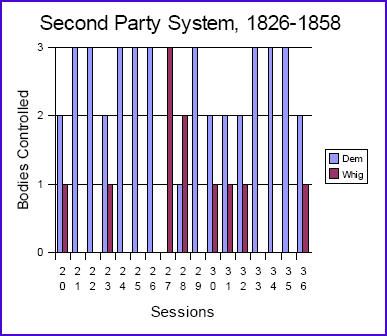
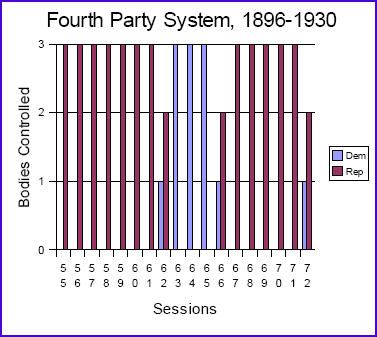
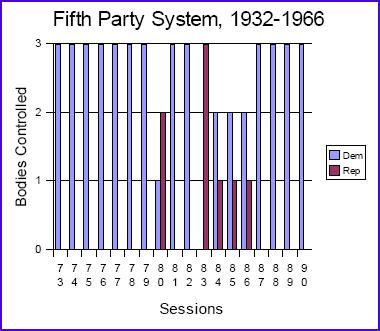
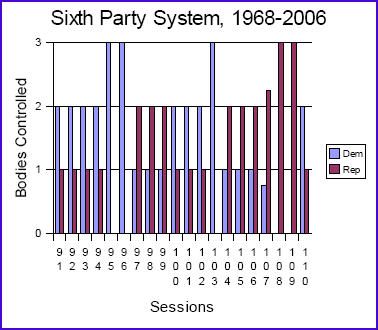
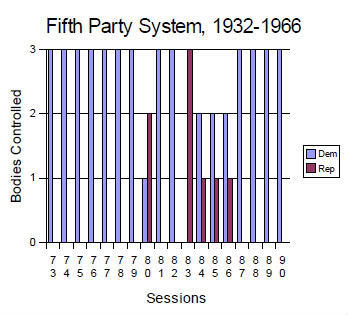
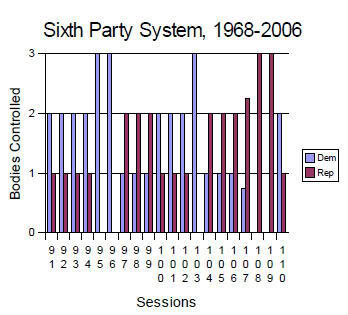
The New Deal [Fifth] Party System (1932-1968) built the American welfare state. The Sixth Party System (1968-2008) saw conservatives fail to destroy it, and turn to repurposing it instead--doing more and more for the wealthy and powerful, and less and less for the rest of us. At the dawn of the Seventh Party System, Barack Obama is potentially headed toward cutting the welfare state far more seriously than conservatives ever managed to during the Sixth Party System. This comes out of his de facto acceptance of the Versailles status quo, despite all his superficial talk of change.
As Chris noted Monday, over at Think Progress, Jamelle Bouie singled me out as a stand-in for all progressives who "understate or dismiss most of the work Congress and President Obama have done over the past sixteen months". He said " I need help understanding this strange impulse," and Chris-ever the gentleman-gladly obliged. He helpfully quoted from a post by Yglesias himself from February, listing "the mainstream liberal policy agenda for the 111th Senate" and then noting that "None of these things have happened. And it's worth emphasizing that the White House hasn't even seriously attempted to do the vast majority of these things."
So, case closed on one point. But there was a broader point Bouie began with, and it's a point worth examining more carefully, precisely because it's not so easily answered. And for this, I think it's worth quoting the whole passage that Chris quoted from Bouie's post:
I need help understanding how OpenLeft's Paul Rosenberg can credibly argue that Barack Obama has manically embraced "discredited conservative ideas" and "helped enormously in extended the hegemonic continuity of [the] Nixon-Reagan Eara. [Emphasis his]" More specifically, I need help understanding this strange impulse among liberals of Rosenberg's ilk to understate or dismiss most of the work Congress and President Obama have done over the past sixteen months, especially when - as David Leonhardt noted in yesterday's New York Times - it's been a burst of activity that "rivals any other since the New Deal in scope or ambition."
The broader point is about Obama's approach in general, about what one might call the context of his governance, as opposed to the content, which was dealt by Chris with via the Yglesias list. And to begin discussing the question of Obama's context of governance, it's helpful to start by looking at the context of what I said that started all this. To wit:
When Hurricane Katrina hit New Orleans, and George Bush was photographed posing with a guitar and giving John McCain a birthday cake, I had one happy thought to offset all the horror that was unfolding before us: I was convinced that the Democrats would win back Congress in 2006 with a wave election, and win a second wave election in 2008, along with the White House. It would be, I believed, a classic realigning election. Howard Dean was already out there working on his 50-state strategy, which was absolutely huge. But the Katrina disaster finally punctured the bubble of Versailles ass-covering for conservative failures. My only regret, looking backward, was that I didn't write more systematically about what I felt. While I was right about the shape of elections to come, the waves were not as large as I had hoped, nor were the policy consequences--due largely to Barack Obama's manic embrace of discredited conservative ideas. This has helped enormously in extending the hegemonic continuity of Nixon-Reagan Era.
With all the talk of a GOP wave in November, it has seemed that the once-promising opportunity to shake off 30 years of failed conservative policies was about to disappear. (Obama's own infatuation with those failed policies, reflected most recently in David Kaib's quick hit, HUD is Trying to Privatize and Mortgage Off All of America's Public Housing, is another huge part of the problem--but outside the scope of this diary. Suffice it to say that if Obama triangulates like this with large Democratic majorities, one shudders to think what he'd do with the GOP holding some actual face cards.)
Now, I think I've learned my lesson, though--which is to be far more outspoken about what I think the future holds. Unfortunately, I'm not nearly as certain now as I was then. But I am as certain that the conventional wisdom is missing something big--although as Tom Schaller notes the Critz victory in PA-12 is already having some impact on the conventional wisdom about a GOP wave in the House. But the wave election narrative is just the tip of the iceberg of what I'm thinking about. The wave is a "what?" kind of question. I'm thinking about "why?"--and "what's next?".
Before going any farther in thinking about the future, I need to add one more point about the past: The change I foresaw in September 2005 did not actually materialize, due largely to Barack Obama's manic embrace of discredited conservative ideas--though of course he was not alone. This has helped enormously in extending the hegemonic continuity of Nixon-Reagan Era. And that leads directly to what I think the conventional wisdom is missing: the distinct possibility that that hegemony might actually fall apart sooner, rather than later. I say only possibility, because that's all there realistically is at this time. But Paul Krugman made a very good point last weekend with his post "Will 2010 be 1948?"
Taking note of the recent trend back toward a slight Democratic edge in Pollster.com's generic ballot poll average, Krugman wrote:
The Political Foundations of A Liberal/Reform Coalition
In Part 1, I introduced Chris's idea of A Liberal/Reform Coalition, which he introduced in his post-2004 election diary, "Eureka! Or How To Break the Republican Majority Coalition". In that diary, Chris identified a non-ideological reform-oriented segment of the population, which has shown up in third-party presidential campaigns since the Populist era, which he talked about thus:
This segment of the electorate can be swung toward the liberal camp, thus breaking the Republican majority coalition, if the pragmatic, non-dogmatic, reformer, anti-status quo, entrepreneurial aspects of liberalism are foregrounded and turned into a national narrative and platform. Pulling this off will also require dismantling the Great Backlash narrative of oppressive liberal elites, and replacing it with a narrative about conservatism being a force that relies on pure theory, faith-based worldviews, and that supports status-quo institutions such as corporations and the media.
In this diary, I want explore what it would take to actually do that, focusing on a few key foundational thrusts.
Millennial Foundations
To begin with, I want to argue that the Democrats have already started down the path Chris suggests, albeit not fully consciously. The Dean campaign was the start of this, and Dean's implementation of the 50-state strategy--which Chris also talked about in a couple of related posts at the time--continued the process. What's key to this was/is creating a vibrant grass-roots political culture in which ideas and initiative can come from below--and, indeed, are encouraged to do so. And the evidence of the success of this can be seen in a recent Pew report, "A Pro-Government, Socially Liberal Generation: Democrats' Edge Among Millennials Slips". This report shows both the enormous potential support among Millenials, as well how Obama's status quo presidency has undercut this support. It's my contention that the significant difference between Millenials and earlier generations you'll see in the chart below is due in large part to their shared perception of the liberal/reform coalition as logical political development--as already demonstrated by the Dean campaign and the 50-state strategy.
Perhaps the most striking evidence of this can be seen by comparing the ideological self-identification of Millennials to other generations:
The difference here is simply astonishing. Even the electorate the gave LBJ a 60-40 landslide victory over Barry Goldwater was significantly more likely to identify itself as "conservative" rather than "liberal" by a margin somewhere between 3-2 and 2-1, a range that the conservative/liberal ratio has stayed within ever since then. Of course, this has been counterbalanced by the fact that a large number of self-identified conservatives actually support liberal policies, particularly on core New Deal social spending issues. But the more that politics revolves around identity, the more this ideological ratio has favored conservatives. With Millennials, this is no longer so. The identification ratio hovers around 1-1 instead.
Immediately following the 2004 election, Chris engaged in nearly month-long period of analysis and reflection, which culminated in a post "Eureka! Or How To Break the Republican Majority Coalition". In it, Chris proposed a very different direction from that of a liberal/libertarian coalition along the lines proposed by Markos (in his Cato Institute "Libertarian Democrat" article) and others. Instead of aligning ourselves with anti-government types, Chris argued we should align ourselves with government-reformer types--voters who could be anti-government in some ways or circumstances, but who were just as much reachable by a messages of reform, transparency and openness. Howard Dean took the party in a promising direction with his 50-state strategy, nurturing the grassroots s never before, and Obama campaigned by appearing to stand for more of the same. But by aligning himself with Wall Street & other insiders, Obama has drastically undercut the logic of the direction Chris laid out, even as libertarians have turned sharply against him, as others, such as Ed Kilgore ("Liberals and Libertarians Finally Break Up") have recently noted. Chris was right on target, I argue in this diary, and to get out of the hole Obama & the Democrats have dug for themselves, we need to get back to the strategy that Chris proposed. It's going to be harder with Obama working against us--no question about it. But it's far and away the most realizable political path forward over the long haul. Let's look at the argument in more detail.
The Potential of A Liberal/Reform Coalition
Specifically, in "Eureka!" Chris wrote:
I believe it is possible to break the majority Republican coalition, which is primarily an ideological coalition of conservatives against liberals, and create a majority Democratic coalition that will last for at least two or three decades, by liberalizing / progressivizing the 10-15% of the population that is currently primarily reform minded and non-ideological (and thus has a strong tendency to support major third-party efforts). While it is currently non-ideological, this segment of the population, which has existed in large numbers since at least the 1880's, has an outlook on politics that is far more closely allied with liberalism than conservatism because of its emphasis on reform. It is, to put it one way, latently liberal. This segment of the electorate can be swung toward the liberal camp, thus breaking the Republican majority coalition, if the pragmatic, non-dogmatic, reformer, anti-status quo, entrepreneurial aspects of liberalism are foregrounded and turned into a national narrative and platform. Pulling this off will also require dismantling the Great Backlash narrative of oppressive liberal elites, and replacing it with a narrative about conservatism being a force that relies on pure theory, faith-based worldviews, and that supports status-quo institutions such as corporations and the media.
More specifically, Chris presented a series of seven maps of significant third party presidential vote strength:
When I wrote this diary, on early Sunday morning, it was still about chasing individual votes, with the amorphous unnamed "Stupak block" in the background, like an iceberg shrouded in night and fog. But I was thinking about a much, much bigger state of flux--akin to the state of flux seen in American politics after the election of 1896, when the big-business Republicans triumphed as representatives of "progress", only to find themselves with an immensely popular trust-busting reformer as President five years later.
Early in 2006, I began looking at how terribly unpopular the GOP had become, as opposed to the much more modest extent that Dems had opened an advantage over them. I began thinking in terms of two things: (1) a potential realignment via regaining Congress in 2006 and the White House in 2008, and (2) the need to engage in organized political action and messaging to maximize the potential for this to happen. Four years later, institutional power has shifted, but in terms of long-term political realignment, we're still fundamentally in the much the same place. Right now, the Democrats health care "reform" bill-devoid of a public option-is basically a sane Republican bill that Republicans oppose because it's being advanced by Democrats, leading the GOP to consolidate in the insane Republican camp.
Do you believe that Barack Obama was born in the United States of America, or not? (Republican primary voters only) Yes 33 (35)
No 30 (29)
Not sure 37 (36)
Obama born in US: Rubio: 23 (16)
Crist: 66 (73)
Obama not born in US: Rubio: 74 (54)
Crist: 8 (31)
Not Sure where Obama was born: Rubio: 76 (45)
Crist: 16 (33)
In other words, Crist dominates the sane GOP wing, but given that 2/3rds is either batshit insane, or is considering insanity, Rubio has the clear and easy path to the GOP nomination.
For the past year, I've been arguing that Crist's collapse in the GOP primary was inevitable, that his only path to the Senate was by switching parties and becoming a Democrat. Well, that window of opportunity has closed.
Comparing the "born in US"/"not born in US" splits is like comparing Dem/Rep splits in a general election--particularly Crist's measly 8% among the "not born in US" faction. These are party-like splits within the GOP. (For example, in his 2006 gubernatorial race Crist carried Republicans 90-8, while losing Democrats 14-85.)
The fact that DKos is still the only organization paying attention to the crazy divide in the GOP electorate is indicative of just how deeply broken American journalism is. It's such an obviously important part of the political landscape, but the need to pretend that it doesn't exist is so powerful that the journalistic establishment willfully chooses to blind itself by not asking this question and deriving cross-tabs.
And, of course, the Democratic establishment is no better.
Forgive me if a diary of charts seems dry--the purpose behind it is anything but. I think of it in terms of things I talked about or alluded to in Dollhouse Lessons: Echoing America, like Echo's learning to read, finding ways to remind herself, and looking for ways to wake others up. The purpose is to clear our heads of ghosts and demons that scare us off from seizing the historical opportunities before us. Versailles is blinded by its own gossip and selective short-term memory. Our answer should rely on reality-based, long-term vision--a combination of deep compassion, common sense, rigorous analysis and bold imagination. To accurately see ourselves in history is key to accurately seeing how we can break the narrow bonds of short-term rear-view thinking. That is the purpose of this diary. We need to wake up.
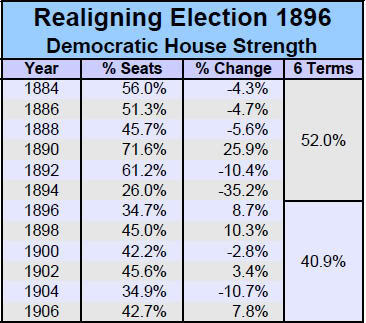
Three weekends ago, I wrote a diary, "Reagan Did NOT Win A Realigning Election In 1980". I wanted to show conclusively that the 1980 election didn't look anything like the commonly-recognized realigning elections, such as 1932 and 1896. In addition to the macro-political event of a political party disintegrating (the Federalists in the 1820s, the Whigs in the 1850s), I identified two metrics to identify a realigning election--one for the House, the other for the Presidency. (The Senate was not directly elected for more than half our history, so it's not suitable to use.) The idea of both was simple: a realignment ought to show a significant before/after shift--and it ought to show up in both metrics. If there is no such shift, then there is no realignment. (Unless, of course, the complete collapse of one party makes use of the metric superfluous and/or problematic.) The comparisons of 1980 to 1896 showed quite clearly what this shift looked like in the House (1896), and what its absence looked like (1980):
Of course, simply presenting these in isolation raises the question of how significant the 11+ point shift in House balance for 1896 really is, historically speaking. And the same can also be said about my presidential metric. This was actually a rather atypical election, since the GOP didn't pick up seats that year--it lost a good number in a counter-swing election after winning two consecutive wave elections. While realigning electios generally involved two consecutive wave elections paired with a decisive party-changing Presidential election, this is the only time that the Presidential election came after both wave elections. And yet, a strong GOP majority remained even after this anomalous House election.
For me, this leads toward shifting focus to the longer patterns of political ebb and flow, a perspective from which the nature of specific biennial and quadrennial elections is more easily understood in comparison to others. Instead of cherry-picking whatever particular fact pops out of us to prove or disprove a favored or disfavored argument, we look to find a consistent guide for analyzing all in a common framework.
is Countdown's Free Clinic partnership events shaping up. I honestly don't know if they can pull this off fast enough to make a difference in the short term, soon enough to win the battle in this go-round. But this is the sort of thing we need to start seeing in terms of changing the whole zeitgeist. The contrast between these mass events of public healing and the jackassery of the tea-partiers should be particularly striking.
It took a couple of years of this sort of thing to build up the momentum for the really big stuff during the New Deal, so I think that if we focus on building strength, and pulling off events like this, our strength will only increase in the years ahead. Maybe not the Conservadem's, but they're really not my concern. And since Obama loves them so much, he's not my concern, either. He will come to us when there's nowhere else to go.
I want to be clear, I'm not giving up on us getting a decent bill this year. But I think that if we take a longer view--and don't buy the Versailles CW that it's got to be now or never--then we'll be much better prepared to hang tough in the short run, and not fold. And that's what's needed to win.
Don't get me wrong--I want health care reform to pass this year. But I want us to be both as clear and strong as we possibly can be. And I want to draw a very clear distinction between the logic of Versailles and the Democratic leadership, and the logic of progressive Democrats out in the wilds of America.
Inside Versailles, there can be no doubt--if the Democrats don't pass health care now, it will be dead for another decade or more--and so will the Democrats. There can be no doubt about this, just as there could be no doubt that Iraq had WMDs, and that Bush's election in 2004 signaled the consolidation of a permanent GOP governing majority.
In other words, it's pure and utter crap. Maybe it will happen. Maybe it won't. Nobody knows for sure. But we do know what follows from assuming that it's true: a wholly uncalled-for degree of Democratic paralysis. In virtually all other walks of life, what's more American than saying, "If at first you don't succeed, try, try again"?
But when it comes to health care reform, we're supposed to stand and salute the proposition, "Take anything you can get--brown rice, seaweed and a dirty hot dog--and call it a victory, no matter what." Could there possigbly be a more cowardly, unimaginative, downright un-American fore-ordained loserattitude than that?
Political Poison: None For Me, Thanks...
Furthermore, if we recognize the obvious--that an individual mandate forcing people to buy private crapolla insurance is pure political poison, then how can we not be willing to see health care "reform" die this year, rather than pass such a suicidal bill into law?
As Digby wrote, regarding individual mandates, and potential Constitutional challenges:
Reform advocates will undoubtedly look back on all this and wonder if the politics of single payer would have actually been easier. In this particular respect, it almost certainly would have been. There's no doubt that the federal government has the power to tax for certain benefits or compel payments to outside parties for certain optional privileges (like driving.) But whether it has the power to compel all citizens to pay money to particular private interests is an unknown. Who knows what the Roberts Court will decide on that?
Of course, if a public option is in place it's a different argument altogether, isn't it?
Sigh! None of this would have happened if only we'd had a constitutional lawyer as President!
I don't think that it needs to come to this. In fact, I think that being willing to let health care reform die may well be the key to ensuring that it doesn't. "Boldness has genius, power, and magic in it." -- So wrote Goethe, and he was absolutely right. The converse of that is, "If you don't stand for something, you'll fall for anything." And that's become the Democrat's de factor operating script ever since 1994.
After 14 years of operating out of fear of failure, isn't it time we started operating out of hope of success?
At the very least, can't we just stop trying to out-stupid the Republicans? Because in that game, even when you win, you lose.
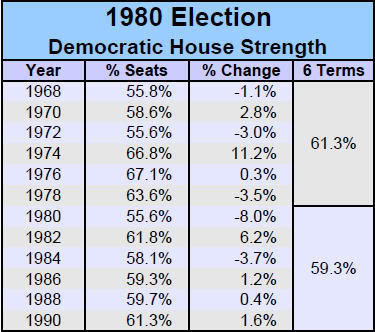
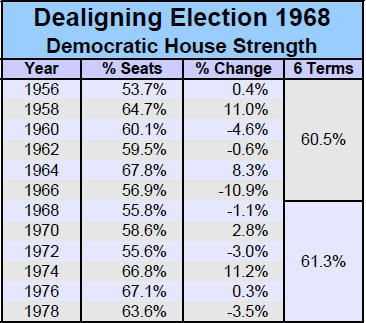
The problem of tossing around the notion of Reagan winning a realigning election popped up again this week in the discussion thread of Chris's Monday diary, "Wall Street Bailout Thwarting Democratic Realignment", and so I decided it was time to take another solid whack at it, something to bookmark, perhaps. Which is why I'm going to give you some picture first, and then explain what they mean.
First, here's Reagan's election in 1980, along with averages of Democratic House share for 6 elections before that, and six elections from 1980 on. You will note that there is very little difference between the averages.
Next, here's the same thing, with Nixon's election in 1968--the de-aligning election that kicked off the Sixth Party System, the only party system in which divided government is the rule, not the exception. You will note that again there is very little difference between the averages:
Finally, here's an example of what a true realigning election looks like--in fact, the weakest example of one using this particular tool. The difference between averages is just over eleven points (for other realigning elections it's roughly 20-25 points):
That's step one in the demonstration to be explained below, showing quite clearly that Reagan did not win a realigning election.
We seem to have reached a watershed moment these past two weeks. We've had long enough to process what happened with the Town Hall thuggery, and how it fits into the larger framework of the Democrats' delusional bipartisan fantasy strategy. The GOP has had sufficient time to start building on it, with their McCarthyite attacks on ACORN, and snookering the spineless Dems into going along with them. (Not to mention threatened followup attacks on SEIU). In response, progressives seem to have finally awakened to the fact that we're on our own, and we need to have our own independent strategy that's not subordinate to Obama, and that directly contradicts the Versailles norms by which only Republicans are allowed to be forceful and moralistic--let alone apeshit, batshit, and zombieshit crazy. In light of this, I want to take a look at two broad topics this weekend-perhaps more if I manage to start feeling better. But the top two concerns hare are getting a handle on realignment and the devolution of conservative/GOP lies. Both tie back in part to frontpage diaries earlier this week, but I've got a bunch of other thoughts about them as well-pre-existing intellectual conditions, if you will.
While Chris wrote a diary on Monday, "Wall Street Bailout Thwarting Democratic Realignment", whose main thrust I agree with --that the Wall Street bailout has been massively counter-productive to the goal of building a solid long-term Democratic majority--I disagree with the underpinings of how he's expressed that argument. First off, not all realignments are as clear cut as 1932-1896 was particularly muddled. Second, even 1932 was not immediately as clear cut as it became over the course of time. Thus, while the precedent of 1932 should have been enough to point the way forward quite clearly (massive gov't spending w/ public sector jobs was key), and that example was foolishly disregarded, that doesn't mean that realignment is kaput.
Inevitable Fact--Uncertain Shape
Quite the contrary. I would argue that realignment is an inevitability that we are living through, even though the shape of what we're realigning to remains very much up for grabs, even though it currently looks very disappointing. I would also argue that because we're living through a time of realignment, different rules apply than during normal periods of political struggle. On the one hand, we're likely to see more upsetting primary challenges ala Donna Edwards and Ned Lamont, and these future challenges have the potential to be even more contagious in terms of spreading to other races. On the other hand, temporary compromises and disappointments that would normally signal the ignominious end of reform efforts may well serve to only encourage another round of effort, which will serve to further energize the forces of a progressive realignment.
Neither of these possibilities-the spread of progressive electoral challenges or the followup of more progressive second-round efforts in areas like financial regulation, stimulus funding, and health care reform-are a given. All that I am saying is that during periods of realignment struggles, they are much more possible than they otherwise would be, and we should not, therefore, simply assume that what will happen in the next few years will inevitably mirror what has happened before.
I've always expressed a certain bewilderment about Barack Obama. The things he does just don't make sense if you look at them at all carefully. Or rather, they do make sense--but only if you make rather bizarre assumptions. For example, assume on the one hand that (A) he actually does understand the basics of American political history, he knows that no major, transformational policy ever came from bipartisanship, he understands that he just won a realigning election, (B) he's spent years working within the Democratic Party, and (C) that he wants to utterly destroy the Democratic Party's chance for political dominance over the next 40 years. If you accept those three premises, then the following makes perfect sense.
It was laid out exquisitely by Dday at Hullabaloo on Friday, "The Costs Of Reductive Thinking". In it, he quoted Barack Obama from the Organizing for America strategy session on health care saying:
"So for about the same cost per year as we've been spending over the last five to six years, we could have funded this health care reform proposal, just to give you a sense of perspective."
And himself responding:
I don't know if I was the only one, but my immediate reaction was, "Um, well, why don't you do something about that?" I mean, sure, the costs of an unnecessary war in Iraq and a war headed toward quagmire in Afghanistan could have paid for the front end of health care reform. But they're both still raging, at a time when we have few national security interests in those regions, and certainly nothing that could not be handled with a diplomatic, law enforcement and intelligence approach rather than a military one.
So if the cost of the wars from 2003-2009 could pay for health care, the future costs from 2009-2019 could go a pretty long way in their own right.
It's particularly pernicious to find the President making this argument, when as commander-in-chief he has the ability to draw down forces in Iraq and Afghanistan. If he wants to make that kind of comparison, he ought to back it up.
Democrats currently enjoy a trifecta controlling the US House, Senate, and White House. Trifectas are more common than one might think.
32 Presidents have had a trifecta, 73% of the total. The 24 periods total 135 years or 61% of US history. Only six trifectas lasted at least 8 years and only three Presidents served at least 8 full years with a trifecta (Jefferson, Madison, FDR). The last trifecta to last 8 years was during the Kennedy and Johnson administrations 40 years ago. Although the average trifecta lasted 5.6 years the median is 2 years. The granddaddy of them all was the 22 year reign from 1801-23 ended not by an opposition party but a plethora of factions (see election of 1824).
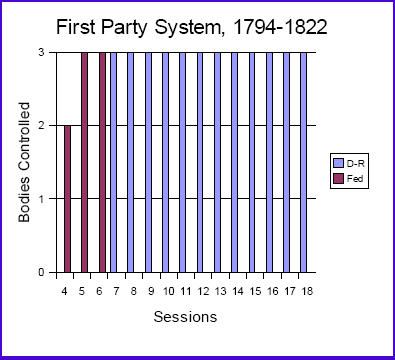
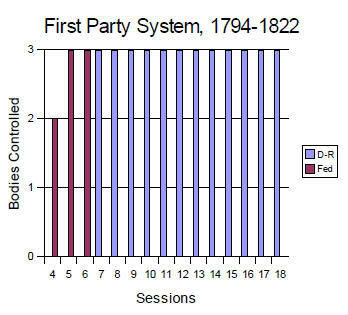
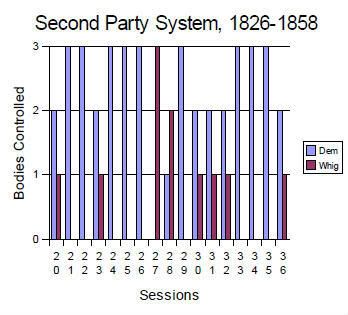
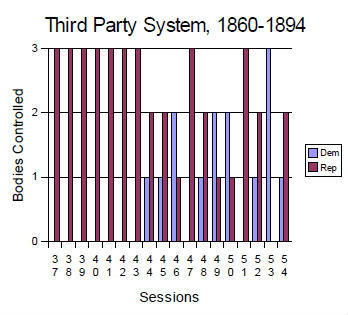
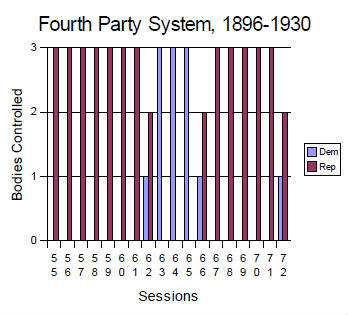
This moved me to take out my table of party systems again, just one week after its last appearance, because I think it has something to teach us that these sort of aggregate statistics can't. Here's the table:
Partisan Balance In US History
Through Six Party Systems
Control of Presidency, House & Senate
Dem-Reps: 12 / Feds: 2 / Split: 1
Dem-Reps: 9 / Whigs: 1 / Split: 7
Dems: 1 / Reps: 9 / Split: 8
Dems 3 / Reps: 12 / Split: 3
Dems: 13 / Reps: 1 / Split: 4
Dems: 3 / Reps 2.25 / Split: 13.75
Summarizing just the figures from above:
First Party System: Dem-Reps: 12 / Feds: 2 / Split: 1 Second Party System: Dem-Reps: 9 / Whigs: 1 / Split: 7 Third Party System: Dems: 1 / Reps: 9 / Split: 8 Fourth Party System: Dems 3 / Reps: 12 / Split: 3 Fifth Party System: Dems: 13 / Reps: 1 / Split: 4 Sixth Party System: Dems: 3 / Reps 2.25 / Split: 13.75
I've written a lot about partisan realignments over the past several years. Above all, I've repeatedly pushed the idea that they happen with surprising regularity, like this:
Partisan Balance In US History
Through Six Party Systems
Control of Presidency, House & Senate
Dem-Reps: 12 / Feds: 2 / Split: 1
Dem-Reps: 9 / Whigs: 1 / Split: 7
Dems: 1 / Reps: 9 / Split: 8
Dems 3 / Reps: 12 / Split: 3
Dems: 13 / Reps: 1 / Split: 4
Dems: 3 / Reps 2.25 / Split: 13.75
While the realignment of 1932 is the most archetypal and among the most consequential, it can be quite misleading to think of it as the model. Indeed, there were two realignments in which one of the parties was totally destroyed, and other was radically transformed. In view of how little "change we can believe in" is actually happening post-2008, and how utterly blob-like the GOP has become, perhaps it's worth considering the possible lessons we might draw from the realignments of 1828 and 1860, both of which revolved around slow-moving scenarios in which both major parties failed in fundamental ways, two of them so profoundly that they ceased to exist.
The week before last (week of June 15), TPMCafe hosted a book club discussion of Eric Bohlert's Bloggers on the Bus: How the Internet Changed Politics and the Press, which was as much a forward-looking discussion of the future of blogging as it was a backwards-looking discussion of the Eric's book and the history it covers. One reason for this was that everyone pretty much agreed-Eric got it where earlier authors did not. So discussions of the past linked more naturally to forward-looking speculation than to criticism of Eric's narrative.
That forward-looking discussion links quite naturally, I think, with my earlier diary, Changing The Dynamic of Congress--"The Choice Is Ours", and where I want to go next-into a deeper look at what it will take to change the dynamic, not just of Congress, but of American politics more generally. An added factor is the perspective I articulated in my series "Three Waves and A Wall: 2008 And The American Future, dealing with the confluence of macro-historical forces in our time, which I'll briefly recapitulate below.
But before doing that, I just want to note that Eric's first post, "The Rise of the Liberal Blogosphere", kicks off by mentioning Chris as the very first blogger he talks about:
In the introduction of my book, Bloggers on the Bus: How the Internet Changed Politics and the Press, I highlighted a YouTube clip from 2006, right after the mid-term elections, when blogger Chris Bowers is talking into the camera (I think) of Matt Stoller and Bowers answers the question: What does it take to be a liberal blogger? He starts listing all the requirements: "If you have no children, no one to support, and no career ambitions, then you too can become a full-time progressive blogger, as long as you're wiling to do nothing else in your entire life."
There's more about Chris in that diary, so if nothing else, you should read it for that. But there's actually a lot more, with folks like Amanda Marcotte, Armando Llorens, Greg Mitchell and Duncan Black weighing in. I want to cite a few of the things they said, before adding my two cents about how the blogosphere--along with the rest of the online new media--may be able to help do even more than any of the contributors to that discussion have imagined. This is not, I hope, because of an over-inflated sense of the blogosphere's importance, but rather, because of a larger sense of its place within a broader inter-active, flat-hierarchy media environment and how that plays into some much, much bigger historical forces at work....
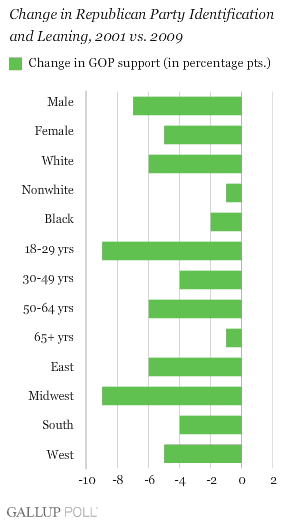
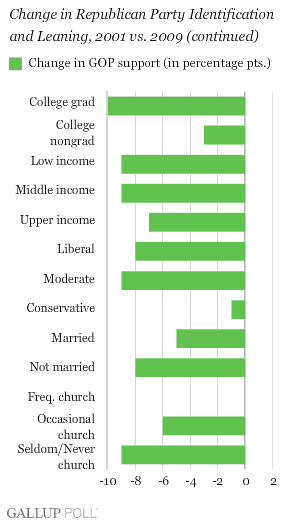
Frequent church-goers were the only demographic subgroup to show no decline in GOP allegiance from 2001 to 2009, according to a new survey brief from Gallup. Declines among conservatives and those 65 and older were also minimal--the only bright spots reported for the GOP....
Democrats gained most from further consolidating support in their strongest demographic groups, rather than winning over Republican core groups, a shift that goes contrary to President Obama's repeated overtures to the GOP base....
The chart below (which adds a fourth column to the one released by Gallup) shows a loss of at least one in five GOP supporters among eight of the nine groups where the GOP lost eight or more percent support among the population at large. For example, the nine percent loss among moderates in general, from 37% to 28%, translated into a loss of 24% of GOP moderates--just shy of one in five. Combined with a 47% loss of GOP liberals and a 0% loss of GOP conservatives, this is yet another indication that the GOP is becoming more extreme as it shrinks
The logic here seemed incredibly obvious and straight-forward to me: If GOP losses were minimal among their core conservative demographics, and heavy elsewhere, then the party as a whole was becoming more extreme, and hence more unreachable via bi-partisan gestures, directly contrary to the basic logic behind Obama's repeated stress of a commitment to bi-partisan "pragmatism": if the pragmatists are fleeing the GOP in droves, then who's there left to be bi-partisanly pragmatic with?
The utter lack of any serious policy proposals from the GOP since Obama came to office would only seem to underscore the obviousness of the point I was making. But instead, I got a range of counter-arguments, plus several folks who claimed to not understand what I was saying. Obviously, it wasn't as obvious as I thought it was. Hence, this diary.
Frequent church-goers were the only demographic subgroup to show no decline in GOP allegiance from 2001 to 2009, according to a new survey brief from Gallup. Declines among conservatives and those 65 and older were also minimal--the only bright spots reported for the GOP:
Democrats gained most from further consolidating support in their strongest demographic groups, rather than winning over Republican core groups, a shift that goes contrary to President Obama's repeated overtures to the GOP base:
Aside from education, for which the parties were basically at even strength in 2001, the Republicans' losses tend to be greater among groups that were not strong GOP supporters to begin with. These include self-identified liberals and moderates, church non-attenders, and lower-income and young adults. Thus, a big factor in the GOP's overall decline is the Democratic Party's consolidating its support among normally Democratically leaning groups.