Global Neo-Hooverism
....After thinking about it for a bit, I'm not sure the same phenomenon we see here isn't happening internationally. It's an article of faith among financial elites across the planet that the welfare state is an abomination and this is a global opportunity to end it. Each culture will deal with it slightly differently --- riots in Greece, marches in France, blog posts in America. But in the end, the result, short of revolution, will be similar everywhere --- the post-war welfare state will be weakened or destroyed. The left is barely relevant anywhere anymore and they simply do not fear any kind of serious populist uprising. I'm not suggesting conspiracy. I think it's more of a natural result of ideological capture....
But aside from the inadequate stimulus, everything they have said up to now is in service of the hoary old Hooverite ideas about belt tightening and sacrifice even down to giddily announcing they are going to reform social security the "right way." The re-institution of Paygo, the deficit commission, the constant lip service to austerity has led to a validation of the erroneous idea that deficits are causing our economic problems and that government needs to hold back spending to fix them --- when the opposite is true.
I think it's easy to over think this. The world economy is unstable for myriad reasons. But the reasons for insisting on austerity are fairly obvious. The question is whether or not people will see through this or not. Disaster capitalism depends upon the people being confused and stressed for its success. (In that sense, rioting in the streets may actually help them.) And all over the world right now, with the rapid change from globalization and resistance to modernity in general, there is a tremendous amount of social stress and cultural upheaval on top of this economic downturn. It's the perfect time to strike.
There's a whole lot behind all this. But the continued pushing of outright lies on multiple levels plays no small part. Expanding on what Digby had to say, so long as the Soviet Union--however badly compromised--managed to keep the threat of a radical alternative alive, there was tremendous ideological pressure on Western elites to keep themselves in line.
It's not that they were only pretending to be concerned about anyone other than themselves. Some were, some weren't. But as a rule, they all were living in an environment that supported the logic of caring for the public good. But that environment has long since vanished from the globe. There are, of course, other factors that would contribute to such an environment, but none, apparently, with the sort of salience that the Soviet Union represented, for all the hollowness of what it actually was. Remove that outside constraint, and what we see as a result is the virulent spread of disaster capitalism, which feeds as much on lies as it does on chaos, confusion and fear.
A major focus of those lies is the proven capacity of the mixed economy to outperform the "free market". When the stimulus was first being debated, we had the Big Lie claim that the New Deal and massive government spending did nothing to end the Great Depression--indeed, the Big Lie claimed that the New Deal only made things worse, a claim wildly at odds with the dramatic GDP gains that followed FDR's inauguration almost immediately.
More recently, the lies have broadened to attack any possible alternative scenario to neoliberalism and Reaganomics. On May 24, Krugman blogged:
Did The Postwar System Fail?
I've been posting about the contrast between the popular perception on the right that America had slow growth until Reagan came along, and the reality that we did fine pre-Reagan, in fact better; see here, here, and here. And what I'm getting as a common response - including from liberals - is something along the lines of, "That's all very well, but by 1980 the postwar system was clearly failing, so what would you have done instead of Reaganomics?"
Which all goes to show just how thoroughly almost everyone has been indoctrinated by the current orthodoxy.
How do we know that the postwar system was failing? Yes, there were some bad years - largely due to oil shocks - and there was stagflation. But stagflation was not, as far as I know - and as far as standard textbook economics says - the result of high taxes and/or excessive regulation; it was a problem of monetary policy. It's a testimony to the strength of supply-side propaganda that so many people think they know differently.
And how bad were those bad years, anyway? Well, let's look at real median family income over two 8-year stretches, 1973 to 1981 and 2000 to 2008, in each case with income in the first year set to 100:
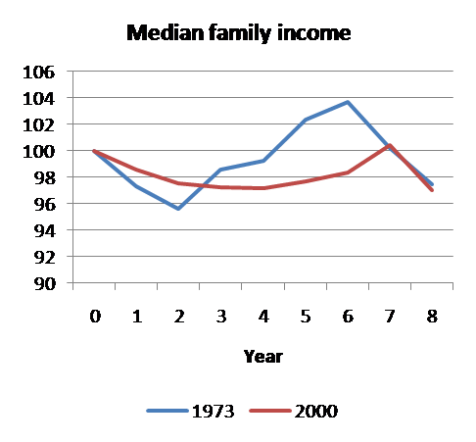
Funny, isn't it? The Ford-Carter years look no worse - in fact, somewhat better - than the Bush years, especially if you look from business cycle peak to business cycle peak. And that was in the face of two very severe oil shocks. So a question for all the people who say that the economic troubles under Jimmy Carter discredited postwar economic policies: why don't the troubles under Bush similarly discredit post-Reagan policies? Funny how that works.
Here's what I think: inflation did have to be brought down - and Paul Volcker, not Reagan, did what was necessary. But the rest - slashing taxes on the rich, breaking the unions, letting inflation erode the minimum wage - wasn't necessary at all. We could have gone on with a more progressive tax system, a stronger labor movement, and so on.
A very good point there in that last paragraph. But let's back up a bit to look at that chart. And let's consider some other figures as well.
Let's consider non-farm employment data. From 1970 to 1979, it increased by 26.9%.
From 2000 to 2009, it decreased by 0.7%. Think that's unfair because of the Great Recession? Well, isn't the Great Recession sort of the whole point? But fine, just for the sake of argument, let's take that away. Let's look at 1999-2008. Non-farm employment increased just 6%.
And looking at just manufacturing jobs, things look much, much worse: an 8.8% growth from 1970 to 1979 compared to a 31.2% loss from 2000 to 2009 and "only" a 22.6% loss from 1999 to 2008.
Comparing these two decades to one another, there's simply no comparison. The 1970s were troubled, particularly in comparison to the spectacular growth of the period 1933-1970 that preceeded them. But they were still a period of considerable, if somewhat erratic growth. Adding more than a quarter to the size of your non-farm employment figures is nothing to sneeze at. The last decade, though? It has been a period when growth has virtually disappeared--even before the recession hit.
That's not the end of it though. Consider the poor elites. Here's a comparison of the average growth rates in income for the top 10% of income earners (p90), and more exclusive subsets of, up to an indluding the top 0.01% percent (p99.99), for the seven years following 1973 and the seven years following 2000:
            P90    P95   P99  P99.5  P99.9  P99.99
1974-1980  0.97   0.97  0.93  0.94   0.96    0.98
2001-2007  0.97   0.96  0.94  0.94   0.89    0.82
As you can see, the 1970s were not a particularly good time for those at the top of the economy, but the 2000s were no better--and they were considerably worse for those at the very top.
All this goes to show that there's really no objective reason to see the 1970s as proof that what came before had failed while seeing the the 2000s as a confirmation of what came before. If anything, the figures prove the exact opposite: The 1970s showed the need for adjustments. The 2000s showed a need for serious change... even before the Great Recession struck. |


