Fair warning-Part 2

by: Paul Rosenberg

Sun Jun 06, 2010 at 18:30


Item: Brad DeLong wrote:

Does Washington care about unemployment?
In 1983, Ronald Reagan's Washington regarded high unemployment as a national emergency. Today, with unemployment kissing 10 percent, Barack Obama's Washington scarcely seems perturbed. Why?

....Today, the unemployment rate is kissing 10 percent. Global financial markets are sending us a message that the excess demand for high-quality financial assets is growing again.
Yet, unlike 1983, there is no sense of urgency in Washington.

And it's not just here in America.

Item: Krugman:

The Pain Caucus

.... When the financial crisis first struck, most of the world's policy makers responded appropriately, cutting interest rates and allowing deficits to rise. And by doing the right thing, by applying the lessons learned from the 1930s, they managed to limit the damage: It was terrible, but it wasn't a second Great Depression.

Now, however, demands that governments switch from supporting their economies to punishing them have been proliferating in op-eds, speeches and reports from international organizations. Indeed, the idea that what depressed economies really need is even more suffering seems to be the new conventional wisdom, which John Kenneth Galbraith famously defined as "the ideas which are esteemed at any time for their acceptability."

The extent to which inflicting economic pain has become the accepted thing was driven home to me by the latest report on the economic outlook from the Organization for Economic Cooperation and Development, an influential Paris-based think tank supported by the governments of the world's advanced economies. The O.E.C.D. is a deeply cautious organization; what it says at any given time virtually defines that moment's conventional wisdom. And what the O.E.C.D. is saying right now is that policy makers should stop promoting economic recovery and instead begin raising interest rates and slashing spending.

Item: The Financial Times writes:

G20 drops support for fiscal stimulus
By Chris Giles and Christian Oliver in Busan
Published: June 5 2010 11:54 | Last updated: June 6 2010 17:25

Finance ministers of the world's leading economies have been so spooked by the sovereign debt crisis that they have decided they can no longer wait until economies are growing strongly before they remove fiscal stimulus.

The meeting of the Group of 20 finance ministers and central bank governors in Busan, South Korea, at the weekend also dropped proposals for a global banking levy, giving countries leeway to do what they thought best for their domestic circumstances.

The communiqué of the meeting made clear the G20 no longer thought expansionary fiscal policy was sustainable or effective in fostering recovery because investors were no longer confident about some countries' public finances.

Item: Spinning off from the a discussion of the later, Digby writes:

Paul Rosenberg :: Fair warning-Part 2
Global Neo-Hooverism

....After thinking about it for a bit, I'm not sure the same phenomenon we see here isn't happening internationally. It's an article of faith among financial elites across the planet that the welfare state is an abomination and this is a global opportunity to end it. Each culture will deal with it slightly differently --- riots in Greece, marches in France, blog posts in America. But in the end, the result, short of revolution, will be similar everywhere --- the post-war welfare state will be weakened or destroyed. The left is barely relevant anywhere anymore and they simply do not fear any kind of serious populist uprising. I'm not suggesting conspiracy. I think it's more of a natural result of ideological capture....

But aside from the inadequate stimulus, everything they have said up to now is in service of the hoary old Hooverite ideas about belt tightening and sacrifice even down to giddily announcing they are going to reform social security the "right way." The re-institution of Paygo, the deficit commission, the constant lip service to austerity has led to a validation of the erroneous idea that deficits are causing our economic problems and that government needs to hold back spending to fix them --- when the opposite is true.

I think it's easy to over think this. The world economy is unstable for myriad reasons. But the reasons for insisting on austerity are fairly obvious. The question is whether or not people will see through this or not. Disaster capitalism depends upon the people being confused and stressed for its success. (In that sense, rioting in the streets may actually help them.) And all over the world right now, with the rapid change from globalization and resistance to modernity in general, there is a tremendous amount of social stress and cultural upheaval on top of this economic downturn. It's the perfect time to strike.

There's a whole lot behind all this. But the continued pushing of outright lies on multiple levels plays no small part.  Expanding on what Digby had to say, so long as the Soviet Union--however badly compromised--managed to keep the threat of a radical alternative alive, there was tremendous ideological pressure on Western elites to keep themselves in line.

It's not that they were only pretending to be concerned about anyone other than themselves.  Some were, some weren't. But as a rule, they all were living in an environment that supported the logic of caring for the public good. But that environment has long since vanished from the globe.  There are, of course, other factors that would contribute to such an environment, but none, apparently, with the sort of salience that the Soviet Union represented, for all the hollowness of what it actually was.  Remove that outside constraint, and what we see as a result is the virulent spread of disaster capitalism, which feeds as much on lies as it does on chaos, confusion and fear.

A major focus of those lies is the proven capacity of the mixed economy to outperform the "free market".  When the stimulus was first being debated, we had the Big Lie claim that the New Deal and massive government spending did nothing to end the Great Depression--indeed, the Big Lie claimed that the New Deal only made things worse, a claim wildly at odds with the dramatic GDP gains that followed FDR's inauguration almost immediately.

More recently, the lies have broadened to attack any possible alternative scenario to neoliberalism and Reaganomics.  On May 24, Krugman blogged:

Did The Postwar System Fail?

I've been posting about the contrast between the popular perception on the right that America had slow growth until Reagan came along, and the reality that we did fine pre-Reagan, in fact better; see here, here, and here. And what I'm getting as a common response - including from liberals - is something along the lines of, "That's all very well, but by 1980 the postwar system was clearly failing, so what would you have done instead of Reaganomics?"

Which all goes to show just how thoroughly almost everyone has been indoctrinated by the current orthodoxy.

How do we know that the postwar system was failing? Yes, there were some bad years - largely due to oil shocks - and there was stagflation. But stagflation was not, as far as I know - and as far as standard textbook economics says - the result of high taxes and/or excessive regulation; it was a problem of monetary policy. It's a testimony to the strength of supply-side propaganda that so many people think they know differently.

And how bad were those bad years, anyway? Well, let's look at real median family income over two 8-year stretches, 1973 to 1981 and 2000 to 2008, in each case with income in the first year set to 100:
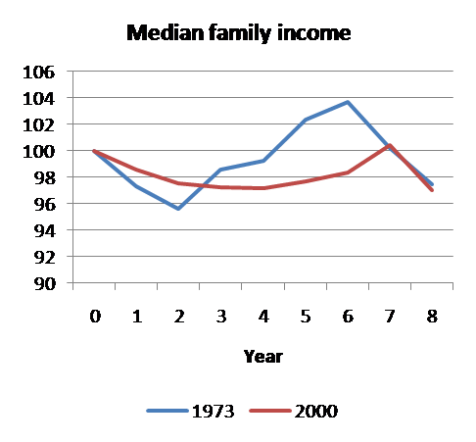
Funny, isn't it? The Ford-Carter years look no worse - in fact, somewhat better - than the Bush years, especially if you look from business cycle peak to business cycle peak. And that was in the face of two very severe oil shocks. So a question for all the people who say that the economic troubles under Jimmy Carter discredited postwar economic policies: why don't the troubles under Bush similarly discredit post-Reagan policies? Funny how that works.

Here's what I think: inflation did have to be brought down - and Paul Volcker, not Reagan, did what was necessary. But the rest - slashing taxes on the rich, breaking the unions, letting inflation erode the minimum wage - wasn't necessary at all. We could have gone on with a more progressive tax system, a stronger labor movement, and so on.

A very good point there in that last paragraph.  But let's back up a bit to look at that chart.  And let's consider some other figures as well.

Let's consider non-farm employment data.  From 1970 to 1979, it increased by 26.9%.

From 2000 to 2009, it decreased by 0.7%.  Think that's unfair because of the Great Recession?  Well, isn't the Great Recession sort of the whole point?  But fine, just for the sake of argument, let's take that away.  Let's look at 1999-2008.  Non-farm employment increased just 6%.

And looking at just manufacturing jobs, things look much, much worse: an 8.8% growth from 1970 to 1979 compared to a 31.2% loss from 2000 to 2009 and "only" a 22.6% loss from 1999 to 2008.

Comparing these two decades to one another, there's simply no comparison. The 1970s were troubled, particularly in comparison to the spectacular growth of the period 1933-1970 that preceeded them.  But they were still a period of considerable, if somewhat erratic growth.  Adding more than a quarter to the size of your non-farm employment figures is nothing to sneeze at.  The last decade, though?  It has been a period when growth has virtually disappeared--even before the recession hit.

That's not the end of it though.  Consider the poor elites.  Here's a comparison of the average growth rates in income for the top 10% of income earners (p90), and more exclusive subsets of, up to an indluding the top 0.01% percent (p99.99), for the seven years following 1973 and the seven years following 2000:

                P90    P95   P99  P99.5  P99.9  P99.99
    1974-1980  0.97   0.97  0.93  0.94   0.96    0.98
    2001-2007  0.97   0.96  0.94  0.94   0.89    0.82

As you can see, the 1970s were not a particularly good time for those at the top of the economy, but the 2000s were no better--and they were considerably worse for those at the very top.

All this goes to show that there's really no objective reason to see the 1970s as proof that what came before had failed while seeing the the 2000s as a confirmation of what came before.  If anything, the figures prove the exact opposite:  The 1970s showed the need for adjustments.  The 2000s showed a need for serious change... even before the Great Recession struck.


Tags: , , , , , , , , (All Tags)
Print Friendly View Send As Email
very good post (4.00 / 4)
I've come to the conclusion that the technocrats in power in the Democratic Party and nationally don't care.  In this context, it serves me no good to bother talking to them, about them, or their initiatives - because they don't care.  

I hope Krugman gets more clout- not because I agree with him, but because it makes sense in my mind for the U.S. elite to pay attention to their most articulate and clear spokespeople rather than ignoring them in order to produce another Depression.

As a result, I would like to check out, hopefully to do more radical organizing.  But even if not, it seems like doing nothing would be a step up from doing anything to lend any support to the initiatives and the discourse of American politics today - that I can experience from abroad, anyhow.


The elites of 1883 didn't give a rats ass about the poor (4.00 / 3)
what happened to change that atmosphere so that it shackled even hard right-wingers like Nixon and Reagan?

As you pointed out, it was the threat of uprising from below, and from the diplomatic competition with the Soviets for the souls of the third world.

Why is it gone now?

People have it very well. They lost the appetite for change and let their guard down, forgetting just how mendacious and conspiratorial the elites actually are. Additionally in America, the labor movement was shattered along racial lines.

One might argue that we need more of a threat from below, a stronger immune system against conspiracy, and we need to unite people of various tribes into a coherent social movement in order to "spread the wealth". I agree.

Yet, only a fool or a liar would suggest that what the world needs now is more total economic growth. Growth in technology, certainly, but growth in general is actually killing the planet.

Notice how the various indexes of environmental destruction decelerated during the recent downturn, only to resume their inexorable climb with the "stimulus".

People have to be made to live with less.

As always, the counter argument to the New Deal is Weimar. Rather than forestalling the clack-clack-clack of the jackboots, an "in the long run we're all dead" economic philosophy forgets that in the long run, we aren't all dead. Society marches on and the sins of today will be purged by the penance of tomorrow.

Folks as detached from normal people (especially the young) as Krugman is just cannot comprehend just how hungry people are for real change.


People have to be made to live with less.... (4.00 / 6)
An interesting formulation. Made by whom? As things are going, it's unlikely that our own informed consent will be part of the new bill of goods.

What we need is a little vision:

a) If we had convenient mass transit, comfortable pubs, theaters, music halls, decent schools and well-stocked libraries in the communities where we live, along with a stores and restaurants which sold real food,

b) If the streets were safe, and we couldn't get mugged in the parks, or suffocated by exhaust fumes on our sidewalks, or thrown into jail on a whim of our local uniformed thugs,

c) If we had decent working conditions, job security and healthcare,

d) If we could trust our local news, and our local politicians,

I doubt I'd mind giving up my SUV, my ranch house in the suburbs, my freezer full of steak, my wide-screen TV, my gun collection, my stock market investments, and even my iPad.

If all that came to pass, how much less would I be living with? How unsustainable would our civilization be then?


[ Parent ]
Less is a terrible mantra (4.00 / 1)
better is, well, better.

That said, Paul is right that the cult of growth is insane - it is, as they say, the ideology of cancer.

Politics is the art of the possible, but that means you have to think about changing what is possible, not that you have to accept it in perpetuity.


[ Parent ]
you beat me to the punch (4.00 / 2)
Also am comenting on "People have to be made to live with less."

This has been ongoing since the "Reagan revolution" for the vast majority. Those doing the "makeing" have (at the same time) further advanced their holdings and income percentage to the highest disparency ever in the U.S.

To really regain any part of our former lifestyle the people who must be made to live with less are the republican/conservative elite...the "have mores" of Bush supporters.

Their wealth and near domination of media has made this impossible previously. But as the suffering of the masses increases, more and more will see the need for change. Politically, if possible, but change regardless.

Isn't this the line of thinking (by the British) what led to creation of the United States in the first place?


Government by organized money is just as dangerous as government by organized mob..... FDR


[ Parent ]
The biggest threat to any kind of Keynsian economics (4.00 / 2)
is a capital stike.  In order to fund stimulus, you have to borrow at reasonable rates.  That in turn depends on maintaining you credit rating.

Krugman has argued for over a year that the cost of the stimulus was near or even less than zero.  US rates have headed even lower recently, but the core of his argument - which I have believed - is now threatened.  US rates have headed lower because of fears that the Euro is about to blow apart.  Make no mistake, though, this is a temporary phenomenon, and the odds of a sovereign debt crisis for the United States are no longer zero.

The ECB seems determined to make this crisis spread.  The head of the ECB said that the crisis would have a positive effect in that it would make the southern economies more productive.  This would be fine if every other economy in the World wasn't seeing enormous productivity growth as well.   Like mice on a wheel workers everywhere are being told to make the wheel go faster to get the ever scarcer piece of cheese.  

The Germans, of course, with 7% unemployment and a deficit to gdp ratio of 3% love the crisis since it makes their exports cheaper.  Who the Germans think is actually going to buy their exports if the global crisis continues is anyone's guess, but they will drag everyone around them down following an incredibly deflationary policy.

The sovereign debt crisis is real.  It is in essence the start of a capital strike that effectively has severely limited the ability of countries to pursue stimulus.   I have long thought that the real purpose of the deficit commission was to prevent one from happening here.   FDR made similar noises all through '35 and '36 with a similar objective.  Obama's hope, I  think, was that a recovery would cut the deficit to around 3% of GDP, and hence change the entire discussion of the subject.  

But the sovereign debt crisis may be enough to kill the Keynesian "animal spirits" from becoming robust enough to sustain any recovery at all.

If the capital strike spreads to the US, our policy options will become narrower quickly.   Someone inclined toward conspiracy theories (I am not so inclined) might see the sovereign debt crisis as an intentional capital strike aimed at the heart of the modern welfare state.   Whatever its cause, if we don't get significantly better economic policy from the rest of the World (for all its limitations, the US has acted for more sensible since this crisis has begun than most) and Europe in particular,  the capital strike's ability to permanently effect the balance between of power between capital and labor will grow exponentially.


Dumb money (4.00 / 4)
What you're presenting here is a recipe for the early 1930s.  The rest of the cookbook includes the late 1930s and the 1940s. What I would say to anyone threatening to withhold capital is to consider what their capital will be worth if their chef serves them up one of those dishes. Of course, we aren't dealing with single rational actors here, we're dealing with a stampede.

Economics since 1950 has considered itself the queen of disciplines, and politics its humble vassal. The real revolution will come when -- not if, when -- that relationship is once again reversed. Nobody with a lick of sense should look forward to that day with gleeful anticipation.


[ Parent ]
Socialism Is What Makes Capitalism Possible (4.00 / 2)
It's the same old song.

It begins with "primitive capital accumulation"--a polite term for stealing common resources, be it land, labor or capital.

This is facilitated, of course, by government (socialism).

And thereafter, whenever capitalism hits any one of its periodic crises, it needs to be bailed by government (socialism).

And now?

Poor dumb capitalists!  They've fallen for their own propaganda, and now they may well end up destroying most of their wealth once again.

Same as it ever was.

"You know what they say -- those of us who fail history... doomed to repeat it in summer school." -- Buffy The Vampire Slayer, Season 6, Episode 3


[ Parent ]
re: g20 (4.00 / 2)

G20 drops support for fiscal stimulus

By Chris Giles and Christian Oliver in Busan

Published: June 5 2010 11:54 | Last updated: June 6 2010 17:25

Finance ministers of the world's leading economies have been so spooked by the sovereign debt crisis that they have decided they can no longer wait until economies are growing strongly before they remove fiscal stimulus.

The meeting of the Group of 20 finance ministers and central bank governors in Busan, South Korea, at the weekend also dropped proposals for a global banking levy, giving countries leeway to do what they thought best for their domestic circumstances.

The communiqué of the meeting made clear the G20 no longer thought expansionary fiscal policy was sustainable or effective in fostering recovery because investors were no longer confident about some countries' public finances.

that belongs to 'idiot wind.'


USER MENU


blog advertising is good for you

Donate to Open Left

QUICK HITS
SEARCH


Advanced Search

STATE BLOGS