Narrating The Conservative Destruction of America--and getting Paul Krugman on board

by: Paul Rosenberg

Mon Jul 12, 2010 at 16:00


In Quick Hits, counterspin calls attention to a several weeks old Alternet piece by Open Left's Dave Johnson, who wrote the original as a Fellow at Campaign for America's Future, "6 Shocking Ways Conservatives Helped Cause the Economic Destruction of America".  It's actually more than that.  It's more like "6 Charts Showing  6 Shocking Ways Conservatives Helped Cause the Economic Destruction of America Starting with the Election of Ronald Reagan", and it reminded me of another item I noted recently, but didn't do a diary about, Paul Krugman's late May blog post, "Did The Postwar System Fail?"  What struck me about these items in tandem is the contrast between the density of Krugman's argument vs. the conversation-stopping clarity of Dave Johnson's sequence of charts.

Johnson's piece starts off bluntly, followed by a series of charts telling a simple, but powerful story (the first three are included):

It seems that you can look at a chart of almost anything and  right around 1981 or soon after you'll see the chart make a sharp change  in direction, and probably not in a good way.  And I really do mean  almost anything, from economics to trade to infrastructure to  ... well almost anything.  I spent some time looking for charts  of things, and here are just a few examples.  In each of the  charts below look for the year 1981, when Reagan took office.

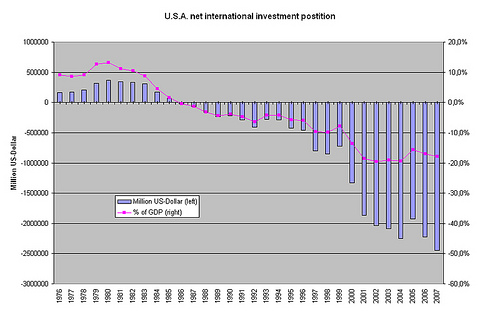
Conservative policies transformed the  United States from the largest creditor nation to the largest debtor  nation in just a few years, and it has only gotten worse since then:

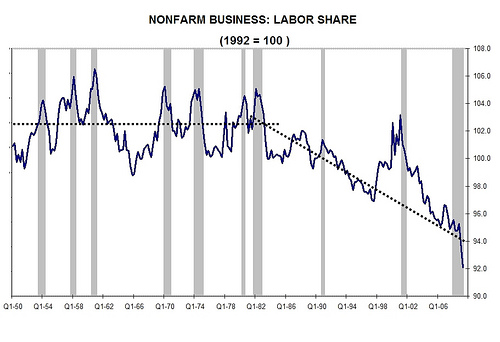
Working people's share of the benefits from increased productivity took a sudden turn down:

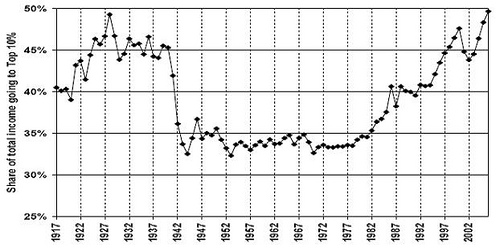
This resulted in intense concentration of wealth at the top:

The rest of the charts illustrate further links in the chain:

  • And forced working people to spend down savings to get by:
  • Which forced working people to go into debt: (total household debt as percentage of GDP)
  • None of which has helped economic growth much: (12-quarter rolling average nominal GDP growth.)

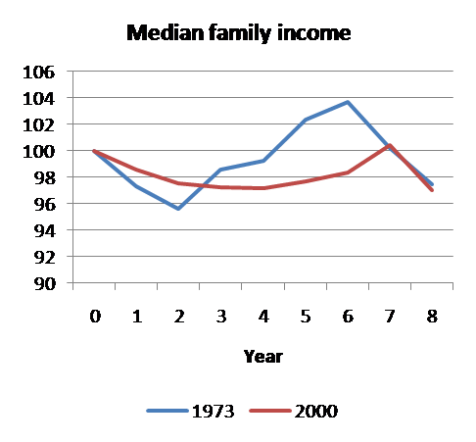
In contrast, Krugman gives us one much more ambiguous chart, comparing the 1970s and 2000s:

Paul Rosenberg :: Narrating The Conservative Destruction of America--and getting Paul Krugman on board

Beneath the chart, Krugman writes:

Funny, isn't it? The Ford-Carter years look no worse - in fact, somewhat better - than the Bush years, especially if you look from business cycle peak to business cycle peak. And that was in the face of two very severe oil shocks. So a question for all the people who say that the economic troubles under Jimmy Carter discredited postwar economic policies: why don't the troubles under Bush similarly discredit post-Reagan policies? Funny how that works.

Krugman's argument is similarly nuanced.  On the one hand, he says, 'yes, there was a problem in the 1970s', but on the other hand, he says that the measures taken went far beyond what was necessary:

Here's what I think: inflation did have to be brought down - and Paul Volcker, not Reagan, did what was necessary. But the rest - slashing taxes on the rich, breaking the unions, letting inflation erode the minimum wage - wasn't necessary at all. We could have gone on with a more progressive tax system, a stronger labor movement, and so on.

My point here is not that Johnson is right and Krugman is wrong.  Both are right, in their own ways.  But the problem that even Krugman has recognized (albeit not in those terms) is one of hegemonic warfare.  And only Johnson is responding in a manner that reflects that, working to construct a counter-hegemonic narrative.

Krugman's blog post is only one of many in his ongoing struggle to discredit a number of conservative economic narratives.  This is one that grew out of trying to debunk the myth of Reagan as some kind of economic savior, as Krugman explains at the beginning of this post:

I've been posting about the contrast between the popular perception on the right that America had slow growth until Reagan came along, and the reality that we did fine pre-Reagan, in fact better; see here, here, and here. And what I'm getting as a common response - including from liberals - is something along the lines of, "That's all very well, but by 1980 the postwar system was clearly failing, so what would you have done instead of Reaganomics?"

Which all goes to show just how thoroughly almost everyone has been indoctrinated by the current orthodoxy.

So, it seems clear to me that Krugman recognizes the need for the sort of argument that Johnson is making, but he's still too much wedded to his own training as an academic economist to fully embrace the sort of argumentation that's needed to get the job done.  He's also probably constrained by his own habits of thought that revolve around the New Keynesian modeling tradition.

Yet, Krugman has already displayed a remarkable ability to grow beyond his old boundaries in public, in real-time.  So why not suggest that he can and should do more?  There is a moral imperative here, and moral imperatives are what have driven him before--not just the imperative toward honesty, but also toward public service, the root reasons that economics was born as a branch of moral philosophy in the first place.


Tags: , , , , (All Tags)
Print Friendly View Send As Email
Thanks for featuring this (4.00 / 9)
The charts reveal in raw form that the entire essence of conservatism can basically be boiled down to the elites oppressing organized labor and wage negotiation.  Since the non-elites represent 99% of society, this war on labor by Reagan / Bush I / Bush II has resulted in the destruction of our economy.

This is a good point (4.00 / 2)
It's one I used to occasionally make on the late, lamented MaxSpeak blog.  (Max Sawicky is a progressive economist in real life but no longer a blogger, alas.)  It seems that economists, no matter how progressive or bold, have a hard time saying something that one of their conservative colleagues can critique as biased.  Meanwhile, the rightwing has no such scruples.  

I guess this is part of what hegemonic discourse means.

Meanwhile, Paul, can you get your mind around this?

The second highest ranking Republican in the Senate doubled down on a controversial statement he made this weekend, arguing in greater detail that tax cuts for wealthy people should never be offset by tax increases in other areas -- but that unemployment benefits need to be fully paid for by either spending cuts or tax increases. In so doing, he claimed candidly that the very existence of unemployment insurance is a "necessary evil," while tax cuts ought not be paid for by increases in order to make it easier to shrink the size of government.

If we can't counter stuff like this, maybe we ARE doomed.

sTiVo's rule: Just because YOU "wouldn't put it past 'em" doesn't prove that THEY did it.


If You Live In A Fantasy World, Like Kyl Does (4.00 / 1)
You can say just about anything.  And then if someone else says, "You're wrong", you can just accuse them of being mean.  Or even downright evil.

This works very well when you're four to seven years old.

Compared to this, your average Randian--arrested development at age 13--seems positively adult.

"You know what they say -- those of us who fail history... doomed to repeat it in summer school." -- Buffy The Vampire Slayer, Season 6, Episode 3


[ Parent ]
The trouble with Kyl's fantasy world (0.00 / 0)
is that the media agrees with him and will not countenance publication or broadcast of anything that indicates he is wrong.

What's really weird is that the major media is more than happy to publish or broadcast conservative propaganda. Why else would the Peterson Group get so much airtime and print-space? They also happily give us the libertarian idiocies from Rand Paul and the tea-baggers.

How does a democracy survive when the media that is supposed to cover government limits itself to socially destructive messages and carefully prevents any discussion of either the alternatives or the quality of the crap they are publishing?

That seems to me to be a recipe for the intelligent people to eliminate both democracy and the media that covers government. The price of not taking that action is way too high.  


[ Parent ]
I Explained This Recently (4.00 / 1)
It's the result of chosing "balance" over truth.  Conservatives understand the game, since they had such a hand in inventing it.

The incentives are all in favor of making more and more extreme claims, thus moving the center ever farther in your direction.  Only chumps try to find middle ground, or even just stick with facts.

"You know what they say -- those of us who fail history... doomed to repeat it in summer school." -- Buffy The Vampire Slayer, Season 6, Episode 3


[ Parent ]
Sinking Ships (4.00 / 2)
It's rather like being on a sinking ship, knowing exactly the reason the ship is doomed and how to fix it (or at least get everyone off safely) yet the Captain and crew insist everyone go below and lock themselves in steerage.

Call me a chump for insisting on facts. Indeed, the six charts you've posted here, and the QH posted by counterspin, should be tacked up in every newsroom in this country. It's irrefutable evidence that government policy for decades has led us to this economic disaster and that more of the same is suicidal. But that won't happen.

My hunch is that unless and until the wealthiest see their economic situations go south, where they lose massive sums of money from a Depression, they will continue to push us into disaster.


[ Parent ]
Would be good if you would get Krugman on board. (0.00 / 0)
I would love to see him concentrate on US issues again, instead of him spreading nonsense about the Eurozone!


USER MENU


blog advertising is good for you

Donate to Open Left

National House Ballot All Polls


Without Rasmussen


Senate Forecast All Polls

Without Rasmussen

QUICK HITS
SEARCH


Advanced Search