In Quick Hits, counterspin calls attention to a several weeks old Alternet piece by Open Left's Dave Johnson, who wrote the original as a Fellow at Campaign for America's Future, "6 Shocking Ways Conservatives Helped Cause the Economic Destruction of America". It's actually more than that. It's more like "6 Charts Showing 6 Shocking Ways Conservatives Helped Cause the Economic Destruction of America Starting with the Election of Ronald Reagan", and it reminded me of another item I noted recently, but didn't do a diary about, Paul Krugman's late May blog post, "Did The Postwar System Fail?" What struck me about these items in tandem is the contrast between the density of Krugman's argument vs. the conversation-stopping clarity of Dave Johnson's sequence of charts.
Johnson's piece starts off bluntly, followed by a series of charts telling a simple, but powerful story (the first three are included):
It seems that you can look at a chart of almost anything and right around 1981 or soon after you'll see the chart make a sharp change in direction, and probably not in a good way. And I really do mean almost anything, from economics to trade to infrastructure to ... well almost anything. I spent some time looking for charts of things, and here are just a few examples. In each of the charts below look for the year 1981, when Reagan took office.
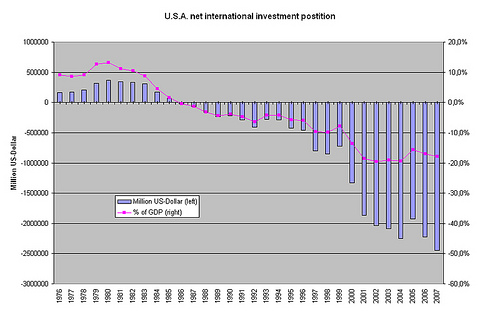
Conservative policies transformed the United States from the largest creditor nation to the largest debtor nation in just a few years, and it has only gotten worse since then:
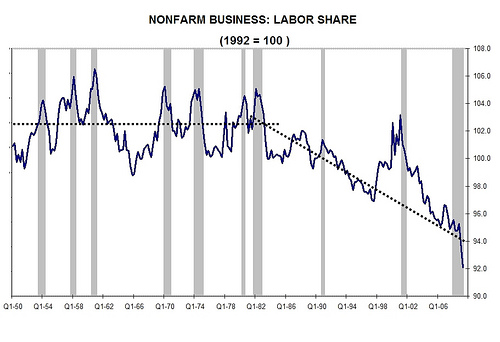
Working people's share of the benefits from increased productivity took a sudden turn down:
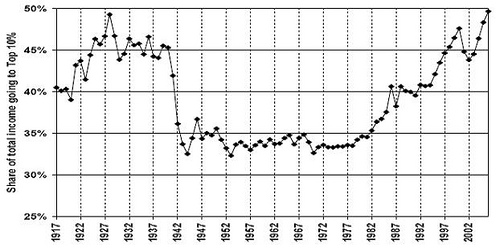
This resulted in intense concentration of wealth at the top:
The rest of the charts illustrate further links in the chain:
And forced working people to spend down savings to get by:
Which forced working people to go into debt: (total household debt as percentage of GDP)
None of which has helped economic growth much: (12-quarter rolling average nominal GDP growth.)
In contrast, Krugman gives us one much more ambiguous chart, comparing the 1970s and 2000s: