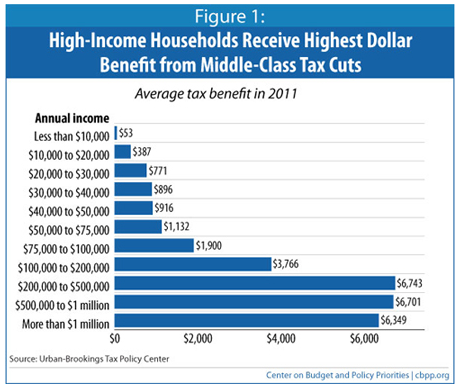
It's from a mid-August report by the Center on Budget and Policy Priorities "High-Income People Would Benefit Significantly From Extension of 'Middle-Class' Tax Cuts", by Chuck Marr and Gillian Brunet. Along with a segment on Democracy Now! this morning with David Cay Johnston, it sheds significant light on just how deeply conservative the entire discussion of taxes specifically and the economy generally remains. In turn, this is but another indication of just how far Obama is from having brought about any significant movement toward a progressive reframing of issues. (On another topic, last night, Megan McCain criticized his similar failure to lead on gay issues on the Rachel Maddow Show--not just gay marriage, but even DADT. And Democracy Now! also had a segment on his doubling down in support of protecting Bush-era torturers & the exapansion of the "state secrets" doctrine, so there's an unmistakable pattern here.)
As the CBPP report explains:
A fact generally overlooked in the debate over whether Congress should extend the high-income Bush tax cuts - i.e. those targeted exclusively at couples making over $250,000 and single individuals making over $200,000 - is that these households will still receive substantial tax cuts if Congress extends the so-called "middle-class" Bush tax cuts while letting the high-income tax cuts expire as scheduled.
This is because the 2001 tax law's reductions in the lower tax brackets benefit not only people whose incomes fall within the lower brackets but also those whose incomes exceed those brackets. In fact, high-income people actually receive much larger benefits in dollar terms from the so-called "middle-class tax cuts" than middle-class people do.[1]
Specifically, recent estimates from the Joint Committee on Taxation show that extending just the middle-class tax cuts would provide more than $6,300 in tax cuts to households with incomes above $200,000, on average, compared to $1,132 in tax cuts for households with incomes between $50,000 and $75,000. The Joint Tax Committee estimates show:
Households with incomes exceeding $1 million will receive an average tax cut of $6,349 in 2011 if the middle-class tax cuts are extended while the high-income tax cuts are allowed to expire. (They will receive an average tax cut of nearly $104,000 if the high-income tax cuts are extended as well.)
The story is similar, if not quite as dramatic, for households that make between $500,000 and $1 million. They will receive an average tax cut of $6,701 if the middle-class tax cuts are excluded (and of $17,467 if the high-income tax cuts are also extended).
For all other income categories, by contrast, the size of the tax cuts are about the same whether the high-income tax cuts are extended or not. Even for households with incomes between $200,000 and $500,000, the effects are similar. The Joint Tax Committee figures show that they would receive an average tax cut of $6,743 if only the middle-class tax cuts are extended, and of $7,152 if the high-income tax cuts are extended, as well.
But it gets significantly worse:
The middle-class tax-cut package the Joint Tax Committee analyzed does not extend the reduction in the tax rate on dividends for couples with incomes over $250,000 (and singles over $200,000). President Obama has proposed, however, that the dividend top rate for high-income people be permanently set at 20 percent, rather than being allowed to return to its pre-2001 level of 39.6 percent. If Congress follows that approach and incorporates this proposal into a middle-class tax-cut package, the average tax cut that high-income households will receive from enactment of such a package will be considerably larger than the figures just cited, and the dollar amount by which the average tax cut going to high-income households exceeds the average tax cut for middle-income households will be significantly larger, as well.
Now let's turn to Democracy Now! and see how David Cay Johnston frames things very differently than you'll normally hear it framed. Johnson, by the way, considers himself a libertarian, but in the old-school sense of not cottoning much to state-created & supported private fortunes. Here's how the interview starts:
AMY GOODMAN: .... David, welcome to Democracy Now! Lay out what this issue is. What are the tax cuts? Who do they benefit? And what about the fact that the top budget adviser to President Obama, his former adviser, Orszag, is saying stick with the Bush tax cuts?
DAVID CAY JOHNSTON: Well, when President Bush came into office, he had a tax cut proposal. It was the key thing in his campaign. He did not, however, pass it through normal legislative means. They did it through something called reconciliation. You'll recall that's how healthcare was passed earlier this year. And that meant there was a ten-year limit on these tax cuts. The Republicans at one point during the last decade controlled the House, the Senate and the White House, but they did not make these tax cuts permanent. And the issue now is that the Republicans' position, at least so far, has been that they will not support anything the President is proposing, which means everyone's taxes would go back up January 1st. That is, the Republicans' position, if it stands, is higher taxes for everyone. The President's position is higher taxes only for only those people in the top two or three percent.
Not being discussed in all of this are two crucial issues. One of them is how much those tax cuts cost us. Basically, all the income taxes that everyone in America paid in January and February of this year only went to cover interest on the money borrowed for the Bush tax cuts over the last decade. Just interest on those tax cuts.
The second issue not being discussed is that this top tax rate, the two that President Obama wants to have go back to the Clinton-era level, they cut in at a quarter-million dollars and about $400,000 of taxable income. In fact, we have a large number of people in this country now who are making multimillion-dollar annual incomes, and we're not talking about a higher tax rate on them. We're starting actually at a very low level. And the very highest-paid workers in the history of the world, hedge fund managers, at least twenty-five of whom made a billion dollars last year, pay a current tax rate of zero. The news media keeps saying 15 percent. They pay the 15 percent, when they cash out, which could be decades from now. None of that is on the table.
So let's review a few of the salient points Johnston has made:
(1) Bush started it all, but even with a GOP majority in Congress never pushed for what the GOP is demanding now.
(2) The GOP position now is tax hikes for everyone on January 1!unless the rich get a massive tax cut all their own.
(3) The Bush tax cuts have been so costly that all the income taxes paid in January and February just go to cover the interest on the debt caused by those tax cuts.
(4) Not even talked about are very high-income people whose income isn't treated like normal income. Specifically hedge fund managers making over a billion dollars with an effective tax rate of zero.
Now, imagine if we had Democratic spokespeople on every network using those talking points?
Sure, we'd have to have a different Democratic Party for that to happen. And that's precisely what we should be out there fighting for.
p.s. Yes, it's true that Obama campaigned on maintainting these tax cuts. But he also campaigned on the public option, and on reversing Bush-era torture policies (more on that later today). So just saying that he campaigned on something doesn't carry a whole lot of weight.