The consensus for MUCH greater wealth equality in America

by: Paul Rosenberg

Tue Oct 12, 2010 at 13:30


In a diary last Monday, "Even monkeys know that inequality is wrong, so why doesn't Versailles?", I first introduced a brief video of primatologist Frans de Waal talking about monkeys & equality, then went on to say:

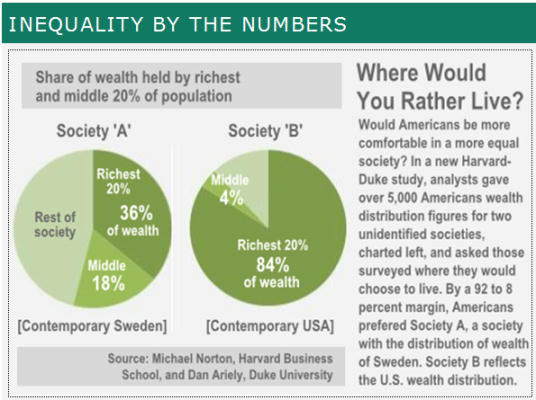
[H]ere's a chart from this week's edition of Too Much, an online weekly publication of the Institute for Policy Studies.  It turns out that over 90% of Americans would prefer to live in Sweden, rather than the US, so far as wealth distribution is concerned:

The chart was based on a paper, "Building a Better America - One Wealth Quintile at a Time" by Michael I. Norton of Harvard Business School and Dan Ariely of Duke University, and is Forthcoming in Perspectives on Psychological Science.  The abstract begins as follows:

Disagreements about the optimal level of wealth inequality underlie policy debates ranging from taxation to welfare. We attempt to insert the desires of "regular" Americans into these debates, by asking a nationally representative online panel to estimate the current distribution of wealth in the United States and to "build a better America" by constructing distributions with their ideal level of inequality.

This is, in fact, as the authors go on to explain, an attempt to essentially operationalize philosopher John Rawls "veil of ignorance" from his Theory of Justice.  And the results are truly eye-opening:

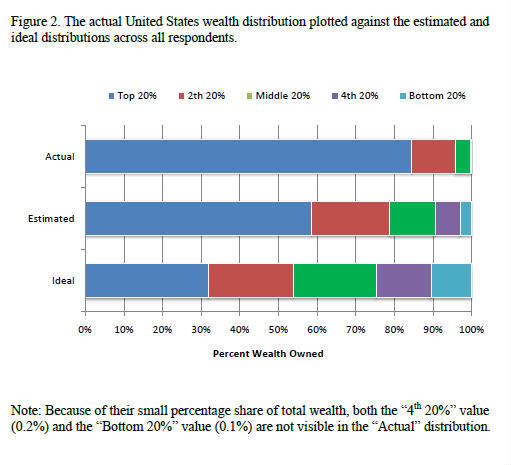
First, respondents dramatically underestimated the current level of wealth inequality. Second, respondents constructed ideal wealth distributions that were far more equitable than even their erroneously low estimates of the actual distribution. Most important from a policy perspective, we observed a surprising level of consensus: All demographic groups - even those not usually associated with wealth redistribution such as Republicans and the wealthy - desired a more equal distribution of wealth than the status quo.

What this tells us, in essence, is that our political system is far out of whack in creating the sort of nation that the vast majority of Americans want to live in.  The Constitution says in its preamble that it exists in part to "promote the general welfare", and this is what almost all Americans believe that the general welfare looks like.  Something is deeply and seriously wrong, and it's not just a matter of liberal opinion.  This is cold, hard data.

It's also worth noting the vast gap between the outcomes of the "marketplace" (which is, of course, nothing like the simple, idealized competetive market of early capitalist economics) which are assumed to reflect the totality of individual preferences and the explicityly expressed preferences found in this poll.  This is but another indicator of the profound disconnect in the field of economics.

More about the results on the flip.

Paul Rosenberg :: The consensus for MUCH greater wealth equality in America
In the body of their paper, the authors explain:

We take a different approach to determining the "ideal" level of wealth inequality: Following the philosopher John Rawls (1971), we ask Americans to construct distributions of wealth they deem just. Of course, this approach may simply add to the confusion if Americans disagree about the ideal wealth distribution in the same way that policymakers do. Thus, we have two primary goals. First, we explore whether there is general consensus among Americans about the ideal level of wealth inequality, or whether differences - driven by factors such as political beliefs and income - outweigh any consensus (McCarty, Poole, & Rosenthal, 2006). Second, assuming sufficient agreement, we hope to insert the preferences of "regular Americans" regarding wealth inequality into policy debates.

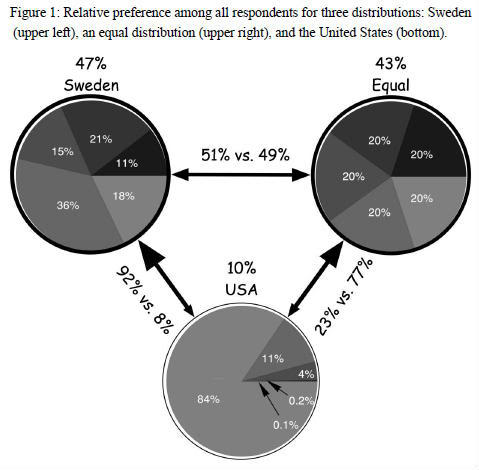
There's one caveat before proceeding.  The authors use Swedish income distributions in their study, since even Swedish wealth distributions are relatively concentrated (I know, Newt will have a heart attack), and thus would not present as clear a contrast as using income distribution does.

Here's what they found in terms of preferences between the Swedish income distrubtion, the US wealth distribution, and complete equality:

Next, here's a comparison of the actual distribution, the perceived distribution, and the ideal distribution:

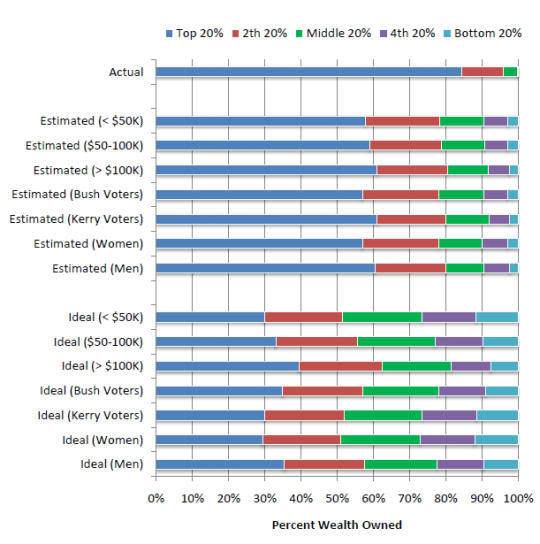
Finally, here's a breakdown of the perceived and ideal distributions of various different sub-groups, which shows that even relatively conservative subgroups--Bush voters, those making over $100K, men--have an aggregate preference for much higher levels of equality--quite contrary to what their political representatives call for and defend:

Concerning this figure, the authors write:

What is most striking about Figure 3, however, is its demonstration of much more consensus than disagreement among these different demographic groups. All groups - even the wealthiest respondents - desired a more equal distribution of wealth than what they estimated the current United States level to be, while all groups also desired some inequality - even the poorest respondents. In addition, all groups agreed that such redistribution should take the form of moving wealth from the top quintile to the bottom three quintiles. In short, while Americans tend to be relatively more favorable toward economic inequality than members of other countries (Osberg & Smeeding, 2006), Americans' consensus about the ideal distribution of wealth within the United States appears to dwarf their disagreements across gender, political orientation, and income.

Finally, in conclusion the authors write:

Given the consensus among disparate groups on the gap between an ideal distribution of wealth and the actual level of wealth inequality, why don't more Americans - especially those with low income - advocate for greater redistribution of wealth? First, our results demonstrate that Americans appear to drastically underestimate the current level of wealth inequality, suggesting they may simply be unaware of the gap. Second, just as people have erroneous beliefs about the actual level of wealth inequality, they may also hold overly optimistic beliefs about opportunities for social mobility in the United States (Benabou & Ok, 2001; Charles & Hurst, 2003; Keister, 2005), beliefs which in turn may drive support for unequal distributions of wealth. Third, despite the fact that conservatives and liberals in our sample agree that the current level of inequality far from ideal, public disagreements about the causes of that inequality may drown out this consensus (Alesina & Angeletos, 2005; Piketty, 1995). Finally, and more broadly, Americans exhibit a general disconnect between their attitudes towards economic inequality and their self-interest and public policy preferences (Bartels, 2005; Fong, 2001), suggesting that even given increased awareness of the gap between ideal and actual wealth distributions, Americans may remain unlikely to advocate for policies that would narrow this gap.

All this may be true.  But the stunning fact that (1) there is such a strong preference for much greater equality and (2) that it is broadly shared strongly suggests that there is a sleeping political giant here, just waiting to be awakened.  It would behove us to devote a good deal of thought and energy to considering how that might be done.


Tags: , , (All Tags)
Print Friendly View Send As Email
Thanks for repeating the enlightenment, Paul. (0.00 / 0)

One thing you've forgotten: the Republican idiot who keeps asking, did a guy making 30 thousand a year ever offer you a job? Ergo, wealth inequality helps people get jobs. Sigh.

Yeah, That Whole Trickle-Down Mythology Needs Its Own Special Treatment (0.00 / 0)
I've been thinking about it for a couple of weeks now.

Methinks that no one who ever worked in the private sector longer than a week would ever say anything that foolish.

"You know what they say -- those of us who fail history... doomed to repeat it in summer school." -- Buffy The Vampire Slayer, Season 6, Episode 3


[ Parent ]
Precisely (0.00 / 0)
Not only does management have clay feet, you realize very quickly that everyone is required to make wealth happen. Even on Wall Street, traders couldn't last long if no one cleaned their offices and took out the garbage and handled the phone calls. Yet they would tell you the contribution of those people has zero value and zero impact on their work and the value they supposedly create.

Bottomline, we're in this together. Taxes are indeed the price we pay for a civilized society.


[ Parent ]
My husband's company is Swedish, hmmm.... (4.00 / 1)
I wonder how long we should keep trying before just giving up and moving to Sweden?

 http://www.SincereJobs.com

Before you move, (0.00 / 0)
you should realize that the current Swedish government is not as left-centered as it used to be.  Some Swedes (on the other side) are calling it "center-right" or even "rightist."  Of course, you also have to realize that their right to center-right is still way left of ours.

"We are all born ignorant, but one must work hard to remain stupid."
Benjamin Franklin


[ Parent ]
Educate People (4.00 / 1)
It would beho[o]ve us to devote a good deal of thought and energy to considering how that might be done.

Given the lack of knowledge about income disparity (gee, I wonder how that happens?), the best way to make income inequality a political issue is for the media to man up and report the facts, starting with this report and then all sorts of storylines (e.g. exactly how does someone on Wall Street earn a seven figure bonus? What do billionaires do with all their extra money while infrastructure repair and basic things like teacher salaries go unfunded?). Imagine a couple stories a month for years from McClatchy with real reporters and an eye to teasing out all the nuances of income inequality in this country. Not just the canned sad sack stories about the unemployed and foreclosed on.

But the first step is to let the 99% of us who are not wealthy know the results of this research. Probably most people would be surprised.

Back on planet Earth, however, I'd guess this information will never be widely shared because it violates the current status quo and the people who benefit. They absolutely will not give up their perogatives without a second economic collapse. And even then, they'll do everything to avoid responsibility. So we'll continue with this odd situation where the elites and the media parrot one line while the rest of the country lives another completely different storyline, one based on the facts of income inequality.

BTW, these finding also generally support the General Social Survey results going back decades in that they show most Americans, regardless of political persuasion, are for at least basic government involvement in making the economy and our society more fair.


The Consistency With GSS Findings Is Duly Noted (0.00 / 0)
In fact, it surprised me in that it's basically even stronger, in terms of how broad the consensus is.

I'll try to do a followup drawing so more connectons.

"You know what they say -- those of us who fail history... doomed to repeat it in summer school." -- Buffy The Vampire Slayer, Season 6, Episode 3


[ Parent ]
What I Find Interesting (0.00 / 0)
... is the disconnect between what a majority of Americans apparently think and feel, both over decades and in surveys like this report, and political reality. It's as if the political reality has been hijacked for decades, stolen outright. A kind of Wizard of Oz effect with all the noise and thunder yet behind it all is a small little man. I wonder how long it can last.

It's also worth noting that neither the GSS or these survey results dig into the actual policy differences. If you waved a magic wand, for example, and we had Medicare for All right now, my guess is a majority would be thrilled and you could never repeal it. However, there are no wands. You get to a solution for health care, or any gnarly issue, through a series of steps, arguments, debates, missteps, and so on. It's quite possible you'd wind up with no public option (never mind single payer) even if the President and conservative Democrats had not put their thumb on the political scale by killing off the public option. This dynamic applies to any political issue.

So yes there's a lot of agreement not reflected in current policy. But that doesn't mean any one policy solution would be the end result. The right solutions would have to be fought for long and hard.


[ Parent ]
on the subject of tax cuts, don't we place more focus on who will benefit? (0.00 / 0)
maybe we should place a greater emphasis on the hurt that will be suffered by the lower income levels

I'm not really sure but it seems to me that when the subject of tax cuts arrives the focus is on how the lesser incomes will get a 5% cut and the upper incomes a 15% cut.

when people hear millionaire X will get such and such a tax cut they don't care much. but if they hear that to give that to X they will have to pay more for such and such, things are different.

for example all I hear from dem pols when it comes to renewing the tax cuts for money after the first $250,000 is that it will cost the gov't some amount of money. does john doe care as much as he would care if he hears you will have to pay 100 bucks more for this and 200 bucks more for that?


We Shouldn't Be Discussing Tax Cuts In The First Place (4.00 / 3)
That's my answer.  This was yet another brilliant Obama idea.  "I'll say that I'm for tax cuts, too, and everyone will love me!"

Yeah, right.

Stupid as the day is long.

"You know what they say -- those of us who fail history... doomed to repeat it in summer school." -- Buffy The Vampire Slayer, Season 6, Episode 3


[ Parent ]
He CONSTANTLY reinforces right-wing framing (4.00 / 1)
On taxes, Social Security, national "security", you name it. It's just amazing.  

[ Parent ]
but we don't control if a subject is discussed or not? (0.00 / 0)


[ Parent ]
and`\ (0.00 / 0)
We Shouldn't Be Discussing Tax Cuts In The First Place

why not? what do we have to fear? I'll discuss how we don't need the dividend rate to go from 35 to 15 anytime it's raised. discussion doesn't mean agreement.


[ Parent ]
What to do? (4.00 / 1)
I don't know what any individual could do, but surely some large-scale national organization like MoveOn could get its supporters out canvassing on this subject - and other subjects related to the ongoing class war.

Why not do a day of action featuring an outreach canvass in which people go door to door, leaving a pamphlet about income inequality behind if they don't reach someone, and running through these survey questions if they do?

Throw in a few details about the real state of social mobility (you can get from the top 10% to the top 1% if you're lucky, but everything else is a long shot), some salient facts about what causes inequality - and what inequality causes in turn (ex. the Koch brothers) - and a few remedies (like repealing the tax breaks for top earners) that everyone can probably agree on, and you're probably going to convert quite a few people. After all, folks are often satisfied as long as they hear any answer to their objections.

This would only start a conversation. But it might seed the ground for populist candidates. Even many liberal Democrats probably don't think of what's happening as a class war: if they think about our current debate, they probably either see it from a single-issue perspective, or as a clash of ideologies. It'd be great if they were encouraged to think of the issues and ideologies as proxies for an oligarchical takeover.


USER MENU


blog advertising is good for you

Donate to Open Left

QUICK HITS
SEARCH


Advanced Search

STATE BLOGS