On Sunday, Juan Cole wrote a very concise backgrounder to peaceful revolution going on in Egypt, “Egypt’s Class Conflict”. It’s not only about class conflict, of course, but also about the shifts in political ideology and foundations of legitimacy from Nasser’s time to today. As such, one of the most valuable things it does is to highlight the role played by failed neo-liberal policies–which are hardly unique to Egypt, of course. Last August, for example, in my diary “The neoliberal failure”, I called attention to a five year old report from the Center on Economic Policy Research (CEPR) “Scorecard on Development: 25 Years of Diminished Progress” by Mark Weisbrot, Dean Baker and David Rosnick, a broad survey of results in over 100 developing countries. From its executive summary, here is what it found:
This paper looks at the available data on economic growth and various social indicators – including health outcomes and education – and compares the last 25 years (1980-2005)1 with the prior two decades (1960-1980). The paper finds that, contrary to popular belief, the past 25 years (1980-2005) have seen a sharply slower rate of economic growth and reduced progress on social indicators for the vast majority of low- and middle-income countries.
The picture of Egypt that Cole paints–powerful enough in its own right–is thus but one example of many. And the failure being underscored by the unfolding revolution is likewise but one example among many.
As hundreds of thousands (then, now millions) had ignored government-called curfews, that was a clear sign the government had lost authority, Cole noted, then wrote:
Authority is rooted in legitimacy. Leaders are acknowledged because the people agree that there is some legitimate basis for their authority and power. In democratic countries, that legitimacy comes from the ballot box. In Egypt, it derived 1952-1970 from the leading role of the Egyptian military and security forces in freeing Egypt from Western hegemony. That struggle included grappling with Britain to gain control over the Suez Canal (originally built by the Egyptian government and opened in 1869, but bought for a song by the British in 1875 when sharp Western banking practices brought the indebted Egyptian government to the brink of bankruptcy). It also involved fending off aggressive Israeli attempts to occupy the Sinai Peninsula and to assert Israeli interests in the Suez Canal. Revolutionary Arab nationalist leader Gamal Abdel Nasser (d. 1970) conducted extensive land reform, breaking up the huge Central America-style haciendas and creating a rural middle class. Leonard Binder argued in the late 1960s that that rural middle class was the backbone of the regime. Abdul Nasser’s state-led industrialization also created a new class of urban contractors who benefited from the building works commissioned by the government.
This was the social democratic foundations of the modern Egyptian state’s legitimacy. And just as the Democratic Party in America is living off of its social democratic past, so, too, the Egyptian regime, which has abandoned that past with even more abandon:
From 1970, Anwar El Sadat took Egyptian in a new direction, opening up the economy and openly siding with the new multi-millionaire contracting class. It in turn was eager for European and American investment. Tired of the fruitless Arab-Israeli wars, the Egyptian public was largely supportive of Sadat’s 1978 peace deal with Israel, which ended the cycle of wars with that country and opened the way for the building up of the Egyptian tourist industy and Western investment in it, as well as American and European aid. Egypt was moving to the Right.
But whereas Abdel Nasser’s socialist policies had led to a doubling of the average real wage in Egypt 1960-1970, from 1970 to 2000 there was no real development in the country. Part of the problem was demographic. If the population grows 3 percent a year and the economy grows 3 percent a year, the per capita increase is zero. Since about 1850, Egypt and most other Middle Eastern countries have been having a (mysterious) population boom. The ever-increasing population also increasingly crowded into the cities, which typically offer high wages than rural work does, even in the marginal economy (e.g. selling matches). Nearly half the country now lives in cities, and even many villages have become ‘suburbs’ of vast metropolises.
So the rural middle class, while still important, is no longer such a weighty support for the regime. A successful government would need to have the ever-increasing numbers of city people on its side. But there, the Neoliberal policies pressed on Hosni Mubarak by the US since 1981 were unhelpful. Egyptian cities suffer from high unemployment and relatively high inflation. The urban sector has thrown up a few multi-millionaires, but many laborers fell left behind. The enormous number of high school and college graduates produced by the system can seldom find employment suited to their skills, and many cannot get jobs at all. Urban Egypt has rich and poor but only a small “middle class.” The state carefully tries to control labor unions, who could seldom act independently.
The state was thus increasingly seen to be a state for the few. Its old base in the rural middle classes was rapidly declining as young people moved to the cities. It was doing little for the urban working and middle classes. An ostentatious state business class emerged, deeply dependent on government contracts and state good will, and meeting in the fancy tourist hotels. But the masses of high school and college graduates reduced to driving taxis or selling rugs (if they could even get those gigs) were not benefiting from the on-paper growth rates of the past decade.
From the CEPR paper, here is how economic development has stagnated worldwide under neoliberal policies:
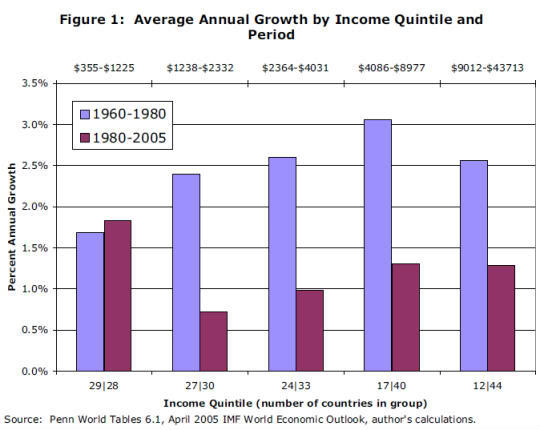
The developing world is full of Egypts, ready to explode.
|

 STATE BLOGS


