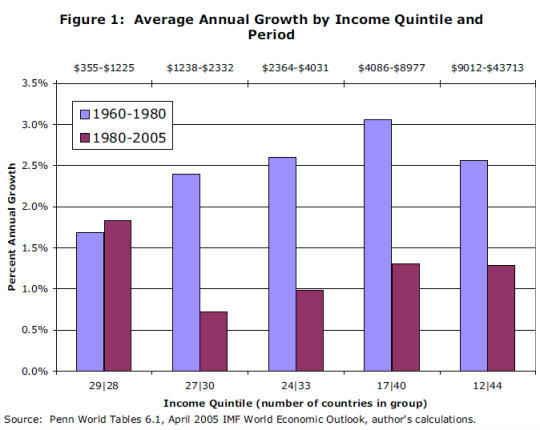
On Sunday, Juan Cole wrote a very concise backgrounder to peaceful revolution going on in Egypt, "Egypt's Class Conflict". It's not only about class conflict, of course, but also about the shifts in political ideology and foundations of legitimacy from Nasser's time to today. As such, one of the most valuable things it does is to highlight the role played by failed neo-liberal policies--which are hardly unique to Egypt, of course. Last August, for example, in my diary "The neoliberal failure", I called attention to a five year old report from the Center on Economic Policy Research (CEPR) "Scorecard on Development: 25 Years of Diminished Progress" by Mark Weisbrot, Dean Baker and David Rosnick, a broad survey of results in over 100 developing countries. From its executive summary, here is what it found:
This paper looks at the available data on economic growth and various social indicators - including health outcomes and education - and compares the last 25 years (1980-2005)1 with the prior two decades (1960-1980). The paper finds that, contrary to popular belief, the past 25 years (1980-2005) have seen a sharply slower rate of economic growth and reduced progress on social indicators for the vast majority of low- and middle-income countries.
The picture of Egypt that Cole paints--powerful enough in its own right--is thus but one example of many. And the failure being underscored by the unfolding revolution is likewise but one example among many.
As hundreds of thousands (then, now millions) had ignored government-called curfews, that was a clear sign the government had lost authority, Cole noted, then wrote:
Authority is rooted in legitimacy. Leaders are acknowledged because the people agree that there is some legitimate basis for their authority and power. In democratic countries, that legitimacy comes from the ballot box. In Egypt, it derived 1952-1970 from the leading role of the Egyptian military and security forces in freeing Egypt from Western hegemony. That struggle included grappling with Britain to gain control over the Suez Canal (originally built by the Egyptian government and opened in 1869, but bought for a song by the British in 1875 when sharp Western banking practices brought the indebted Egyptian government to the brink of bankruptcy). It also involved fending off aggressive Israeli attempts to occupy the Sinai Peninsula and to assert Israeli interests in the Suez Canal. Revolutionary Arab nationalist leader Gamal Abdel Nasser (d. 1970) conducted extensive land reform, breaking up the huge Central America-style haciendas and creating a rural middle class. Leonard Binder argued in the late 1960s that that rural middle class was the backbone of the regime. Abdul Nasser's state-led industrialization also created a new class of urban contractors who benefited from the building works commissioned by the government.
This was the social democratic foundations of the modern Egyptian state's legitimacy. And just as the Democratic Party in America is living off of its social democratic past, so, too, the Egyptian regime, which has abandoned that past with even more abandon:
From 1970, Anwar El Sadat took Egyptian in a new direction, opening up the economy and openly siding with the new multi-millionaire contracting class. It in turn was eager for European and American investment. Tired of the fruitless Arab-Israeli wars, the Egyptian public was largely supportive of Sadat's 1978 peace deal with Israel, which ended the cycle of wars with that country and opened the way for the building up of the Egyptian tourist industy and Western investment in it, as well as American and European aid. Egypt was moving to the Right.
But whereas Abdel Nasser's socialist policies had led to a doubling of the average real wage in Egypt 1960-1970, from 1970 to 2000 there was no real development in the country. Part of the problem was demographic. If the population grows 3 percent a year and the economy grows 3 percent a year, the per capita increase is zero. Since about 1850, Egypt and most other Middle Eastern countries have been having a (mysterious) population boom. The ever-increasing population also increasingly crowded into the cities, which typically offer high wages than rural work does, even in the marginal economy (e.g. selling matches). Nearly half the country now lives in cities, and even many villages have become 'suburbs' of vast metropolises.
So the rural middle class, while still important, is no longer such a weighty support for the regime. A successful government would need to have the ever-increasing numbers of city people on its side. But there, the Neoliberal policies pressed on Hosni Mubarak by the US since 1981 were unhelpful. Egyptian cities suffer from high unemployment and relatively high inflation. The urban sector has thrown up a few multi-millionaires, but many laborers fell left behind. The enormous number of high school and college graduates produced by the system can seldom find employment suited to their skills, and many cannot get jobs at all. Urban Egypt has rich and poor but only a small "middle class." The state carefully tries to control labor unions, who could seldom act independently.
The state was thus increasingly seen to be a state for the few. Its old base in the rural middle classes was rapidly declining as young people moved to the cities. It was doing little for the urban working and middle classes. An ostentatious state business class emerged, deeply dependent on government contracts and state good will, and meeting in the fancy tourist hotels. But the masses of high school and college graduates reduced to driving taxis or selling rugs (if they could even get those gigs) were not benefiting from the on-paper growth rates of the past decade.
From the CEPR paper, here is how economic development has stagnated worldwide under neoliberal policies:
The developing world is full of Egypts, ready to explode.
In Quick Hits, FLGibsonJr points to a Time magazine piece, "The Role Model: What Obama Sees in Reagan", which is at best simply a confirmation of what many of us have been saying for quite some time now.
As Mark Matson says:
The Theory Into Practice section starts to sound more like the president we all know and ... well, know:
In Obama's mind, his election was not an endorsement of the outsize government role that Reagan battled - bureaucratic, ever expanding, self-interested - but a cry for government that could carry out its basic missions more effectively. "I think what you're seeing is a correction to the correction," Obama explained.
That one quote sums up Obama perfectly. The "correction to the correction" fundamentally assumes that Reagan was correct, but just overshot. The writers use of words sounds resonant with Obama as well, as it limits government to its "basic missions" but only asks to be more effective.
That's neoliberalism defined, right there.
To this, I would only add that this didn't have to be so. The neo-liberals are not so much a "correction to the correction" in the way they think they are--guided by pragmatism--as they are guided by an anti-leftist ideology that shares far more in common with the right than they can ever admit. Indeed, one can distinguish between the two by looking at welfare reform, and contrasting Clinton's original intent with what he ended up signing onto. The original intent was somewhat of a concession to rightwing attacks on welfare, but it was also (1) a recognition that with women's role in workforce drastically expanded the underlying assumption of welfare that mothers did not work was no longer valid and (2) an attempt to make the transition in a relatively non-punitive way that had a genuine interest in empowering women to successfully move out of poverty. This is not what Clinton ended up signing, although his vast expansion of the earned income tax credit and the writing of the implementation rules after the law was passed both served to mitigate some of the harsher effects, as did the relatively strong economy.
If all of Clinton's policies had been similarly conceived in terms of realistic considerations, if they had not been compromised with conservatives, and if they had been modified over time to correct shortcomings as they became obvious, then this sort of "correction to the correction" could have genuinely claimed to be pragmatic. But of course, it was not. The failings of NAFTA, for example, never got corrected--and they were pretty much all foreseen in advance by its opponents and critics. The same for financial deregulation. The reality of neo-liberalism--as opposed to its PR-assured that it would be so. In comments yesterday, I was asked to define neo-liberalism, and after quoting from I quoted from a Wikileaks for a basic definition:
Neoliberalism describes a market-driven[1] approach to economic and social policy based on neoclassical theories of economics that stresses the efficiency of private enterprise, liberalized trade and relatively open markets, and therefore seeks to maximize the role of the private sector in determining the political and economic priorities of the state.
The term "neoliberalism" has also come into wide use in cultural studies to describe an internationally prevailing ideological paradigm that leads to social, cultural, and political practices and policies that use the language of markets, efficiency, consumer choice, transactional thinking and individual autonomy to shift risk from governments and corporations onto individuals and to extend this kind of market logic into the realm of social and affective relationships
I went on to flesh it out by quoting from Corpwatch:
Haiti is the site of the world's first successful slave revolt of the modern nation-state era, and it has always been imperative that it should not be allowed to succeed. On the one-year anniversary of the Haiti earthquake, Democracy Now! took a critical look at the "lack of progress" to put things kindly. It began by replaying a clip from its coverage a year ago, a clip that ended thus:
DR. EVAN LYON: This aid attention is nice. The extra supplies are nice. The energy and the money is helpful. But if the Haitian institutions are not rebuilt, nothing will be durable, and in one year we'll be exactly where we are right now, which is in pain.
Followed by Amy Goodman:
AMY GOODMAN: And one year later, the words of Dr. Evan Lyon, a professor with Partners in Health, are agonizingly true: Haiti is still in pain. If anything, the situation has gotten worse. A cholera epidemic has spread throughout the country, killing more than 3,600 people, infecting more than 170,000. More than a million people remain homeless, still living in makeshift shelters in hundreds of tent camps. Port-au-Prince is a city of earthquake refugees. There is little food, clean water or sanitation.
Reconstructions efforts have barely begun a full 12 months after the disaster. By some estimates, less than five percent of the rubble has been cleared, and only 15 percent of the temporary housing that is needed has been built. Less than 10 percent of the $9 billion pledged by foreign donors has been delivered.
This outcome is hardly a surprise. In fact, it's exactly what anyone with a knowledge of Haiti's history would have predicted: an continuing intensification of outside control, overpromising aid and goodwill, under-delivering basic necessities and turning a blind eye to ongoing inequities when not actively engaged in perpetuating or expanding them. Haiti is the site of the world's first successful slave revolt of the modern nation-state era, and it has always been imperative that it should not be allowed to succeed.
Upward counterfactuals look at "how much better it would have been if..."-these reduce satisfaction with reality but help individuals prepare for better performance in the future. The "sanctimonious purists" with whom the President parts company are engaging in upward counterfactuals-and rightly so.
Downward counterfactuals look at "how much worse it would have been if..."-and engender a sense of complacency and satisfaction; to me, they can be rationalizations for "settling" or, worse, defeatist.
The entire line from the Obama administration and its most ardent supporters has been, among other things, one long exercise in downward counterfactualism-"it would have been even worse if we had not gotten x,"
This diary is basically an expansion on a brief response I made to another atute comment by Jeff in the discussion thread of that diary. We've actually covered this territory before, but not from this precise angle. In February of this year, I wrote a diary, "Conservative manifestos are provably false", which contained a brief passage on the emergence of the British "New Liberals" in the 1870s, which Daniel then quoted, and used as a launching pad for his diary "One liberalism through the ages". In it, he argued that "'classic' liberals are just liberals operating in a different socio-political environment"--one that no longer actually exists.
And he turns to Boston College political scientist Alan Wolfe for a definition of liberalism that works to cover both:
Wolfe provides a really good one: "As many people as possible should have as much say as is feasible over the direction their lives will take."
In a radio interview Wolfe once gave, he highlighted the concept of autonomy as vital to liberalism. It is distinct (ironically considering the etymology of the word) from "liberty" (or "freedom"). I have never liked the word liberty. Perhaps it is because those who extol it most often seem to be referring to the liberty of a predator to consume prey. What of the liberty of the prey not to be eaten? Liberty and freedom are negative concepts. They imply merely the absence of formal restraint (usually by the state). However autonomy is a richer and more complete concept. It is akin to the distinction Martin Luther King Jr. once drew between peace that was merely the absence of violence, and peace which contained the presence of justice. Thus it is not merely enough to remove the chains that bind humanity, if they are left destitute in the street to wander aimlessly and hungry. Autonomy requires the capacity to pursue goals. It is still individualistic, but allows for the real support all of us need from without to make any of those goals a reality.
Now, I disagree slightly with Daniel here, since, as I noted in another diary today, Brad DeLong points out that even classical liberal heroes like Bastiat didn't actually believe in "classical liberal" absolutes as they were later articulated by people who I don't think ought to be included as liberals, precisely because they don't really want to protect the autonomy of the prey. Either way, though, I think there are two clearly visible distinctions here, both of which can be seen as reflecting an underlyhing cleavage between upward-looking and downward-looking counterfactual thinking: the autonomy vs. liberty/freedom cleavage and the historical cleavage between liberalism expressed in the early-mid 19th century vs. how it came to be expressed later.
All of a sudden, there seems to be a sweeping recognition that the President we elected is not the President that most folks voted for. Pardon me for saying it, but it's about damn time. And I can say that, in part, because I've been saying for a pretty damn long time. Of course, he's turned out to be even worse than I imagined. But still, there have fairly clear signs right out there in public for anyone who wanted to to see. Here just a few highlights from my own notebook that made it painfully obvious why I could never endorse him, even if there were no clearly superior alternatives to vote for instead. This is not so much an "I told you so" post, as it is a "This is what we've been staring in the face for four years now, so now that we've finally woken up, now what do we so" kind of post.
First, back in late 2006, was Obama hippy-sniping at those who dared to make the "No Blood For Oil" connection:
Obama vs. ISG: Yes Blood For Oil!
by Paul Rosenberg , Fri Dec 08, 2006 at 03:06:08 PM EST
Cross-posted from Patterns That Connect
On Dec 04, Chris Bowers wrote a post, which contrasted the principle-driven Obama who first inspired tremendous netroots support with the compromise-driven Obama who now seems intent on demonizing the very people who helped get him his start. One example Chris cited of the second Obama was this:
In town-hall meetings, when those who opposed the war get shrill, Obama makes a point of noting that while he, too, opposed the war, he's "not one of those people who cynically believes Bush went in only for the oil."
Chis followed up:
Did anyone with any power every say that? Did any leading Democrats ever say that? Did any progressive or liberal of any public stature ever say that? If they did, I'd love to see the quote.
Well, now it appears that someone has come quite close to saying that: The Baker/Hamilton Iraq Study Group (ISG). Privatizing Iraq's oil is one of their fundamental recommendations--regardless of what the Iraqis want. Democracy--well, that was always an afterthought.
The ISG is a center-right outfit, composed entirely of people who were wrong about Iraq. Anyone who opposed the war from the gitgo was simply not considered ISG material. As Glen Greenwald points out today ("The principal sin of the Baker-Hamilton Report"), their overall proposal is clearly to prolong US involvement, a position that the American people now soundly reject. Greenwald points to an AP poll:
Seventy-one percent said they would favor a two-year timeline from now until sometime in 2008, but when people are asked instead about a six-month timeline for withdrawal that number drops to 60 percent.
In defiance of these numbers, the ISG is attempting to once again redefine a "center" that's an extreme minority position, so that the mainstream of American opinion can in turn be defined as "extremist,""defeatist" and "off the table." One part of that center, pointed out by author Antonia Juhasz (The Bush Agenda: Invading the World, One Economy at a Time) in an LA Times Op-Ed today, is the ISG's "advocacy for securing foreign companies' long-term access to Iraqi oil fields." (More on this below.)
Barack Obama, of course, has helped make this happen. Every enabler of bipartisan rhetoric has helped make this happen. But Obama has a special role, since his early backers, those who helped him early when he needed it most, had every reason to suppose that he would be a powerful, eloquent, moral voice of leadership opposing the war. Instead, we've gotten a weathervane routine from him, as David Sirota wrote last June for The Nation:...
Well, everyone knows that David was ahead of all of us. Damn reporters!
But the less obvious point I want to underscore here is that everyone forgets how firmly center-right the Baker-Hamilton Report--and then Bush ran well to the right of that with his highly deceptive "Surge", whose "success" was quite foreseeable from his vantage point, as the recent WikiLeaks Iraq document dump helped to further underscore: They knew that the internal dynamics driving the fighting were already on the downswing (ethnic cleansing almost finished, different set of deals being struck), and therefore whatever they floated in front of it would appear to be a "success", and could then be used to justify whatever they wanted to do in the next war theatre--which is exactly what Obama has since done.
Then, in late 2007, I wrote about the profoundly contradictory nature of his delusional embrace of "bipartisanship", since it depended, in large part, on the existence of the Dixiecrats:
Paul Krugman had a typically restrained response to a profile by one of the dumbest Versailles scribes around. In fact, it was more than just restrained, it took the opportunity to make a very telling point... or two:
One thing I'd note, however: there's a hint in Kurtz's article of an attitude one sees all the time - namely, that there's something inauthentic about people who complain about current policies and the state of the economy when they are personally doing well.
This brings to mind a review I once read of a bad movie in which Mel Gibson played a Revolutionary War patriot. The film made a point of showing the Gibson character as being apolitical - until the British did him personal harm; that's when he got involved. As the reviewer pointed out, this gets the notion of patriotism all wrong - you're supposed to care about the cause regardless of your personal interests. In fact, there's something especially laudable if you oppose a regime even though you were doing fine under that regime.
Of course the fact that conservative icon Mel Gibson has no idea what patriotism is about should hardly be surprising, much less shocking. But what is distressing is how dimly even most liberals are aware of what's wrong with it. However, it's actually part of a much wider phenomena, which Salon's Heather Havrilesky mused upon in a recent column, "Will 'The Event' just get 'Lost'?", where she writes:
Similarly, though, pretty much every single character on "The Event" seems to want something so bad they could kill for it, from the mysterious lady locked in the government facility at Mount Inostranka in Alaska to the scared pilot who hijacks a plane because he's afraid some masked strangers are going to execute his two daughters. The big trouble with "The Event" isn't that the stakes aren't high enough (they're sky-high) or that the characters don't have clear motives for taking the desperate measures that they take. The real problem is, we don't care because there clearly isn't any larger meaning guiding the action, and the only thing we know about each character is that he/she totally loves his/her fiancé/wife/husband/children sooo much that he/she would do anything to keep them safe.
In a country where many viewers don't have a lot of thoughtful or idealistic notions outside of a "love of family" -- worthy though this love obviously is -- this is what passes for character development and premise, over and over again. Even on the most popular TV shows and movies out there, this is often the one humanizing factor, the one guiding principle, the one very simple central thrust of the entire narrative. Even in a smart psychological thriller like "Inception," what do you ever know about Leo DiCaprio's character, other than that he loves his wife and wants to get back to his kids? What should merely be a character's motive stands in for almost everything else, so that all we get is an enormous layer cake of action, all balancing on the faces of two young children. By the time we see the kids' faces, I half expect them to be hideous monsters or extraterrestrials. (If only.)
What Havrileskyis describing is the minimal self of neo-liberalism, for whom all higher things have either been commodofied, or reduced to single-minded love of family. Given this, there simple is no possible foundaiton for a truly democratic politics of any sort, much less for actual patriotism.
And that realization adds a much deeper level of resonance and pathos to Krugman's conclusion:
Peter Daou has a followup diary, "Liberal bloggers are bringing down Obama, part II: It's NOT the economy, stupid, it's Obama's character", and there's some I agree with, some I don't, but I want to focus like a laser on one particular part that I agree with, in order to take the argument further in the direction I think it needs to go--that it's not just about Obama's character, it's about the character of neo-liberalism, which Obama embodies to a remarkable extent.
Here's Daou:
Long before the American public rendered judgment on Obama's economic policies, a core group of progressive bloggers and activists were expressing alarm at everything from gay rights to Gitmo to torture, women's reproductive freedom to Afghanistan. They were essentially saying that Obama was betraying his implied and explicit promise to be the anti-Bush.
There's a lot of denial revisionism about this now, but at the time, the fact that Obama gave a speech against the war while other top Dems had voted for the AUMF was utterly decisive for giving Obama a huge leg up on everyone else: the anti-Bush. Continuing:
Over the past four months there have been a series of flare-ups between the Obama administration and the progressive activist community, centered mainly around the new administration's willingness (or lack thereof) to reverse Bush-Cheney's radical excesses in the realm of civil liberties, secrecy, detainee treatment, interrogation, and counter-terrorism.
Ever astute and incisive, Digby raises what I think is the critical point in this entire debate: "The argument against torture is slipping away from us. In fact, I'm getting the sinking feeling that it's over. What was once taboo is now publicly acknowledged as completely acceptable by many people. Indeed, disapproval of torture is now being characterized as a strictly partisan issue, like welfare reform or taxes."
Indeed, this was the whole point of holding people accountable for torture and other war crimes: It wasn't to be mean & evil partisans, as Obama seemed to think. It was to preserve our own humanity and save our country from the descent into barbarism, where torture is just another option--and who doesn't love options? Continuing:
Back on July 8, Eliot Spitzer and William Black co-authored a brief piece at HuffPo that I meant to comment on, but then failed to because of the shift to weekday blogging. Better late than never, I supposed. Here's a key part of SEC and MMS: A Tale of Two Failures:
The SEC and the Minerals Management Service's (MMS) share a number of characteristics we can't help but notice in the wake of the worst environmental disaster in U.S. history, which followed the second-worst financial disaster in same....Both agencies have been failures for at least a decade.
In both instances, the regulators accepted industry assertions about the reliability of their safety mechanisms while failing to acknowledge -- much less investigate -- the darker, more complex reality. In each crisis, we had the same story of a belief in the reporting done by corporations, and in each case, we had a failure to recognize the enormous potential for fraud and the lack of incentives these corporate entities have in ascertaining and measuring potential risks to the public. The regulators continued to believe the lies fed them by CEOs even when the lies had become absurd. Both times, the agencies charged with regulating ignored the advice of their own experts, neglected to enforce rules, and engaged in an alarmingly cozy relationship with the industry they were supposed to be monitoring.
So far, the Obama administration has failed to fully grapple with the weaknesses and corruption of the regulatory agencies meant to guard the public from harm. Across the entire spectrum of regulatory agencies, there exists a dangerous atrophy of infrastructure which may lead to disasters we cannot yet imagine. Maybe now, as the oil slicks spread across the Gulf, killing wildlife and wrecking lives, our false sense of security is dissolving. We hope so, because if we don't learn from these horrific experiences, we can expect more of them. Where will the next disaster occur? At the Food and Drug Administration? At the National Transportation Safety Board? At the Nuclear Regulatory Commission?
There are two points I want to make: First, that this is just the tip of the iceberg of a sweeping conservative attack on regulatory and scientific integrity. Second, that Obama's demonstrable indifference gives the lie to the Third "Third Way" claim that their approach--using private entities and 'strict regulation'--can do the job as well as public ownership. The theory just might be plausible, but the practice gives the game away: They are much more partners with conservatives in re-purposing the welfare (and regulatory) state for conservative ends than they allies with true progressives in preserving the welfare state's public-serving ethos.
First, a powerful piece of framing, brought to you from Rockridge Institute:
[Framing explained here]
As noted in the diary, "Labor & Lakoff: Fighting for Single-Payer" by California Nurses Shum, George Lakoff and the Rockridge Institute have weighed in heavily on the health care debate . An article Lakoff co-authored with Glenn W. Smith (who posts occasionally at OpenLeft) at Salon, "Don't think of a sick child" begins thus:
George W. Bush doesn't want you to think of a sick child. Not Graeme Frost. Not Gemma Frost. Not Bethany Wilkerson. Not any of the real children affected.
He wants you straining your eyes on the fine print of policies, puzzling over the nuances of coverage -- whether you can afford premiums for basic, catastrophic, comprehensive or limited health insurance. Last week on "Real Time With Bill Maher," even Tucker Carlson kind of got it right, saying, "No one child is a metaphor -- he's a kid!" That's the point. They're all kids, each one, one by one. The question is, do you care?
The actuaries don't. And can't. Health insurance companies make their money by denying care. They maximize profit by authorizing as little care as they can get away with. That's what all those administrative costs -- as high as 30 percent -- and all that paperwork are mostly about. It takes a lot of people to justify denying care.
It's the opposite of the way the market is supposed to work: Make more money by delivering more product. The health insurance industry makes more money by delivering less product. It maximizes profits by minimizing care.
The logic here is as simple as it is compelling: by its very nature, for-profit health care cannot solve our national health care problem. Which, of course, is why the logic must be suppressed. And in a short paper, ""The Logic of the Health Care Debate" [PDF], Lakoff and co-authors Eric Haas, Glenn W. Smith and Scott Parkinson explain precisely how this is done--by the "third way" mechanism of neo-liberalism, sidelining the liberal argument for single-payer, so that it never gets made.
In this paper Lakoff explains the logic of the conservative view-based on a commodity view of health care, and the notion of individual responsibility, the liberal/progressive view, based on "the morality of empathy and responsibility, for oneself and others," and the neo-liberal view, which shares the liberal foundations in terms of proper ends, but is heavily invested in a rationalist approach that accepts the market as a means, and in the process loses sight of the means. Extended excerpts and discussion on the flip.

 STATE BLOGS


 Powered by: SoapBlox