Frank Capra & A Little Straight Talk About The Debt

by: Paul Rosenberg

Sat Oct 04, 2008 at 09:38


From a macro-economic point of view, the most important way to think about the debt is as a percentage of GDP.  Put simply: how big is the governments' debt compared to the size of the whole economy--the tax base available for paying the interest, and hopefully paying down the debt.  And if we start off by thinking of it that way, then the record is strikingly clear: throughout the heyday of "big government," the size the debt shrank consistently--if not uniformly--under every post-WWII Administration, until Ronald Regan:
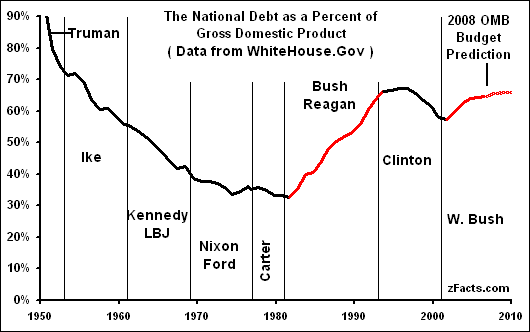
It's equally notable that the size of the debt shrank under Clinton as well, while rising under both Bushes.  This is important for at least two immediate reasons:

(1) It shows that even with the incredibly foolish bailout package, our debt levels should remain managable, if the next President is sane (i.e. not a Republican).  This doesn't mean we have no problems.  It just means that this bailout, however odious, is not a crushing blow that destroys all hope.

(2) It  reminds us of the basic argument we should have been making ever since 1984: so-called "conservative," supply-side, voo-doo economics does not work, and drives the government into needless levels of high debt. (As opposed to the WWII debt, which was quite necessary.)

Paul Rosenberg :: Frank Capra & A Little Straight Talk About The Debt
Point #1 echoes the point of a diary I wrote on Thursday, "Losing A Battle To Win The War? Robert Reich on The Bailout".  Reich's article had two main points, as I read it.  First is the clarifying distinction between two seemingly contradictory reactions:

An important distinction here. While more Americans are coming around to "supporting" the bailout bill, the vast majority still hate the idea of bailing out Wall Street. They're for the bailout bill now only because they fear that a failure to pass it will have worse consequences -- drying up credit at a time when Main Street is struggling. But make no mistake: America is mad as hell. They resent what they perceive as extortion by the Masters of the Universe.

His second point, less succinctly argued, was that there really is a realistic chance to continue the larger fight, with a different outcome in 2009.  Just how that will play out, no one can say.  But that it can play out, that is what is most significant.  Reich concludes by saying:

The Era of Angry Populism has only just begun. Let's hope Obama wins, and is able to mobilize the anger into fierce pressure on Congress to get his agenda enacted, as well as reform Wall Street and Washington.

Point #2 should be obvious from this chart, but translating it into effective populist rhetoric for affirmative policy initiatives will take a good deal more working through.  A key problem is that there's a fundamental shift between the logic of the individual actor and that of the larger economy.  Indeed, learning this fact was a key aspect of the New Deal, and re-learning it must be vital for a progressive future.

Here's what I'm talking about.  From Ronald Reagan onwards, conservatives loved to say things like, "You have to balance your budget, why shouldn't the government balance its budget, too?"  Underlying this specific argument was a fundamental logic: whatever made sense at the individual level made the very same sense at the level of society, too.

Of course, when it came to actually balancing budgets, conservatives were the worst offenders ever, as the chart above clearly shows.  But that didn't matter, because their narrative came to dominate the public discourse, along with the underlying logic that individual answers absolutely determined answers for all of society.  For us to put progressive economic policy back into a dominant position, we need to replace that narrative--and related ones that depend on that same basic logic--with our own counter-narrative, and a radically different logic.

What could that possibly be?  Oh, yeah:

Simple, eh?  What "makes sense" for the rationally fearful individual--"grab my money, fast!"--spells doom for the whole community.  It's a simple point, really, considering that millions of kids have watched this movie, and have not had any problem following it.  We haven't done nearly as a good a job taking this simple truth, and building a more extended structure of narratives upon it.  But it clearly can be done.

This is the challenge we face: taking this key demonstration of how individual fear-based logic must be transformed for the good of all, and rebuilding our economic narratives around it.  There's a whole lot more we need to say as well, but it's mostly an elaboration on this same basic theme.

Building a sustainable green economy for future generations rests on the same fundmantal logic: what seems best from the fear-driven individual perspective is actually a recipe for collective destruction.  It's a variation on the same bit of George Bailey's wisdom.  And it very well may hold the key to all our future.


Tags: , , , , , , (All Tags)
Print Friendly View Send As Email
One more nail (4.00 / 5)
Maybe 20 or 30 years ago a book came out called "How Real is the Federal Deficit."  The point of the book was that the federal government's accounting was more screwed up than federal policies.  In addition to the point that your graph beautifully presents, during most of the time, we were investing a substantial anount of money into long term assets: roads, bridges, schools, tanks, airplanes, education, post offices, etc.

The most pernicious part of the Regan/Bush voodoo economics is that at the federal and state levels the investments stopped and were rolled back.  Public education in the state of California post Propisition 13 went from being the finest in the world yo being aberage for the US.  Yeah, it took 30 years to happen but happen it did.  We not only fail to build new roads, water, sewer, etc. we fail to mainatain what we have.

The result, sure as could be is that (in the movie sense) we are creating a future of "Pottervilles" rather than a future of neat suburban subdivisions.  Sure, Lionel Barrymore gets to lord it over the town, but the vast mass of individuals just struggles to get by.  Those other graphs (not here) tell the story.  Jesse Jackson was so right (in 1988): "A rising tide lifts all boats."  The corollary is that treickle down only lifts a handful of boats.


This Is Sooo True! (4.00 / 3)
And here in California, we even have a ballot initiative mandating that we pour even more money into our bloated prison system, when public sentiment is strongly in favor of spending money on drug treatment, instead of prison and jail, and drug-related arrests are the largest driving force in prison expansion.

Folks are hopeful about this one, but if the initiative were a straight-up prisons vs. treatment one, it wouldn't have a prayer.  So we're still fighting these rear-guard actions, rather than getting ourselves firmly back on track, even though public opinion has firmly shifted in our favor.

This is the challenge we face on multiple levels and issues.

"Senate passes expanded GI bill despite Bush, McCain opposition"


[ Parent ]
Didn't know you're in CA, Paul (0.00 / 0)
So, what are you thinking about the showdown between the Terminator and the Dems? Who's gonna win? And will CA become collateral damage???

Let it be said by our children's children that when we were tested, we refused to let this journey end, that we did not turn back, nor did we falter

[ Parent ]
CA Is ALREADY Collateral Damage (0.00 / 0)
But I'm not sure what you mean when you say "the showdown between the Terminator and the Dems".  With the end of the legislative session, all sorts of battles have come to a close, and folks are considering which ones to take up again next year.

If you have a better fix than we do here, I'd love to hear about it!

"Senate passes expanded GI bill despite Bush, McCain opposition"


[ Parent ]
THE budget showdown, of course! (0.00 / 0)
And pls excuse me for not knowing all the details of the ongoing war between liberals and the skynet. Yeah, I should read the LATimes more often, but I get depressive when I do...

Let it be said by our children's children that when we were tested, we refused to let this journey end, that we did not turn back, nor did we falter

[ Parent ]
Budget Is Old News--Read Calitics, Not LA Times (0.00 / 0)
The budget was signed almost two weeks ago.  If you want to keep up on California news, you should read Calitics (just click on "California" under "State Blogs".

After the budget, the Gropenator vetoed over 130 bills, and the legislature once again seems prepared to do absolutely nothing.  There's a story about this at Calitics here.

"Senate passes expanded GI bill despite Bush, McCain opposition"


[ Parent ]
The real deficit (4.00 / 1)
If Bush had added 100 billion to all his deficits over 8 years it would have hardly been noticeable, but it would have been equal to this package.

The liberal wiki
Send an email to [email protected]


100 billion, equal to this package? (0.00 / 0)
Uh, could you pls show how you get to this statement???

Let it be said by our children's children that when we were tested, we refused to let this journey end, that we did not turn back, nor did we falter

[ Parent ]
$100 Billion x 8 Years = $800 Billion (0.00 / 0)
Have to adjust for inflation, of course. Which would put it somewhat higher.  

"Senate passes expanded GI bill despite Bush, McCain opposition"

[ Parent ]
Ah, now I get it... (0.00 / 0)
thx Paul.

Let it be said by our children's children that when we were tested, we refused to let this journey end, that we did not turn back, nor did we falter

[ Parent ]
What would the chart look like with (0.00 / 0)
future promises to spend factored in?

Unfortunately, promises like medicare, social security, and other pensions ARE FACTORED IN TO EVERYDAY PEOPLE"S PORTFOLIOS!

They believe the money will be there!

Thus, our Current GDP is higher than it otherwise be in a savings regime.

Thus, our current GDP will decline WHILE debt skyrockets AND interest rates go up to stave off a dollar implosion.

So add in the future payments (the taxes to cover them has already been spent) and then reassess your chart.


Not Exactly (4.00 / 3)
First off, Social Security is not in crisis, and probably not even in long-term deficit.  The figures used to show that it is are the most pessimistic, low-growth projection scenario, and they've been repeatedly exceeded, pushing back the projected "fail" date so that it's farther off now than when Bill Clinton first took office.

Secondly, the main reason that Medicare is in trouble is because of our private health care system, which drives up the cost of health care system-wide.  We spend much more for health care than other countries do, for much worse health outcomes.  I did a diary about this some time ago.  Other countries with much older populations are feeling a bit of a pinch, but they're nowhere near the dire straits we're already in, much less what we're headed for.

If we instituted a single-payer system, we would not only reduce individual health care costs, we would reduce total costs, and put ourselves in a position where we could beging to bring our long-term obligations into line with revenues.

So, in short, these future deficits you point to are not fixed in stone the way a merely legal obligation is.  They are subject to political action that can drastically alter them for the better.  Treating them the way you suggest is precisely the sort of paralyzing path that conservatives want to drive us down.  It should be resisted and reversed at every opportunity.

"Senate passes expanded GI bill despite Bush, McCain opposition"


[ Parent ]
George Bailey's wisdom may hold the key to all our future. (4.00 / 3)
I am one of those people expecting my social security.  First, I paid into it for 40 years, and I expect a return on my money.  If they had kept their grubby mitts off of it instead of spending it on everything and everyone else, the money would still be there.  

Second. How come this country always has plenty of money to spend on wars, prisons, bombs, and oil and be too poor to afford health care, higher education, and social security?

It is all priorities, and this country's priorities are totally screwed up.  

Let's hope Obama wins, and is able to mobilize the anger into fierce pressure on Congress to get his agenda enacted, as well as reform Wall Street and Washington.

I hope Robert Reich is right and that those of you with more heart hope faith than I can make those wishes come true.  


They're asking for another four years -- in a just world, they'd get 10 to 20. ~~ Dennis Kucinich  


[ Parent ]
numbers (4.00 / 1)
Here the debt is listed as 70 to 80% of GDP.  Finfacts agrees with your number of 70%.  This guy in US News says 60%.  I read a report somewhere by IMF economists that said 86% though I can't find it right now.

However, this doesn't factor in that in the next 16 months AT LEAST, we will be paying for a) the Iraq War b) the Afghanistan war; c) more bailouts or economic stimulus measures (we have simultaneously a credit crisis that probbaly hasn't been resolved and a recession and it seems intuitive that the two will exacerbate each other).  

This is why if you want to reduce cuts to social security and medicare benefits (and other programmes), I think we need to start talking about the revenue side NOW.  Tax increases NOW on the rich (and wherever else it does no harm), Ending these wars NOW not just on moral or geopolitical grounds anymore but on financial grounds as well now.

If the beast hasn't been starved, it potentially will have been shortly, and I don't think that Americans are going to deal with scarcity very well.  So I agree that economic populism is on the rise and this IS a time to be optimistic on those grounds.  At the same time, we're so used to the idea that the U.S. economy is inherently stable and we're just fighting over pieces of that pie in the U.S. that we've forgotten it's not a natural law - it's just how things have been.  If things go wrong, this has the potential to be revolutionary (not just progressive), but the same means that it has the strong potential to be fascistic (though probably abroad).  If it's not already (i mean, what is the paulson plan / bushism if not fascism - big business + statism).

Anyway, yes, i focus on worst case scenarios, and yes, that's what they are, but they are worth understanding as baselines to which we might fall.


You Don't Need To Frighten People (4.00 / 2)
Fear is the friend of the right.  FDR was precise right when he said, "We have nothing to fear, but fear itself."  Do we have to think of the big picture, and take prudent steps to forestall the worst possible case?  Certainly.  But threats of economic disaster are always used to derail progressive policies.  We need to focus on that connection first, and blowing it to smithereens.

Raising taxes on the rich is a relatively more promising line of argument right now, precisely because of the bailout just passed.  The justice of such an approach is something most folks don't have to be convinced of right now.

"Senate passes expanded GI bill despite Bush, McCain opposition"


[ Parent ]
i agree (0.00 / 0)
i can't help it - i have an anxiety condition and live in fear.  a friend once told me that i have the power to paralyze people with my neuroses.

but even a stopped clock is right twice a day ;)


[ Parent ]
Damn... (4.00 / 1)
Could you pls switch your opions even faster, so to spare supporters of your views the embarassment to argue against people you suddenly agree with?
:D
"but even a stopped clock is right twice a day ;)"
And this doesn't go well with my "it's five minutes to twelve" statement. Grrr.
:-(  

Let it be said by our children's children that when we were tested, we refused to let this journey end, that we did not turn back, nor did we falter

[ Parent ]
i haven't switched any opinions dude (0.00 / 0)
i still maintain that pauls' take is economically overly optimistic and that i tend to focus on more dire scenarios.  but also that fear-based politics is destructive and i shouldn't succumb to it and that i often do.  all of those sentiments are in the original comment and the subsequent one :)

To detox for a second - the main question is really a central one - are we going to enter an era of scarcity for American political economy, or is the free ride going to continue (i.e. "the American Dream" "a rising tide lifts all boats" etc.).  And if we don't, what happens.

My main error is just that I'm transposing some Indian political stuff inappropriately onto the U.S. (the chances of actual fascism are MUCH higher there, I think).  But I don't have answers, which is why you see conflict in my words.


[ Parent ]
Mix Your Metaphors With Your Drinks! (0.00 / 0)
As illustrated by this bit of dialogue from Buffy, The Vampire Slayer,  "Lover's Walk" Season 3, Episode 8:

Mayor Wilkins:  See, and it's not the carpet. It's me. (gets up to retrieve his ball) I swear, I would sell my soul for a decent short game. (drops the ball for another try) Of course, (chuckles) it's a  little late for that. (chuckles) (to Allan) I don't suppose I could  offer your soul, huh? Really help me on the green.

Allan gives him a shocked look.

Mayor Wilkins:  I'm just funning. So, we have a Spike problem, do we? (takes another shot)

Allan:  He's been spotted back in town.

The Mayor's shot is on target this time, but comes up short. He lets out a frustrated sigh and goes to retrieve his ball.

Allan:  And there was an incident at a magic shop in broad daylight. Police had a hell of a time covering it up.

Mayor Wilkins:  (drops the ball) (laughs) Well, yes, y'know, he was up to all sorts of shenanigans last year. We had a world of fun trying to guess what he'd do next.

Allan:  I remember. (leans against the Mayor's desk)

The Mayor whistles at Allan, who immediately stands back up.

Mayor Wilkins:  But I guess we're past that now. This year is too important to let a loose cannon rock the boat.

Allan:  Should I have Mr. Trick send a... committee to deal with this?

Mayor Wilkins:  Loose cannon. Rock the boat. Is that a mixed metaphor?

Allan:  (confused) Uh...

Mayor Wilkins:  (musing out loud) Boats did have cannons. And a loose one would cause it to rock. Oh, honestly. I don't know where my mind goes these days. (chuckles) Why don't you take care of that Spike problem? A committee, like you said.

Allan:  As good as done. (leaves the office)

Mayor Wilkins:  That's swell. Fore!

He takes another shot, and this one is directly on target. He spreads his arms, elated.

Mayor Wilkins:  Hey!


"Senate passes expanded GI bill despite Bush, McCain opposition"

[ Parent ]
Lethargy is the friend of the left??? (0.00 / 0)
Sry, but I think doc is right. Too many people still believe that nothing bad can happen, that something like the great depression is a thing of the past. That's wrong. And many other nations had to make this experience the hard way.

I don't think some fear can hurt, if it results in people waking up and fighting the forces that drove the nation into the wrong direction. It's five minutes to twelve.

Let it be said by our children's children that when we were tested, we refused to let this journey end, that we did not turn back, nor did we falter


[ Parent ]
The Bailout Was Passed Less Than 24 Hours Ago (0.00 / 0)
based entirely on fear, the same way that the Iraq War was, and you're telling us Americans that we're not fearful enough?

I'm hardly arguing for lethargy, just because I'm opposed to panic.

"Senate passes expanded GI bill despite Bush, McCain opposition"


[ Parent ]
how about (4.00 / 1)
panic bad, (we agree)
realistic assessment of economic situation good. (and we disagree on what that is).

[ Parent ]
Yes, there's a difference between fear and panic.. (0.00 / 0)
and fear can actually sharpen your instincts and produce the adrenaline that is necessary to get into action. Besides, acting as if there's nothing to fear would be foolish now.

Let it be said by our children's children that when we were tested, we refused to let this journey end, that we did not turn back, nor did we falter

[ Parent ]
But It Doesn't Work That Way In Politics (4.00 / 1)
Fear is obviously adaptive on the individual evolutionary level.  You encounter something frightening and you respond with a jolt of adrenaline, you run away, or you quickly lash out, whatever, and the situation is over, usually within minutes, if not seconds.

But it's not anything like that in modern civilization generally, where fear tends to become a long-term condition, and this is especially true in politics.  Being motivated by fear is one of most basic hallmarks of conservtive politics.  It factors into the basis for Lakoff's Strict Father family model, it is a key characteristic of rightwing authoritarianism (RWA), fear and hatred of subordinate groups is a key aspect of social dominance orientation (SDO), it's the key characteristic of terror management theory (TMT).

These are all different modalities through which fear contributes to a conservative political orientation.  And they most assuredly do not sharpen people's instincts.  They cloud their judgment.

"Senate passes expanded GI bill despite Bush, McCain opposition"


[ Parent ]
Seems it depends on the level of fear (0.00 / 0)
"As long as fear is the response to actual danger, it is a natural and even useful phenomenon," says Dr. Michael Stadler in The Psychology of Sailing. He adds that fear in an ample (but not excessive) degree can sharpen your senses and improve your capacity to anticipate and assess the risks inherent in certain situations.Seasoned sailors, therefore, experience anxiety before the danger arrives and are in a better position to deal with or even avoid it. Inexperienced sailors may wander blindly into danger and then become incapacitated with fear when it's too late.

http://www.answers.com/topic/fear

Let it be said by our children's children that when we were tested, we refused to let this journey end, that we did not turn back, nor did we falter

[ Parent ]
Based on fear? (0.00 / 0)
Now, come on Paul, pls stop this mindreading. These baseless assumptions are not typical for you. And to declare that the supporters of the bailout acted on fear, in spite of the many rational arguements that were discussed here, is somewhat insulting.  

Let it be said by our children's children that when we were tested, we refused to let this journey end, that we did not turn back, nor did we falter

[ Parent ]
There Were Abundant Alternatives That Were Never Discussed (4.00 / 1)
much less considered.  There were no committee hearings.  No testimony.  No independent assessment.  There was none of the normal, deliberative legislative process.

It was driven by fear every step of the way, and the system, which was designed to prevent just this sort of rash action, totally failed to provide checks and balances.


"Senate passes expanded GI bill despite Bush, McCain opposition"


[ Parent ]
There was also was no time (0.00 / 0)
159000 lost jobs in September. Small businesses and communities becoming unable to get new credits. Many economic indicator trends pointing to a recession. Does this look as if there is time to waste? Not to speak of that Congress was about to go out of session. Can action wait until next January? Who's going to be t the welfare of the nation on that?

And still, if a prominent objector of the bailout would have taken the lead, he/she could have united the opposing forces, orchestrated a media storm of blog posts, emails, letters and phone calls, and force the leadership to take an alternative plan, like the swedish precdent, into consideration. There's no guarantee this would have succeeded, but at least it would have been worth a serious try. If Dodd was able to create a complex bill in this small timeframe, another Senator certainly could have done the same. Hell, Bernie Sanders even did it! But there wasn't an organized effort to give his bill, which was certainly closer to the popular view, a fair up or down vote.

So, respectfully, no, the fact that the bailout bill was rushed doesn't excuse the opponents' failure to influence the political process. Whinig and fingerpointing doesn't help now, progressives should better think about building up a more efficient organisation to make their voices heard next time. This would be helpful. And then this experience would have had a good side, too.

Let it be said by our children's children that when we were tested, we refused to let this journey end, that we did not turn back, nor did we falter


[ Parent ]
That's PRECISELY The Time You Have To Slow Down And Think (4.00 / 1)
It doesn't take that long to hold committee hearings, draft a set of reality-based principles, and then bring something to the floor.  Particularly if we're talking about something that some folks have been warning about for years, decades even.

Here's a helpful little rule of thumb:  Listen to the folks who saw the problem coming a mile off, and tried their damnedest to warn you, not the folks who caused it.

You do need an agreed-upon process to keep things on track, but there is always time to think when it comes to crafting legislation. Always.

"Senate passes expanded GI bill despite Bush, McCain opposition"


[ Parent ]
Well, exactly my point (0.00 / 0)
Things were rushed, but there was enough time to act against the bill. Sanders proved this. Now, as we don't seem too far apart on this point, how do you explain that the popular opposition didn't gain more traction among lawmakers? Especially why there wasn't an organized opposition in Congress?

Let it be said by our children's children that when we were tested, we refused to let this journey end, that we did not turn back, nor did we falter

[ Parent ]
Hegemonic Struggle (0.00 / 0)
There are a wide range of reasons, but most all of them fall somewhere under the umbrella of simply not being organized for hegemonic struggle.

"Senate passes expanded GI bill despite Bush, McCain opposition"

[ Parent ]
As Paul said - number of reasons (4.00 / 2)
But in the immediate sense, the reason for the lack of traction was the cooperation of the party leadership of both parties pushing for this bill.  When Pelosi, Hoyer, Reid, Obama, McCain, McConnell, Boehner, Paulson, and Bush all march in the same direction (even if their goals were marginally different) that we have to act now, Now, NOW!, then that pretty much drowns out any opposition, organized or not.  

However, that's really a symptom of Paul's main point.  If progressives were organized for hegemonic struggle, then the Dem leadership never would have been co-opted as completely as they were.  And if we were organized, Paulson and Bush never would have even attempted to ram this through in the first place.  They only pushed so hard because they knew there was no effective opposition in place to stop them.  It is ever the way of the world...


[ Parent ]
time enough for alternative plans (4.00 / 1)
How many economists came up with how many alternatives that could have been crunched in just as much time as it took for the Senate to throw out a 400-plus page rehash of the Paulson Plan? Press these experts into national service, and we have something that at the very least isn't pulled out of Goldman Sachs' ass.

[ Parent ]
FDR took the time (4.00 / 1)
In 1932 and 1933 the economy was not only worse but miles worse.  Unemployment (a real number not the Regan-adjusted non-count) was a staggering 32%.  One out of three Americans was out of work.  Stock market values were obviously down the toilet.  Banks were failing.  Hoover was running up record deficits and achieving nothing.  So FDR went along with Hoover's pleas to go along with his plan?  Not on your life.  He waited till he was in charge with a friendly Congress and then implemented a sweeping and comprehensive program of change.

Statistics and stories from World War II and the Civil War show that veteran troops were likely to take far snaller casualties than rookies.  Adrenaline?  No, wisdom born from experience.  Lay low.  Examine what needs to be done.  Plan and act carefully.  Don't rush into battle without thoroughly knowing the strength and location of the enemy.  Bush and his administration are acting like green troops.  Unfortunately, it is the American public who will take the casualties.  


[ Parent ]
The addicts need a fix. (4.00 / 3)
Cold turkey is not an option, but we've got to collectively demand an end to our addiction. False wealth through credit must end. Living wages must return.

We need some stern yet caring withdrawal treatment, and we need the guts to turn away from our addiction. We need a sea change, from short-term gotta have it now fixes to long-term, slow but steady patience. We need to live within our means, but we also need the means to live. People must come before profits, and companies need to exist not only to turn a profit but to return prosperity to their workers.

Credit needs to dry up, but we can't just go from a flood to a drought. I hope that our government turns to people with vision to create a long-term solution given this oppportunity to turn our backs on decades of American irresponsibility and greed.


[ Parent ]
debt-to-GDP ratio (4.00 / 3)
Matt Yglesias had a good line about that chart up top:

As you can see, there are basically two kinds of situations in which this ratio skyrockets - either World War II breaks out, or else you put representatives of the modern conservative movement in the White House.


I agree with your overall point but... (0.00 / 0)
I hate to throw a bucket of cold water, but the graph you show is only a small part of the picture, and one-sided at that.  How so?

Well, the graph shows only debt as a percentage of GDP since WWII, but unlike today, the US had some tremendous advantages to allow us to deal with all that debt - the almost complete destruction of manufacturing capability of other modern industrial nations (WWII bombing and all that...), thus a huge trade surplus.  Hand in hand with that was the amount of loans held by the US in relation to its debt.  In other words, up until Reagan, the US was the largest creditor nation in the world.  Now we are the largest debtor nation in the world.  Post-WWII also had the baby boom generation, with the spike in population causing a tremendous growth in domestic consumption, which also spurred economic growth and thus revenue.  And don't forget the far more progressive income and corporate tax structure.

All of this is to say that we are in a much more serious situation today then we were in 1950, even if a our debt is much lower as a percentage of GDP today.

Don't get me wrong, the US still has a lot of tools to work with, and the bailout is not the end of the world (even if it is a serious anchor dragging any fiscal plan to turn the US economic ship around).  But let's face facts, and recognize the Obama and the Democrats really did themselves no favors by pushing for this bailout.  The damage is worse than having done nothing at all.


You're Right That This Is Only Part of the Picture (0.00 / 0)
But it's far more realistic than just hearing about the debt as a lump sum of money.

IMHO, we ought to be talking in terms of long-term strategic planning to deal with the major challenges we can see coming at us--the need for massive transformation in our energy budget, global warming, and the continuing antagonisms sketched out by Benjamin Barber in Jihad vs. McWorld that can only be dealt with by significantly strenghtening democratic institutions and civil society.

This perspective sees the runaway destructiveness of the unregulated economic system as an antagonistic yet synergistic companion to fundamentalist extremism that gives us incidents like 9/11 on the one hand, and a virtual re-starting of the Crusades as America's response on the others.  There are a wide range of potential solutions to the difficulties we face, but both these extremes threaten to short-cirtcuit anything approaching the sort of reality-based discussions we need to have in order to re-orient our political system toward implementing those solutions.

"Senate passes expanded GI bill despite Bush, McCain opposition"


[ Parent ]
Who do you mean by "we"? (0.00 / 0)
I haven't read Jihad v. McWorld (although it's on my way too long list of books to read), so I'm not sure I get the full point of your message.

But in terms of addressing the major challenges coming at us, that usually means the President and Congress addressing the major challenges.  Which I'm afraid we (in the literal sense of you and me) have little or no influence over.  Obama clearly has an agenda in mind, but his actions over the past several months are leading me to believe that it's not the agenda we think it is, or even the agenda he claims it is.  I don't mean that in some nefarious manner, but just that his success in Washington is based in part with his comfort with Washington culture as it is.  That means he is constantly being bombarded with the idea that the maintenance of the current power structures (modified by his rise within that power structure and his de facto control of the Democratic Party power structure) may mitigate any progressive tendencies that he has.

What that means, to borrow some of Atrios' terminology, is that we can develop all the pony plans we want to address the challenges we face, but the reality is that the only plan that will actually be implemented will be Obama's plan, and all discussion of what he "should" do is just an attempt to find the pony.

So when Obama lobbies for the bailout, after acknowledging that he will have to scale back his policy objectives because of it, then discussion that the bailout is not the be all/end all is wrong.  It is the be all/end all because Obama says it is.  And what he says, goes, because he holds the power.

My discussion about how financial realities today make it much more difficult to implement major Government initiatives than it was in 1950 is true, but even if it wasn't in a literal sense, it would still be true because that's how Obama sees it.  If he thinks we are too financially strapped to propose major health care reform, then for all intents and purposes, we are too financially strapped.  I don't like it, but that's the way it is.

My solution is to push for more progressive institutions and institutional players (e.g. Darcy Burner in the House, and Al Franken in the Senate) who can in turn apply more progressive pressure on Obama.  I really don't see any other realistic means to apply effective pressure, because if millions of Americans overwhelmingly opposing a bailout wasn't enough to get Obama's ear, then I'm pretty sure that wonky plans hashed out in the blogosphere won't do it either.


[ Parent ]
There Are No Magic Bullets (0.00 / 0)
You have to elect better Democrats.  But that's only part of the battle.

Without developing ideas for them to fight for--and hopefully not just one idea, but a whole range of them--they will be fighting at a severe disadvantage.


"Senate passes expanded GI bill despite Bush, McCain opposition"


[ Parent ]
True Dat. (4.00 / 2)
An effective network of left-wing think tanks would be fantastic, something comparable in scope (although not necessarily in form) to the network of large and mid-size right wing think tanks.  I know it's beating a dead horse, but we need that infrastructure of institutions to continually push the envelope of acceptable discourse to the left by developing ideas and draft legislation for progressive politicians at the local, state, and federal level to use.

[ Parent ]
For each DVD you purchase, Brave New Films will donate $5 to OpenLeft.com to support our various projects. Please click on the buttons above to make a purchase.
SEIU will donate $1 to OpenLeft for each individual who signs up for their campaign to pass health care for all Americans. Sign up here.
Donate to Open Left

--Senate Whip Count
--The Progressive Block
--Senate 2010 Forecast

QUICK HITS

blog advertising is good for you

Friends of the Earth thanks the OpenLeft community for the ideas you generate and your contributions to the progressive movement.


blog advertising is good for you
SEARCH


Advanced Search