Kevin's made the point before, and repeats it today, that Democrats have to run to the center more than Republicans because more people identify as conservative than liberal and therefore, they have to appeal to fewer "moderates" or people in the center than the Democrats do. Or put another way, since there are so many more people in their base, they have to pander to it to win while the Democrats have to pander to the center in order to get a majority.
The problem with this analysis is that he thinks all this has something to do with how people self-identify, as if the people who identify as "conservative" are all really conservative or the moderates and liberals are truly moderate and liberal. I don't know that that's the case. Sure it's true in some cases, but I don't think people necessarily identify with these ideological labels out of ideology. It's more of a tribal ID or a social designation.
And I think it's fairly clear that a huge propaganda campaign to demonize the word liberal that has lasted nearly 30 years has taken its toll on the willingness of people to wear it. Even I, old time lib that I am, have found myself in large social and business situations in which self-identifying as a liberal is uncomfortable....
Boy howdy! As they say in the trade. The GOP just voted to block discussion of the Defense Authorization Act. If Dems had done this, the only thing you'd hear for the next week would have been, "Why do the Democrats hate the troops?" And yet, not only do the Democrats not even dream of making such a politically potent attack on Republican obstructionists, the Republican senators are acting in defense of a position that even a majority of Republicans oppose. How, exactly does Kevin Drum's reasoning explain that? Simple: It doesn't.
Beck says his 8-28 rally will "reclaim the civil rights movement." On the May 26 edition of his radio show, Beck claimed that the civil rights movement "has been so distorted and so turned upside down. It is -- it's an abomination what has happened." He said that his rally would "be an iconic event" and that "this is a moment, quite honestly, that I think we reclaim the civil rights movement." Beck also stated that though, at the rally, "we're not going to talk about the issues of illegal immigration or anything that's happening in Washington," the attendees of the rally "will reclaim the civil rights moment. We will take that movement, because we were the people that did it in the first place.
Well, not exactly. In fact, you guys were on the other side. And not just way long time ago. You've always been there and you still are. I'll have more words on this later. But I want to start off the day with cold hard numbers showing quite clearly the persistence of conservative opposition to the civil rights movement. To do so, I'm going to depend on the most reliable indicator of conservatism on the group level, and that is opposition to domestic spending. To establish that point--as well as its connection to hostility to civil rights--I'll need to provide some background data first.
Operational Conservatism & Racial Animus
It's long been established that the core of conservatism in the US is opposition to social spending, aka "operational" or "pragmatic" conservatism--and that this is correlated to opposition to black political power. These were two of many important findings in Lloyd Free and Hadley Cantril's landmark 1967 book, The Political Beliefs of Americans: A Study of Public Opinion, based on surveys done by Gallup in 1964. I wrote about this back in early 2006 at my old blog, Patterns that Connect, in a post, "Conservatism As Identity Politics--Pt2: Hard Core Data ". (It was cross-posted at MyDD, but the charts are no longer there). Free and Cantril used three measures of libgeral/conservative ideology--self-identification, a set of questions devoted to ideology as they understood, and a set of five questions dealing with federal aid to education, Medicare, the Federal housing program, the urban renewal program, and the government's responsibility to do away with poverty.
The ideological spectrum was based on the following (from the book):
Ideological Spectrum (Statements presented with respondents asked to agree or disagree):
1. The Federal Government is interfering too much in state and local matters.
2. The government has gone too far in regulating business and interfering with the free enterprise system.
3. Social problems here in this country could be solved more effectively if the government would only keep its hands off and let people in local communities handle their own problems in their own ways.
4. Generally speaking, any able-bodied person who really wants to work in this country can find a job and earn a living.
5. We should rely more in individual initiative and ability and not so much on governmental welfare programs.
This scale over-estimated ideological conservatives (for one thing, all the conservative answers were "yes" and we now know that other things being equal, people will answer "yes" rather than "no"), but there's little doubt that it did reflect something real, even if exaggerated: plenty of people with conservative sentiments none-the-less support the welfare state. This was neatly shown by comparing all three specturms:
And further clarified by this graphic comparison of the ideological and operational spectrums, which shows that almost all ideological liberals are operational liberals, while even a substantial plurality of ideological conservatives are operational liberals:
From a Keynesian standpoint, I believe that with the economy depressed it's better to spend the money in Afghanistan than not to spend it.
There was a whole lot else wrong with that post, I thought. Enough to do a diary about. But before doing that, I just want to take one part of it for a jumping-off point.
Matt begins:
People who believe that the war in Afghanistan is important to the long-term interests of the United States of America are absolutely, unequivocally correct to vote to spend tens of billions of dollars on it notwithstanding the adverse impact that has on the deficit. I think we should be clear about that. If you think this war is important, then you should blow up the deficit to get the job done.
But is war spending really a conservative priority, while domestic spending is not? Or is this just your normal elite conservative burn-the-house down politics-as-usual? Nearly 30 years of General Social Survey data strongly suggests its the later. Looking only at self-identified conservatives, I took the average of 6 component items from my NatSpend6Sp index:
NATCITY: Solving problems of big cities
NATEDUC: Improving nations education system
NATENVIR: Improving protecting environment
NATFARE: Welfare
NATHEAL: Improving protecting nations health
NATRACE: Improving the conditions of blacks
for those saying we were spending "too little," "too much" or "about right", and subracted the corresponding figures for military spending. Even though this index contains the highly unpopular "welfare" item (which scores far lower than "assistance to the poor", for example), we see that conservatives generlly think we're spending "too little" on domestic programs, rather than defense, As you can see in the chart, the only times this has not been so were the around the late 70s/early 80s when the phony Soviets-are-going-to-kill-us-all scare helped bring Reagan to office, and the early 2000s, when Republicans were pushing a similar theme about Democrats fatally weakening our military:
Note how quickly and dramatically those passing phases melted away. So what's all this about what conservatives believe is important?
During Netroots Nation, we are running Golden Oldies plus a few surprises. Regularly Scheduled programming will resume on July 26.
A Paul Rosenberg Golden Oldie
From Sat Jul 25, 2009. Original HERE.
In early 2006, I began working on a book project that never really worked out. (Got a spare $20k? I'm willing to give it another shot!) I wanted to address the extreme disconnect between the conservative political climate in Washington (remember, this was about six months before the 2006 midterms) and the political attitudes of the American people, which, according to the best social science, had only changed modestly overall since the early Nixon era. During the course of researching and drafting an introductory chapter, the importance of conservative identity politics became blindingly clear as the result of a series of number-driven arguments.
As I've been wrestling with recent manifestations of conservative identity politics that I planned to blog about this weekend--the Birthers, The Family, etc.--I remembered this earlier work, and the hard foundations of data on which it rested. I thought it would make a good companion piece to my contemporary observations to go back and resurrect that argument. So I took a draft chapter, whittled it down a bit, and I'm presenting it after the jump.
There are two overarching points that I hope will clearly emerge from this. The first is that my contemporary focus on conservative identity politics is not just some arbitrary whim. It emerges out of an inquiry that was not originally concerned with it at all. In fact, I was taken by surprise as the logic of it virtually ambushed me. The second point--closely related--is that conservative identity politics cannot simply be ignored, or factored out of other discussions. It lies at the very heart of understanding conservative hostility to liberals, which is the main driving force polarizing our politics today, and interfering with the important work of solving major problems that confront us as a society--such as meeting the challenge of climate change.
This is a long diary, over 4000 words, so feel free to skim the parts that may seem tangential to you. I wanted to preserve enough of the original to accurately reflect the range of factors that I had considered. And I hope that even if this is a bit long for you to read online all at one go, you'll want to bookmark it and return to it again. Heck, maybe even as soon as my next diary posts.
Obama's sudden lurch to the right is all in accord with one of Versailles' most treasured, and most bogus narratives, the claim that America is a "center-right" country, and thus that it's both natural and necessary for any Democrat to attack the party's base and trample the things it believes in. After all, they're just a bunch of DFHs, whose views are hated and despised by real Americans (who read David Brooks religiously to know what they should think).
I'll have more to say about the center-right premise in another diary...
Well, this is that diary. I want to go back to the same data source I used before, the General Social Survey (GSS), which is the most thorough long-term survey of American public opinion, administered 26 times since 1972. The GSS is the gold standard when it comes to American public opinion research, and is cited more frewuently by social scientists than any other data source except the US Census. The data I've drawn from it relates to social spending, and it shows remarkably consistent findings across all the times it has been administered. There are fluctuations, to be sure, but even when the public is in its most conservative frame of mind, support for these programs remains remarkably robust-and not just among liberals and moderates. This data provides undeniable evidence of conservative support for welfare state social spending.
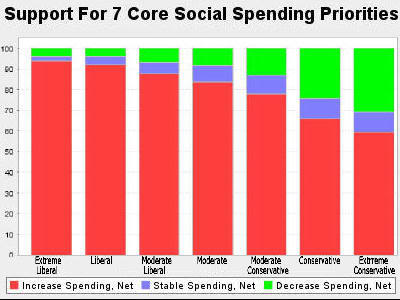
The first thing I'm going to do is look at a combined index of spending preferences, a slightly different one than the one I used in my earlier diary, since this one includes Social Security, which the GSS did not start polling for until 1984. Since then, majority of extreme conservatives (self-identified 7 on a 1-7 scale) said we were spending too little on a combined measure (call it NatWelfComp) of whether people think we're spending too little, too much or about right on seven different areas-Social Security, welfare, "improving [the] nation's education system," "improving & protecting [the] environment," "improving & protecting [the] nations health," "improving the conditions of blacks," and "solving problems of big cities." The number of extreme conservatives who thought we were spending too little on one or more programs (net: i.e. "too little" on two, but "too much" on one is a net of "too little" on one) was nearly twice the number of extreme conservatives who thought we were spending too much: 59.3% to 30.7%. This can be seen in the last column of the chart below:
In Chris's early October diary "Wall Street Bailout Thwarting Democratic Realignment" , a couple of commentators talked themselves into a fact-free Versailles kool-aide fest, confusing Versailles Dems with the Democratic base.
Texas Dem began with a comment that I might argue with, but that held a modicum of truth:
Labor atrophied, and the Democrats went from being a party of labor
to being a party of labor AND of business AND of half of the rich.
That is the real source of the "Democrats divided" meme. The true left base is not large enough in this country to rest a party on, so we have a party built on labor AND on business, which can barely function.
Democrats don't propose restoring the Reagan Brackets because a significant fraction of their donor base would revolt. Until we get a party built only on unions and working people without any rich people required (they can join out of conviction, but not to defend their interests), then even the obvious cannot be done.
I don't remember the details of when Obama waffled on rolling back the Bush tax cuts vs letting them expire (after the primary, or did Hillary do it too?), but that was the tell.
Actually, the Democratic Party was never a party of labor, labor didn't simply atrophy, the left was purged from it during the McCarthy Era and the business-friendly labor leadership that remained misrepresented labor even when it was still strong, and even today the Democratic Party is not the party of "half the rich." But ever since the early 80s, the party has gone out of its way to court Wall Street, and Obama has done the same to a ridiculous extent:
Given Obama' vast small donor base, he could have kept his distance from Wall Street. Instead, he's turned the other way around. But the comment thread quickly diverged further and further from reality:
This donor base that would revolt...
...why are they Democrats to begin with?
"We judge ourselves by our ideals; others by their actions. It is a great convenience." -- oward Zinn
by: Master Jack @ Mon Oct 05, 2009 at 20:08
Social issues
by: DTOzone @ Mon Oct 05, 2009 at 20:30
So the Dems have been reduced to...
...being the Abortion Party.
Lovely.
"We judge ourselves by our ideals; others by their actions. It is a great convenience." -- Howard Zinn
by: Master Jack @ Mon Oct 05, 2009 at 20:34
yes...sorta
that's how they rose from the 1980's doldrums...by winning over socially liberal fiscal conservatives in the Northeast.
and similarly, the GOP is the Christian party.
by: DTOzone @ Mon Oct 05, 2009 at 23:02
In fact, the Democratic electorate has not changed significantly since the 1980s in the ways alleged, and the gap between Democratic and Republican voters on a state-by-state basis is quite distinct on economic issues compared to social ones. Details on the flip.
In early 2006, I began working on a book project that never really worked out. (Got a spare $20k? I'm willing to give it another shot!) I wanted to address the extreme disconnect between the conservative political climate in Washington (remember, this was about six months before the 2006 midterms) and the political attitudes of the American people, which, according to the best social science, had only changed modestly overall since the early Nixon era. During the course of researching and drafting an introductory chapter, the importance of conservative identity politics became blindingly clear as the result of a series of number-driven arguments.
As I've been wrestling with recent manifestations of conservative identity politics that I planned to blog about this weekend--the Birthers, The Family, etc.--I remembered this earlier work, and the hard foundations of data on which it rested. I thought it would make a good companion piece to my contemporary observations to go back and resurrect that argument. So I took a draft chapter, whittled it down a bit, and I'm presenting it after the jump.
There are two overarching points that I hope will clearly emerge from this. The first is that my contemporary focus on conservative identity politics is not just some arbitrary whim. It emerges out of an inquiry that was not originally concerned with it at all. In fact, I was taken by surprise as the logic of it virtually ambushed me. The second point--closely related--is that conservative identity politics cannot simply be ignored, or factored out of other discussions. It lies at the very heart of understanding conservative hostility to liberals, which is the main driving force polarizing our politics today, and interfering with the important work of solving major problems that confront us as a society--such as meeting the challenge of climate change.
This is a long diary, over 4000 words, so feel free to skim the parts that may seem tangential to you. I wanted to preserve enough of the original to accurately reflect the range of factors that I had considered. And I hope that even if this is a bit long for you to read online all at one go, you'll want to bookmark it and return to it again. Heck, maybe even as soon as my next diary posts.
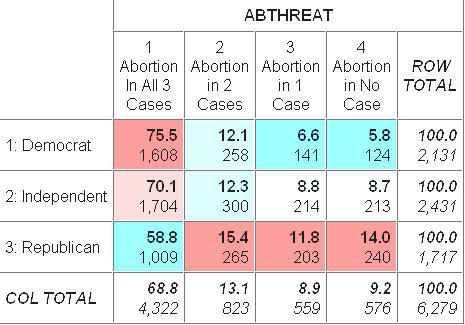
The murder of Dr. George Tiller is evidence of the re-emergence of violent rightwing extremism, which many observers expected in the wake of Bush & Cheney's exit from the White House. Indeed, a report released in April, Rightwing Extremism: Current. Economic and Political Climate Fueling. Resurgence in Radicalization and Recruitment (pdf), was subject to rightwing backlash, precisely because it accurately focused attention on the potential for increased rightwing terrorism at this time. While it didn't focus specifically on anti-abortion activists, it has been ten years since the last abortion provider was murdered. While the numbers of violent rightwing activists can be measured in the thousands, they are representative of a much larger segment of the population, measuring in the millions. However, this still represents only a relatively small political fringe in the total electorate, as can be seen by this chart, showing that total opposition to all abortions encompasses roughly one in 11 Americans, and one in seven Republicans:
(Source: General Social Survey. Interactively generated by author, May 31, 2009, Sun 03:04 PM PDT. Filtered for years 2000-2008.)
Abthreat is a combined scale, measuring attitudes toward abortion in case of rape, threat to the health of the mother, or significant birth defect.
In my previous diary, "Nate Silver Redux", I wrote about a "Composite Index" of the long-term national spending items on the General Social Survey underlying Obama's "progressive" policies as identified by Nate Silver:
The Composite Index
If we combine all of the above questions that were asked of the same people (split samples were used, so we can't include all the tables), we have seven spending items we can combine with a distribution of support that looks like this:
Spending Composite Index--Seven Items
Spending?
Progress- ives
Center- Left
Center
Center- Right
Conserv- ative
1: "Too Little"
87.3
83.9
71.8
69.2
50.0
2: "About Right"
8.7
9.0
15.5
16.6
15.2
3: "Too Much"
4.0
7.4
12.4
14.0
34.8
4: Lib Index
95.6
91.9
85.2
83.1
59.0
5: #1 + #2
96.0
93.0
87.3
85.8
65.2
Change in #4
--
3.6
6.7
2.1
24.2
Change in #5
--
3.0
5.7
1.5
20.6
What we see first in this table is a relatively slow gradation from progressive to center-right, followed by a sharp drop off among conservatives. The liberalism index only declines 12.5 points from progressive to center-right, but then plunges 24.1-almost twice as much-from center-right to conservative. The drop-off in total support (#1 +#2) is smaller, but the ratio is greater: a 10.2 point drop from progressive to center-right, followed by a 20.6 point drop (more than twice as much) from center-right to conservative. By both measures, conservatives are outliers.
But there's an interesting additional twist to this story....
Last weekend, I was trying to lay out the foundations of an argument that we need to understand the tension between Obama and progressives in terms of hegemonic power. On the one hand, in "Digby, Hegemony and the Policy-Personnel Debate", I argued that Digby was mistaken to say:
Liberals took cultural signifiers as a sign of solidarity and didn't ask for anything.
Rather, Obama really did have something in the way of a progressive agenda to offer, as Nate Silver had argued-although Nate overstated the case for how progressive that agenda was, as I argued in "Nate Silver's Curious Categorization of Obama's Policy Agenda". In the Digby diary, I laid down the bottom line to my argument:
progressives need to learn about political power. They need to learn about building it for the long term. They need to learn about investing in building power over the long haul, as opposed to simply spending wildly to avoid being utterly crushed in the next election. This is what hegemonic struggle is all about: building power across a range of institutions, so that their normal functioning produces the sorts of outcomes you want.
Obama has, quite simply, been responding to who's got the power, and how those with power define reality. That's my argument. And to change how he acts, in making further appointments as well as substantive policy, we have to change the hegemonic equation.
The main objections to my diary "Center-Left Nation: Congress Since WWII" seemed to be two-fold: first that I was only using a single data source. Second, more significantly, that I was making an argument that ignored the racism of the Southern Dems. My answers were that (1) You only need one data source to disprove a thesis ("center-right nation"), and advance (not prove) another ("center-left nation"); (2) It was still true in the aggregate, as shown, for example, by the Congressional DW-Nominate scores.
I stand by those answers, but of course, they don't need to be the last word. And, indeed, they shouldn't be the last word. Hence, a look at party ID since 1972, from the General Social Survey (GSS). It should be noted that the figures here--which include partisan leaners--are not as strikingly Democratic as those from Pew, which is also a very reputable pollster, and I have no explanation for the discrepancy. But GSS figures are available going much further back.
(GSS polls not taken every year, see tables below for exact dates.)
So, the Democrats have lost their crushing 2-1 advantage enjoyed in the early 70s, but still have maintained an edge in every GSS poll since that time. And as for arguments about Southern racist Dems, well, that's what God made regional crosstabs for...
Obama's sudden lurch to the right is all in accord with one of Versailles' most treasured, and most bogus narratives, the claim that America is a "center-right" country, and thus that it's both natural and necessary for any Democrat to attack the party's base and trample the things it believes in. After all, they're just a bunch of DFHs, whose views are hated and despised by real Americans (who read David Brooks religiously to know what they should think).
I'll have more to say about the center-right premise in another diary...
Well, this is that diary. I want to go back to the same data source I used before, the General Social Survey (GSS), which is the most thorough long-term survey of American public opinion, administered 26 times since 1972. The GSS is the gold standard when it comes to American public opinion research, and is cited more frewuently by social scientists than any other data source except the US Census. The data I've drawn from it relates to social spending, and it shows remarkably consistent findings across all the times it has been administered. There are fluctuations, to be sure, but even when the public is in its most conservative frame of mind, support for these programs remains remarkably robust-and not just among liberals and moderates. This data provides undeniable evidence of conservative support for welfare state social spending.
The first thing I'm going to do is look at a combined index of spending preferences, a slightly different one than the one I used in my earlier diary, since this one includes Social Security, which the GSS did not start polling for until 1984. Since then, majority of extreme conservatives (self-identified 7 on a 1-7 scale) said we were spending too little on a combined measure (call it NatWelfComp) of whether people think we're spending too little, too much or about right on seven different areas-Social Security, welfare, "improving [the] nation's education system," "improving & protecting [the] environment," "improving & protecting [the] nations health," "improving the conditions of blacks," and "solving problems of big cities." The number of extreme conservatives who thought we were spending too little on one or more programs (net: i.e. "too little" on two, but "too much" on one is a net of "too little" on one) was nearly twice the number of extreme conservatives who thought we were spending too much: 59.3% to 30.7%. This can be seen in the last column of the chart below:
Obama's sudden lurch to the right is all in accord with one of Versailles' most treasured, and most bogus narratives, the claim that America is a "center-right" country, and thus that it's both natural and necessary for any Democrat to attack the party's base and trample the things it believes in. After all, they're just a bunch of DFHs, whose views are hated and despised by real Americans (who read David Brooks religiously to know what they should think).
I'll have more to say about the center-right premise in another diary, but here I want to dramatically illustrate quite the opposite conclusion--that it's not the DFHs who are out of touch with the American people. It's the movement conservatives who are so far out there that even the vast majority of day-to-day conservatives are opposed to their fundamental agenda.
I will do this by looking at just two areas--albeit fairly crucial ones: social spending and abortion, using data from the General Social Survey (GSS), the gold standard of public opinion polling. (The GSS is cited by social scientists more often than any other data source except the US Census.) In both cases, it turns out, conservative doctrine has little mass support.
Abortion
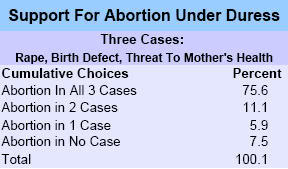
First, we take a look at a combined measure of support for abortion in three cases where a pregnant woman is under duress--in the case of rape, potential birth defect(s) or threat to her health. The hardline conservative position is that abortion is murder, period, and therefore cannot be allowed for any reason. This is, however, a clear minority position:
Well, 7.5%. That sure makes Mr. 23% seem like a popular guy, now doesn't it?
But we're just getting started!
Social Spending--Round 1
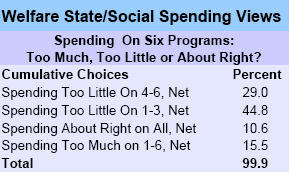
Next, we look at another combined measure, which measures support for social spending on aix national priorities:
A. Improving and protecting the environment.
B. Improving and protecting the nation's health
C. Solving the problems of the big cities
D. Improving the nation's education system
E. Improving the conditions of Blacks
F. Welfare
Again, the movement conservative position is clear: none of this is any of the government's business. Just to be merciful, I'm going to start off with a measure that lumps things together into big chunks. That way, conservatives can claim anyone who wants to cut more than they want to hold steady or increase spending--a much bigger group of people than those who want to cut everything. But even being exceedingly generous, the number of conservative believers is a tiny minority--again, even less than the 23% Bush dead-enders:
When Obama praised Reagan, he was echoing the elite, Versailles conventional wisdom, as he all too often does, rather than challenging it, and presenting the American people with a true, substantive choice for a real change of direction. How much change of direction is possible while still clinging to the myths of the past?
NObama! Reagan Did NOT Change The Trajectory Of America
"I think Ronald Reagan changed the trajectory of America in a way that Richard Nixon did not and in a way that Bill Clinton did not. He put us on a fundamentally different path because the country was ready for it. I think they felt like with all the excesses of the 1960s and 1970s and government had grown and grown but there wasn't much sense of accountability in terms of how it was operating. I think people, he just tapped into what people were already feeling, which was we want clarity we want optimism, we want a return to that sense of dynamism and entrepreneurship that had been missing."
Reality:
Reagan was a figurehead, a rallying point for the conservative movement that has taken over many of the elite institutions of America, but it has not changed the heart of America. In particular, the notion that "government had grown and grown but there wasn't much sense of accountability" is directly refuted by the most-respected, and most-cited public opinion survey in America, the General Social Survey , which is cited by social scientists more often than any other data source, except for the US Census.
Here's how attitudes toward spending on the environment were not changed by Ronald Reagan:
Charts for seven more spending categories on the flip...