President Obama was in surgery this afternoon at Walter Reed Hospital, after GOP Senators had finished feasting on his right arm and leg, but Press Secretary Robert Gibbs was upbeat.
"The President thinks we made real progress today toward his goal of bipartisan compromise," Gibbs said. "He gave up an arm and a leg, and Senators McConnell, McCain, Kyle, and DeMint gave up almost an hour of their precious time," Gibbs explained. He dismissed what he called "dead-enders in the professional left" who complained that Obama had "given up too much."
"I'm sure there are those on the other side who feel that the Republicans didn't get enough," Gibbs said. But then he admitted that another lunch was scheduled for tomorrow.
"Aren't you afraid that after tomorrow, Obama won't have a leg left to stand on?" Gibbs was asked by a reporter whose name cannot be repeated for national security reasons. He was immediately whisked away by Secret Service agents.
"We're all encouraged by the President's new spirit of bipartisan cooperation," said Senator Ben Nelson of Nebraska. "It's just unfortunate that it's taken so long for him to begin to show some real consideration for the views of others."
"This is a very hopeful sign," wrote David Broder, in an unprecedented front-page Op-Ed in the Washington Post. "The Republican senators deserve high praise for having the patience to wait for the President to finally pay attention to them. All Americans owe them a profound debt of gratititude for not having him assasinated years ago."
But others worried that the President's change of heart had come too late.
"We all had such high hopes," New York Times columnist David Brooks lamented in private. "If only he had done this on day one, he could have been truly a great president. As it is, he won't even be able to feed the entire Senate."
And still others were openly disdainful. Former Speaker Newt Gingrich called it "a cheap stunt."
"Leaders lead from day one," said talkshow host Rush Limbaugh. "This is so many days late, I can't count on my fingers don't know how you call it anything but pathetic."
Fox News host Glenn Beck called it "a clever Communist trick," shaking his head. "Hitler is kicking himself in the head," Beck added. "If only he'd thought of it, he would have won WWII."
"Real leadership requires real sacrifice," Gingrich pontificated. "I just don't think that Obama has it in him."
It now appears that in all likelihood republicans will win a congressional majority this coming Tuesday. Nate Silver's projections of Friday October 29...
...found Republicans gaining an average of 53 seats, which would bring them to 232 total. Democrats are given a 16 percent chance of holding the House, down slightly from 17 percent on Wednesday.
Increasingly, there seems to be something of a consensus among various forecasting methods around a projected Republican figure somewhere in the 50-60 seat range.
Several of the expert forecasters that FiveThirtyEight's model uses, like the Cook Political Report, the Rothenberg Political Report, and Larry Sabato, have stated that they expect the Republicans' overall total to fall roughly in this range. A straw poll of political insiders for Hotline on Call found an average expectation of a 50-seat gain. And some political science models have been forecasting gains somewhere in this range for some time.
The forecast also seems consistent with the average of generic ballot polling. Our model projects that Republicans will win the average Congressional district by between 3 and 4 points.
The modeling also suggests that there is a 90% chance that after Tuesday Democrats will control at least 50 seats in the Senate, but that there is a 0% chance that Democrats will control at least 60 seats.
It's not looking good by any stretch of the imagination.
The American economy is falling apart - but, as an election approaches, the public debate concerns the following: College pranks at Baylor in the 1980s; a high school date with a dabbler in witchcraft; the fact that someone called someone a whore; a joke about being a bearded Marxist in a college newspaper.
Daily Howler, October 20, 2010
Monday's Rachel Maddow Show was a good example of the problem of both 'Republican' and 'Democratic' mainstream political shows: screw serious evidence, me and my audience got some bonding to do! And, as always, Daily Howler made the point well and provocatively. The larger point I took away from his screed about Monday's show, and the Howler quote above in particular (whether or not it is/was Howler's point), is that IT IS A BIPARTISAN PROJECT to distort and distract election and political coverage away from the economic crisis and related injustices. (The Howler's main purpose, whether its author Bob Somerby realizes it or not, is to make this point with airtight specificity.)
I get it. It's true. There is an in-group mentality common to virtually every human social group you can name. It's not just the right, it's present on the left as well. But there's still a helluva difference between a group that thinks anyone who's not a member in good standing is going to Hell, and a group that thinks virtually every religion has something good to teach--a group like the Unitarians, where I grew up. And this isn't the only way that left and right may appear similar at one level--often limited to process--but then look quite different when you actually take a closer look, oh, say for example at the substance of what they're about. After all, the left gave us Martin Luther King and the NAACP--both demonized as "Communists" during the height of the Civil Rights struggle--while the right gave us all-Americans like George Wallace and the KKK.
One of the great tests of politics in the present time is just how much reality is able to break through Versailles' profound confusion on just such basic matters. It was demonstrated once again this week in slightly-more-sophisticated-than-usual piece by AP writer Charlest Babington, "Voters hate partisan sniping, but fuel its growth", which Digby took note of on Wednesday. She quoted the following passage:
In a January poll by NBC News and the Wall Street Journal, 93 percent agreed there is too much partisan fighting between Democrats and Republicans. In a March Associated Press-GfK poll, 84 percent said it was important that any health care plan have support from both parties in Congress.
Voters' behavior, however, often works against such sentiments.
"People will tell you they don't like partisanship, but their solution is, 'The other side should give in to us,'" said Emory University political scientist Alan Abramowitz, author of "Voice of the People: Elections and Voting in the United States."
She then observed:
Uhm yes. They want their agenda to be enacted and they don't like the idea that their opponents are standing in the way. When one party say, wins a super-majority, they think they have a perfect right to expect that it will happen. It's a mistaken idea they learned back in civics class in high school, I imagine.
Now, Republicans have good reason to define bipartisanship as Democrats capitulating because there is a history of doing just that. Democrats, not so much, but that's no reason they shouldn't think that "two way street" might be defined as the Republicans doing the same thing when the Dems are in the majority. (Alas, they have learned the hard way that this is not going to happen.) I fairly sure it's only the vaunted "centrists" who define bipartisanship as a Chinese menu or splitting the baby. Everyone else thinks that elections actually mean something.
While the above passage takes note of one crucial asymmetry between left and right, it's hardly the only one here. After all, the "Democrat's healthcare plan" that passed into law was actually based on the GOP's plan crafted by the Heritage Foundation back in the 1990s and implemented by George Mitt Romney in Massachusetts just a few short years ago. Furthermore, Abramowitz's statement:
"People will tell you they don't like partisanship, but their solution is, 'The other side should give in to us,'"
ignores the rather unsurprising fact that Pew recently found that Republicans were far less interested in compromise:
As I sit here writing, I have the White House Health Care Summit running in the background. This is the meeting where President Obama invited Congressional leaders to sit down at the table in front of the American public and talk about how to find common ground over what has become a very divisive, political debate about healthcare.
On Monday, the White House released its plan for health care reform, which resembles the Senate bill with additional concessions for liberals and labor unions. Tomorrow, President Obama will hold a televised health care summit. Obama is billing the summit as a last-ditch attempt to solicit Republican ideas for health care reform. In fact, he's hoping to give the GOP enough rope to hang itself.
It takes two...
As Katrina vanden Huevel argues in the Nation, bipartisanship takes two parties, but the Republicans have refused to negotiate unless health care reform starts over from scratch. That's not bipartisanship, that's showboating. President Obama is giving the Republicans one last chance to waste the entire country's time so that he can point to the sorry spectacle and say, "Look, what they made us do."<!--more-->
In other words, the White House has finally accepted what progressives have been saying for months: There's no way to pass an acceptable health care reform without using the budget reconciliation process to circumvent the filibuster.
What's in the White House plan?
What does the White House want for health reform? Kevin Drum of Mother Jones summarizes some highlights of the Obama plan: Increasing premium subsidies for working families; delaying the so-called "Cadillac" tax on expensive health plans and increasing the threshold at which plans are subject to tax; and empowering the Department of Health and Human Services to crack down on exploitative premium hikes, like the 39% increase recently announced by Anthem of California.
In AlterNet, Byard Duncan points to a lesser-known but important facet of the president's plan, reviving the Indian Health Care Improvement Act-which would modernize the Indian health care system, which serves 1.9 million Native Americans and indigenous Alaskans, and not a moment too soon. American Indians are 3 times more likely to die of diabetes, 5 times more likely to die of alcoholism, and 6 times more likely to die of tuberculosis than any other ethnic group. If Obama's plan is approved, the Indian Health Service (IHS) will get a 13% budget increase to address these and other pressing issues.
Stupak, stopped?
Abortion continues to cast a shadow over health reform. As Nick Baumann explains in Mother Jones, the original House health care bill only passed by 5 votes. Then Rep. Robert Wexler (D-FL) resigned and Rep. John Murtha (D-PA) died. Rep. Joseph Cao (R-LA) only voted for the House bill because he liked the Stupak abortion funding ban, which is no longer operative. Rep. Bart Stupak (D-MI) and his coalition of anti-choice Democrats supported health reform last time around in exchange for their notorious amendment. Nobody knows how many of them Speaker Nancy Pelosi can keep in the fold. At this point, she has the counter-intuitive advantage of having nothing to offer them.
The Senate's abortion language can't be modified through reconciliation for procedural reasons. The Stupack Pack's bluff has been called: Either they'll kill health reform out of spite, or they'll fall into line. They could go either way.
Speaking of abortion, Jodi Jacobson of RH Reality Check reports that "Amelia", a young pregnant woman in Nicaragua is being denied chemotherapy because it might hurt her fetus. Amelia's doctors say she needs an abortion, but all abortion is illegal in Nicaragua. Nicaraguan women's groups are urging people to write to the Inter-American Commission on Human Rights (IACHR) and Nicaraguan government officials to protest.
This post features links to the best independent, progressive reporting about health care by members of The Media Consortium. It is free to reprint. Visit the Pulse for a complete list of articles on health care reform, or follow us on Twitter. And for the best progressive reporting on critical economy, environment, health care and immigration issues, check out The Audit, The Mulch, and The Diaspora. This is a project of The Media Consortium, a network of leading independent media outlets.
I've been thinking about the bipartisan health care summit, and I go back to what Mike Lux said early in Obama's administration, which is that if Obama wants to do these "symbolic" outreach gestures to Republicans- along the lines of going to the Inauguration dinner honoring John McCain, meeting with Republican leadership, etc.- go ahead. With the bipartisan health care summit, the point seems twofold. The first part is that kind of bipartisan outreach to demonstrate that the President is indeed listening to Republicans and their ideas, like he said at the House Republican retreat.
The second part is unclear to me. A friend of mine involved with health care reform commented that it's either a great way to help the push to reconciliation, or it's the start of a campaign blame the Republicans for the failure of health care reform. To me, it could be two birds with one stone- emphasize how the Republicans are obstructing progress while using the summit to beat back the misinformation and strengthen public support. The important part, for those interested in finishing health care reform, is to emphasize the former, and treat it the way campaigns do debates- in the post-summit efforts, spin the results, use polling, and so forth.
Aside from intent here, the other aspect is performance. If Obama "brings it" like he did in Baltimore and during the Presidential debates last year, and demonstrates before a national audience that (a) the health care bill is better than it's made out to be, and (b) the Republicans are wrong on the facts, then the results could drive up support for the plan and strengthen the backbone of Democrats who are wavering on supporting a bill. If not, then health care reform could be in even deeper trouble. I see this summit as high risk and high reward, and it depends on what each side brings to the debate.
The one other thing I want to note is some of Obama's rhetoric on bipartisanship at his press conference yesterday (excerpts):
Now, bipartisanship depends on a willingness among both Democrats and Republicans to put aside matters of party for the good of the country. I won't hesitate to embrace a good idea from my friends in the minority party, but I also won't hesitate to condemn what I consider to be obstinacy that's rooted not in substantive disagreements but in political expedience. We talked about this as well, particularly when it comes to the confirmation process. I respect the Senate's role to advise and consent, but for months, qualified, non- controversial nominees for critical positions in government, often positions related to our national security, have been held up despite having overwhelming support. My nominee for one important job, the head of General Services Administration, which helps run the government, was denied a vote for nine months. When she finally got a vote on her nomination, she was confirmed 96 to nothing. That's not advise and consent; that's delay and obstruct...
But here's the point that I made to John Boehner and Mitch McConnell: Bipartisanship can't be that I agree to all the things that they believe in or want, and they agree to none of the things I believe in and want, and that's the price of bipartisanship, right? But that's sometimes the way it gets presented...
Bipartisanship cannot mean simply that Democrats give up everything that they believe in, find the handful of things that Republicans have been advocating for and we do those things, and then we have bipartisanship. That's not how it works in any other realm of life.
Well done, Mr. President. The key thing, as Jason Rosenbaum notes, is to point out that Republicans have had more than ample opportunities to contribute to the debate- both in terms of rhetoric and in terms of legislation. Republicans offered a substitute bill in the House. Baucus spent a great deal of time negotiating with Grassley, Enzi and Snowe. That's important to keep noting, and the President should point that out at the summit.
Barack Obama's repeated calls for bipartisanship, taken together with his almost uniform rightward-tilting actions during his first year as President, have finally borne fruit for him - corporate-owned politicians, including noted Republicans, are starting to line up behind him, as his administration ramps up the Afghanistan war and hammers on leftish Democrats (most recently, Howard Dean), creating a schism in Democratic ranks. As he reveals his inner Republican, Obama is becoming the toast of the corporate elite, while alienating his former leftish supporters. Recognizing that corporatism was what he has always meant as "biparisanship" reveals the common thread which linked many of his curious actions and statements which previously just hadn't added up to those (of us, I confess) who had hopes he was really a closet progressive. Turns out he was not a closet progressive, but a closet corporatist. Some of the evidence below.
I have a thought to add on what I think is an important broader point to Darcy's post last night on the lack of opportunity for bipartisanship.
The point for me is what happens when you pursue this game anyway. In every election, Democratic Party institutional structures (principally the party committees and, if a Democrat is President, the White House) target vulnerable Republicans, many of whom are moderates. Think DeWine-Brown, Chafee-Whitehouse, Talent-McCaskill, Collins-Allen, Sununu-Shaheen, Smith-Merkley. If Specter had not switched, he would have a big bulls-eye on his back, too. They also target moderates and drive them into retirement with the threat of a strong challenger-see Warner, John. They also target open seats where voters may have elected moderate Republicans- there are places, for example, where moderate Republicans decide not to run because they are facing a high-profile, highly-recruited Democrat who will mop the floor with them.
Targeting resources in this way keeps moderates out of the House and Senate and decreases opportunities for bipartisanship. Yet the White House keeps insisting on bipartisanship, and we find ourselves in a no-win scenario. If this were 2002, the Republicans looking at our side across the negotiating table probably would have been Chafee, Snowe, Collins (at least initially), Specter, Ben Nighthorse Campbell, and maybe DeWine or Voinovich. Instead, we're dealing with Grassley, Enzi, and Snowe. Why? Because we kicked out all the rest (and tried to beat Collins with Tom Allen). That is a major ideological shift. When you have this going on, and the White House keeps pursuing bipartisanship, it is self-defeating. Instead of compromising with a Lincoln Chafee, you find yourself compromising with a John McCain. If you beat McCain, you find yourself at the table with a Saxby Chambliss. And so forth.
The positive result of this is that you eventually find yourself with such a hard-right, "party of no" Senator, like Kyl or someone, that won't even come to the table, and Obama can do his "well, I reached out and tried" shtick and then muscle something through. I don't care as much about window dressing bipartisanship, like Obama doing that shtick or holding inauguration dinners for "my dear friend Sen. McCain", so whatever. But my concern is that Obama's philosophy does not line up with the "muscle something through" way of doing things, and that he will diddle around for months and try and move to the right, chasing whichever Senator he has to deal with further and further to the right to get to their position instead of telling them to fuck off. That's where you find the negative result. My point to add onto Darcy's post is that the blind pursuit of bipartisanship becomes a dangerous game where you both waste the nation's time at the negotiating table and/or you end up with a bill so devoid of progressive principles it's not worth doing anything on.
This whole set-up reminds me of the prophecy in the Harry Potter series- "neither can live while the other survives." You can't have (a) a strategy of targeting moderates (b) an insistence upon bipartisanship, and (c) a willingness to drag things on/not muscle legislation when you can't get bipartisanship, all at the same time. Something has to give. The White House and Democratic Congressional leaders have to pick and choose, and for our country's sake, I hope they give up this blind pursuit of bipartisanship.
There has been a lot of talk lately about bipartisanship, particularly with respect to the healthcare bill. Paul Krugman in the New York Times recently described how bipartisanship is impossible because moderate Republicans have been driven out of the Republican party. I'd like to take the analysis a step further.
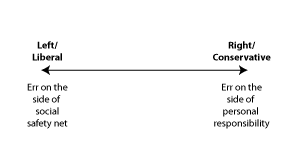
When we talk about the political spectrum, we usually talk about it as though it is a line with a left and a right, like this:
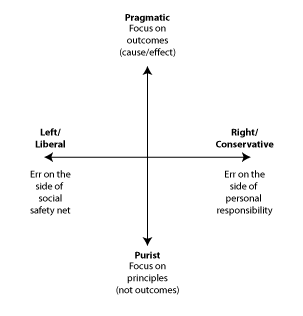
But that's inadequate to describe a lot of the political dynamics that are playing out. There's another axis perpendicular to the first that's become very important recently, which I have been referring to in conversations as the cause-effect axis:
Bipartisanship at the federal level is impossible in any meaningful way right now because there are almost no elected Republicans in the upper right quadrant.
For all that we bash the pointless lionization of bipartisanship, it turns out that the public does claim to value it, when asked about it in polling. This week's ABC/WaPo poll provides a case-in-point:
Seems clear enough. The public wants the governing party to compromise to include the minority view. Ok, how about this:
The New York State Senate and Assembly, too often a model of corruption and dysfunctionality, rose above petty politics last week to pass forward-thinking legislation on climate and energy, setting a precedent for bipartisanship and a sensible cap and trade system. The State Senate passed the groundbreaking Green Job/Green New York Act, with strong support from Republicans, Democrats, and the Working Families Party, which spearheaded the legislation. The bill -- expected to be signed into law this week by Gov. David Patterson leverages $112m in revenue from the Northeasts's Regional Greenhouse Gas Initiative (RGGI) into $5 billion of private investment to finance home weatherization, energy efficiency projects, and green jobs creation.
Once upon a time, bipartisanship was not an illusion. It wasn't a panacea. It wasn't the key to getting most things done. But it was a good bet that if something needed doing, there would be at least some bipartisan support. In most cases, it just wasn't that hard to get. And that very fact meant that it wasn't a constant fetish, the way it is in Versailles nowadays. One reason for that was that the two parties had a non-trivial amount of ideological overlap, which is most consistently mapped by first dimension of the DW-Nominate scale. In those days--the first eight years of the 1960s, for example, here's what overlap in ideology in the US looked like:
In sharp contrast, here's the disappearing ideological overlap in the Senate the first eight years of the 2000s:
BTW, that's no overlap at all in the last two congresses before Obama took office. So the idea of getting "bipartisan support" as a prerequisite and a priority for any piece of legislation in this sort of political environment is nothing short of crazy. It is, in effect, a unilateral surrender of the majority to the minority, so long as the minority holds its ideological ground. And that is precisely what we have been seeing since Obama took office last January.
Here's my definition of maturity. Yours may vary, and I'm mature enough to realize that, and perhaps even appreciate it. But here's mine: If you find out you've been wrong about something, and you respond by changing your mind, and feeling grateful for having learned something, then you've shown the cardinal sign of maturity. If, instead, you get really angry, and insist that you "are too right!" then you've shown the cardinal sign of immaturity.
In other words, maturity is when you have an ego, immaturity is when your ego has you.
Here's why I think it's important. The number one problem facing our civilization today is our collective lack of maturity.
A classic example: The Iraq War was a terrible mistake, but those who questioned or criticized it have not gained stature or influence because of their superior good judgment in not going along with a very bad foreign policy blunder. Instead, they've been treated like they should apologize for getting it right. (And even then, the apology should probably not be accepted.) Who is listened to instead? Who is on cable TV, writing on the op-ed pages, taking up space on the Sunday talk shows? Those who got it wrong. The hook-line-and-sinker crowd. But it's not just the media, it's the Obama Administration as well. Who is running America's foreign and military policy? Again: Those who got it wrong.
How about torture? The outing of Valerie Plame? Any of the Bush national security screwups? Any of them? FISA?
The fallacy of equivocation has a number of different forms, all of which involve confusing two different meanings. One of the forms is known as "switch-referencing," in which the same term is used twice, but with a different reference each time, and then a third time a conclusion is reached by falsely equating the two different meanings. This can be used, for example, to prove that a ham sandwich is better than eternal salvation:
(1) Nothing is better than eternal salvation.
(2) A ham sandwich is better than nothing.
(3) Therefore, a ham sandwich is better than eternal salvation.
Something quite similar, but not the least bit amusing, is at least partly at the root of Obama's increasingly evident problem of mis-government. The term being switch-referenced in this case is "bipartisanship."
Obama's desire to be bipartisan in the sense that ordinary Americans understand the term is being thwarted by an intransigent national GOP leadership that that has a totally different sense of the word, and Versailles punditry is only too happy to confuse the two meanings... not least because Obama himself is equally confused.
The broad support enjoyed by Medicare is an example of bipartisanship as ordinary Americans understand the term. The same can be said of support for the public option. Likewise, there is broad bipartisan support for the welfare state, as I've shown on a number of occasions by citing General Social Survey data.
For almost 40 years, under the New Deal Fifth Party System, Democrats dominated national politics, and they did so based on the primacy of economic issues revolving around--but not limited to--the welfare state. In 1968, this period ended, as we entered a very anomalous period of American history, where neither party had the upper hand, and social issues tended to divide the electorate, even though there continued to be a broad consensus on core welfare state spending, and many related issues.
In 2008, this era was headed to its end. After various different combinations of mostly divided government, the GOP finally achieved control of all branches from 2002 to 2006, and the result of finally having such control was so disastrous that it impelled the political system toward the creation of a new party system, in which, presumably, the GOP would have substantially less power. What remained unclear was the basis on which the Democrats would establish their new position of dominance.


 It now appears that in all likelihood republicans will win a congressional majority this coming Tuesday.
 On Monday, the White House released its plan for health care reform, which resembles the Senate bill with additional concessions for liberals and labor unions. Tomorrow, President Obama will hold a televised health care summit. Obama is billing the summit as a last-ditch attempt to solicit Republican ideas for health care reform. In fact, he's hoping to give the GOP enough rope to hang itself.